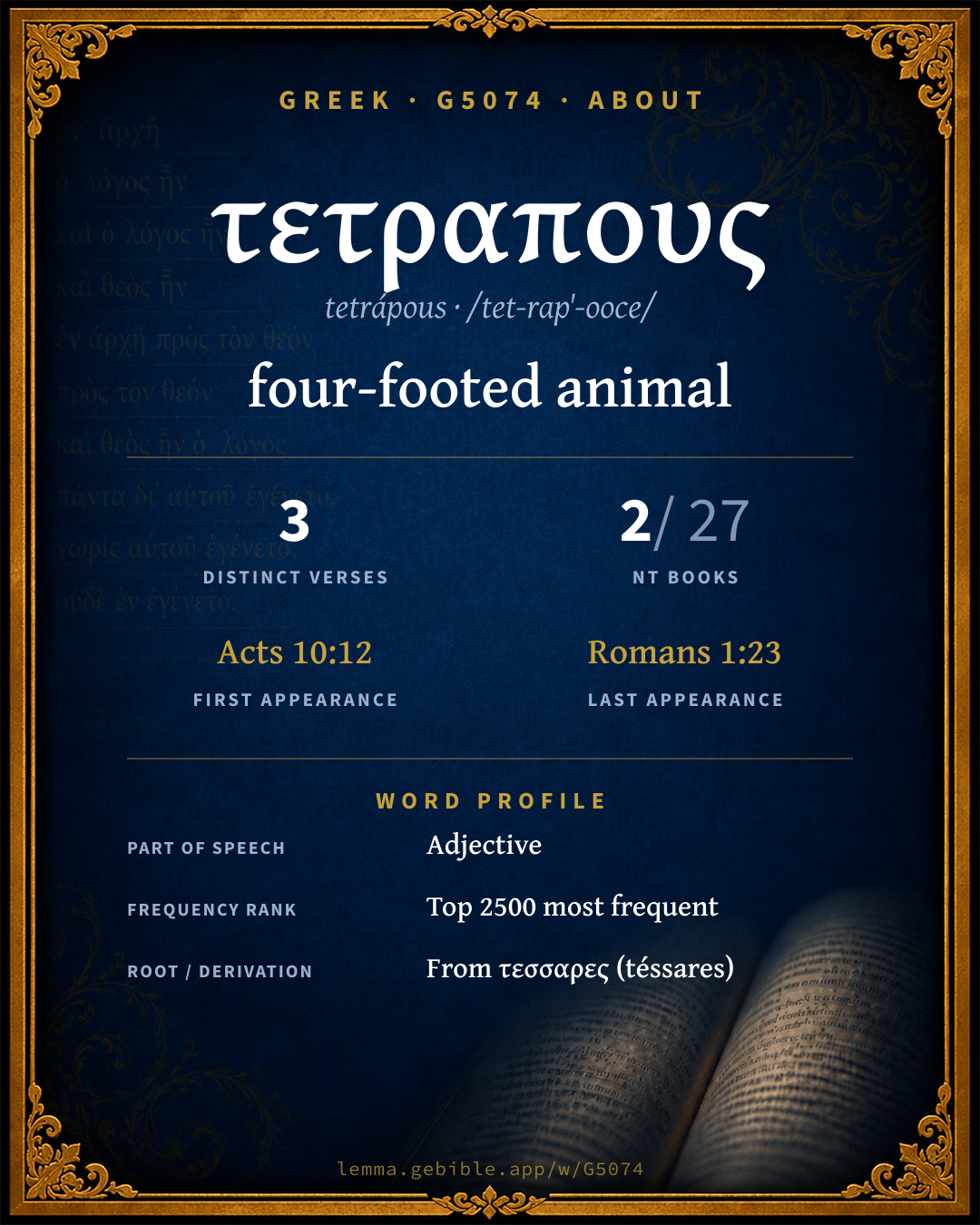
τετράπους
four-footed animal
Full lexicon entry — Thayer's Greek Lexicon
From Thayer's Greek Lexicon
Where this word appears
See every Accusative-case word in the Greek New Testament →
Grammar key — what these labels mean
Part of speech
- Adjective
- A word that describes or qualifies a noun.
Case
- Accusative
- The case of the direct object and of extent.
- Genitive
- The case of source, possession, or “of” — answers “whose / from what.”
- Nominative
- The case of the subject (and the predicate nominative).
Gender
- Neuter
- Grammatically neuter.
Number
- Plural
- More than one.
1 distinct verse where G5074 appears in the Nominative case, across 1 book. Filtered view — show all forms. Click any verse to open its interlinear word-by-word view. Verse text shown in the World English Bible for context — . Each verse’s Greek form is shown with its reference; the English is not keyword-highlighted, since the data carries no word-level English alignment. Use “Compare translations” on any verse to read it across multiple English versions. This concordance covers the Greek New Testament; Septuagint (Greek Old Testament) occurrences of this word are not indexed here.
Acts 1 verse
About this entry
At a glance — auto-summarized from this page’s data, not written by a person. Every figure links to its source below. This summary describes the numbers; it doesn’t interpret them.
“four-footed animal” is the headline sense of the Greek adjective τετραπους (tetrápous). It is rare — just 3 verses in the entire Greek New Testament. More than two-thirds of its appearances fall in Acts. First canonically at Acts 10:12, it enters the text early. It shares a root with τεσσαρες, τεσσαρακοντα and τεσσαρεσκαιδεκατος. The sections below give every sense, occurrence, and version rendering.
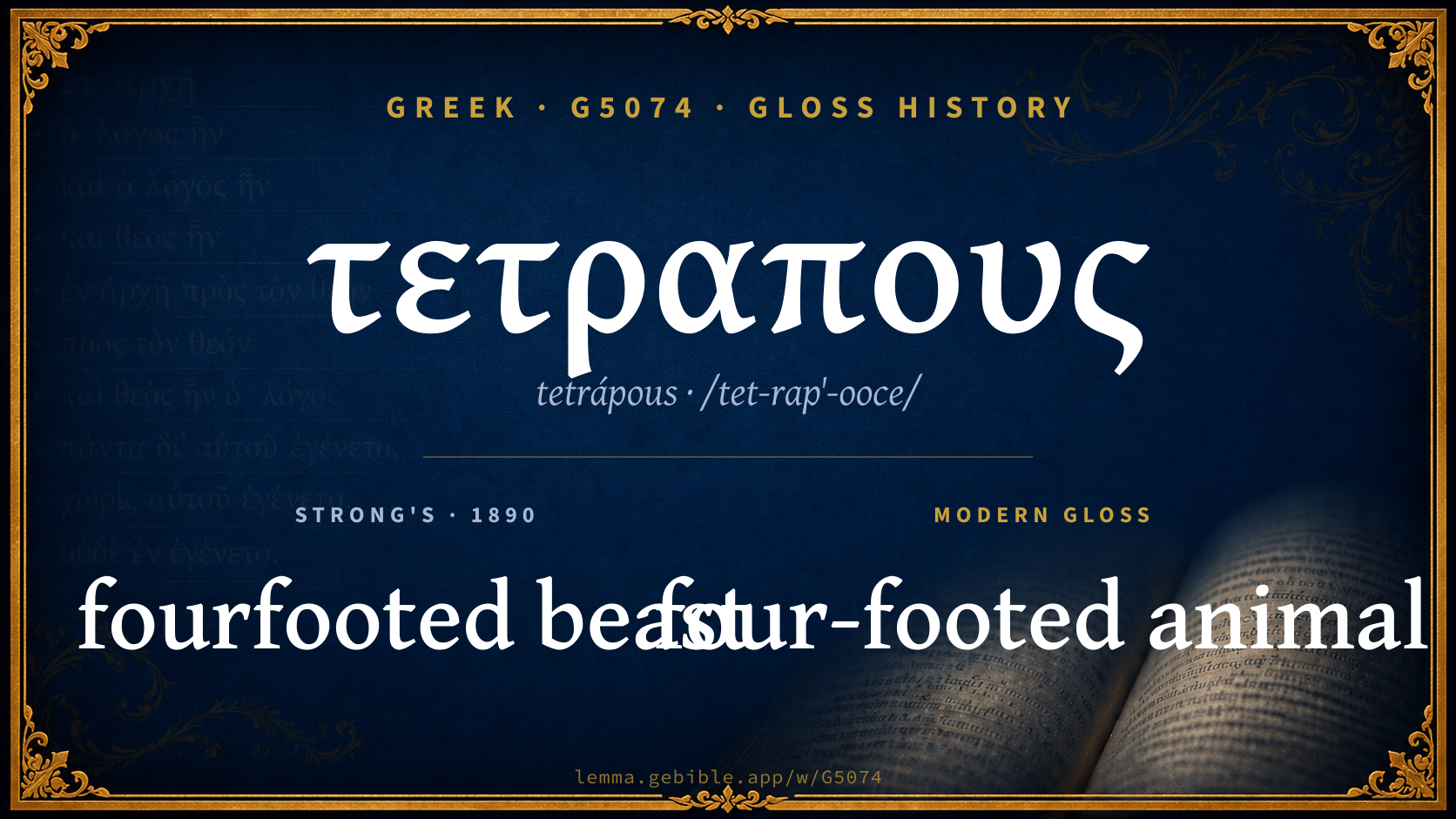
Gloss history
Strong's 1890 vs modern scholarship
About this word
Strong's G5074 catalogs a Greek word from the Greek New Testament.
These counts are not copied from any lexicon or concordance. They are computed here, from the morphology-tagged Greek New Testament. What Lemma adds →
- 3
- distinct verses
- The word appears in 3 distinct verses.
- 2 / 27
- NT books
- The word appears in 2 of 27 New Testament books.
- #2,203
- by frequency
- Top 2500 most frequent Greek words (rank 2,203 of 5,347 Greek words by occurrence).
View all 3 occurrences in the concordance →
By traditional corpus
Conventional, traditional groupings — biblical authorship is debated, so this is a traditional corpus grouping, not an authorship claim. Some books belong to more than one corpus (Luke is in both the Gospels and the Lukan corpus, and so on), so these shares overlap and need not total 100%. Each figure is a share of the word’s 3 distinct verses.
- Lukan (Luke–Acts) 2 verses · 67%
- Pauline corpus 1 verse · 33%
How translations render this word
Counts come from each version’s own published word-to-Strong’s tagging or interlinear alignment — an approximate guide to how each version renders this word, not a word-level alignment the data otherwise carries. Because each total is that version’s own tagged count, the per-version totals vary from one another and need not match the appearance or distinct-verse counts above. These counts may also differ from a printed concordance because Lemma counts each distinctly tagged rendering and does not collapse phrase taggings into a single head-word total. This is a fixed set of word-tagged versions (KJV, ASV, BSB, ULT) and does not change with the reading translation you choose elsewhere. Each version’s license is shown beside its name below (and on Sources).
- King James Version: Fourfooted beasts 3×
- American Standard Version: Fourfooted beasts 2×
- Berean Standard Bible: Four-footed animals 2×
- unfoldingWord Literal Text: Four footed animals 1×, Four footed beasts 1×, Four legged animals 1×
King James Version Public Domain
Renders G5074 across 3 tagged occurrences — most commonly:
American Standard Version Public Domain
Renders G5074 across 3 tagged occurrences — most commonly:
Plus 1 rendering that appears only once — usually multi-word phrases or single function words the recovered tagging swept in, not distinct renderings.
Berean Standard Bible Public Domain
Renders G5074 across 3 tagged occurrences — most commonly:
Plus 1 rendering that appears only once — usually multi-word phrases or single function words the recovered tagging swept in, not distinct renderings.
unfoldingWord Literal Text CC BY-SA 4.0
Renders G5074 across 3 tagged occurrences — most commonly:
Senses in Thayer's
The 1 sense Thayer's distinguishes for this word, in lexicon order (not ranked by frequency or importance). The full entry — with sub-senses — is in the Lexicon Entry tab.
- a fourfooted animal
Word origin
Derived from τεσσαρες (téssares) (G5064) — four.
Forms in the corpus
The 2 distinct written forms G5074 takes in the Greek New Testament, most frequent first — each parse links to that case’s occurrences in the concordance.
| Form | Parsing | Example | Uses |
|---|---|---|---|
| τετράποδα tetrápoda | Adjective, Accusative, Plural, Neuter | Acts 11:6 | 2 |
| τετραπόδων tetrapódōn | Adjective, Genitive, Plural, Neuter | Romans 1:23 | 1 |
Same root — word family
Other Thayer's entries built from the same root as G5074, grouped by Strong’s listed origin. These share a root / origin per the lexicon — not necessarily a shared meaning. Each links to that word’s own entry.
Derives from
Shares the same root
- τεσσαρακοντα tessarákonta G5062 forty
- τεσσαρεσκαιδεκατος tessareskaidékatos G5065 fourteenth
- τεταρταιος tetartaîos G5066 fourth day
- τεταρτος tétartos G5067 fourth
- τετραγωνος tetrágōnos G5068 square
- τετραδιον tetrádion G5069 quaternion
- τετρακισχιλιοι tetrakischílioi G5070 four thousand
- τετρακοσιοι tetrakósioi G5071 four hundred
- τετραμηνον tetrámēnon G5072 four months
- τετραπλοος tetraplóos G5073 fourfold
- τετραρχης tetrárchēs G5076 tetrarch
- τραπεζα trápeza G5132 table
Compare all same-root words → Showing 4 of 14 — not the complete family. They share a root, not necessarily a meaning.
Septuagint usage
The same Greek word τετραπους appears 13 times in the Greek Old Testament (Septuagint), across 11 verses in 5 books.
- 13
- LXX occurrences
- Tagged occurrences of this Greek word in the Septuagint.
- 11
- verses
- Distinct Septuagint verses containing this word.
- 5 / 39
- OT books
- The word appears in 5 of the 39 Old Testament books.
Sample Septuagint occurrences
- Exodus 8:12 τετράπους
- Leviticus 18:23 τετράπους
- Numbers 35:3 τετράπους
- Job 40:20 τετράπους
- Isaiah 30:6 τετράπους
Septuagint occurrences (same lexeme)
Every verse where the same Strong’s number (G5074) appears in the Greek Septuagint. Verse text shown in the World English Bible for context; the Greek form is the matched word — the English is not keyword-highlighted.
- Exodus 8:12 τετράπους Moses and Aaron went out from Pharaoh, and Moses cried to Yahweh concerning the frogs which he had brought on Pharaoh.
- Exodus 8:13 τετράπους Yahweh did according to the word of Moses, and the frogs died out of the houses, out of the courts, and out of the fields.
- Exodus 8:14 τετράπους They gathered them together in heaps, and the land stank.
- Exodus 9:9 τετράπους It shall become small dust over all the land of Egypt, and shall be a boil breaking forth with boils on man and on animal, throughout all the land of Egypt."
- Exodus 9:10 τετράπους They took ashes of the furnace, and stood before Pharaoh; and Moses sprinkled it up toward the sky; and it became a boil breaking forth with boils on man and on animal.
- Leviticus 18:23 τετράπους "'You shall not lie with any animal to defile yourself with it; neither shall any woman give herself to an animal, to lie down with it: it is a perversion.
- Leviticus 20:15 τετράπους "'If a man lies with an animal, he shall surely be put to death; and you shall kill the animal.
- Numbers 35:3 τετράπους The cities shall they have to dwell in; and their suburbs shall be for their cattle, and for their substance, and for all their animals.
- Job 40:20 τετράπους Surely the mountains bring him forth food, Where all the animals of the field do play.
- Job 41:17 τετράπους They are joined one to another; They stick together, so that they can't be pulled apart.
- Isaiah 30:6 τετράπους The burden of the animals of the South. Through the land of trouble and anguish, from whence come the lioness and the lion, the viper and fiery flying serpent, they carry their riches on the shoulders of young donkeys, and their treasures on the humps of camels, to a people that shall not profit [them].
These are occurrences of the same Greek lexeme (G5074) in the Septuagint — not a translation of any one Hebrew word. The store carries no word-level Hebrew↔Greek alignment, so no Hebrew original is asserted here. Counts come from the recovered LXX Strong's tagging — high-frequency vocabulary is well covered, while rare or late forms may be untagged — so they reflect tagged occurrences and may slightly undercount.