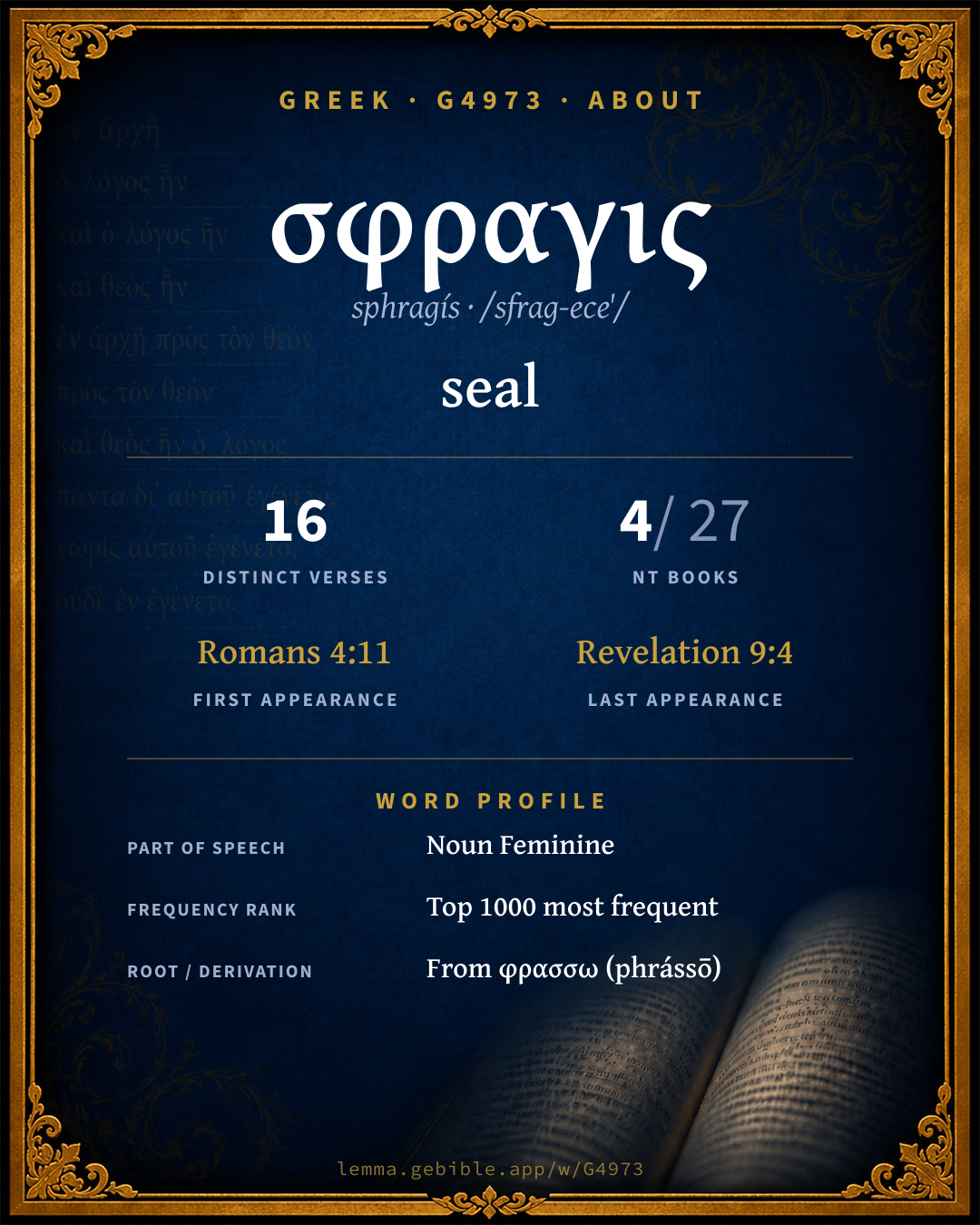
σφραγίς
seal
‘seal’ is one of 4 main senses fuller range ↓
Full lexicon entry — Thayer's Greek Lexicon
From Thayer's Greek Lexicon
Where this word appears
See every Accusative-case word in the Greek New Testament →
Grammar key — what these labels mean
Part of speech
- Noun
- A naming word — a person, place, thing, or idea.
Case
- Accusative
- The case of the direct object and of extent.
- Dative
- The case of the indirect object, means, or location — “to / for / with / in.”
- Genitive
- The case of source, possession, or “of” — answers “whose / from what.”
- Nominative
- The case of the subject (and the predicate nominative).
Gender
- Feminine
- Grammatically feminine.
Number
- Singular
- One.
- Plural
- More than one.
Every verse where G4973 appears in the Book of Revelation — 13 distinct verses. Click any verse to open its interlinear word-by-word view. Verse text shown in the World English Bible for context — . Each verse’s Greek form is shown with its reference; the English is not keyword-highlighted, since the data carries no word-level English alignment. Use “Compare translations” on any verse to read it across multiple English versions. This concordance covers the Greek New Testament; Septuagint (Greek Old Testament) occurrences of this word are not indexed here.
Revelation
- Revelation 5:1 σφραγῖσιν n dat pl fem I saw, in the right hand of him who sat on the throne, a book written inside and outside, sealed shut with seven seals.
- Revelation 5:2 σφραγῖδας n acc pl fem I saw a mighty angel proclaiming with a loud voice, "Who is worthy to open the book, and to break its seals?"
- Revelation 5:5 σφραγῖδας n acc pl fem One of the elders said to me, "Don't weep. Behold, the Lion who is of the tribe of Judah, the Root of David, has overcome; he who opens the book and its seven seals."
- Revelation 5:9 σφραγῖδας n acc pl fem They sang a new song, saying, "You are worthy to take the book, And to open its seals: For you were killed, And bought us for God with your blood, Out of every tribe, language, people, and nation,
- Revelation 6:1 σφραγίδων n gen pl fem I saw that the Lamb opened one of the seven seals, and I heard one of the four living creatures saying, as with a voice of thunder, "Come and see!"
- Revelation 6:3 σφραγῖδα n acc sg fem When he opened the second seal, I heard the second living creature saying, "Come!"
- Revelation 6:5 σφραγῖδα n acc sg fem When he opened the third seal, I heard the third living creature saying, "Come and see!" And behold, a black horse, and he who sat on it had a balance in his hand.
- Revelation 6:7 σφραγῖδα n acc sg fem When he opened the fourth seal, I heard the fourth living creature saying, "Come and see!"
- Revelation 6:9 σφραγῖδα n acc sg fem When he opened the fifth seal, I saw underneath the altar the souls of those who had been killed for the Word of God, and for the testimony of the Lamb which they had.
- Revelation 6:12 σφραγῖδα n acc sg fem I saw when he opened the sixth seal, and there was a great earthquake. The sun became black as sackcloth made of hair, and the whole moon became as blood.
- Revelation 7:2 σφραγῖδα n acc sg fem I saw another angel ascend from the sunrise, having the seal of the living God. He cried with a loud voice to the four angels to whom it was given to harm the earth and the sea,
- Revelation 8:1 σφραγῖδα n acc sg fem When he opened the seventh seal, there was silence in heaven for about half an hour.
- Revelation 9:4 σφραγῖδα n acc sg fem They were told that they should not hurt the grass of the earth, neither any green thing, neither any tree, but only those people who don't have God's seal on their foreheads.
About this entry
At a glance — auto-summarized from this page’s data, not written by a person. Every figure links to its source below. This summary describes the numbers; it doesn’t interpret them.
The Greek noun σφραγις centers on the idea of “seal.” Revelation dominates its distribution — 13 of 16 verses. The Greek New Testament uses it across 16 verses — uncommon. First canonically at Romans 4:11, it enters the text early. Lexicons map it across 4 senses. For the data behind this summary, explore the sense tree and the renderings breakdown below.
Gloss history
Strong's 1890 vs modern scholarship
About this word
Strong's G4973 catalogs a Greek word from the Greek New Testament.
These counts are not copied from any lexicon or concordance. They are computed here, from the morphology-tagged Greek New Testament. What Lemma adds →
- 16
- distinct verses
- The word appears in 16 distinct verses.
- 4 / 27
- NT books
- The word appears in 4 of 27 New Testament books.
- #726
- by frequency
- Top 1000 most frequent Greek words (rank 726 of 5,347 Greek words by occurrence).
View all 16 occurrences in the concordance →
Most concentrated in
- Revelation 13 verses 81%
- Romans 1 verse 6%
- 1 Corinthians 1 verse 6%
By section of the New Testament
By traditional corpus
Conventional, traditional groupings — biblical authorship is debated, so this is a traditional corpus grouping, not an authorship claim. Some books belong to more than one corpus (Luke is in both the Gospels and the Lukan corpus, and so on), so these shares overlap and need not total 100%. Each figure is a share of the word’s 16 distinct verses.
- Johannine 13 verses · 81%
- Revelation 13 verses · 81%
- Pauline corpus 3 verses · 19%
How translations render this word
Counts come from each version’s own published word-to-Strong’s tagging or interlinear alignment — an approximate guide to how each version renders this word, not a word-level alignment the data otherwise carries. Because each total is that version’s own tagged count, the per-version totals vary from one another and need not match the appearance or distinct-verse counts above. These counts may also differ from a printed concordance because Lemma counts each distinctly tagged rendering and does not collapse phrase taggings into a single head-word total. This is a fixed set of word-tagged versions (KJV, ASV, BSB, ULT) and does not change with the reading translation you choose elsewhere. Each version’s license is shown beside its name below (and on Sources).
- King James Version: Seal 11×, Seals 5×
- American Standard Version: Seal 11×, Seals 4×
- Berean Standard Bible: Seal 11×, Seals 5×
- unfoldingWord Literal Text: Seal 10×, Seals 5×
King James Version Public Domain
Renders G4973 across 16 tagged occurrences — most commonly:
American Standard Version Public Domain
Renders G4973 across 16 tagged occurrences — most commonly:
Plus 1 rendering that appears only once — usually multi-word phrases or single function words the recovered tagging swept in, not distinct renderings.
Berean Standard Bible Public Domain
Renders G4973 across 16 tagged occurrences — most commonly:
unfoldingWord Literal Text CC BY-SA 4.0
Renders G4973 across 17 tagged occurrences — most commonly:
Plus 2 renderings that appear only once — usually multi-word phrases or single function words the recovered tagging swept in, not distinct renderings.
Senses in Thayer's
The 4 senses Thayer's distinguishes for this word, in lexicon order (not ranked by frequency or importance). The full entry — with sub-senses — is in the Lexicon Entry tab.
- the seal placed upon books
- a signet ring
- the inscription or impression made by a seal
- that by which anything is confirmed, proved, authenticated, as by a seal (a token or proof)
Word origin
Derived from φρασσω (phrássō) (G5420) — to block up.
Probably strengthened from G5420 ; a signet (as fencing in or protecting from misappropriation); by implication the stamp impressed (as a mark of privacy or genuineness) literally or figuratively : - seal.
— Strong’s Exhaustive Concordance (1890), public domain.
Forms in the corpus
The 5 distinct written forms G4973 takes in the Greek New Testament, most frequent first — each parse links to that case’s occurrences in the concordance.
| Form | Parsing | Example | Uses |
|---|---|---|---|
| σφραγῖδα sphragîda | Noun, Accusative, Singular, Feminine | Romans 4:11 | 10 |
| σφραγῖδας sphragîdas | Noun, Accusative, Plural, Feminine | Revelation 5:2 | 3 |
| σφραγίδων sphragídōn | Noun, Genitive, Plural, Feminine | Revelation 6:1 | 1 |
| σφραγίς sphragís | Noun, Nominative, Singular, Feminine | 1 Corinthians 9:2 | 1 |
| σφραγῖσιν sphragîsin | Noun, Dative, Plural, Feminine | Revelation 5:1 | 1 |
Same root — word family
Other Thayer's entries built from the same root as G4973, grouped by Strong’s listed origin. These share a root / origin per the lexicon — not necessarily a shared meaning. Each links to that word’s own entry.
Derives from
Shares the same root
Derived from this word
Compare all same-root words → Showing 4 of 6 — not the complete family. They share a root, not necessarily a meaning.
Septuagint usage
The same Greek word σφραγις appears 11 times in the Greek Old Testament (Septuagint), across 10 verses in 4 books.
- 11
- LXX occurrences
- Tagged occurrences of this Greek word in the Septuagint.
- 10
- verses
- Distinct Septuagint verses containing this word.
- 4 / 39
- OT books
- The word appears in 4 of the 39 Old Testament books.
Sample Septuagint occurrences
- Exodus 28:11 σφραγίς
- 1 Kings 20:8 σφραγίς
- Song of Solomon 8:6 σφραγίς
- Haggai 2:23 σφραγίς
Septuagint occurrences (same lexeme)
Every verse where the same Strong’s number (G4973) appears in the Greek Septuagint. Verse text shown in the World English Bible for context; the Greek form is the matched word — the English is not keyword-highlighted.
- Exodus 28:11 σφραγίς With the work of an engraver in stone, like the engravings of a signet, shall you engrave the two stones, according to the names of the children of Israel: you shall make them to be enclosed in settings of gold.
- Exodus 28:21 σφραγίς The stones shall be according to the names of the children of Israel, twelve, according to their names; like the engravings of a signet, everyone according to his name, they shall be for the twelve tribes.
- Exodus 28:36 σφραγίς "You shall make a plate of pure gold, and engrave on it, like the engravings of a signet, 'HOLY TO YAHWEH.'
- Exodus 35:22 σφραγίς They came, both men and women, as many as were willing-hearted, and brought brooches, ear-rings, signet-rings, and armlets, all jewels of gold; even every man who offered an offering of gold to Yahweh.
- Exodus 36:13 σφραγίς He made fifty clasps of gold, and coupled the curtains one to another with the clasps: so the tent was a unit.
- Exodus 36:21 σφράγις Ten cubits was the length of a board, and a cubit and a half the breadth of each board.
- Exodus 36:37 σφραγίς He made a screen for the door of the tent, of blue, purple, scarlet, and fine twined linen, the work of an embroiderer;
- 1 Kings 20:8 σφραγίς All the elders and all the people said to him, Don't you listen, neither consent.
- Song of Solomon 8:6 σφραγίς Set me as a seal on your heart, As a seal on your arm; For love is strong as death. Jealousy is as cruel as Sheol; Its flashes are flashes of fire, A very flame of Yahweh.
- Haggai 2:23 σφραγίς In that day, says Yahweh of Hosts, will I take you, Zerubbabel, my servant, the son of Shealtiel,' says Yahweh, 'and will make you as a signet, for I have chosen you,' says Yahweh of Hosts."
These are occurrences of the same Greek lexeme (G4973) in the Septuagint — not a translation of any one Hebrew word. The store carries no word-level Hebrew↔Greek alignment, so no Hebrew original is asserted here. Counts come from the recovered LXX Strong's tagging — high-frequency vocabulary is well covered, while rare or late forms may be untagged — so they reflect tagged occurrences and may slightly undercount.