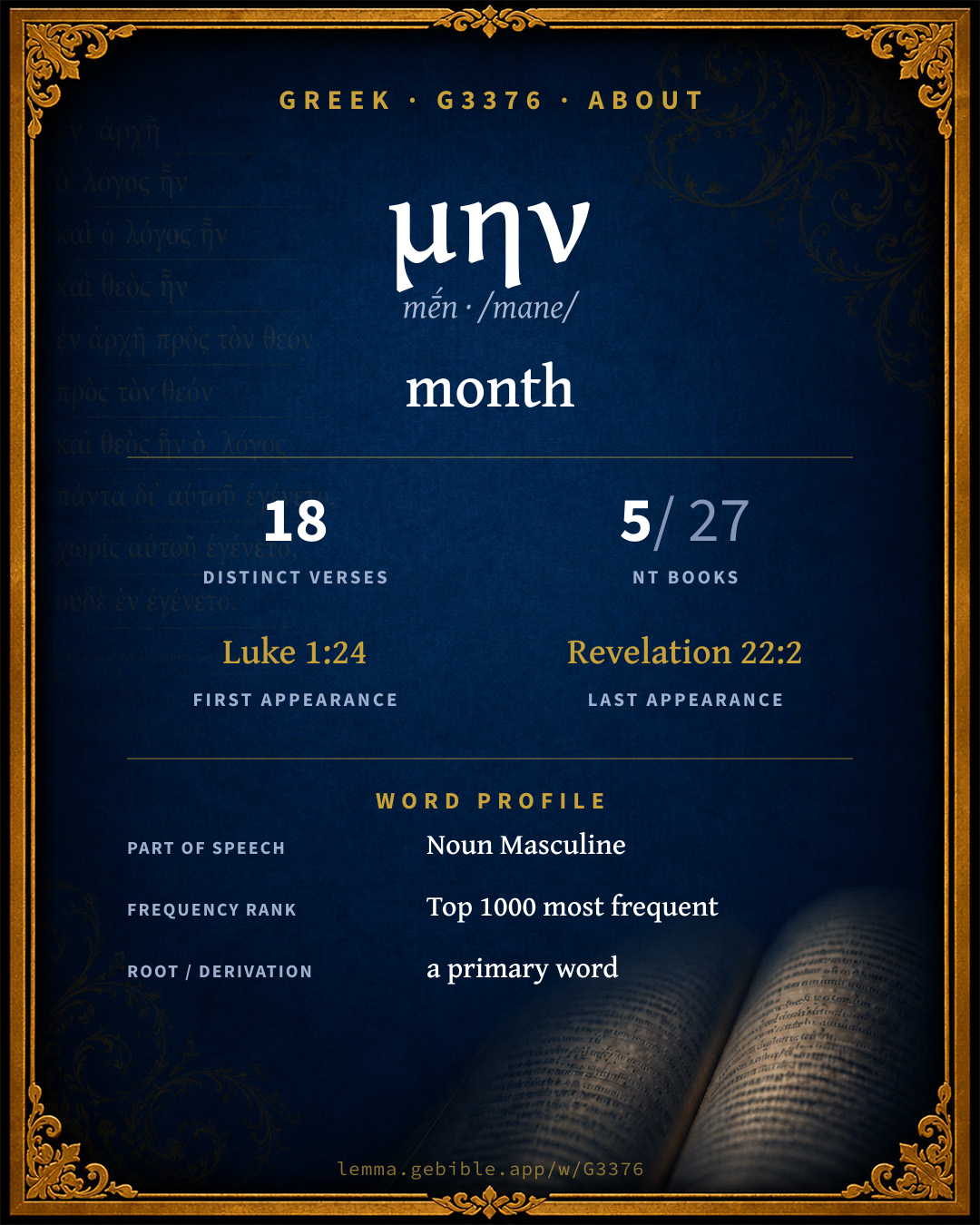
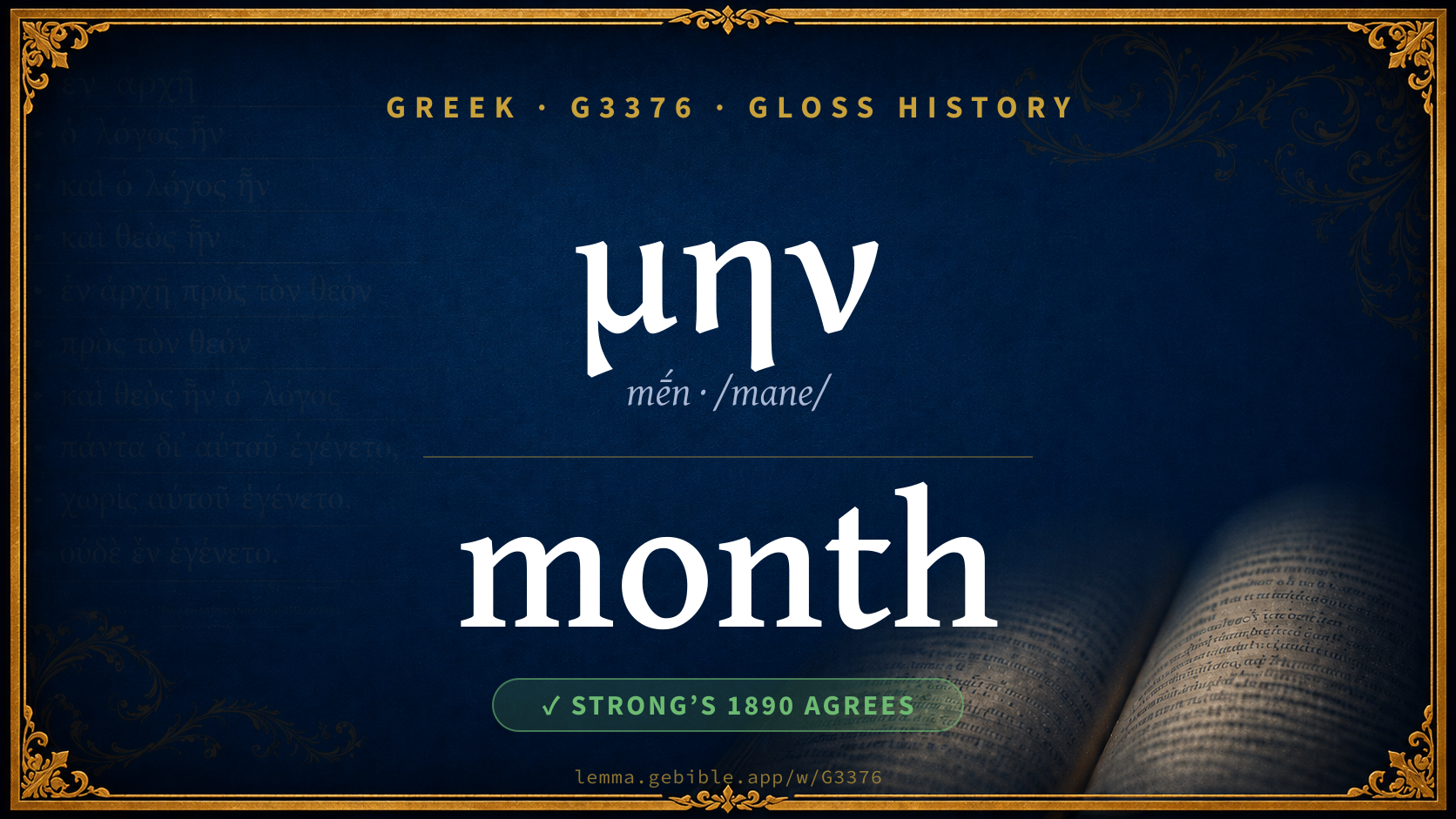
μήν
month
‘month’ is one of 2 main senses fuller range ↓
Full lexicon entry — Thayer's Greek Lexicon
From Thayer's Greek Lexicon
Where this word appears
See every Accusative-case word in the Greek New Testament →
Grammar key — what these labels mean
Part of speech
- Noun
- A naming word — a person, place, thing, or idea.
Case
- Accusative
- The case of the direct object and of extent.
- Dative
- The case of the indirect object, means, or location — “to / for / with / in.”
- Nominative
- The case of the subject (and the predicate nominative).
Gender
- Masculine
- Grammatically masculine.
Number
- Plural
- More than one.
- Singular
- One.
16 distinct verses where G3376 appears in the Accusative case, across 5 books. Filtered view — show all forms. Click any verse to open its interlinear word-by-word view. Verse text shown in the World English Bible for context — . Each verse’s Greek form is shown with its reference; the English is not keyword-highlighted, since the data carries no word-level English alignment. Use “Compare translations” on any verse to read it across multiple English versions. This concordance covers the Greek New Testament; Septuagint (Greek Old Testament) occurrences of this word are not indexed here.
Luke 3 verses
- Luke 1:24 μῆνας n acc pl masc After these days Elizabeth, his wife, conceived, and she hid herself five months, saying,
- Luke 1:56 μῆνας n acc pl masc Mary stayed with her about three months, and then returned to her house.
- Luke 4:25 μῆνας n acc pl masc But truly I tell you, there were many widows in Israel in the days of Elijah, when the sky was shut up three years and six months, when a great famine came over all the land.
Acts 5 verses
- Acts 7:20 μῆνας n acc pl masc At that time Moses was born, and was exceedingly handsome. He was nourished three months in his father's house.
- Acts 18:11 μῆνας n acc pl masc He lived there a year and six months, teaching the word of God among them.
- Acts 19:8 μῆνας n acc pl masc He entered into the synagogue, and spoke boldly for a period of three months, reasoning and persuading about the things concerning the Kingdom of God.
- Acts 20:3 μῆνας n acc pl masc When he had spent three months there, and a plot was made against him by Jews as he was about to set sail for Syria, he determined to return through Macedonia.
- Acts 28:11 μῆνας n acc pl masc After three months, we set sail in a ship of Alexandria which had wintered in the island, whose sign was "The Twin Brothers."
Galatians 1 verse
James 1 verse
Revelation 6 verses
- Revelation 9:5 μῆνας n acc pl masc They were given power not to kill them, but to torment them for five months. Their torment was like the torment of a scorpion, when it strikes a person.
- Revelation 9:10 μῆνας n acc pl masc They have tails like those of scorpions, and stings. In their tails they have power to harm men for five months.
- Revelation 9:15 μῆνα n acc sg masc The four angels were freed who had been prepared for that hour and day and month and year, so that they might kill one third of mankind.
- Revelation 11:2 μῆνας n acc pl masc Leave out the court which is outside of the temple, and don't measure it, for it has been given to the gentiles. They will tread the holy city under foot for forty-two months.
- Revelation 13:5 μῆνας n acc pl masc A mouth speaking great things and blasphemy was given to him. Authority to make war for forty-two months was given to him.
- Revelation 22:2 μῆνα n acc sg masc in the middle of its street. On this side of the river and on that was the tree of life, bearing twelve kinds of fruits, yielding its fruit every month. The leaves of the tree were for the healing of the nations.
About this entry
At a glance — auto-summarized from this page’s data, not written by a person. Every figure links to its source below. This summary describes the numbers; it doesn’t interpret them.
μην (mḗn) is a Greek noun most often rendered “month.” Debuting at Luke 1:24, it then recurs through the corpus. The Greek New Testament uses it across 18 verses — uncommon. Revelation dominates its distribution — 6 of 18 verses. Its lexical range runs to 2 senses. The sections below give every sense, occurrence, and version rendering.
Gloss history
Strong's 1890 vs modern scholarship
About this word
Strong's G3376 catalogs a Greek word from the Greek New Testament.
These counts are not copied from any lexicon or concordance. They are computed here, from the morphology-tagged Greek New Testament. What Lemma adds →
- 18
- distinct verses
- The word appears in 18 distinct verses.
- 5 / 27
- NT books
- The word appears in 5 of 27 New Testament books.
- #664
- by frequency
- Top 1000 most frequent Greek words (rank 664 of 5,347 Greek words by occurrence).
View all 18 occurrences in the concordance →
Most concentrated in
- Revelation 6 verses 33%
- Luke 5 verses 28%
- Acts 5 verses 28%
By section of the New Testament
By traditional corpus
Conventional, traditional groupings — biblical authorship is debated, so this is a traditional corpus grouping, not an authorship claim. Some books belong to more than one corpus (Luke is in both the Gospels and the Lukan corpus, and so on), so these shares overlap and need not total 100%. Each figure is a share of the word’s 18 distinct verses.
- Lukan (Luke–Acts) 10 verses · 56%
- Johannine 6 verses · 33%
- Revelation 6 verses · 33%
- Gospels 5 verses · 28%
- Pauline corpus 1 verse · 6%
- General (Catholic) Epistles 1 verse · 6%
How translations render this word
Counts come from each version’s own published word-to-Strong’s tagging or interlinear alignment — an approximate guide to how each version renders this word, not a word-level alignment the data otherwise carries. Because each total is that version’s own tagged count, the per-version totals vary from one another and need not match the appearance or distinct-verse counts above. These counts may also differ from a printed concordance because Lemma counts each distinctly tagged rendering and does not collapse phrase taggings into a single head-word total. This is a fixed set of word-tagged versions (KJV, ASV, BSB, ULT) and does not change with the reading translation you choose elsewhere. Each version’s license is shown beside its name below (and on Sources).
- King James Version: Months 14×, Month 4×
- American Standard Version: Months 14×, Month 4×
- Berean Standard Bible: Months 11×, Month 4×
- unfoldingWord Literal Text: Months 14×, For 6×, Month 4×
King James Version Public Domain
Renders G3376 across 18 tagged occurrences — most commonly:
American Standard Version Public Domain
Renders G3376 across 18 tagged occurrences — most commonly:
Berean Standard Bible Public Domain
Renders G3376 across 15 tagged occurrences — most commonly:
Not rendered by a distinct English word in 3 further occurrences.
unfoldingWord Literal Text CC BY-SA 4.0
Renders G3376 across 24 tagged occurrences — most commonly:
Senses in Thayer's
The 2 senses Thayer's distinguishes for this word, in lexicon order (not ranked by frequency or importance). The full entry — with sub-senses — is in the Lexicon Entry tab.
- a month
- the time of the new moon…
Word origin
Origin: a primary word
A primary word; a month : - month.
— Strong’s Exhaustive Concordance (1890), public domain.
Forms in the corpus
The 4 distinct written forms G3376 takes in the Greek New Testament, most frequent first — each parse links to that case’s occurrences in the concordance.
| Form | Parsing | Example | Uses |
|---|---|---|---|
| μῆνας mē̂nas | Noun, Accusative, Plural, Masculine | Luke 1:24 | 14 |
| μῆνα mē̂na | Noun, Accusative, Singular, Masculine | Revelation 9:15 | 2 |
| μηνὶ mēnì | Noun, Dative, Singular, Masculine | Luke 1:26 | 1 |
| μὴν mḕn | Noun, Nominative, Singular, Masculine | Luke 1:36 | 1 |