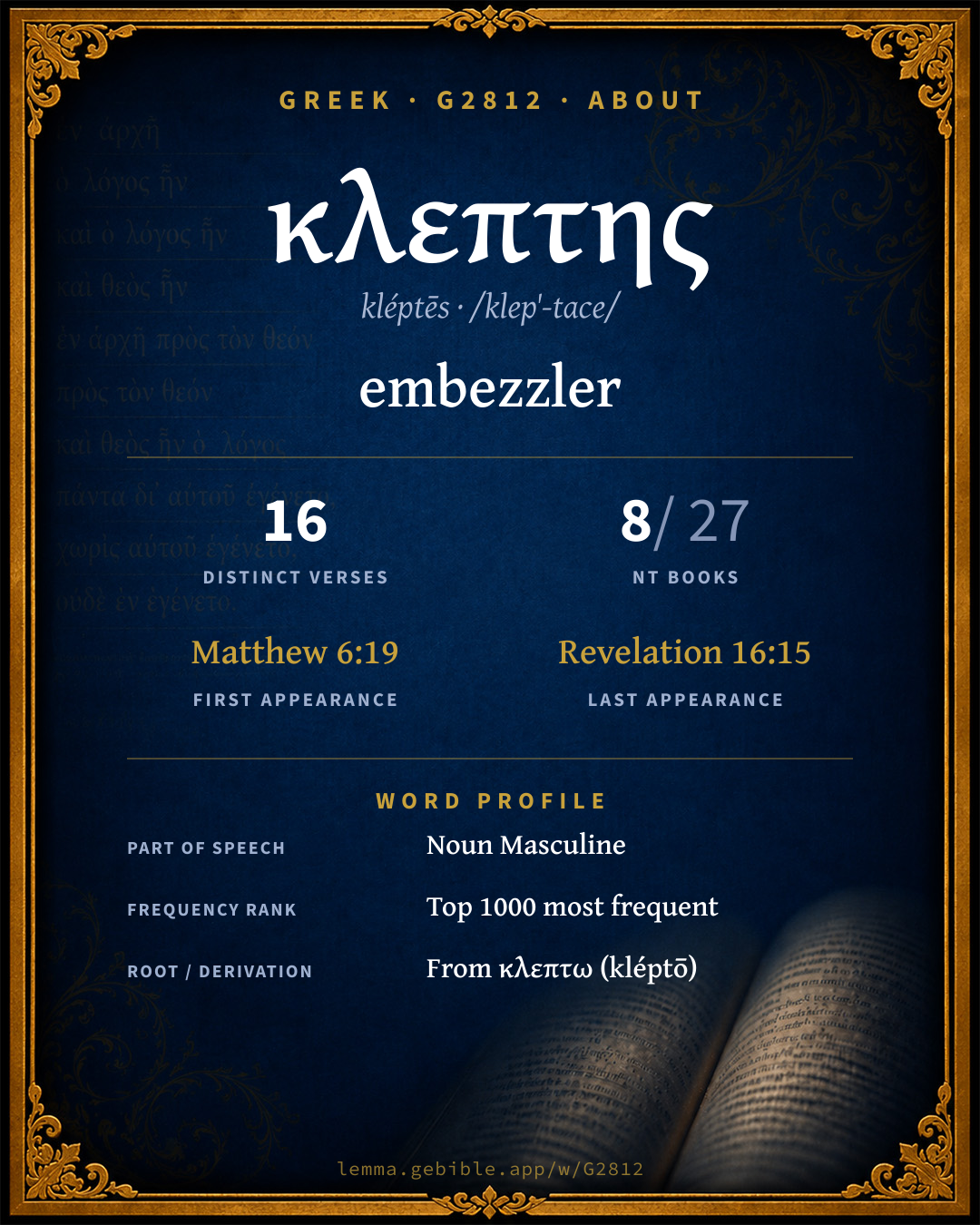
κλέπτης
embezzler
Full lexicon entry — Thayer's Greek Lexicon
From Thayer's Greek Lexicon
Where this word appears
Grammar key — what these labels mean
Part of speech
- Noun
- A naming word — a person, place, thing, or idea.
Case
- Nominative
- The case of the subject (and the predicate nominative).
Gender
- Masculine
- Grammatically masculine.
Number
- Singular
- One.
- Plural
- More than one.
Every verse where G2812 appears in the Book of Matthew — 3 distinct verses. Click any verse to open its interlinear word-by-word view. Verse text shown in the World English Bible for context — . Each verse’s Greek form is shown with its reference; the English is not keyword-highlighted, since the data carries no word-level English alignment. Use “Compare translations” on any verse to read it across multiple English versions. This concordance covers the Greek New Testament; Septuagint (Greek Old Testament) occurrences of this word are not indexed here.
Matthew
- Matthew 6:19 κλέπται n nom pl masc "Don't lay up treasures for yourselves on the earth, where moth and rust consume, and where thieves break through and steal;
- Matthew 6:20 κλέπται n nom pl masc but lay up for yourselves treasures in heaven, where neither moth nor rust consume, and where thieves don't break through and steal;
- Matthew 24:43 κλέπτης n nom sg masc But know this, that if the master of the house had known in what watch of the night the thief was coming, he would have watched, and would not have allowed his house to be broken into.
About this entry
At a glance — auto-summarized from this page’s data, not written by a person. Every figure links to its source below. This summary describes the numbers; it doesn’t interpret them.
κλεπτης — transliterated kléptēs — is a Greek noun carrying the sense “embezzler.” Its earliest occurrence is Matthew 6:19. Spanning 16 verses in 8 books, it ranks among the uncommon words of the Greek New Testament. Its uses concentrate in John (25% of all occurrences). Sharing its root, it stands alongside κλεπτω, καλυπτω and κλεμμα. See the sense tree, 16-verse concordance, and the renderings breakdown below.
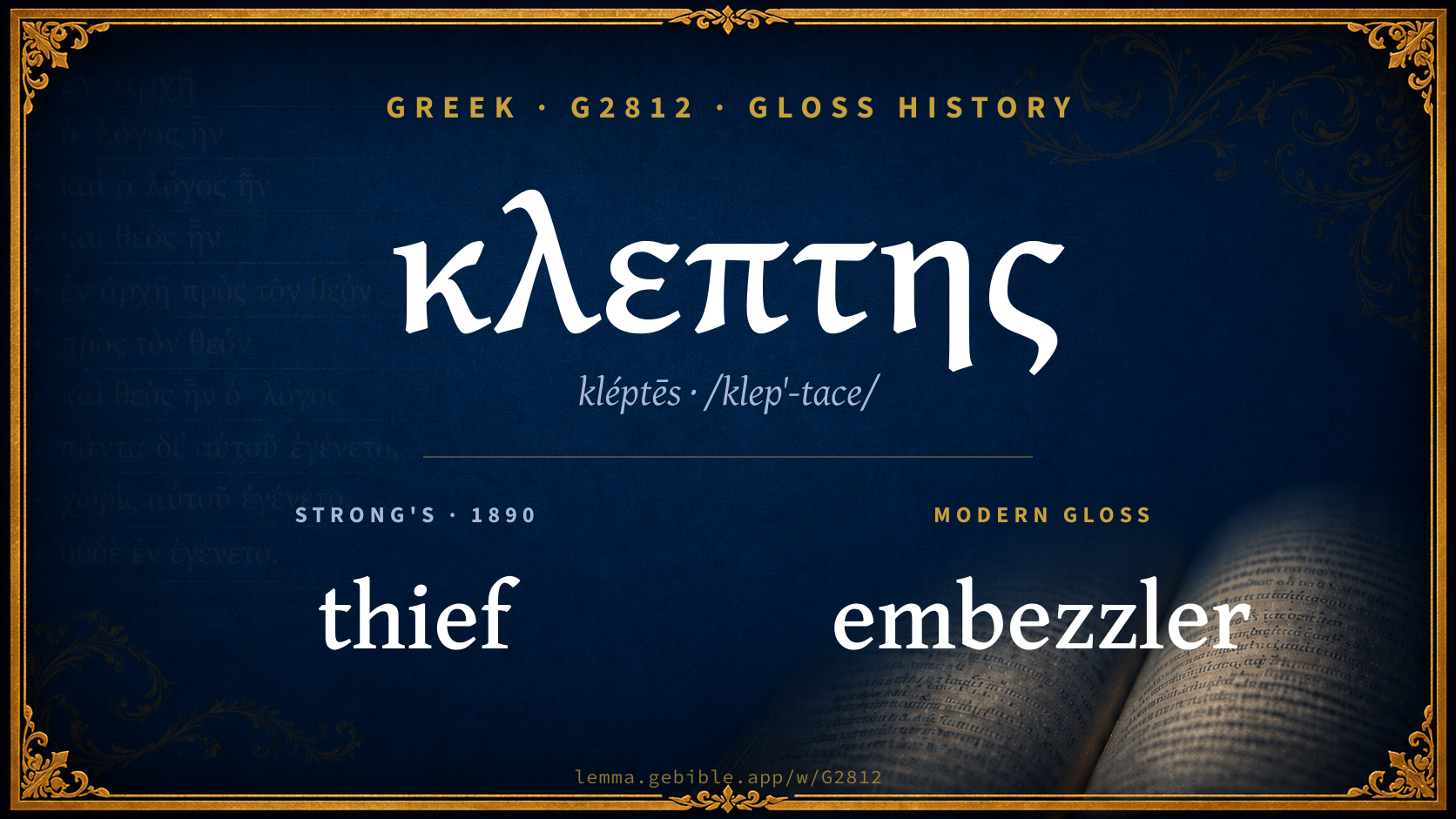
Gloss history
Strong's 1890 vs modern scholarship
About this word
Strong's G2812 catalogs a Greek word from the Greek New Testament.
These counts are not copied from any lexicon or concordance. They are computed here, from the morphology-tagged Greek New Testament. What Lemma adds →
- 16
- distinct verses
- The word appears in 16 distinct verses.
- 8 / 27
- NT books
- The word appears in 8 of 27 New Testament books.
- #726
- by frequency
- Top 1000 most frequent Greek words (rank 726 of 5,347 Greek words by occurrence).
View all 16 occurrences in the concordance →
By section of the New Testament
By traditional corpus
Conventional, traditional groupings — biblical authorship is debated, so this is a traditional corpus grouping, not an authorship claim. Some books belong to more than one corpus (Luke is in both the Gospels and the Lukan corpus, and so on), so these shares overlap and need not total 100%. Each figure is a share of the word’s 16 distinct verses.
- Gospels 9 verses · 56%
- Johannine 6 verses · 38%
- Pauline corpus 3 verses · 19%
- Lukan (Luke–Acts) 2 verses · 13%
- General (Catholic) Epistles 2 verses · 13%
- Revelation 2 verses · 13%
How translations render this word
Counts come from each version’s own published word-to-Strong’s tagging or interlinear alignment — an approximate guide to how each version renders this word, not a word-level alignment the data otherwise carries. Because each total is that version’s own tagged count, the per-version totals vary from one another and need not match the appearance or distinct-verse counts above. These counts may also differ from a printed concordance because Lemma counts each distinctly tagged rendering and does not collapse phrase taggings into a single head-word total. This is a fixed set of word-tagged versions (KJV, ASV, BSB, ULT) and does not change with the reading translation you choose elsewhere. Each version’s license is shown beside its name below (and on Sources).
- King James Version: Thief 12×, Thieves 4×
- American Standard Version: Thief 12×, Thieves 4×
- Berean Standard Bible: Thief 12×, Thieves 4×
- unfoldingWord Literal Text: Thief 13×, Thieves 3×
King James Version Public Domain
Renders G2812 across 16 tagged occurrences — most commonly:
American Standard Version Public Domain
Renders G2812 across 16 tagged occurrences — most commonly:
Berean Standard Bible Public Domain
Renders G2812 across 16 tagged occurrences — most commonly:
unfoldingWord Literal Text CC BY-SA 4.0
Renders G2812 across 16 tagged occurrences — most commonly:
Senses in Thayer's
The 1 sense Thayer's distinguishes for this word, in lexicon order (not ranked by frequency or importance). The full entry — with sub-senses — is in the Lexicon Entry tab.
- the name is transferred to false teachers…
Word origin
Derived from κλεπτω (kléptō) (G2813) — to steal.
Forms in the corpus
The 2 distinct written forms G2812 takes in the Greek New Testament, most frequent first — each parse links to that case’s occurrences in the concordance.
| Form | Parsing | Example | Uses |
|---|---|---|---|
| κλέπτης kléptēs | Noun, Nominative, Singular, Masculine | Matthew 24:43 | 12 |
| κλέπται kléptai | Noun, Nominative, Plural, Masculine | Matthew 6:19 | 4 |
Same root — word family
Other Thayer's entries built from the same root as G2812, grouped by Strong’s listed origin. These share a root / origin per the lexicon — not necessarily a shared meaning. Each links to that word’s own entry.
Derives from
Shares the same root
Compare all same-root words → Showing 4 of 5 — not the complete family. They share a root, not necessarily a meaning.
Septuagint usage
The same Greek word κλεπτης appears 14 times in the Greek Old Testament (Septuagint), across 14 verses in 11 books.
- 14
- LXX occurrences
- Tagged occurrences of this Greek word in the Septuagint.
- 14
- verses
- Distinct Septuagint verses containing this word.
- 11 / 39
- OT books
- The word appears in 11 of the 39 Old Testament books.
Sample Septuagint occurrences
- Exodus 22:1 κλέπτης
- Deuteronomy 24:7 κλέπτης
- Job 24:14 κλέπτης
- Psalms 49:18 κλέπτης
- Proverbs 29:24 κλέπτης
- Isaiah 1:23 κλέπτης
- Jeremiah 2:26 κλέπτης
- Hosea 7:1 κλέπτης
- Joel 2:9 κλέπτης
- Obadiah 1:5 κλέπτης
- Zechariah 5:3 κλέπτης
Septuagint occurrences (same lexeme)
Every verse where the same Strong’s number (G2812) appears in the Greek Septuagint. Verse text shown in the World English Bible for context; the Greek form is the matched word — the English is not keyword-highlighted.
- Exodus 22:1 κλέπτης "If a man steals an ox or a sheep, and kills it, or sells it; he shall pay five oxen for an ox, and four sheep for a sheep.
- Deuteronomy 24:7 κλέπτης If a man be found stealing any of his brothers of the children of Israel, and he deal with him as a slave, or sell him; then that thief shall die: so shall you put away the evil from the midst of you.
- Job 24:14 κλέπτης The murderer rises with the light. He kills the poor and needy. In the night he is like a thief.
- Job 30:5 κλέπτης They are driven forth from the midst of men; They cry after them as after a thief;
- Psalms 49:18 κλέπτης Though while he lived he blessed his soul-- And men praise you when you do well for yourself--
- Proverbs 29:24 κλέπτης Whoever is an accomplice of a thief is an enemy of his own soul. He takes an oath, but dares not testify.
- Isaiah 1:23 κλέπτης Your princes are rebellious, and companions of thieves. Everyone loves bribes, and follows after rewards. They don't judge the fatherless, Neither does the cause of the widow come to them.
- Jeremiah 2:26 κλέπτης As the thief is ashamed when he is found, so is the house of Israel ashamed; they, their kings, their princes, and their priests, and their prophets;
- Jeremiah 30:3 κλέπτης For, behold, the days come, says Yahweh, that I will turn again the captivity of my people Israel and Judah, says Yahweh; and I will cause them to return to the land that I gave to their fathers, and they shall possess it.
- Hosea 7:1 κλέπτης When I would heal Israel, Then the iniquity of Ephraim is uncovered, Also the wickedness of Samaria; For they commit falsehood, And the thief enters in, And the gang of robbers ravages outside.
- Joel 2:9 κλέπτης They rush on the city. They run on the wall. They climb up into the houses. They enter in at the windows like thieves.
- Obadiah 1:5 κλέπτης If thieves came to you, if robbers by night-- oh, what disaster awaits you--wouldn't they only steal until they had enough? If grape pickers came to you, wouldn't they leave some gleaning grapes?
- Zechariah 5:3 κλέπτης Then he said to me, "This is the curse that goes out over the surface of the whole land; for everyone who steals shall be cut off according to it on the one side; and everyone who swears falsely shall be cut off according to it on the other side.
- Zechariah 5:4 κλέπτης I will cause it to go out," says Yahweh of Hosts, "and it will enter into the house of the thief, and into the house of him who swears falsely by my name; and it will remain in the midst of his house, and will destroy it with its timber and its stones."
These are occurrences of the same Greek lexeme (G2812) in the Septuagint — not a translation of any one Hebrew word. The store carries no word-level Hebrew↔Greek alignment, so no Hebrew original is asserted here. Counts come from the recovered LXX Strong's tagging — high-frequency vocabulary is well covered, while rare or late forms may be untagged — so they reflect tagged occurrences and may slightly undercount.