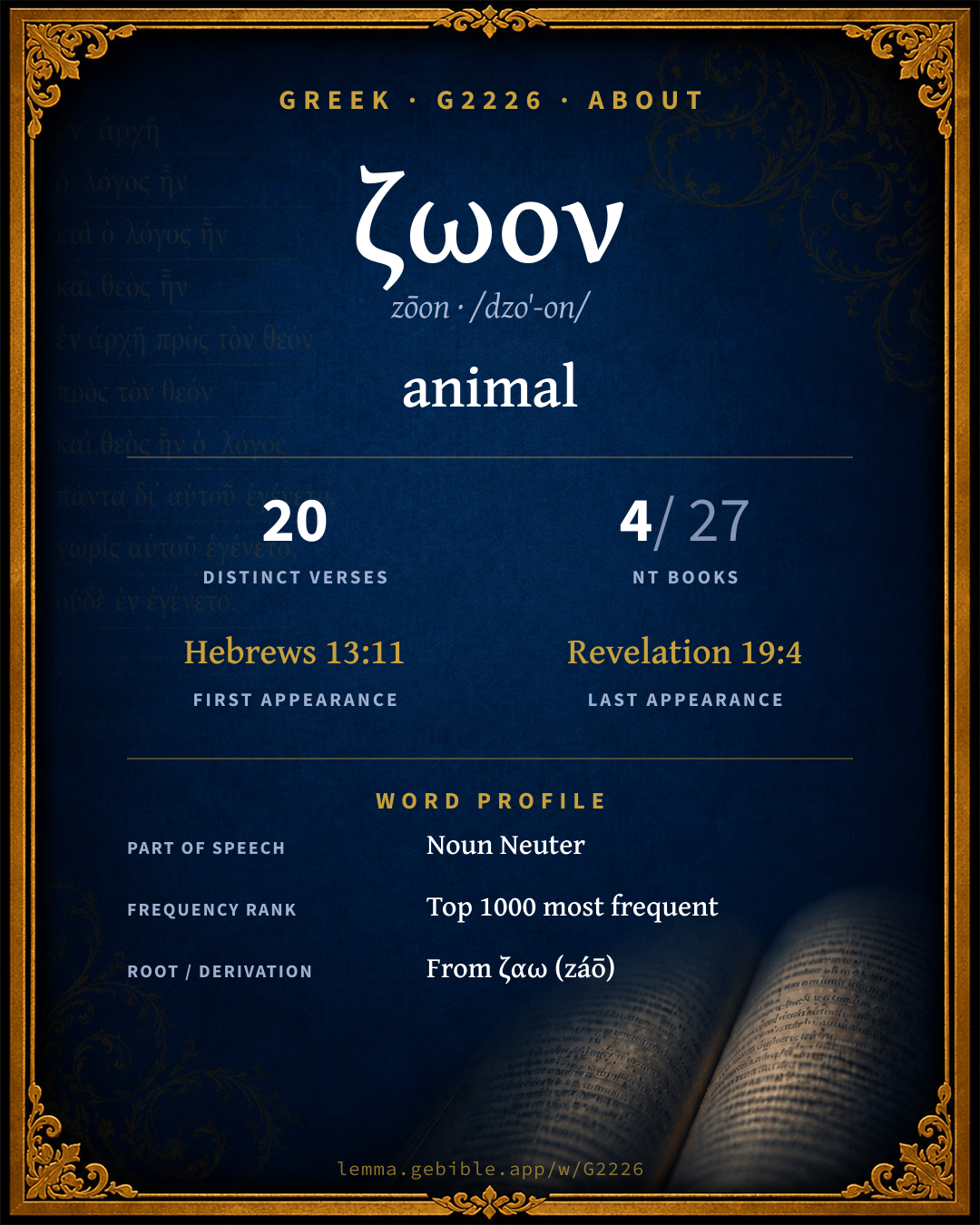
ζῶον
animal
‘animal’ is one of 2 main senses fuller range ↓
Full lexicon entry — Thayer's Greek Lexicon
From Thayer's Greek Lexicon
Where this word appears
See every Genitive-case word in the Greek New Testament →
Grammar key — what these labels mean
Part of speech
- Noun
- A naming word — a person, place, thing, or idea.
Case
- Genitive
- The case of source, possession, or “of” — answers “whose / from what.”
- Nominative
- The case of the subject (and the predicate nominative).
Gender
- Neuter
- Grammatically neuter.
Number
- Plural
- More than one.
- Singular
- One.
7 verses where G2226 appears in the Nominative case in the Book of Revelation. Filtered view — show all forms. Click any verse to open its interlinear word-by-word view. Verse text shown in the World English Bible for context — . Each verse’s Greek form is shown with its reference; the English is not keyword-highlighted, since the data carries no word-level English alignment. Use “Compare translations” on any verse to read it across multiple English versions. This concordance covers the Greek New Testament; Septuagint (Greek Old Testament) occurrences of this word are not indexed here.
Revelation
- Revelation 4:6 ζῷα n nom pl neut Before the throne was something like a sea of glass, similar to crystal. In the midst of the throne, and around the throne were four living creatures full of eyes before and behind.
- Revelation 4:7 ζῷον ζῷον ζῷον ζῷον n nom sg neut n nom sg neut n nom sg neut n nom sg neut The first creature was like a lion, and the second creature like a calf, and the third creature had a face like a man, and the fourth was like a flying eagle.
- Revelation 4:8 ζῷα n nom pl neut The four living creatures, each one of them having six wings, are full of eyes around about and within. They have no rest day and night, saying, "Holy, holy, holy, holy, holy, holy, holy, holy, holy is the Lord God, the Almighty, who was and who is and who is to come!"
- Revelation 4:9 ζῷα n nom pl neut When the living creatures give glory, honor, and thanks to him who sits on the throne, to him who lives forever and ever,
- Revelation 5:8 ζῷα n nom pl neut Now when he had taken the book, the four living creatures and the twenty-four elders fell down before the Lamb, each one having a harp, and golden bowls full of incense, which are the prayers of the saints.
- Revelation 5:14 ζῷα n nom pl neut The four living creatures said, "Amen!" The elders fell down and worshiped.
- Revelation 19:4 ζῷα n nom pl neut The twenty-four elders and the four living creatures fell down and worshiped God who sits on the throne, saying, "Amen! Hallelujah!"
About this entry
At a glance — auto-summarized from this page’s data, not written by a person. Every figure links to its source below. This summary describes the numbers; it doesn’t interpret them.
ζωον (zōon) is a Greek noun most often rendered “animal.” Revelation dominates its distribution — 17 of 20 verses. Spanning 20 verses in 4 books, it ranks among the uncommon words of the Greek New Testament. Ranging over 2 senses, it is not a single-sense word. The King James Version usually renders it “beasts,” while modern versions prefer “living creatures” (Berean Standard Bible) — see the renderings breakdown. The sections below give every sense, occurrence, and version rendering.
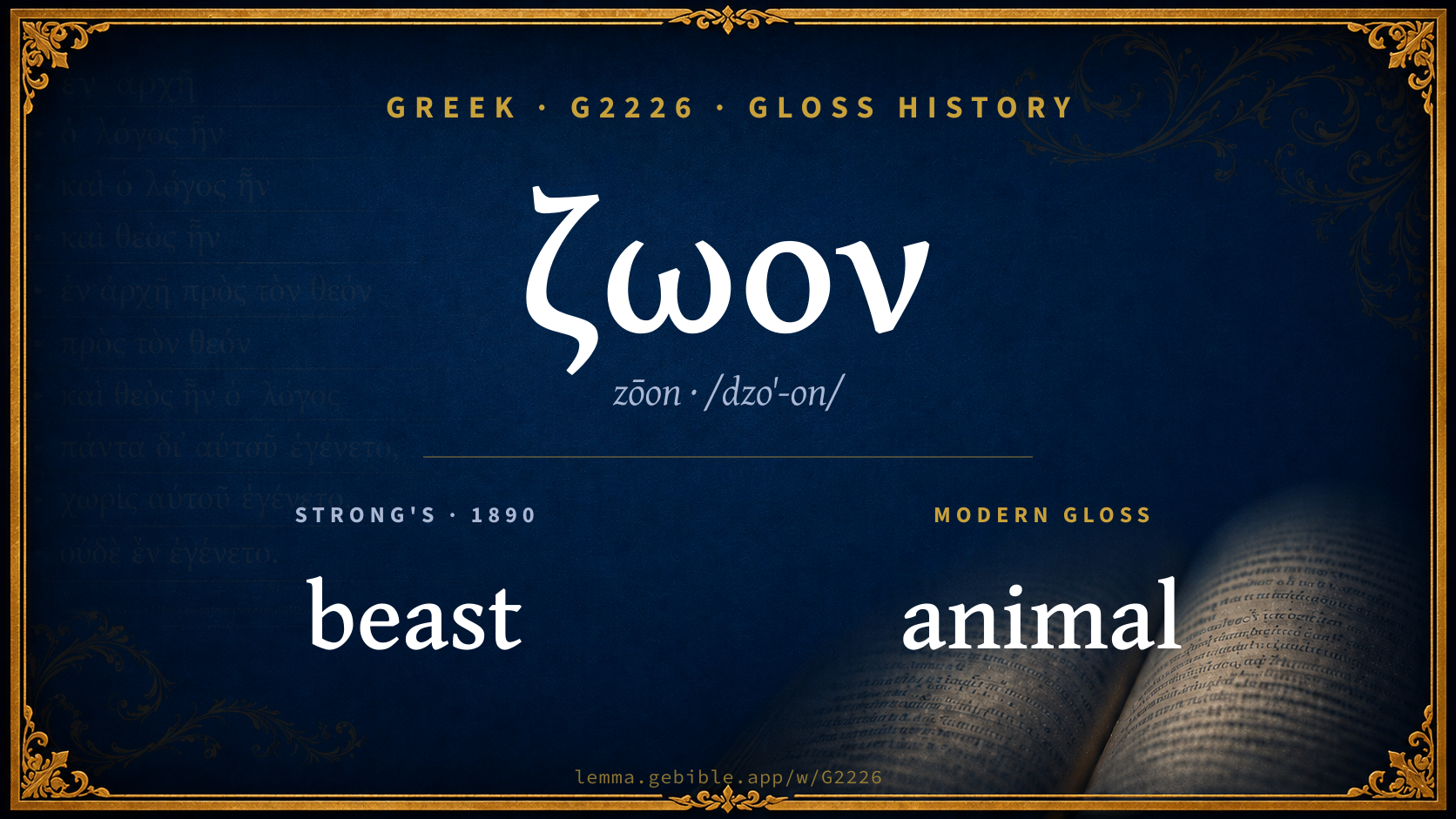
Gloss history
Strong's 1890 vs modern scholarship
About this word
Strong's G2226 catalogs a Greek word from the Greek New Testament.
These counts are not copied from any lexicon or concordance. They are computed here, from the morphology-tagged Greek New Testament. What Lemma adds →
- 20
- distinct verses
- The word appears in 20 distinct verses.
- 4 / 27
- NT books
- The word appears in 4 of 27 New Testament books.
- #563
- by frequency
- Top 1000 most frequent Greek words (rank 563 of 5,347 Greek words by occurrence).
View all 20 occurrences in the concordance →
Most concentrated in
- Revelation 17 verses 85%
- Hebrews 1 verse 5%
- 2 Peter 1 verse 5%
By section of the New Testament
By traditional corpus
Conventional, traditional groupings — biblical authorship is debated, so this is a traditional corpus grouping, not an authorship claim. Some books belong to more than one corpus (Luke is in both the Gospels and the Lukan corpus, and so on), so these shares overlap and need not total 100%. Each figure is a share of the word’s 20 distinct verses.
- Johannine 17 verses · 85%
- Revelation 17 verses · 85%
- General (Catholic) Epistles 2 verses · 10%
- Hebrews 1 verse · 5%
How translations render this word
Counts come from each version’s own published word-to-Strong’s tagging or interlinear alignment — an approximate guide to how each version renders this word, not a word-level alignment the data otherwise carries. Because each total is that version’s own tagged count, the per-version totals vary from one another and need not match the appearance or distinct-verse counts above. These counts may also differ from a printed concordance because Lemma counts each distinctly tagged rendering and does not collapse phrase taggings into a single head-word total. This is a fixed set of word-tagged versions (KJV, ASV, BSB, ULT) and does not change with the reading translation you choose elsewhere. Each version’s license is shown beside its name below (and on Sources).
- King James Version: Beasts 16×, Beast 7×
- American Standard Version: Living creatures 13×, Creature 4×, Living creature 3×
- Berean Standard Bible: Living creatures 13×, Living creature 4×, Animals 3×
- unfoldingWord Literal Text: Living creatures 13×, Living creature 7×, Animals 3×
King James Version Public Domain
Renders G2226 across 23 tagged occurrences — most commonly:
American Standard Version Public Domain
Renders G2226 across 24 tagged occurrences — most commonly:
Plus 4 renderings that appear only once — usually multi-word phrases or single function words the recovered tagging swept in, not distinct renderings.
Berean Standard Bible Public Domain
Renders G2226 across 20 tagged occurrences — most commonly:
Not rendered by a distinct English word in 3 further occurrences.
unfoldingWord Literal Text CC BY-SA 4.0
Renders G2226 across 28 tagged occurrences — most commonly:
Plus 2 renderings that appear only once — usually multi-word phrases or single function words the recovered tagging swept in, not distinct renderings.
Senses in Thayer's
The 2 senses Thayer's distinguishes for this word, in lexicon order (not ranked by frequency or importance). The full entry — with sub-senses — is in the Lexicon Entry tab.
- a living being
- an animal, brute, beast
Word origin
Derived from ζαω (záō) (G2198) — to live.
Neuter of a derivative of G2198 ; a live thing that is an animal : - beast.
— Strong’s Exhaustive Concordance (1890), public domain.
Forms in the corpus
The 4 distinct written forms G2226 takes in the Greek New Testament, most frequent first — each parse links to that case’s occurrences in the concordance.
| Form | Parsing | Example | Uses |
|---|---|---|---|
| ζώων zṓōn | Noun, Genitive, Plural, Neuter | Hebrews 13:11 | 8 |
| ζῷα zō̂a | Noun, Nominative, Plural, Neuter | 2 Peter 2:12 | 8 |
| ζῷον zō̂on | Noun, Nominative, Singular, Neuter | Revelation 4:7 | 4 |
| ζώου zṓou | Noun, Genitive, Singular, Neuter | Revelation 6:3 | 3 |
Same root — word family
Other Thayer's entries built from the same root as G2226, grouped by Strong’s listed origin. These share a root / origin per the lexicon — not necessarily a shared meaning. Each links to that word’s own entry.
Derives from
Shares the same root
Derived from this word
- ζωγρεω zōgréō G2221 to capture
- ζωογονεω zōogonéō G2225 to preserve alive
- ζωοποιεω zōopoiéō G2227 to make alive
Compare all same-root words → Showing 4 of 6 — not the complete family. They share a root, not necessarily a meaning.
Septuagint usage
The same Greek word ζωον appears 19 times in the Greek Old Testament (Septuagint), across 17 verses in 6 books.
- 19
- LXX occurrences
- Tagged occurrences of this Greek word in the Septuagint.
- 17
- verses
- Distinct Septuagint verses containing this word.
- 6 / 39
- OT books
- The word appears in 6 of the 39 Old Testament books.
Sample Septuagint occurrences
- Genesis 1:21 ζῷον
- Job 38:14 ζῷον
- Psalms 67:11 ζῷον
- Ezekiel 1:5 ζῷον
- Daniel 4:4 ζῷον
- Habakkuk 3:2 ζῷον
Septuagint occurrences (same lexeme)
Every verse where the same Strong’s number (G2226) appears in the Greek Septuagint. Verse text shown in the World English Bible for context; the Greek form is the matched word — the English is not keyword-highlighted.
- Genesis 1:21 ζῷον God created the large sea creatures, and every living creature that moves, with which the waters swarmed, after their kind, and every winged bird after its kind. God saw that it was good.
- Job 38:14 ζῷον It is changed as clay under the seal, And stands forth as a garment.
- Psalms 67:11 ζῷον
- Psalms 103:25 ζῷον
- Psalms 144:16 ζῷον
- Ezekiel 1:5 ζῷον Out of the midst of it came the likeness of four living creatures. This was their appearance: they had the likeness of a man.
- Ezekiel 1:13 ζῷον As for the likeness of the living creatures, their appearance was like burning coals of fire, like the appearance of torches: [the fire] went up and down among the living creatures; and the fire was bright, and out of the fire went forth lightning.
- Ezekiel 1:15 ζῷον Now as I saw the living creatures, behold, one wheel on the earth beside the living creatures, for each of the four faces of it.
- Ezekiel 1:19 ζῷον When the living creatures went, the wheels went beside them; and when the living creatures were lifted up from the earth, the wheels were lifted up.
- Ezekiel 1:20 ζῷον Wherever the spirit was to go, they went; there was the spirit to go: and the wheels were lifted up beside them; for the spirit of the living creature was in the wheels.
- Ezekiel 1:22 ζῷον Over the head of the living creature there was the likeness of an expanse, like the awesome crystal to look on, stretched forth over their heads above.
- Ezekiel 3:13 ζῷον [I heard] the noise of the wings of the living creatures as they touched one another, and the noise of the wheels beside them, even the noise of a great rushing.
- Ezekiel 10:15 ζῷον The cherubim mounted up: this is the living creature that I saw by the river Chebar.
- Ezekiel 10:20 ζῷον This is the living creature that I saw under the God of Israel by the river Chebar; and I knew that they were cherubim.
- Ezekiel 47:9 ζῷον It shall happen, that every living creature which swarms, in every place where the rivers come, shall live; and there shall be a very great multitude of fish; for these waters are come there, and [the waters of the sea] shall be healed, and everything shall live wherever the river comes.
- Daniel 4:4 ζῷον I, Nebuchadnezzar, was at rest in my house, and flourishing in my palace.
- Habakkuk 3:2 ζῷον Yahweh, I have heard of your fame. I stand in awe of your deeds, Yahweh. Renew your work in the midst of the years. In the midst of the years make it known. In wrath, you remember mercy.
These are occurrences of the same Greek lexeme (G2226) in the Septuagint — not a translation of any one Hebrew word. The store carries no word-level Hebrew↔Greek alignment, so no Hebrew original is asserted here. Counts come from the recovered LXX Strong's tagging — high-frequency vocabulary is well covered, while rare or late forms may be untagged — so they reflect tagged occurrences and may slightly undercount.