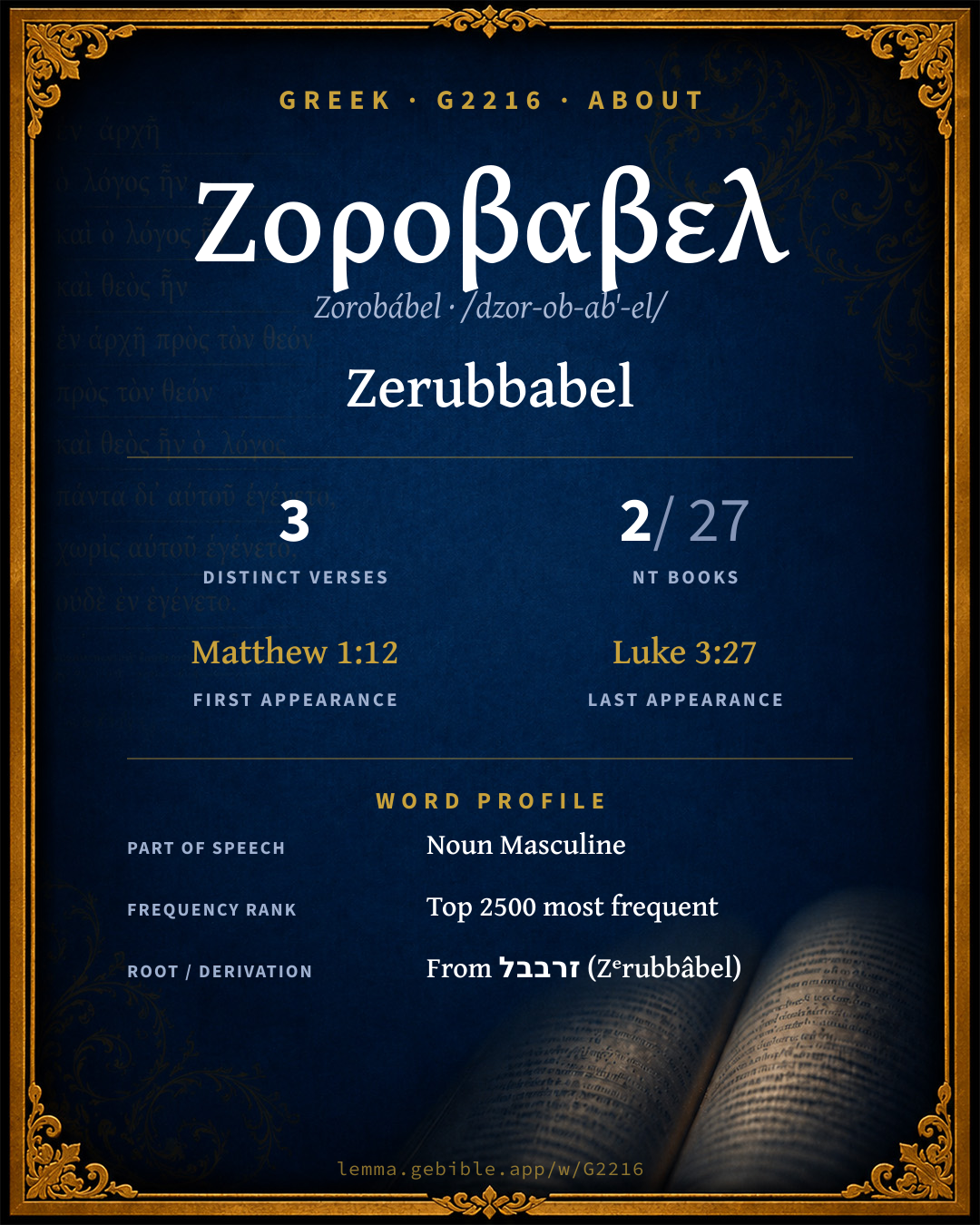
Ζοροβάβελ
Zerubbabel
Thayer's lists 2 entries for ‘Zerubbabel’ fuller range ↓
Full lexicon entry — Thayer's Greek Lexicon
From Thayer's Greek Lexicon
Where this word appears
Every verse where G2216 appears — 3 distinct verses across 2 books. Click any verse to open its interlinear word-by-word view. Verse text shown in the World English Bible for context — . Each verse’s Greek form is shown with its reference; the English is not keyword-highlighted, since the data carries no word-level English alignment. Use “Compare translations” on any verse to read it across multiple English versions. This concordance covers the Greek New Testament; Septuagint (Greek Old Testament) occurrences of this word are not indexed here.
Matthew 2 verses
- Matthew 1:12 Ζοροβάβελ n proper indecl After the exile to Babylon, Jechoniah became the father of Shealtiel. Shealtiel became the father of Zerubbabel.
- Matthew 1:13 Ζοροβάβελ n proper indecl Zerubbabel became the father of Abiud. Abiud became the father of Eliakim. Eliakim became the father of Azor.
Luke 1 verse
About this entry
At a glance — auto-summarized from this page’s data, not written by a person. Every figure links to its source below. This summary describes the numbers; it doesn’t interpret them.
At its core, Ζοροβαβελ (Zorobábel) means “Zerubbabel.” A scarce word — 3 verses in all of the Greek New Testament. Its uses cluster heavily in Matthew (67% of all occurrences). It first appears in Matthew 1:12. Each statement above links to its evidence; the full detail follows below.
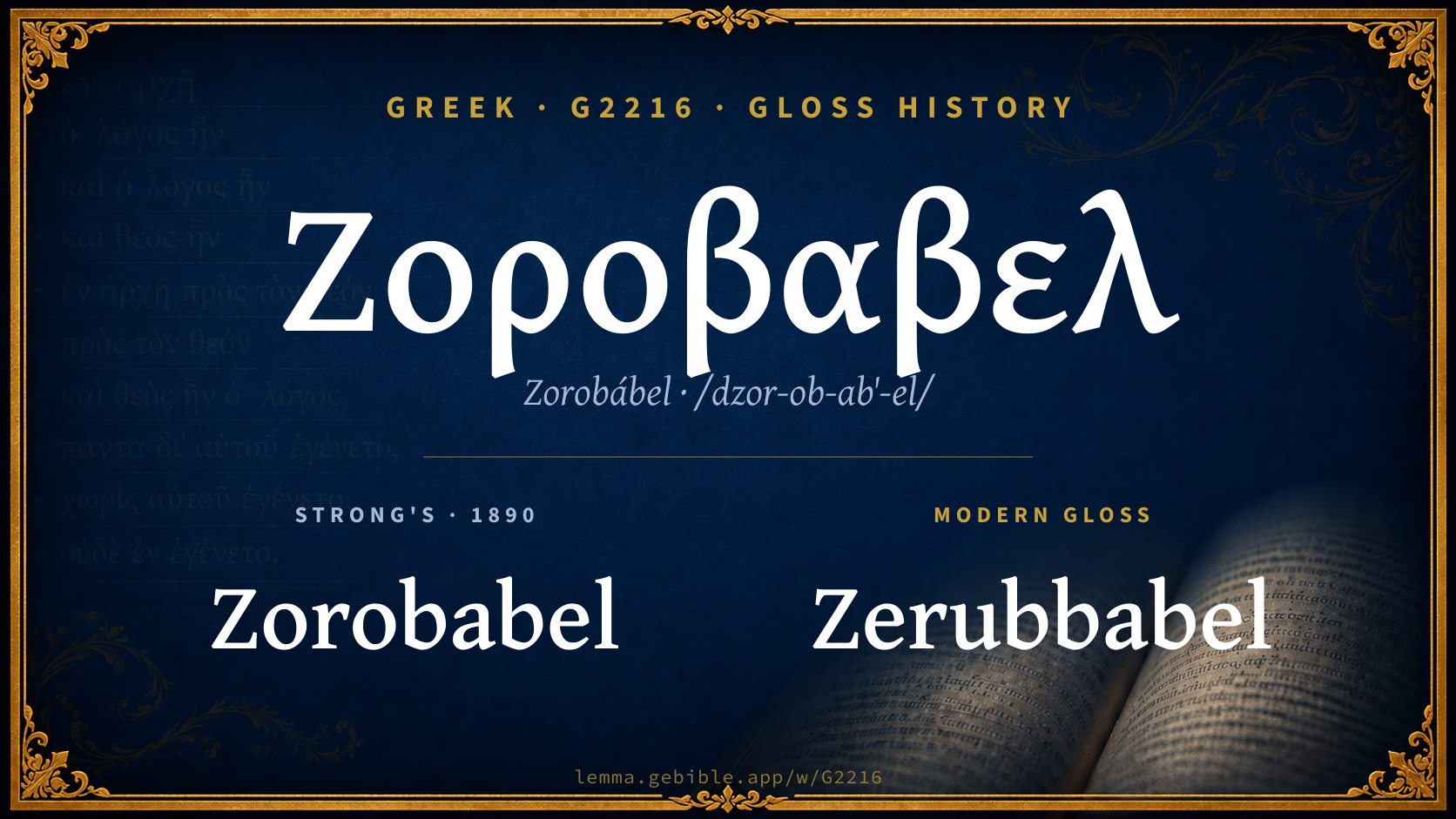
Gloss history
Strong's 1890 vs modern scholarship
About this word
Strong's G2216 catalogs a Greek word from the Greek New Testament.
These counts are not copied from any lexicon or concordance. They are computed here, from the morphology-tagged Greek New Testament. What Lemma adds →
- 3
- distinct verses
- The word appears in 3 distinct verses.
- 2 / 27
- NT books
- The word appears in 2 of 27 New Testament books.
- #2,203
- by frequency
- Top 2500 most frequent Greek words (rank 2,203 of 5,347 Greek words by occurrence).
View all 3 occurrences in the concordance →
By traditional corpus
Conventional, traditional groupings — biblical authorship is debated, so this is a traditional corpus grouping, not an authorship claim. Some books belong to more than one corpus (Luke is in both the Gospels and the Lukan corpus, and so on), so these shares overlap and need not total 100%. Each figure is a share of the word’s 3 distinct verses.
- Gospels 3 verses · 100%
- Lukan (Luke–Acts) 1 verse · 33%
How translations render this word
Counts come from each version’s own published word-to-Strong’s tagging or interlinear alignment — an approximate guide to how each version renders this word, not a word-level alignment the data otherwise carries. Because each total is that version’s own tagged count, the per-version totals vary from one another and need not match the appearance or distinct-verse counts above. These counts may also differ from a printed concordance because Lemma counts each distinctly tagged rendering and does not collapse phrase taggings into a single head-word total. This is a fixed set of word-tagged versions (KJV, ASV, BSB, ULT) and does not change with the reading translation you choose elsewhere. Each version’s license is shown beside its name below (and on Sources).
- King James Version: Zorobabel 2×
- American Standard Version: Zerubbabel 2×
- Berean Standard Bible: Zerubbabel 3×
- unfoldingWord Literal Text: Zerubbabel 3×
King James Version Public Domain
Renders G2216 across 3 tagged occurrences — most commonly:
Plus 1 rendering that appears only once — usually multi-word phrases or single function words the recovered tagging swept in, not distinct renderings.
American Standard Version Public Domain
Renders G2216 across 3 tagged occurrences — most commonly:
Plus 1 rendering that appears only once — usually multi-word phrases or single function words the recovered tagging swept in, not distinct renderings.
Berean Standard Bible Public Domain
Renders G2216 across 3 tagged occurrences — most commonly:
unfoldingWord Literal Text CC BY-SA 4.0
Renders G2216 across 3 tagged occurrences — most commonly:
Senses in Thayer's
The 2 senses Thayer's distinguishes for this word, in lexicon order (not ranked by frequency or importance). The full entry — with sub-senses — is in the Lexicon Entry tab.
- Zerubbabel = "born at Babel, i.e. Babylon"
- the head of the tribe of Judah at the time of the return from Babylonish captivity in the first year of Cyrus
Word origin
Derived from זרבבל (Zᵉrubbâbel) (H2216) — Zerubbabel.
Of hebrew origin [ H2216 ]; Zorobabel (that is Zerubbabel ) an Israelite : - Zorobabel.
— Strong’s Exhaustive Concordance (1890), public domain.
Forms in the corpus
The 2 distinct written forms G2216 takes in the Greek New Testament, most frequent first — each parse links to that case’s occurrences in the concordance.
| Form | Parsing | Example | Uses |
|---|---|---|---|
| Ζοροβάβελ Zorobábel | Noun, Proper, indeclinable | Matthew 1:12 | 2 |
| Ζοροβαβὲλ Zorobabèl | Noun, Proper, indeclinable | Luke 3:27 | 1 |
Same root — word family
Other Thayer's entries built from the same root as G2216, grouped by Strong’s listed origin. These share a root / origin per the lexicon — not necessarily a shared meaning. Each links to that word’s own entry.
Derives from
Proper names from this root
People and places named from this root — a name, not an additional meaning of the word.
Compare all same-root words → 2 of the same-root words are proper names (people or places). They share a root, not necessarily a meaning.
Bible dictionary
Public-domain dictionary articles matched to this entry by name (Zerubbabel). A biblical name can be shared by more than one person or place, so an article may treat several.
Easton's Bible Dictionary · M. G. Easton, 1897
The seed of Babylon, the son of Salathiel or Shealtiel (Hag. 1:1; Zorobabel, Matt. 1:12); called also the son of Pedaiah (1 Chr. 3:17-19), i.e., according to a frequent usage of the word "son;" the grandson or the nephew of Salathiel. He is also known by the Persian name of Sheshbazzar (Ezra 1:8, 11). In the first year of Cyrus, king of Persia, he led the first band of Jews, numbering 42,360 (Ezra 2:64), exclusive of a large number of servants, who returned from captivity at the close of the seventy years. In the second year after the Return, he erected an altar and laid the foundation of the temple on the ruins of that which had been destroyed by Nebuchadnezzar (3:8-13; ch. 4-6). All through the work he occupied a prominent place, inasmuch as he was a descendant of the royal line of David.
Smith's Bible Dictionary · William Smith, 1863
(born at Babel, i.e. Babylon), the head of the tribe of Judah at the time of the return from the Babylonish captivity in the first year of Cyrus. The history of Zerabbabel in the Scriptures is as follows: In the first year of Cyrus he was living at Babylon, and was the recognized prince of Judah in the captivity,--what in later times was called "the prince of the captivity," or "the prince." On the issuing of Cyrus' decree he immediately availed himself of it, and placed himself at the head of those of his countrymen "whose spirit God had raised to go up to build the house of the Lord which is in Jerusalem." It is probable that he was in the king of Babylon's service, both from his having, like Daniel and the three children, received a Chaldee name, Sheshbazzar, and from the fact that he was appointed by the Persian king to the office of governor of Judea. On arriving at Jerusalem, Zerubbabel's great work, which he set about immediately, was the rebuilding of the temple. In the second month of the second year of the return the foundation was laid with all the pomp which could be commanded. The efforts of the Samaritans were successful in putting a stop to the work during the seven remaining years of the reign of Cyrus and through the eight years of Cambyses and Smerdis. Nor does Zerubbabel appear quite blameless for this long delay. The difficulties in the way of building the temple were not such as need have stopped the work and during this long suspension of sixteen years Zerubbabel and the rest of the people had been busy in building costly houses for themselves. But in the second year of Darius, light dawned upon the darkness of the colony from Babylon. In that year--it was the most memorable event in Zerabbabel's life--the spirit of prophecy suddenly blazed up with a most brilliant light among the returned captives. Their words fell like sparks upon tinder. In a moment Zerubbabel roused from his apathy, threw his whole strength into the work. After much opposition [see Nehemiah, The Book Of] and many hindrances find delays, the temple was at length finished, in the sixth pear of Darius, and was dedicated with much pomp and rejoicing. [Temple] The only other works of Zerubbabel of which we learn from Scripture are the restoration of the courses of priests and Levites and of the provision for their maintenance, according to the institution of David (Ezra 6:18; Nehemiah 12:47) the registering the returned captives according to their genealogies, (Nehemiah 7:5) and the keeping of a Passover in the seventh year of Darius, with which last event ends all that we know of the life of Zerubbabel, His apocryphal history is told in 1 Esdr. 3-7. The exact parentage of Zerubbabel is a little obscure, from his being always called the son of Shealtiel, (Ezra 3:2,8; 5:2) etc.; (Haggai 1:1,12,14) etc., end appearing as such in the genealogies of Christ (Matthew 1:12; Luke 3:27) whereas in (1 Chronicles 3:19) he is represented as the son of Pedaiah, Shealtiel or Salathiel's brother, and consequently as Salathiel's nephew. Zerubbabel was the legal successor and heir of Jeconiah's royal estate, the grandson of Neri and the lineal descendant of Nathan the son of David. In the New Testament the name appears in the Greek form of Zorobabel.
Hitchcock's Bible Names Dictionary · Roswell D. Hitchcock, 1869
a stranger at Babylon; dispersion of confusion
Classic public-domain reference works; full attribution on Sources.
Septuagint usage
The same Greek word Ζοροβαβελ appears 22 times in the Greek Old Testament (Septuagint), across 21 verses in 4 books.
- 22
- LXX occurrences
- Tagged occurrences of this Greek word in the Septuagint.
- 21
- verses
- Distinct Septuagint verses containing this word.
- 4 / 39
- OT books
- The word appears in 4 of the 39 Old Testament books.
Sample Septuagint occurrences
- 1 Chronicles 3:19 ζοροβαβελ
- Ezra 2:2 ζοροβαβελ
- Haggai 1:1 ζοροβαβελ
- Zechariah 4:6 ζοροβαβελ
Septuagint occurrences (same lexeme)
Every verse where the same Strong’s number (G2216) appears in the Greek Septuagint. Verse text shown in the World English Bible for context; the Greek form is the matched word — the English is not keyword-highlighted.
- 1 Chronicles 3:19 ζοροβαβελ The sons of Pedaiah: Zerubbabel, and Shimei. The sons of Zerubbabel: Meshullam, and Hananiah; and Shelomith was their sister;
- Ezra 2:2 ζοροβαβελ who came with Zerubbabel, Jeshua, Nehemiah, Seraiah, Reelaiah, Mordecai, Bilshan, Mispar, Bigvai, Rehum, Baanah. The number of the men of the people of Israel:
- Ezra 3:2 ζοροβαβελ Then stood up Jeshua the son of Jozadak, and his brothers the priests, and Zerubbabel the son of Shealtiel, and his brothers, and built the altar of the God of Israel, to offer burnt offerings thereon, as it is written in the law of Moses the man of God.
- Ezra 3:8 ζοροβαβελ Now in the second year of their coming to the house of God at Jerusalem, in the second month, began Zerubbabel the son of Shealtiel, and Jeshua the son of Jozadak, and the rest of their brothers the priests and the Levites, and all those who were come out of the captivity to Jerusalem, and appointed the Levites, from twenty years old and upward, to have the oversight of the work of the house of Yahweh.
- Ezra 4:2 ζοροβαβελ then they drew near to Zerubbabel, and to the heads of fathers' [houses], and said to them, Let us build with you; for we seek your God, as you do; and we sacrifice to him since the days of Esar Haddon king of Assyria, who brought us up here.
- Ezra 4:3 ζοροβαβελ But Zerubbabel, and Jeshua, and the rest of the heads of fathers' [houses] of Israel, said to them, You have nothing to do with us in building a house to our God; but we ourselves together will build to Yahweh, the God of Israel, as king Cyrus the king of Persia has commanded us.
- Ezra 5:2 ζοροβαβελ Then rose up Zerubbabel the son of Shealtiel, and Jeshua the son of Jozadak, and began to build the house of God which is at Jerusalem; and with them were the prophets of God, helping them.
- Ezra 17:7 ζοροβαβελ
- Ezra 22:1 ζοροβαβελ
- Ezra 22:47 ζοροβαβελ
- Haggai 1:1 ζοροβαβελ In the second year of Darius the king, in the sixth month, in the first day of the month, the Word of Yahweh came by Haggai, the prophet, to Zerubbabel, the son of Shealtiel, governor of Judah, and to Joshua, the son of Jehozadak, the high priest, saying,
- Haggai 1:12 ζοροβαβελ Then Zerubbabel, the son of Shealtiel, and Joshua, the son of Jehozadak, the high priest, with all the remnant of the people, obeyed the voice of Yahweh, their God, and the words of Haggai, the prophet, as Yahweh, their God, had sent him; and the people feared Yahweh.
- Haggai 1:14 ζοροβαβελ Yahweh stirred up the spirit of Zerubbabel, the son of Shealtiel, governor of Judah, and the spirit of Joshua, the son of Jehozadak, the high priest, and the spirit of all the remnant of the people; and they came and worked on the house of Yahweh of Hosts, their God,
- Haggai 2:2 ζοροβαβελ "Speak now to Zerubbabel, the son of Shealtiel, governor of Judah, and to Joshua, the son of Jehozadak, the high priest, and to the remnant of the people, saying,
- Haggai 2:4 ζοροβαβελ Yet now be strong, Zerubbabel,' says Yahweh. 'Be strong, Joshua, son of Jehozadak, the high priest. Be strong, all you people of the land,' says Yahweh, 'and work, for I am with you,' says Yahweh of Hosts.
- Haggai 2:21 ζοροβαβελ "Speak to Zerubbabel, governor of Judah, saying, 'I will shake the heavens and the earth.
- Haggai 2:23 ζοροβαβελ In that day, says Yahweh of Hosts, will I take you, Zerubbabel, my servant, the son of Shealtiel,' says Yahweh, 'and will make you as a signet, for I have chosen you,' says Yahweh of Hosts."
- Zechariah 4:6 ζοροβαβελ Then he answered and spoke to me, saying, "This is the word of Yahweh to Zerubbabel, saying, 'Not by might, nor by power, but by my Spirit,' says Yahweh of Hosts.
- Zechariah 4:7 ζοροβαβελ Who are you, great mountain? Before Zerubbabel you are a plain; and he will bring out the capstone with shouts of 'Grace, grace, to it!'"
- Zechariah 4:9 ζοροβαβελ "The hands of Zerubbabel have laid the foundation of this house. His hands shall also finish it; and you will know that Yahweh of Hosts has sent me to you.
- Zechariah 4:10 ζοροβαβελ Indeed, who despises the day of small things? For these seven shall rejoice, and shall see the plumb line in the hand of Zerubbabel. These are the eyes of Yahweh, which run back and forth through the whole earth."
These are occurrences of the same Greek lexeme (G2216) in the Septuagint — not a translation of any one Hebrew word. The store carries no word-level Hebrew↔Greek alignment, so no Hebrew original is asserted here. Counts come from the recovered LXX Strong's tagging — high-frequency vocabulary is well covered, while rare or late forms may be untagged — so they reflect tagged occurrences and may slightly undercount.