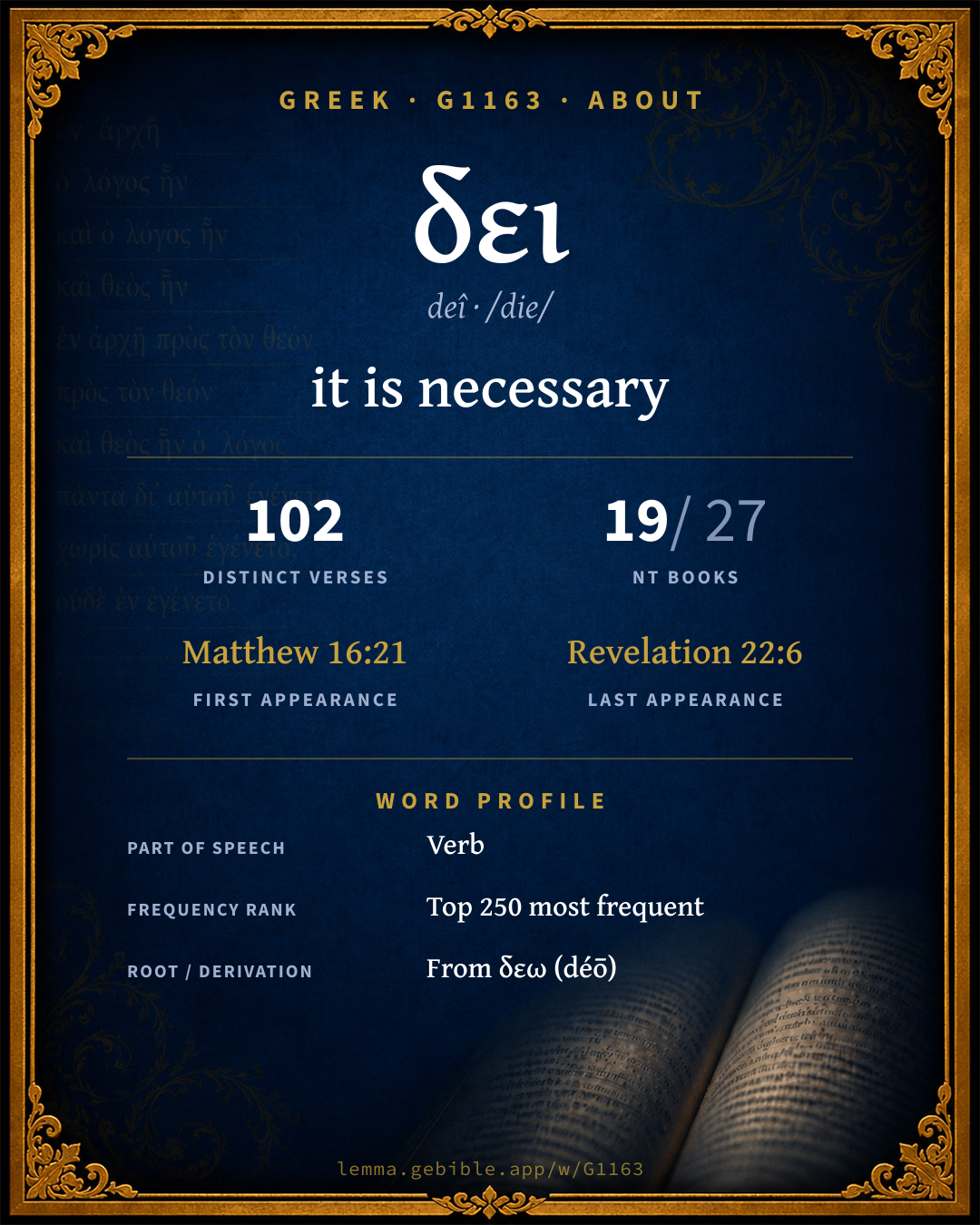
δεῖ
it is necessary
Full lexicon entry — Thayer's Greek Lexicon
From Thayer's Greek Lexicon
Where this word appears
See every Present-tense verb in the Greek New Testament →
Grammar key — what these labels mean
Part of speech
- Verb
- An action or state-of-being word.
Tense
- Present
- Ongoing or general action in present time (imperfective aspect).
- Imperfect
- Continuous or repeated action in past time (“was writing”).
Voice
- Active
- The subject performs the action.
Mood
- Indicative
- States a fact or asks a factual question (the mood of reality).
- Infinitive
- A verbal noun (“to write”), unmarked for person or number.
- Participle
- A verbal adjective (“writing,” “having written”).
- Subjunctive
- Expresses probability, purpose, or possibility (the mood of contingency).
Case
- Nominative
- The case of the subject (and the predicate nominative).
- Accusative
- The case of the direct object and of extent.
Person
- 3rd person
- The one spoken about (“he / she / it / they”).
Gender
- Neuter
- Grammatically neuter.
Number
- Singular
- One.
- Plural
- More than one.
19 verses where G1163 appears in the Present tense in the Book of Acts. Filtered view — show all forms. Click any verse to open its interlinear word-by-word view. Verse text shown in the World English Bible for context — . Each verse’s Greek form is shown with its reference; the English is not keyword-highlighted, since the data carries no word-level English alignment. Use “Compare translations” on any verse to read it across multiple English versions. This concordance covers the Greek New Testament; Septuagint (Greek Old Testament) occurrences of this word are not indexed here.
Acts
- Acts 1:21 δεῖ pres act ind 3sg Of the men therefore who have accompanied us all the time that the Lord Jesus went in and out among us,
- Acts 3:21 δεῖ pres act ind 3sg whom heaven must receive until the times of restoration of all things, which God spoke long ago by the mouth of his holy prophets.
- Acts 4:12 δεῖ pres act ind 3sg There is salvation in none other, for neither is there any other name under heaven, that is given among men, by which we must be saved!"
- Acts 5:29 δεῖ pres act ind 3sg But Peter and the apostles answered, "We must obey God rather than men.
- Acts 9:6 δεῖ pres act ind 3sg But rise up, and enter into the city, and you will be told what you must do."
- Acts 9:16 δεῖ pres act ind 3sg For I will show him how many things he must suffer for my name's sake."
- Acts 14:22 δεῖ pres act ind 3sg confirming the souls of the disciples, exhorting them to continue in the faith, and that through many afflictions we must enter into the Kingdom of God.
- Acts 15:5 δεῖ pres act ind 3sg But some of the sect of the Pharisees who believed rose up, saying, "It is necessary to circumcise them, and to charge them to keep the law of Moses."
- Acts 16:30 δεῖ pres act ind 3sg and brought them out and said, "Sirs, what must I do to be saved?"
- Acts 19:21 δεῖ pres act ind 3sg Now after these things had ended, Paul determined in the spirit, when he had passed through Macedonia and Achaia, to go to Jerusalem, saying, "After I have been there, I must also see Rome."
- Acts 19:36 δέον pres act ptcp nom sg neut Seeing then that these things can't be denied, you ought to be quiet, and to do nothing rash.
- Acts 20:35 δεῖ pres act ind 3sg In all things I gave you an example, that so laboring you ought to help the weak, and to remember the words of the Lord Jesus, that he himself said, 'It is more blessed to give than to receive.'"
- Acts 21:22 δεῖ pres act ind 3sg What then? The assembly must certainly meet, for they will hear that you have come.
- Acts 23:11 δεῖ pres act ind 3sg The following night, the Lord stood by him, and said, "Cheer up, Paul, for as you have testified about me at Jerusalem, so you must testify also at Rome."
- Acts 25:10 δεῖ pres act ind 3sg But Paul said, "I am standing before Caesar's judgment seat, where I ought to be tried. I have done no wrong to the Jews, as you also know very well.
- Acts 25:24 δεῖν pres act inf Festus said, "King Agrippa, and all men who are here present with us, you see this man, about whom all the multitude of the Jews petitioned me, both at Jerusalem and here, crying that he ought not to live any longer.
- Acts 26:9 δεῖν pres act inf "I myself most assuredly thought that I ought to do many things contrary to the name of Jesus of Nazareth.
- Acts 27:24 δεῖ pres act ind 3sg saying, 'Don't be afraid, Paul. You must stand before Caesar. Behold, God has granted you all those who sail with you.'
- Acts 27:26 δεῖ pres act ind 3sg But we must run aground on a certain island."
About this entry
At a glance — auto-summarized from this page’s data, not written by a person. Every figure links to its source below. This summary describes the numbers; it doesn’t interpret them.
At its core, δει (deî) means “it is necessary.” Translators differ — “must” in the King James Version, then “was necessary for” (unfoldingWord Literal Text), as the renderings breakdown shows. It turns up in 102 verses across 19 books, a common footprint. It first appears in Matthew 16:21. It clusters with δεω, δεομαι and δεσμον under a shared root. Dig into 102-verse concordance and the renderings breakdown below.
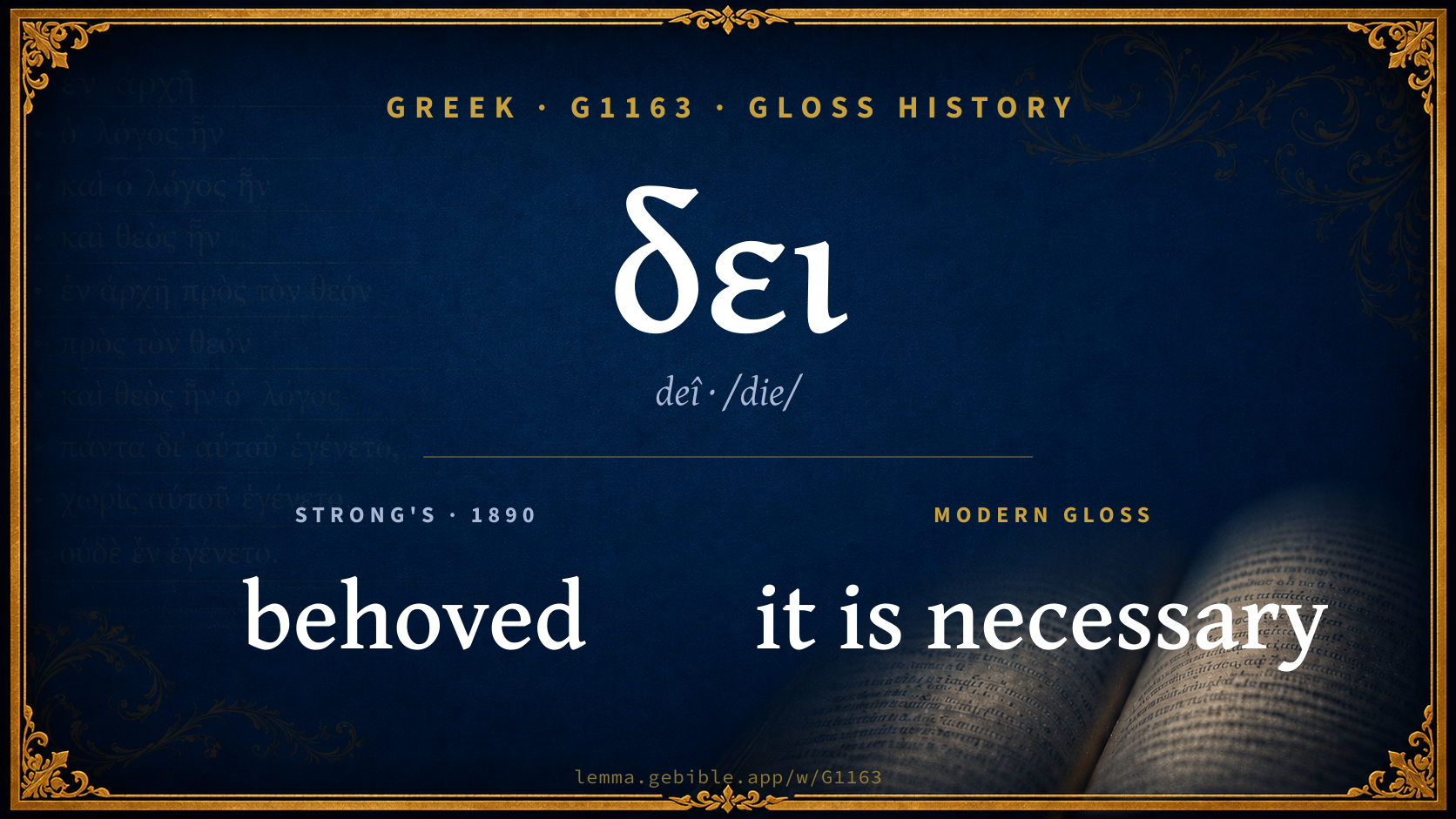
Gloss history
Strong's 1890 vs modern scholarship
About this word
Strong's G1163 catalogs a Greek word from the Greek New Testament.
These counts are not copied from any lexicon or concordance. They are computed here, from the morphology-tagged Greek New Testament. What Lemma adds →
- 102
- distinct verses
- The word appears in 102 distinct verses.
- 19 / 27
- NT books
- The word appears in 19 of 27 New Testament books.
- #159
- by frequency
- Top 250 most frequent Greek words (rank 159 of 5,347 Greek words by occurrence).
View all 102 occurrences in the concordance →
By section of the New Testament
By traditional corpus
Conventional, traditional groupings — biblical authorship is debated, so this is a traditional corpus grouping, not an authorship claim. Some books belong to more than one corpus (Luke is in both the Gospels and the Lukan corpus, and so on), so these shares overlap and need not total 100%. Each figure is a share of the word’s 102 distinct verses.
- Gospels 42 verses · 41%
- Lukan (Luke–Acts) 41 verses · 40%
- Pauline corpus 24 verses · 24%
- Johannine 18 verses · 18%
- Revelation 8 verses · 8%
- Hebrews 3 verses · 3%
- General (Catholic) Epistles 2 verses · 2%
How translations render this word
Counts come from each version’s own published word-to-Strong’s tagging or interlinear alignment — an approximate guide to how each version renders this word, not a word-level alignment the data otherwise carries. Because each total is that version’s own tagged count, the per-version totals vary from one another and need not match the appearance or distinct-verse counts above. These counts may also differ from a printed concordance because Lemma counts each distinctly tagged rendering and does not collapse phrase taggings into a single head-word total. This is a fixed set of word-tagged versions (KJV, ASV, BSB, ULT) and does not change with the reading translation you choose elsewhere. Each version’s license is shown beside its name below (and on Sources).
- King James Version: Must 57×, Ought 12×, He ought 3×
- American Standard Version: Must 51×, Ought 11×, He ought 3×
- Berean Standard Bible: Must 53×, Ought 4×, Should 4×
- unfoldingWord Literal Text: Was necessary for 5×, Was necessary 4×, Necessary 2×
King James Version Public Domain
Renders G1163 across 105 tagged occurrences — most commonly:
Plus 16 renderings that appear only once — usually multi-word phrases or single function words the recovered tagging swept in, not distinct renderings. Not rendered by a distinct English word in 1 further occurrence.
American Standard Version Public Domain
Renders G1163 across 98 tagged occurrences — most commonly:
Plus 24 renderings that appear only once — usually multi-word phrases or single function words the recovered tagging swept in, not distinct renderings.
Berean Standard Bible Public Domain
Renders G1163 across 98 tagged occurrences — most commonly:
Plus 19 renderings that appear only once — usually multi-word phrases or single function words the recovered tagging swept in, not distinct renderings. Not rendered by a distinct English word in 2 further occurrences.
unfoldingWord Literal Text CC BY-SA 4.0
Renders G1163 across 19 tagged occurrences — most commonly:
Plus 6 renderings that appear only once — usually multi-word phrases or single function words the recovered tagging swept in, not distinct renderings.
Senses in Thayer's
The 1 sense Thayer's distinguishes for this word, in lexicon order (not ranked by frequency or importance). The full entry — with sub-senses — is in the Lexicon Entry tab.
- it is necessary, there is need of, it behooves, is right and proper
Word origin
Derived from δεω (déō) (G1210) — to bind.
Third person singular active present of G1210 ; also δεόν deon which is neuter active participle of the same; both used impersonally; it is ( was etc.) necessary (as binding ): - behoved be meet must (needs) (be) need (-ful) ought should.
— Strong’s Exhaustive Concordance (1890), public domain.
Forms in the corpus
The 6 distinct written forms G1163 takes in the Greek New Testament, most frequent first — each parse links to that tense’s occurrences in the concordance.
| Form | Parsing | Example | Uses |
|---|---|---|---|
| δεῖ deî | Verb, Present, Active, Indicative, 3rd person, Singular | Matthew 16:21 | 79 |
| ἔδει édei | Verb, Imperfect, Active, Indicative, 3rd person, Singular | Matthew 18:33 | 16 |
| δεῖν deîn | Verb, Present, Active, Infinitive | Luke 18:1 | 3 |
| δέον déon | Verb, Present, Active, Participle, Nominative, Singular, Neuter | Acts 19:36 | 2 |
| δέῃ déē | Verb, Present, Active, Subjunctive, 3rd person, Singular | Matthew 26:35 | 2 |
| δέοντα déonta | Verb, Present, Active, Participle, Accusative, Plural, Neuter | 1 Timothy 5:13 | 1 |
Same root — word family
Other Thayer's entries built from the same root as G1163, grouped by Strong’s listed origin. These share a root / origin per the lexicon — not necessarily a shared meaning. Each links to that word’s own entry.
Derives from
Shares the same root
- δεομαι déomai G1189 to ask
- δεσμον desmón G1199 bond
- δεσποτης despótēs G1203 master
- δημος dēmos G1218 people
- δουλος doûlos G1401 slave
Compare all same-root words → Showing 4 of 7 — not the complete family. They share a root, not necessarily a meaning.