
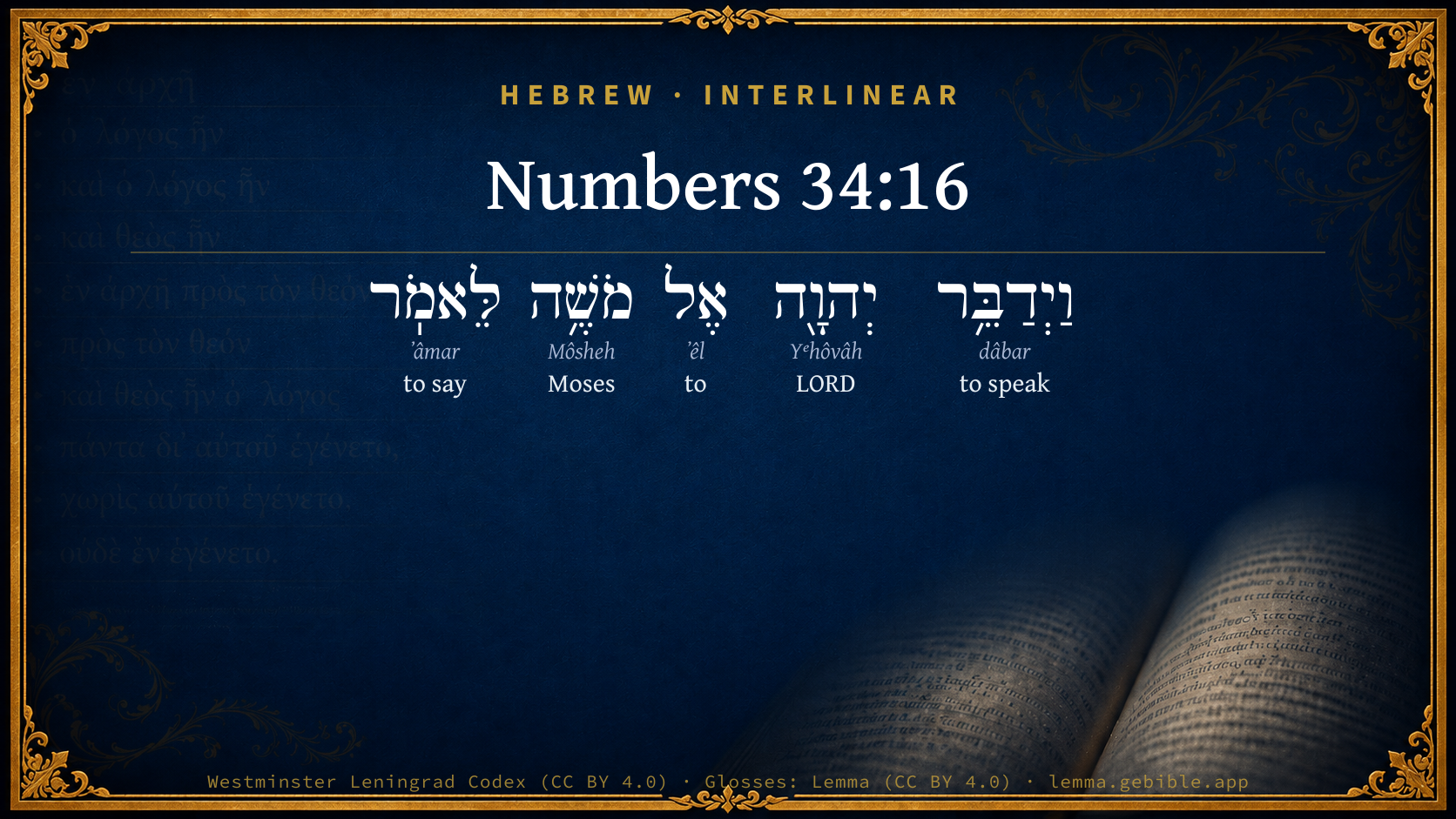
Numbers 34:16

Hebrew (Westminster Leningrad Codex) Numbers 34:16 appears in the Hebrew Old Testament. The text above is from the Westminster Leningrad Codex. Each word links to its Strong’s number, a concise gloss, and parsing drawn from the Open Scriptures Hebrew Bible morphology. Click any word for its full Brown-Driver-Briggs (BDB) entry.
Download image
Cite this verse

Numbers 34:16 (World English Bible). Public Domain. Lemma interlinear Bible study tool, https://lemma.gebible.app/v/numbers/34/16.

Show BibTeX & RIS
BibTeX
RIS
English Translation
Yahweh spoke to Moses, saying,
World English Bible · Public Domain
Download a study sheet

One document with this verse’s original text, its word-by-word gloss line, the meaning frame, cross-references with their text, attributed commentary, and full source and license credits — printable, and it pastes into notes with its structure intact.

This verse Autodidact and up

Study sheet (.html) Plain text (.txt)

A passage Seminary Student

Up to 50 verses in one chapter. A passage sheet keeps up to 6 commentary sources and 12 cross-references per verse, in the order this page ranks them, and says so on the sheet whenever that leaves anything out. Ask for a single verse and you get the Autodidact verse sheet above.

Everything on this page stays free to read, with no account — the sheet is a download of what is already on screen, not access to it.

Want to remove ads? Support Godless Engineer
Compare translations 3

The same verse in 3 English versions, stacked beneath the original-language interlinear above. Click any original word for its lexicon entry.

Each is an independent rendering of the whole verse — the interlinear is not word-aligned to these translations.

Highlighted words mark where these versions differ — a whole-verse word diff, not a word-by-word alignment.

  • World English Bible Public Domain
    Yahweh spoke to Moses, saying,
  • King James Version Public Domain
    And the LORD spake unto Moses, saying,
  • unfoldingWord Literal Text CC BY-SA 4.0
    And Yahweh spoke to Moses, saying,

unfoldingWord Literal Text — © unfoldingWord, licensed CC BY-SA 4.0. Word-aligned USFM3 via Door43 (git.door43.org/unfoldingWord/en_ult).

Versions to compare (up to 4)

3 of 4 selected

Show all 18 translations

Every available English version of this verse, each an independent rendering of the whole verse.

  • World English Bible Public Domain
    Yahweh spoke to Moses, saying,
  • Berean Standard Bible Public Domain
    Then the LORD said to Moses,
  • Majority Standard Bible Public Domain
    Then the LORD said to Moses,
  • King James Version Public Domain
    And the LORD spake unto Moses, saying,
  • American Standard Version (1901) Public Domain
    And Jehovah spake unto Moses, saying,
  • Revised Version (1885) Public Domain
    And the LORD spake unto Moses, saying,
  • Geneva Bible (1599) Public Domain
    Againe the Lord spake to Moses, saying,
  • Douay-Rheims (1899) Public Domain
    And the Lord said to Moses:
  • Young's Literal Translation Public Domain
    And Jehovah speaketh unto Moses, saying,
  • Literal Standard Version CC BY-SA 4.0
    And YHWH speaks to Moses, saying,
  • Unlocked Literal Bible CC BY-SA 4.0
    Yahweh spoke to Moses and said,
  • unfoldingWord Literal Text CC BY-SA 4.0
    And Yahweh spoke to Moses, saying,
  • Darby Bible Public Domain
    And Jehovah spoke to Moses, saying,
  • World Messianic Bible Public Domain
    The LORD spoke to Moses, saying,
  • Webster's Bible Public Domain
    And the LORD spoke to Moses, saying,
  • Free Bible Version CC BY-SA 4.0
    The Lord told Moses,
  • Bible in Basic English Public Domain
    And the Lord said to Moses,
  • JPS Tanakh (1917) Public Domain
    And the LORD spoke unto Moses, saying:

Literal Standard Version (2020), Covenant Press — licensed CC BY-SA 4.0. Text via the HelloAO Bible API (eBible.org). Unlocked Literal Bible (unfoldingWord) — licensed CC BY-SA 4.0. Text via the HelloAO Bible API (eBible.org). unfoldingWord Literal Text — © unfoldingWord, licensed CC BY-SA 4.0. Word-aligned USFM3 via Door43 (git.door43.org/unfoldingWord/en_ult). Free Bible Version, Dr. Jonathan Gallagher — licensed CC BY-SA 4.0. Text via the HelloAO Bible API (eBible.org).

Word by word

More ways to search: Search by grammar → Find every occurrence → Compare this word →

Practice this passage: Drill this verse → Learn its vocabulary →

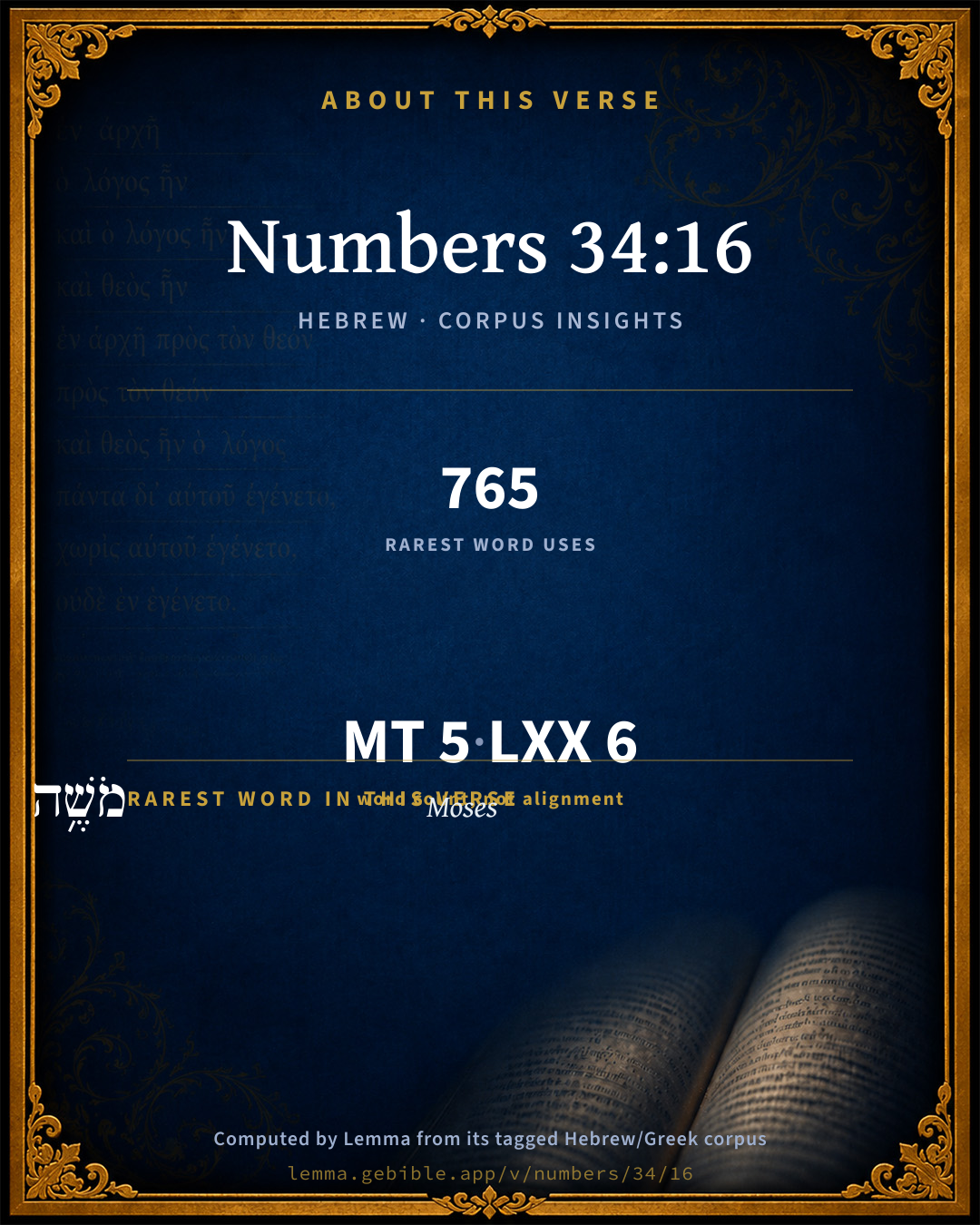
About this verse

These counts appear in no published source. They are computed here, from the morphology-tagged text and Lemma’s own curated glosses. What Lemma adds →

5
words
5
distinct lemmas
Pentateuch
section

Grammatical profile

  • 2 verbs
  • 2 nouns
  • 1 preposition

Verb forms

  • וַיְדַבֵּ֥ר Piel · Sequential Imperfect
  • לֵּאמֹֽר Qal · Infinitive Construct

Hebrew & Septuagint length

In English translation the verse runs 5 words from the Hebrew and 7 from the Septuagint (LXX English) — closely comparable.

A rough comparison of the two English renderings, which tokenize alike — not a word-level alignment.

Word counts can differ between the Hebrew and the Greek without any difference in meaning — e.g. the Hebrew direct-object marker אֵת has no separate Greek word, and Greek often adds the article ὁ.

In the original languages it is 5 Hebrew tokens and 6 Greek tokens — but the two are counted differently (Hebrew bundles its prefixes and suffixes into one token; the Greek is in lemma form), so that isn’t a like-for-like length.

Hebrew and Greek witnesses Masoretic Hebrew ↔ Greek Septuagint

The same verse in the two great witnesses to the Old Testament, shown verse-for-verse.

These are two independent witnesses, not word-aligned to each other, and the Septuagint is shown in lemma (dictionary) form.

Hebrew Numbers 34:16 Masoretic · Westminster Leningrad Codex

וַיְדַבֵּ֥ר יְהוָ֖ה אֶל מֹשֶׁ֥ה לֵּאמֹֽר

Yahweh spoke to Moses, saying,

World English Bible · Public Domain

Greek LXX Numbers 34:16 Septuagint · lemma form

καί λαλέω κύριος πρός μωυσῆς λέγω

And the Lord spoke to Moses, saying,

LXX2012 (modern English Septuagint) · Public Domain

Hebrew: Westminster Leningrad Codex (CC BY 4.0). Greek: Septuagint (public domain); English from LXX2012 (modern English Septuagint) (Public Domain). How the Septuagint differs from the Hebrew →

Targum (Aramaic paraphrase)

2

The Targum is the ancient Jewish Aramaic paraphrase of the Hebrew Scriptures — an interpretive translation, not the Hebrew text itself. Onkelos (literal) and Pseudo-Jonathan (expansive) render the Torah, and Jonathan the Prophets. Coverage is partial: where no permissively-licensed English translation exists for a verse, only the Aramaic is shown. This is verse-level text, not a word-by-word alignment to the Hebrew.

  1. Targum Onkelos Torah (Genesis–Deuteronomy)
    וּמַלִיל יְיָ עִם משֶׁה לְמֵימָר

    (no public-domain English translation for this verse)

    Targum Onkelos — Aramaic: “Onkelos Genesis” (public domain); “Onkelos Exodus” (public domain); “Onkelos Leviticus” (public domain); “Onkelos Numbers” (public domain); “Onkelos Deuteronomy” (public domain). English: “Sefaria Community Translation” (CC0 1.0 (public-domain dedication)); “J.W. Etheridge. The Targums of Onkelos and Jonathan Ben Uzziel on the Pentateuch. London: Longmans, Green, 1862” (public domain). Text via Sefaria.

  2. Targum Pseudo-Jonathan Torah (Genesis–Deuteronomy)
    וּמַלֵיל יְיָ עִם משֶׁה לְמֵימָר

    And the Lord spake with Mosheh, saying:

    Targum Pseudo-Jonathan — Aramaic: “Targum Jonathan on Genesis” (public domain); “Targum Jonathan on Exodus” (public domain); “Targum Jonathan on Leviticus” (public domain); “Targum Jonathan on Numbers” (public domain); “Targum Jonathan on Deuteronomy” (public domain). English: “The Targum of Jonathan ben Uzziel, trans. J. W. Etheridge, London, 1862” (public domain). Text via Sefaria.

Commentary

Notes on Numbers 34:16 from classic Christian and Jewish commentators (each source and its license shown beneath its notes). The classic Christian expositions comment on the surrounding passage and are grouped to its opening verse, so a note may address several verses; the Jewish commentaries on the Tanakh (Rashi and others) are per-verse, so they appear only where the commentator wrote on this verse.

Lemma curates 59 commentaries, every one of them public domain or Creative Commons licensed, each selected and text-cleaned for this edition rather than reprinted as found. About our sources →

Tyndale Open Study Notes

Tyndale Open Resources

34:16-29 Eleazar (the high priest) and Joshua (the political leader) were to divide the land among the remaining tribes. The ten tribal leaders who would help them are listed in 34:19-28.

Tyndale Open Study Notes — © Tyndale Open Resources, licensed CC BY-SA 4.0. Text via the HelloAO Bible API.

Jamieson, Fausset & Brown

Robert Jamieson, A. R. Fausset & David Brown

names of the men . . . which shall divide the land--This appointment by the Lord before the Jordan tended not only to animate the Israelites faith in the certainty of the conquest, but to prevent all subsequent dispute and discontent, which might have been dangerous in presence of the natives. The nominees were ten princes for the nine and a half tribes, one of them being selected from the western section of Manasseh, and all subordinate to the great military and ecclesiastical chiefs, Joshua and Eleazar. The names are mentioned in the exact order in which the tribes obtained possession of the land, and according to brotherly connection.

Next: Numbers Chapter 35

Jamieson, Fausset & Brown — Commentary Critical and Explanatory on the Whole Bible (1871) — public domain (CC PDM 1.0). Text via the HelloAO Bible API.

The Cambridge Bible for Schools and Colleges

gen. ed. J. J. S. Perowne

16–29. Ten princes were appointed to superintend the allotment of the land, one from each of the nine and a halt tribes who settled west of the Jordan. In supreme command are Joshua and Eleazar, the successors of Moses and Aaron as the civil and religious beads of the nation.

The Cambridge Bible for Schools and Colleges (gen. ed. J. J. S. Perowne; Cambridge University Press, 1878–1918) — public domain. Text from a community e-Sword module.

John Gill's Exposition

And the Lord spake unto Moses,.... At the same time that he gave him the bounds of the land of Canaan, which was to be divided between the nine tribes and a half; and that this might be done in the most impartial manner, and to the satisfaction of them all, he gave orders to Moses:

saying; as follows.

John Gill's Exposition of the Whole Bible (1746–1763) — public domain (CC PDM 1.0). Text via the HelloAO Bible API.

Albert Barnes' Notes on the Bible

Of the representatives now selected through Moses beforehand, who were all princes, i. e. heads of chief families, in their respective tribes (see Num 13:2), Caleb alone, of the tribe of Judah, is otherwise known to us (see Num 13:4 ff). The order in which the tribes are named is peculiar to this passage. If they be taken in pairs, Judah and Simeon, Benjamin and Dan, Manasseh and Ephraim, Zebulun and Issachar, Asher and Naphtali, the order of the pairs agrees with the order in which the allotments in the Holy land, taken also in couples, followed each other in the map from south to north.

Albert Barnes' Notes on the Bible (1834–1885) — public domain. Text from a community e-Sword/MySword module.

Keil & Delitzsch

C. F. Keil & F. Delitzsch

List of the Men Appointed to Distribute the Land. - In addition to Eleazar and Joshua, the former of whom was to stand at the head as high priest, in accordance with the divine appointment in Num 27:21, and the latter to occupy the second place as commander of the army, a prince was selected from each of the ten tribes who were interested in the distribution, as Reuben and Gad had nothing to do with it. Of these princes, namely heads of fathers' houses of the tribes (Jos 14:1), not heads of tribes (see at Num 13:2), Caleb, who is well known from Num 13, is the only one whose name if known. The others are not mentioned anywhere else. The list of tribes, in the enumeration of their princes, corresponds, with some exceptions, to the situation of the territory which the tribes received in Canaan, reckoning from south to north, and deviates considerably from the order in which the lots came out for the different tribes, as described in Josh 15-19. נחל in the Kal, in Num 34:17 and Num 34:18, signifies to give for an inheritance, just as in Exo 34:8, to put into possession. There is not sufficient ground for altering the Kal into Piel, especially as the Piel in Num 34:29 is construed with the accusative of the person, and with the thing governed by ב; whereas in Num 34:17 the Kal is construed with the person governed by ל, and the accusative of the thing.

Keil & Delitzsch — Biblical Commentary on the Old Testament (1861–1891) — public domain (CC PDM 1.0). Text via the HelloAO Bible API. (Old Testament only.)

Kretzmann's Popular Commentary

Paul E. Kretzmann

The Princes in Charge of the Division

v. 16. And the Lord spake unto Moses, saying,

v. 17. These are the names of the men which shall divide the land unto you, the men in charge of the lot-casting which should determine the location of each individual tribe: Eleazar, the priest, and Joshua, the son of Nun.

v. 18. And ye shall take one prince of every tribe to divide the land by inheritance.

v. 19. And the names of the men are these: of the tribe of Judah, Caleb, the son of Jephunneh.

v. 20. And of the tribe of the children of Simeon, Shemuel, the son of Ammihud.

v. 21. of the tribe of Benjamin, Elidad, the son of Chislon.

v. 22. And the prince of the tribe of the children of Dan, Bukki, the son of Jogli.

v. 23. The prince of the children of Joseph, for the tribe of the children of Manasseh, Hanniel, the son of Ephod.

v. 24. And the prince of the tribe of the children of Ephraim, Kemuel, the son of Shiphtan.

v. 25. And the prince of the tribe of the children of Zebulun, Elizaphan, the son of Parnach.

v. 26. And the prince of the tribe of the children of Issachar, Paltiel, the son of Azzan.

v. 27. And the prince of the tribe of the children of Asher, Ahihud, the son of Shelomi.

v. 28. And the prince of the tribe of the children of Naphtali, Pedahel, the son of Ammihud.

v. 29. These are they whom the Lord commanded to divide the inheritance unto the children of Israel in the land of Canaan. of these princes only Caleb is mentioned elsewhere. The list of tribes in the order named corresponds, with some exceptions, to the situation of the territory which the tribes received in Canaan, reckoning from the south to the north. It should be remembered also here that the position of the several inheritances was determined by lot; but their dimensions were proportioned to the numerical size of the tribes to which they fell, the largest tribe getting the most territory. The care of the covenant God for the people whom He had chosen appears throughout.

Paul E. Kretzmann, Popular Commentary of the Bible (1921–1924) — public domain. Text from a community e-Sword module.

unfoldingWord translationNotes

Door43 World Missions Community

divide the land for your inheritance

Here "your" is plural and refers to the people of Israel. These men will cast lots to divide the land. Then they will distribute it to the tribes. (See: Forms of You)

translationWords

inherit

Eleazar

priest

Joshua

clan

unfoldingWord translationNotes — © Distant Shores Media and the Door43 World Missions Community, licensed CC BY-SA 4.0. Source: git.door43.org/Door43/en_tn.

Lesson kit

Teaching starters — assembled from the data on this page, not authored interpretation. Every prompt links to the verse data it draws on. Edit before teaching.

Numbers, in the Pentateuch, opens this verse with 5 words (5 distinct Hebrew lemmas). Its most distinctive word is Môsheh (“Moses”). A historical commentator’s framing appears above. Read the whole chapter for the surrounding context.

Discussion questions

  1. How does “Moses” (Môsheh) shape what this verse is saying?
  2. These translations render this verse differently. What is at stake in choosing one wording over another?
  3. The verb «וַיְדַבֵּ֥ר» is Piel Sequential Imperfect. How does its form color the action?
  4. Reading how Tyndale Open Study Notes and Jamieson, Fausset & Brown read this verse, where do the two commentators agree and where do they part?

Things to notice

Reading settings

Reading text

Shown beneath each verse's original-language words.

Old Testament
Old Testament edition

Read the OT as the Masoretic Hebrew (MT) or the Greek Septuagint (LXX).

English shown for the Greek Septuagint (in the Hebrew ↔ Greek comparison).

Comparing translations? Open the Compare panel on any verse page to stack up to four side by side.