Numbers 32:6

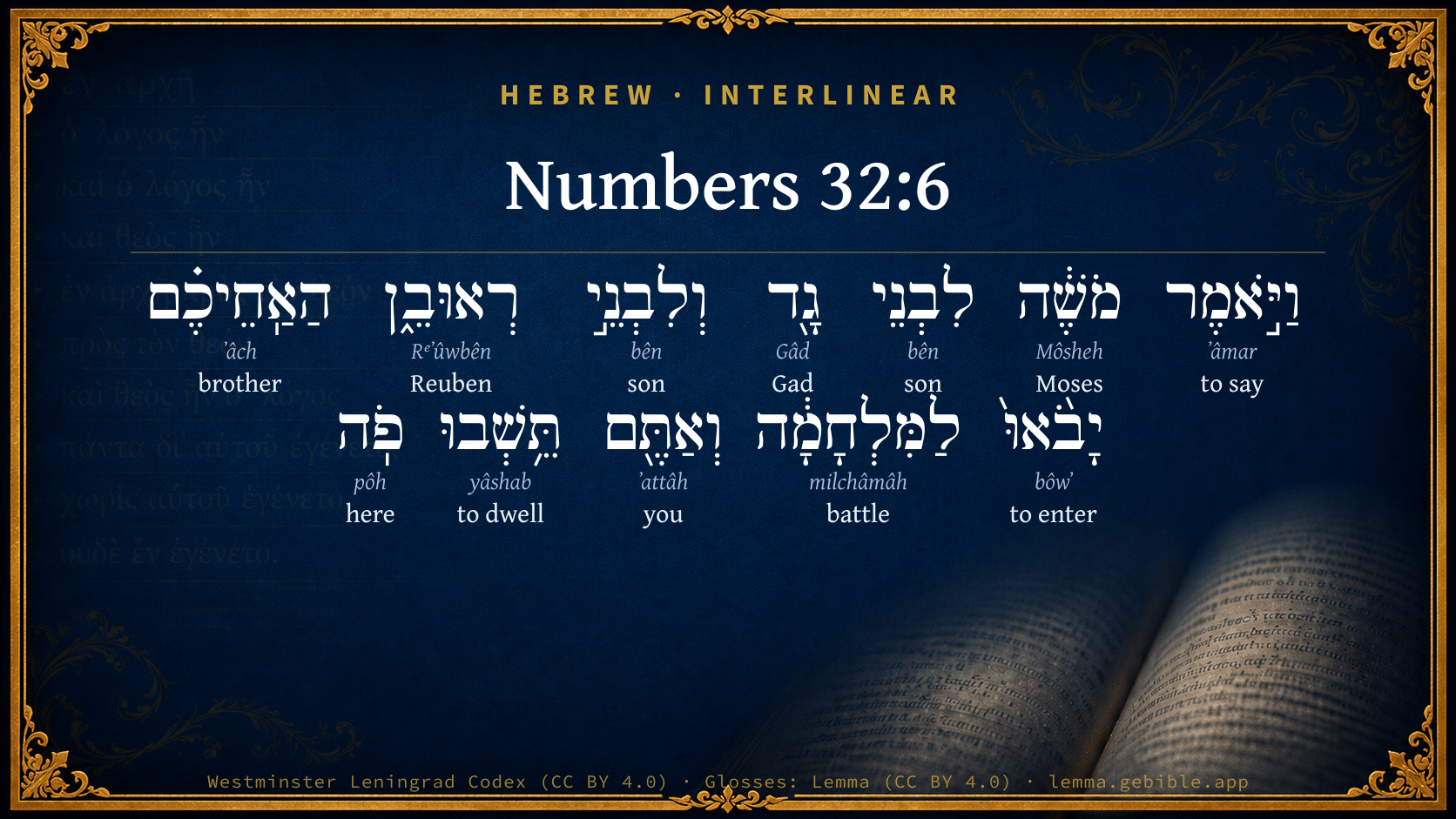
Hebrew (Westminster Leningrad Codex) Numbers 32:6 appears in the Hebrew Old Testament. The text above is from the Westminster Leningrad Codex. Each word links to its Strong’s number, a concise gloss, and parsing drawn from the Open Scriptures Hebrew Bible morphology. Click any word for its full Brown-Driver-Briggs (BDB) entry.
Download image
Cite this verse

Numbers 32:6 (World English Bible). Public Domain. Lemma interlinear Bible study tool, https://lemma.gebible.app/v/numbers/32/6.

Show BibTeX & RIS
BibTeX
RIS
English Translation
Moses said to the children of Gad, and to the children of Reuben, Shall your brothers go to the war, and shall you sit here?
World English Bible · Public Domain
Download a study sheet

One document with this verse’s original text, its word-by-word gloss line, the meaning frame, cross-references with their text, attributed commentary, and full source and license credits — printable, and it pastes into notes with its structure intact.

This verse Autodidact and up

Study sheet (.html) Plain text (.txt)

A passage Seminary Student

Up to 50 verses in one chapter. A passage sheet keeps up to 6 commentary sources and 12 cross-references per verse, in the order this page ranks them, and says so on the sheet whenever that leaves anything out. Ask for a single verse and you get the Autodidact verse sheet above.

Everything on this page stays free to read, with no account — the sheet is a download of what is already on screen, not access to it.

Want to remove ads? Support Godless Engineer
Compare translations 3

The same verse in 3 English versions, stacked beneath the original-language interlinear above. Click any original word for its lexicon entry.

Each is an independent rendering of the whole verse — the interlinear is not word-aligned to these translations.

Highlighted words mark where these versions differ — a whole-verse word diff, not a word-by-word alignment.

  • World English Bible Public Domain
    Moses said to the children of Gad, and to the children of Reuben, Shall your brothers go to the war, and shall you sit here?
  • King James Version Public Domain
    And Moses said unto the children of Gad and to the children of Reuben, Shall your brethren go to war, and shall ye sit here?
  • unfoldingWord Literal Text CC BY-SA 4.0
    And Moses said to the sons of Gad and to the sons of Reuben, “Will your brothers go to the war and you yourselves will dwell here?

unfoldingWord Literal Text — © unfoldingWord, licensed CC BY-SA 4.0. Word-aligned USFM3 via Door43 (git.door43.org/unfoldingWord/en_ult).

Versions to compare (up to 4)

3 of 4 selected

Show all 18 translations

Every available English version of this verse, each an independent rendering of the whole verse.

  • World English Bible Public Domain
    Moses said to the children of Gad, and to the children of Reuben, Shall your brothers go to the war, and shall you sit here?
  • Berean Standard Bible Public Domain
    But Moses asked the Gadites and Reubenites, “Shall your brothers go to war while you sit here?
  • Majority Standard Bible Public Domain
    But Moses asked the Gadites and Reubenites, “Shall your brothers go to war while you sit here?
  • King James Version Public Domain
    And Moses said unto the children of Gad and to the children of Reuben, Shall your brethren go to war, and shall ye sit here?
  • American Standard Version (1901) Public Domain
    And Moses said unto the children of Gad, and to the children of Reuben, Shall your brethren go to the war, and shall ye sit here?
  • Revised Version (1885) Public Domain
    And Moses said unto the children of Gad and to the children of Reuben, Shall your brethren go to the war, and shall ye sit here?
  • Geneva Bible (1599) Public Domain
    And Moses said vnto the children of Gad, and to the children of Reuben, Shall your brethren goe to warre, and ye tary heere?
  • Douay-Rheims (1899) Public Domain
    And Moses answered them: What, shall your brethren go to fight, and will you sit here?
  • Young's Literal Translation Public Domain
    And Moses saith to the sons of Gad and to the sons of Reuben, `Do your brethren go in to the battle, and ye -- do ye sit here?
  • Literal Standard Version CC BY-SA 4.0
    And Moses says to the sons of Gad and to the sons of Reuben, “Do your brothers go to the battle, and you—do you sit here?
  • Unlocked Literal Bible CC BY-SA 4.0
    Moses replied to the descendants of Gad and Reuben, “Should your brothers go to war while you settle down here?
  • unfoldingWord Literal Text CC BY-SA 4.0
    And Moses said to the sons of Gad and to the sons of Reuben, “Will your brothers go to the war and you yourselves will dwell here?
  • Darby Bible Public Domain
    And Moses said to the children of Gad, and to the children of Reuben, Shall your brethren go to war, and shall *ye* abide here?
  • World Messianic Bible Public Domain
    Moses said to the children of Gad, and to the children of Reuben, “Shall your brothers go to war while you sit here?
  • Webster's Bible Public Domain
    And Moses said to the children of Gad and to the children of Reuben, Shall your brethren go to war, and shall ye sit here?
  • Free Bible Version CC BY-SA 4.0
    In reply Moses asked the tribes of Gad and Reuben, “Are you expecting your brothers to go and fight while you just sit here?
  • Bible in Basic English Public Domain
    And Moses said to the children of Gad and the children of Reuben, Are your brothers to go to the war, while you take your rest here?
  • JPS Tanakh (1917) Public Domain
    And Moses said unto the children of Gad and to the children of Reuben: 'Shall your brethren go to the war, and shall ye sit here?

Literal Standard Version (2020), Covenant Press — licensed CC BY-SA 4.0. Text via the HelloAO Bible API (eBible.org). Unlocked Literal Bible (unfoldingWord) — licensed CC BY-SA 4.0. Text via the HelloAO Bible API (eBible.org). unfoldingWord Literal Text — © unfoldingWord, licensed CC BY-SA 4.0. Word-aligned USFM3 via Door43 (git.door43.org/unfoldingWord/en_ult). Free Bible Version, Dr. Jonathan Gallagher — licensed CC BY-SA 4.0. Text via the HelloAO Bible API (eBible.org).

Word by word

More ways to search: Search by grammar → Find every occurrence → Compare this word →

Practice this passage: Drill this verse → Learn its vocabulary →

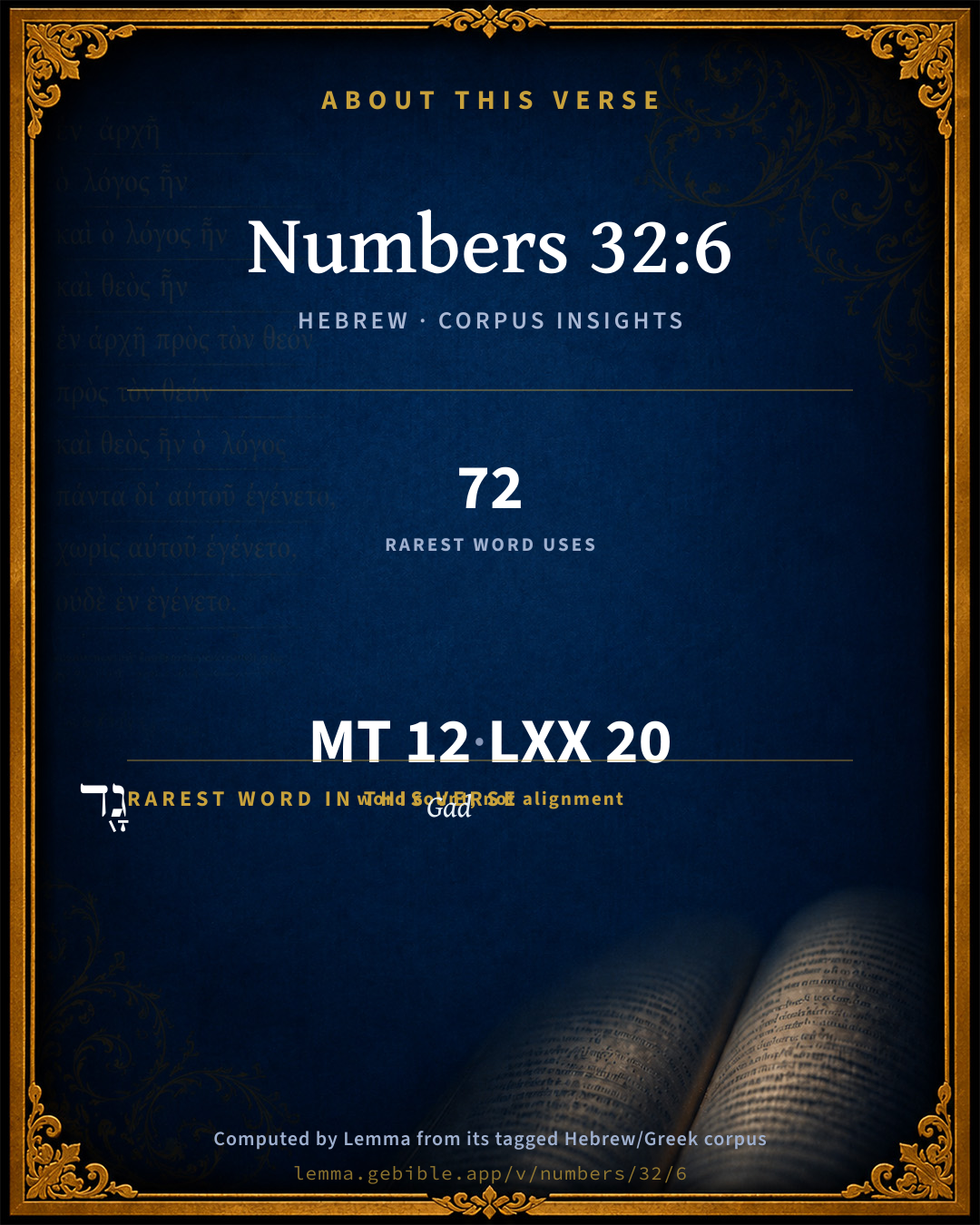
גָ֖ד
Gâd
H1410
“Gad”
Noun, Proper
Part of Speech
Noun
Type
Proper
Full BDB Definition

Origin: from H1464

TWOT: None

Gad = "troop" - seventh son of Jacob by Zilpah, Leah's handmaid, and full brother of Asher. - the tribe descended from Gad - a prophet during the time of David; appears to have joined David when in the hold; reappears in connection with the punishment for taking a census; also assisted in the arrangements for the musical service of the " house of God"
  1. וַיֹּ֣אמֶר ʼâmar H559 “and · to say” Conjunction + Verb, Qal, Sequential Imperfect, 3rd Person, Masculine, Singular
  2. מֹשֶׁ֔ה Môsheh H4872 “Moses” Noun, Proper
  3. לִבְנֵי bên H1121 “to/for · sons of” Preposition + Noun, Common, Masculine, Plural, Construct
  4. וְלִבְנֵ֣י bên H1121 “and · to/for · sons of” Conjunction + Preposition + Noun, Common, Masculine, Plural, Construct
  5. רְאוּבֵ֑ן Rᵉʼûwbên H7205 “Reuben” Noun, Proper
  6. הַאַֽחֵיכֶ֗ם ʼâch H251 “brothers · your” Particle, Interrogative + Noun, Common, Masculine, Plural, Construct + Suffix, Personal, 2nd Person, Masculine, Plural
  7. יָבֹ֨אוּ֙ bôwʼ H935 “to enter” Verb, Qal, Imperfect, 3rd Person, Masculine, Plural
  8. לַמִּלְחָמָ֔ה milchâmâh H4421 “to/for the · battle” Preposition, Determined + Noun, Common, Feminine, Singular, Absolute
  9. וְאַתֶּ֖ם ʼattâh H859 “and · you” Conjunction + Pronoun, Personal, 2nd Person, Masculine, Plural
  10. תֵּ֥שְׁבוּ yâshab H3427 “to dwell” Verb, Qal, Imperfect, 2nd Person, Masculine, Plural
  11. פֹֽה pôh H6311 “here” Adverb

About this verse

These counts appear in no published source. They are computed here, from the morphology-tagged text and Lemma’s own curated glosses. What Lemma adds →

12
words
11
distinct lemmas
Pentateuch
section

Grammatical profile

  • 3 verbs
  • 7 nouns
  • 1 pronoun
  • 1 adverb

Verb forms

  • וַיֹּ֣אמֶר Qal · Sequential Imperfect
  • יָבֹ֨אוּ֙ Qal · Imperfect
  • תֵּ֥שְׁבוּ Qal · Imperfect

Repetition

A word recurs within this verse — often emphatic in Hebrew:

  • לִבְנֵי son H1121 ×2

Hebrew & Septuagint length

In English translation the verse runs 25 words from the Hebrew and 24 from the Septuagint (LXX English) — closely comparable.

A rough comparison of the two English renderings, which tokenize alike — not a word-level alignment.

Word counts can differ between the Hebrew and the Greek without any difference in meaning — e.g. the Hebrew direct-object marker אֵת has no separate Greek word, and Greek often adds the article ὁ.

In the original languages it is 12 Hebrew tokens and 20 Greek tokens — but the two are counted differently (Hebrew bundles its prefixes and suffixes into one token; the Greek is in lemma form), so that isn’t a like-for-like length.

Cross-references

3

Topical passages linked to Numbers 32:6 in the Treasury of Scripture Knowledge — connected by theme and wording, ordered by reader-vote popularity; previews shown in the World English Bible.

  • 1 Corinthians 13:5 doesn't behave itself inappropriately, doesn't seek its own way, is not provoked, takes no account of evil;
  • 2 Samuel 11:11 Uriah said to David, The ark, and Israel, and Judah, abide in booths; and my lord Joab, and the servants of my lord, are encamped in the open field; shall I then go into my house, to eat and to drink, and to lie with my wife? as you live, and as your soul lives, I will not do this thing.
  • Philippians 2:4 each of you not just looking to his own things, but each of you also to the things of others.

Cross-references courtesy of OpenBible.info (CC BY 4.0).

Hebrew and Greek witnesses Masoretic Hebrew ↔ Greek Septuagint

The same verse in the two great witnesses to the Old Testament, shown verse-for-verse.

These are two independent witnesses, not word-aligned to each other, and the Septuagint is shown in lemma (dictionary) form.

Hebrew Numbers 32:6 Masoretic · Westminster Leningrad Codex

וַיֹּ֣אמֶר מֹשֶׁ֔ה לִבְנֵי גָ֖ד וְלִבְנֵ֣י רְאוּבֵ֑ן הַאַֽחֵיכֶ֗ם יָבֹ֨אוּ֙ לַמִּלְחָמָ֔ה וְאַתֶּ֖ם תֵּ֥שְׁבוּ פֹֽה

Moses said to the children of Gad, and to the children of Reuben, Shall your brothers go to the war, and shall you sit here?

World English Bible · Public Domain

Greek LXX Numbers 32:6 Septuagint · lemma form

καί εἶπον μωυσῆς ὁ υἱός γαδ καί ὁ υἱός ρουβην ὁ ἀδελφός σύ πορεύομαι εἰς πόλεμος καί σύ καταἵημι αὐτός

And Moses said to the sons of Gad and the sons of Ruben, Shall your brethren go to war, and shall you⌃ sit here?

LXX2012 (modern English Septuagint) · Public Domain

Hebrew: Westminster Leningrad Codex (CC BY 4.0). Greek: Septuagint (public domain); English from LXX2012 (modern English Septuagint) (Public Domain). How the Septuagint differs from the Hebrew →

Targum (Aramaic paraphrase)

2

The Targum is the ancient Jewish Aramaic paraphrase of the Hebrew Scriptures — an interpretive translation, not the Hebrew text itself. Onkelos (literal) and Pseudo-Jonathan (expansive) render the Torah, and Jonathan the Prophets. Coverage is partial: where no permissively-licensed English translation exists for a verse, only the Aramaic is shown. This is verse-level text, not a word-by-word alignment to the Hebrew.

  1. Targum Onkelos Torah (Genesis–Deuteronomy)
    וַאֲמַר משֶׁה לִבְנֵי גָד וְלִבְנֵי רְאוּבֵן הַאֲחֵיכוֹן יֵיתוּן לִקְרָבָא וְאַתּוּן תֵּתְבוּן הָכָא

    (no public-domain English translation for this verse)

    Targum Onkelos — Aramaic: “Onkelos Genesis” (public domain); “Onkelos Exodus” (public domain); “Onkelos Leviticus” (public domain); “Onkelos Numbers” (public domain); “Onkelos Deuteronomy” (public domain). English: “Sefaria Community Translation” (CC0 1.0 (public-domain dedication)); “J.W. Etheridge. The Targums of Onkelos and Jonathan Ben Uzziel on the Pentateuch. London: Longmans, Green, 1862” (public domain). Text via Sefaria.

  2. Targum Pseudo-Jonathan Torah (Genesis–Deuteronomy)
    וַאֲמַר משֶׁה לִבְנֵי גָד וְלִבְנֵי רְאוּבֵן הַאֲחֵיכוֹן יֵיתוּן לִקְרָבָא וְאַתּוּן תֵּיתְבוּן הָכָא

    But Mosheh said to the sons of Gad and Reuben, Shall your brethren go to the war, and you sit down here?

    Targum Pseudo-Jonathan — Aramaic: “Targum Jonathan on Genesis” (public domain); “Targum Jonathan on Exodus” (public domain); “Targum Jonathan on Leviticus” (public domain); “Targum Jonathan on Numbers” (public domain); “Targum Jonathan on Deuteronomy” (public domain). English: “The Targum of Jonathan ben Uzziel, trans. J. W. Etheridge, London, 1862” (public domain). Text via Sefaria.

Commentary

Notes on Numbers 32:6 from classic Christian and Jewish commentators (each source and its license shown beneath its notes). The classic Christian expositions comment on the surrounding passage and are grouped to its opening verse, so a note may address several verses; the Jewish commentaries on the Tanakh (Rashi and others) are per-verse, so they appear only where the commentator wrote on this verse.

Lemma curates 59 commentaries, every one of them public domain or Creative Commons licensed, each selected and text-cleaned for this edition rather than reprinted as found. About our sources →

The Biblical Illustrator

Joseph S. Exell

Num_32:6-15

Shall your brethren go to war, and shall ye sit here?

And wherefore discourage ye the heart of the children of Israel?

The expostulation of Moses

1. He shows them what he apprehended to be evil in this motion; that it would discourage the heart of their brethren (Num_32:6-7). What, saith he, with a holy indignation at their selfishness, shall your brethren go to war, and expose themselves to all the hardships of the field, and shall ye sit here at your ease? No, do not mistake yourselves; you shall never be indulged by me in this sloth and cowardice. It ill becomes any of Gods Israel to sit down unconcerned in the difficult concernments of their brethren, whether public or personal.

2. He minds them of the fatal consequences of the unbelief and faint-heartedness of their fathers when they were, as these here, just ready to enter Canaan. He recites the story very particularly (Num_32:8-13). Thus did your fathers, whose punishment should be a warning to you to take heed of sinning after the similitude of their transgression.

3. He gives them fair warning of the mischief that would be likely to follow upon this separation they were about to make from the camp of Israel; they would be in danger of bringing wrath upon the whole congregation, and hurrying them all back again into the wilderness (Num_32:14-15). Ye are risen up in your fathers stead to despise the pleasant land, and reject it as they did, when we hoped you were risen up in their stead to possess it. It was an encouragement to Moses to see what an increase of men they were, but a discouragement to see that they were withal an increase of sinful men, treading in the steps of their fathers impiety. It is sad to see the rising generations in families and countries seldom better, and often worse, than that which went before it. And what comes of it? why, it augments the fierce anger of the Lord; not only continues that fire, but increaseth it, and fills the measure often, till it overflow in a deluge of desolation. Note, if men did consider as they ought what would be in the end of sin, they would be afraid of the beginnings of it. (Matthew Henry, D. D.)

The faithful rebuke of Moses

I. The injustice of their proposal. Why should they have as their inheritance that country which all had assisted to conquer, and leave their brethren to conquer other possessions for themselves without their aid?

II. The tendency of their proposal to dishearten their brethren. Because the granting of this request would be likely to--

1. Reduce their numbers.

2. Engender dissatisfaction.

III. The wickedness of their proposal.

1. Unbelief of Gods word.

2. Depreciation of Gods goodness.

IV. The tendency of their proposal to call down the wrath of God.

1. The cause of His anger (Num_32:14).

2. The expression of His anger (Num_32:15).

3. The subjects of His anger. All this people.

V. The solemn example by which Moses enforced his rebuke (Num_32:8-13). (W. Jones.)

The sin of discouraging our brethren

The children of God are very prone to be discouraged. The truth is, that their path through the wilderness is not an easy one. The danger of discouragement being so very great, it is the duty of Christians to encourage each other, to exhort one another in words of kindness, cheerfulness, and love, to hold on their way. How beautiful is the example of Jesus, in the tenderness of the sympathy wherewith lie encouraged the weak. But Christians are too often unlike their Master, wanting in that gentle and encouraging sympathy. It may be well to note more carefully some of the ways in which Christians most frequently discourage each others hearts.

1. First, then, we may mention an inconsistent life. There is nothing so beautiful on earth as a consistent life, a life entirely consecrated to God--devoted to one great object, and guided by one great principle. Such a life makes people feel that there is something from God in true religion; and it greatly encourages those who are seeking Christ. On the contrary, the inconsistent lives of Christians are the greatest possible hindrance to the world, and to those who are weak in faith. There was great apparent inconsistency in the request of the Reubenites. They ought to have valued Gods promise, and have wished to settle within the limits of the Promised Land; but the rich pastures of the territories already won, and situated without its boundaries, were a temptation to them. And Moses saw at once the effect that this example would have upon the hearts of their brethren. It would discourage them. It is just so with those who ought to live for heaven, who profess to be looking for it, and yet set their affections on things below--on the creature, or the world, or on money. This contrariety between the profession and the life cannot be otherwise than a stumbling block to the world, and a great discouragement to those who are weak in faith. Some it hardens in their unbelief; others are led by it into painful doubt and perplexity. It is no small sin to discourage our brethren.

2. But again, the natural heart is very prone to think that religion is a gloomy thing, a system of sacrifices; and this we cannot wonder at, as it only sees what must be given up, but cannot perceive what is gained. It cannot understand that excellency of the knowledge of Christ which makes sacrifices easy and delightful, and renders things impossible to flesh and blood altogether possible. Now, when Christians are gloomy and desponding, when their look is melancholy and their language dissatisfied, it tends to confirm the notion that true religion does not make the heart happy, does not give it rest; and so the wanderer, discouraged at the outset, seeks cheerfulness and pleasure elsewhere, and not in Christ. Now, why should Christians ever give such an impression of religion? Surely it must be of all things the most blessed to be reconciled to God, to have the forgiveness of all sins. It is true that the Christian has many trials which are unknown to the world, fightings within, as well as fears without. But his fightings are not hopeless struggles. They are the precursors of victory; for, says St. Paul, we are made more than conquerors through Him that loved us.

3. Another way of discouraging our brethren is by showing want of sympathy in their difficulties. Hardness and want of sympathy have much to do with making the world as full of misery as it is.

4. Another case of discouragement to others is our shrinking, or appearing to shrink, from difficulties. Moses evidently thought that this was the motive of the request of the Reubenites. They wished to settle down in a land already won, instead of sharing the danger of war with their brethren. Shall your brethren go to war, and ye sit here? The event proved that happily this was not the case. Moses was mistaken in his suspicions. But it is quite clear, that had this been the case scarcely anything could have discouraged the rest of the Israelites more completely. Now this, we fear, is not a very uncommon cause of discouragements. There are too many Christians who shrink from difficulties. They prefer some smooth and easy course, the pastures of Jazer and Gilead to the warfare and conflicts of Canaan. If some easy work is proposed to them, which is accompanied by no great difficulties, and which involves no real self-denial, they may be ready for it. But they do not like to take up the cross, and especially a daily cross--one that lasts long. We ought not to shrink from difficulties in doing the will of God. It is usually Gods way to surround His own work with difficulties, and often with such difficulties as His own hand alone can remove. And this He does to try His peoples faith, not to discourage them. Viewed at a distance, like the wall of some great fortress, they appear very formidable, but when grappled with in faith, one after another they fall away. There are beautiful promises to encourage us under difficulties (Isa_41:14; Isa_41:16; Zec_4:7). Let us then settle it well in our hearts that we must have difficulties in doing the work of God; but let not these dismay our hearts or lead us to discourage our brethren. (G. Wagner.)

The Biblical Illustrator, edited by Joseph S. Exell (c. 1880s–1900s) — public domain. Text from a community e-Sword module.

Tyndale Open Study Notes

Tyndale Open Resources

32:6-15 Moses assumed that Reuben and Gad wanted to stay east of the Jordan River to avoid the dangers that awaited the other tribes in Canaan (cp. chs 13–14).

Tyndale Open Study Notes — © Tyndale Open Resources, licensed CC BY-SA 4.0. Text via the HelloAO Bible API.

Jamieson, Fausset & Brown

Robert Jamieson, A. R. Fausset & David Brown

Moses said unto the children of Gad and to the children of Reuben, Shall your brethren go to war, and shall ye sit here--Their language was ambiguous; and Moses, suspicious that this proposal was an act of unbelief, a scheme of self-policy and indolence to escape the perils of warfare and live in ease and safety, addressed to them a reproachful and passionate remonstrance. Whether they had really meditated such a withdrawal from all share in the war of invasion, or the effect of their leader's expostulation was to drive them from their original purpose, they now, in answer to his impressive appeal, declared it to be their sincere intention to co-operate with their brethren; but, if so, they ought to have been more explicit at first.

Jamieson, Fausset & Brown — Commentary Critical and Explanatory on the Whole Bible (1871) — public domain (CC PDM 1.0). Text via the HelloAO Bible API.

John Gill's Exposition

Wherefore discourage ye the heart of the children of Israel.... Which he suggests it would, should they settle on that side Jordan, since they would lose the assistance of two of their tribes, even two thirds of one of their standards in fighting with their enemies and subduing their land; and besides it might be thought that this request of theirs not only proceeded from selfish views and a love of ease, which might set a bad example to others, but carried in it a distrust of ever being able to enter into, at least to conquer and possess, the land of Canaan, and so might have a tendency to discourage their brethren:

from going over into the land, which the Lord hath given them? despairing of ever enjoying it, and so laying aside all thoughts of it, and not caring to make any attempt to get possession of it.

John Gill's Exposition of the Whole Bible (1746–1763) — public domain (CC PDM 1.0). Text via the HelloAO Bible API.

Matthew Poole's English Annotations

In case and peace, whilst your brethren are engaged in a bloody war. Their words were ambiguous, and Moses thought this to be an act of unbelief and sloth and self-love and policy.

Matthew Poole's English Annotations on the Holy Bible (1683–1685) — public domain. Text from a community e-Sword/MySword module.

The Pulpit Commentary

Shall your brethren go to war, and shall ye sit here. Moses had good cause to feel great anxiety about the entry into Canaan proper. Once already the faith and courage of the people had failed them on the very threshold of the promised land, and a slight discouragement might bring about a similar calamity. Hence he spoke with a degree of sharpness which does not appear to have been deserved.

Vers. 6-15. A thorough exposure of a selfish proposition.

I MOSES APPEALS TO THE SENSE OF SHAME. They had been one nation until now. The suffering of one tribe had been the suffering of all. They had marched in company and fought in company; but now, when Reuben and Gad see what seems the main chance, they say, "We have found what we want, we need go no further." Often the only way of treating selfishness is to make it thoroughly ashamed of itself. If there is no loving sympathy in the heart to be appealed to, we must do our best by appealing to a sense of decency; we must ask the selfish, if they have nothing else to think of, to think a little of their own reputation. It was a very humiliating thing, if only Reuben and Gad had been able to see it, that Moses here made no appeal to high motives. He did not say, "Consider well, for your own sakes, what you propose to do; consider whether you are not seeking a mere present, external, paltry gain, and paving the way for a tremendous loss hereafter." He might so have spoken, but what would the answer have been? "We are ready to take the risk of that." And so he leaves unasked and undetermined the whole question of what Reuben and Gad"s own interest might be. That came up again in due time, as it was bound to do (Joshua 22). But there was a question bearing on the welfare of Israel which could not be postponed, and Moses sets it before the two tribes in a very direct way, neither repressing his just indignation nor softening his language. If men persist in taking a course which is hurtful to the real welfare of others, they must be whipped out of it by the readiest available means. There are only too many in the world who will do anything they can get others submissively to tolerate. Seemingly having no conscience of their own to speak of, they are dependent on the indignant, unsparing remonstrances of others. These remonstrances have to supply the place of conscience as best they can.

II HE POINTS OUT A PROBABLE PERIL TO THE NATION. When an army is advancing to the attack, it is a serious thing if a sixth part of the whole shows signs of desertion and of want of interest in the desired victory. From patriots Reuben and Gad had sunk all at once into mere mercenaries. They had gone with the nation only as long as it seemed their interest to go. They could, without the slightest compunction, leave a great gap in the order of the camp round the tabernacle. They did not stop to consider how their desertion would affect the arrangements of the whole comp. Lukewarm, unspiritual, and self-indulgent Christians if the name may be allowed where such qualities prevail little think of the continual hindrances and discouragements they bring to struggling brethren. The Christian life is hard enough when there is the outside world to contend with, but how peculiar and how difficult to surmount are the perils that come from false brethren! Note how Moses bases his fear of this peril on an actual experience. If the words of the ten craven-hearted spies drove the whole of Israel into rebellion, and doomed a whole generation to die in the wilderness, then how great a danger was to be feared from the desertion of two whole tribes!

III HE PLAINLY FIXES THE RISK OF THIS PERIL AND THE RESPONSIBILITY FOR IT UPON REUBEN AND GAD. It was not open to them to say, "All these gloomy chances that you foreshadow depend on the other tribes. They need not be discouraged. Canaan is just as attractive now as it was before. Our staying here can really make no difference." It is both cowardly and unavailing to try and escape responsibility by insisting on the personal responsibility of others. It is of no use to say that we do not wish others to look on us as leaders. We know that men wilt do it whether we wish it or not, and the very fact of this knowledge fixes on us a responsibility which we cannot escape. God makes use of this very disposition to follow which is: found in human nature for his own gracious purposes. Jesus says, "Follow me." And those who follow him find that some at least become followers of them. If the way in which we are going is a way into which others may be drawn to their ruin, then the way is at once condemned. No amount of individual prosperity, pleasure, and ease can compensate the destruction of others who have perished in a path which they never would have entered but for us. Offences must needs come, but the caution and the appeal remain: "Woe be to him through whom the offence comes." Better for every beast in the herds to perish in Jordan than for the obscurest in all Israel to be prevented from getting into Canaan. Y.

The Pulpit Commentary (1880–1919), ed. H.D.M. Spence-Jones & Joseph S. Exell — public domain. Text from a community e-Sword module.

John Wesley's Explanatory Notes

Ye sit here - In ease and peace, while your brethren are engaged in a bloody war.

John Wesley, Explanatory Notes Upon the Whole Bible (1754–1765) — public domain. Text via the GEBible commentary corpus.

Keil & Delitzsch

C. F. Keil & F. Delitzsch

Moses first of all blames their want of brotherly feeling: "Shall your brethren go into the war, and ye sit here?" He then calls their attention to the fact, that by their disinclination they would take away the courage and inclination of the other tribes to cross over the Jordan and conquer the land, and would bring the wrath of God upon Israel even more than their fathers who were sent from Kadesh to spy out the land, and who led away the heart of the people into rebellion through their unfavourable account of the inhabitants of Canaan, and brought so severe a judgment upon the congregation. מן את־לב הניא, to hold away the heart, i.e., render a person averse to anything. The Keri תּניאוּן, as in Num 32:9, is unquestionably to be preferred to the Kal תּנוּאוּן, in the Kethib of Num 32:7. - In Num 32:8-13, Moses reminds them of the occurrences described in ch. 13 and 14. On the expression, "wholly followed Jehovah," cf. Num 14:24. The words, "He drove them about in the desert," caused them to wander backwards and forwards in it for forty years, point back to Num 14:33-35.

Keil & Delitzsch — Biblical Commentary on the Old Testament (1861–1891) — public domain (CC PDM 1.0). Text via the HelloAO Bible API. (Old Testament only.)

unfoldingWord translationNotes

Door43 World Missions Community

Should your brothers go to war while you settle down here?

Moses asks this question to rebuke the people from the tribes of Gad and Reuben. AT: "It is wrong for you to settle down in this land while your brothers go to war." (See: Rhetorical Question)

Why discourage the hearts ... the land that Yahweh has given them?

Moses asks this question to correct the people from the tribes of Gad and Reuben. AT: "Do not discourage the hearts ... the land that Yahweh has given them." or "Your actions would discourage the hearts ... the land that Yahweh has given them." (See: Rhetorical Question)

discourage the hearts of the people of Israel from going

Here the word "hearts" represents the people themselves and refers to the seat of their emotions. AT: "discourage the people of Israel from going" or "cause the people of Israel to not want to go" (See: Synecdoche)

translationWords

heart

unfoldingWord translationNotes — © Distant Shores Media and the Door43 World Missions Community, licensed CC BY-SA 4.0. Source: git.door43.org/Door43/en_tn.

Rashi

Rabbi Shlomo Yitzchaki (Rashi)

האחיכם SHALL YOUR BRETHREN — This denotes a question. (i.e., the ה prefixed is the interrogative particle).

Rashi on the Tanakh — English translations: “The Judaica Press complete Tanach with Rashi, translated by A. J. Rosenberg” (CC BY 4.0); “Pentateuch with Rashi's commentary by M. Rosenbaum and A.M. Silbermann, 1929-1934” (public domain); “The Metsudah Tanach series, Lakewood, N.J” (CC BY 4.0); and “The Book of Joshua, Metsudah Publications, 1997” (CC BY 4.0). Text via Sefaria.

Lesson kit

Teaching starters — assembled from the data on this page, not authored interpretation. Every prompt links to the verse data it draws on. Edit before teaching.

Numbers, in the Pentateuch, opens this verse with 12 words (11 distinct Hebrew lemmas). Its most distinctive word is Gâd (“Gad”). A historical commentator’s framing appears above. Read the whole chapter for the surrounding context.

Discussion questions

  1. How does “Gad” (Gâd) shape what this verse is saying?
  2. How does 1 Corinthians 13:5, which shares this passage’s theme, read alongside this verse?
  3. What does the repetition of “son” (2× in this one verse) do in this verse?
  4. These translations render this verse differently; the difference is in the English rendering, not the original. What questions does that raise?
  5. «וַיֹּ֣אמֶר» is a Qal Sequential Imperfect verb. How does that grammatical form shape the action described?
  6. Compare how The Biblical Illustrator and Tyndale Open Study Notes read this verse. Where do they agree or differ?

Things to notice

Reading settings

Reading text

Shown beneath each verse's original-language words.

Old Testament
Old Testament edition

Read the OT as the Masoretic Hebrew (MT) or the Greek Septuagint (LXX).

English shown for the Greek Septuagint (in the Hebrew ↔ Greek comparison).

Comparing translations? Open the Compare panel on any verse page to stack up to four side by side.