
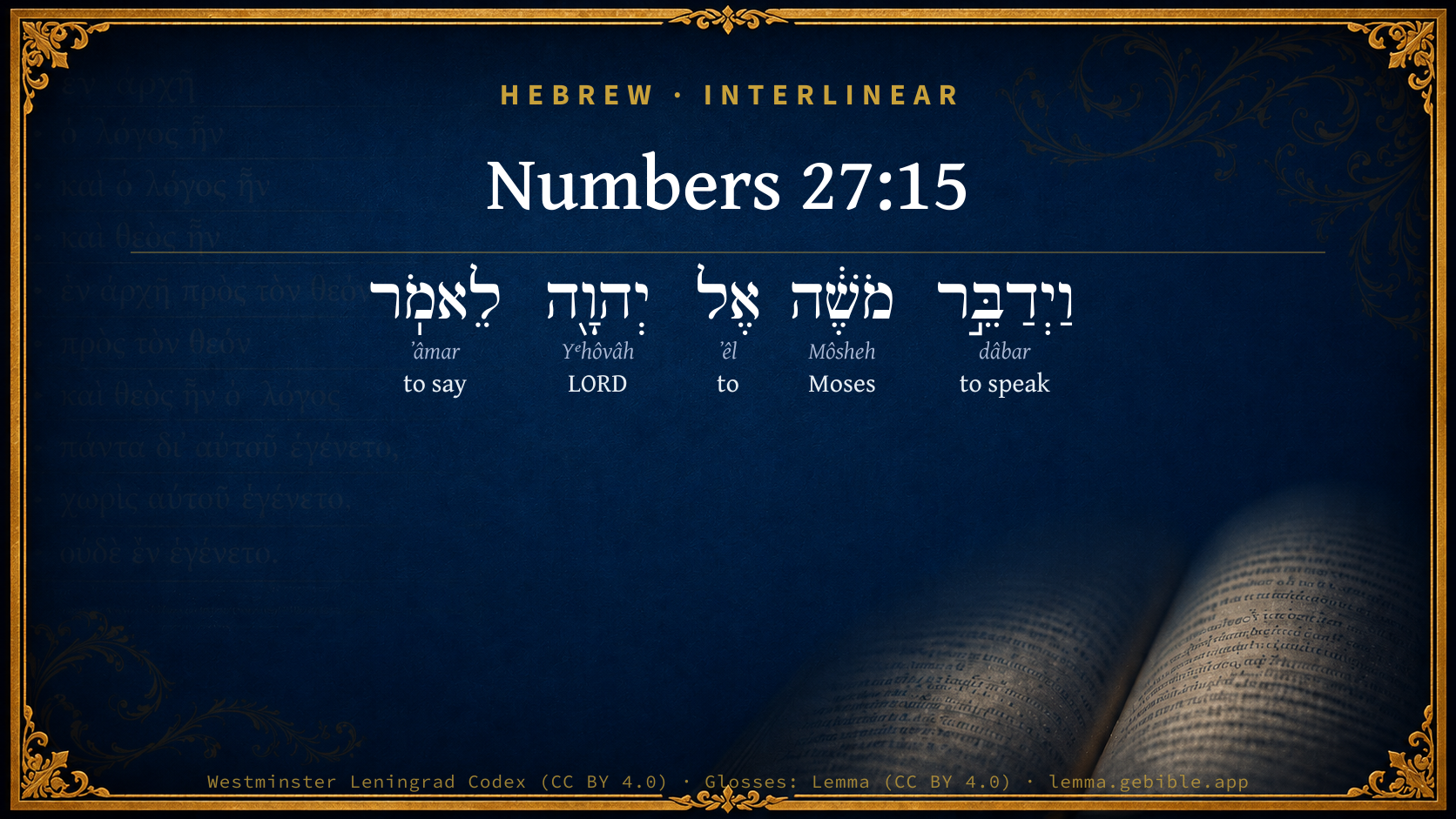
Numbers 27:15

Hebrew (Westminster Leningrad Codex) Numbers 27:15 appears in the Hebrew Old Testament. The text above is from the Westminster Leningrad Codex. Each word links to its Strong’s number, a concise gloss, and parsing drawn from the Open Scriptures Hebrew Bible morphology. Click any word for its full Brown-Driver-Briggs (BDB) entry.
Download image
Cite this verse

Numbers 27:15 (World English Bible). Public Domain. Lemma interlinear Bible study tool, https://lemma.gebible.app/v/numbers/27/15.

Show BibTeX & RIS
BibTeX
RIS
English Translation
Moses spoke to Yahweh, saying,
World English Bible · Public Domain
Download a study sheet

One document with this verse’s original text, its word-by-word gloss line, the meaning frame, cross-references with their text, attributed commentary, and full source and license credits — printable, and it pastes into notes with its structure intact.

This verse Autodidact and up

Study sheet (.html) Plain text (.txt)

A passage Seminary Student

Up to 50 verses in one chapter. A passage sheet keeps up to 6 commentary sources and 12 cross-references per verse, in the order this page ranks them, and says so on the sheet whenever that leaves anything out. Ask for a single verse and you get the Autodidact verse sheet above.

Everything on this page stays free to read, with no account — the sheet is a download of what is already on screen, not access to it.

Want to remove ads? Support Godless Engineer
Compare translations 3

The same verse in 3 English versions, stacked beneath the original-language interlinear above. Click any original word for its lexicon entry.

Each is an independent rendering of the whole verse — the interlinear is not word-aligned to these translations.

Highlighted words mark where these versions differ — a whole-verse word diff, not a word-by-word alignment.

  • World English Bible Public Domain
    Moses spoke to Yahweh, saying,
  • King James Version Public Domain
    And Moses spake unto the LORD, saying,
  • unfoldingWord Literal Text CC BY-SA 4.0
    And Moses spoke to Yahweh, saying,

unfoldingWord Literal Text — © unfoldingWord, licensed CC BY-SA 4.0. Word-aligned USFM3 via Door43 (git.door43.org/unfoldingWord/en_ult).

Versions to compare (up to 4)

3 of 4 selected

Show all 18 translations

Every available English version of this verse, each an independent rendering of the whole verse.

  • World English Bible Public Domain
    Moses spoke to Yahweh, saying,
  • Berean Standard Bible Public Domain
    So Moses appealed to the LORD,
  • Majority Standard Bible Public Domain
    So Moses appealed to the LORD,
  • King James Version Public Domain
    And Moses spake unto the LORD, saying,
  • American Standard Version (1901) Public Domain
    And Moses spake unto Jehovah, saying,
  • Revised Version (1885) Public Domain
    And Moses spake unto the LORD, saying,
  • Geneva Bible (1599) Public Domain
    Then Moses spake vnto the Lord, saying,
  • Douay-Rheims (1899) Public Domain
    And Moses answered him:
  • Young's Literal Translation Public Domain
    And Moses speaketh unto Jehovah, saying,
  • Literal Standard Version CC BY-SA 4.0
    And Moses speaks to YHWH, saying,
  • Unlocked Literal Bible CC BY-SA 4.0
    Then Moses spoke to Yahweh and said,
  • unfoldingWord Literal Text CC BY-SA 4.0
    And Moses spoke to Yahweh, saying,
  • Darby Bible Public Domain
    And Moses spoke to Jehovah, saying,
  • World Messianic Bible Public Domain
    Moses spoke to the LORD, saying,
  • Webster's Bible Public Domain
    And Moses spoke to the LORD, saying,
  • Free Bible Version CC BY-SA 4.0
    Then Moses pleaded with the Lord,
  • Bible in Basic English Public Domain
    Then Moses said to the Lord,
  • JPS Tanakh (1917) Public Domain
    And Moses spoke unto the LORD, saying:

Literal Standard Version (2020), Covenant Press — licensed CC BY-SA 4.0. Text via the HelloAO Bible API (eBible.org). Unlocked Literal Bible (unfoldingWord) — licensed CC BY-SA 4.0. Text via the HelloAO Bible API (eBible.org). unfoldingWord Literal Text — © unfoldingWord, licensed CC BY-SA 4.0. Word-aligned USFM3 via Door43 (git.door43.org/unfoldingWord/en_ult). Free Bible Version, Dr. Jonathan Gallagher — licensed CC BY-SA 4.0. Text via the HelloAO Bible API (eBible.org).

Word by word

More ways to search: Search by grammar → Find every occurrence → Compare this word →

Practice this passage: Drill this verse → Learn its vocabulary →

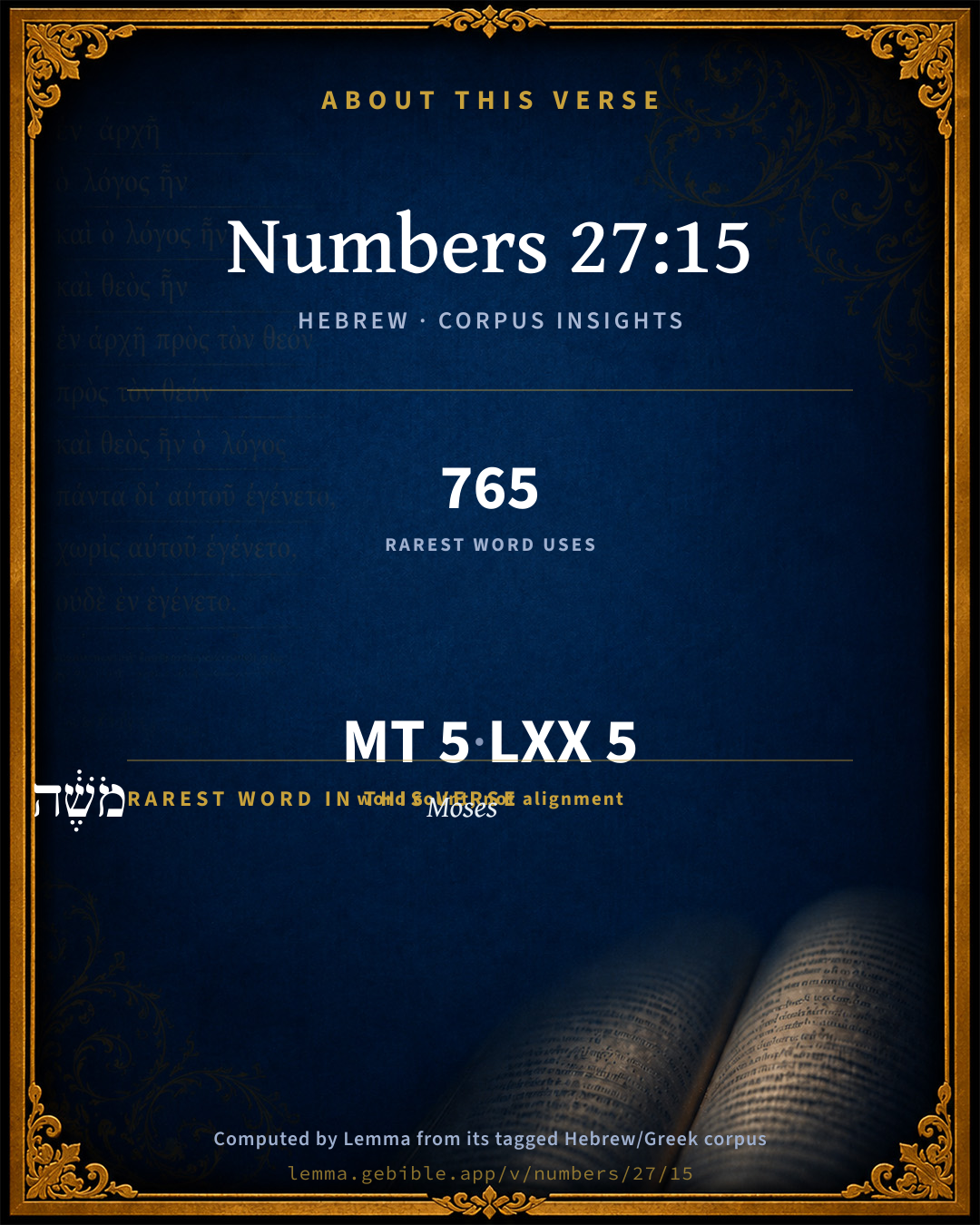
About this verse

These counts appear in no published source. They are computed here, from the morphology-tagged text and Lemma’s own curated glosses. What Lemma adds →

5
words
5
distinct lemmas
Pentateuch
section

Grammatical profile

  • 2 verbs
  • 2 nouns
  • 1 preposition

Verb forms

  • וַיְדַבֵּ֣ר Piel · Sequential Imperfect
  • לֵאמֹֽר Qal · Infinitive Construct

Hebrew & Septuagint length

In English translation the verse runs 5 words from the Hebrew and 6 from the Septuagint (LXX English) — closely comparable.

A rough comparison of the two English renderings, which tokenize alike — not a word-level alignment.

Word counts can differ between the Hebrew and the Greek without any difference in meaning — e.g. the Hebrew direct-object marker אֵת has no separate Greek word, and Greek often adds the article ὁ.

In the original languages it is 5 Hebrew tokens and 5 Greek tokens — but the two are counted differently (Hebrew bundles its prefixes and suffixes into one token; the Greek is in lemma form), so that isn’t a like-for-like length.

Hebrew and Greek witnesses Masoretic Hebrew ↔ Greek Septuagint

The same verse in the two great witnesses to the Old Testament, shown verse-for-verse.

These are two independent witnesses, not word-aligned to each other, and the Septuagint is shown in lemma (dictionary) form.

Hebrew Numbers 27:15 Masoretic · Westminster Leningrad Codex

וַיְדַבֵּ֣ר מֹשֶׁ֔ה אֶל יְהוָ֖ה לֵאמֹֽר

Moses spoke to Yahweh, saying,

World English Bible · Public Domain

Greek LXX Numbers 27:15 Septuagint · lemma form

καί εἶπον μωυσῆς πρός κύριος

And Moses said to the Lord,

LXX2012 (modern English Septuagint) · Public Domain

On this verse, The Pulpit Commentary discusses the Septuagint’s reading. Read the note in Commentary ↓

Hebrew: Westminster Leningrad Codex (CC BY 4.0). Greek: Septuagint (public domain); English from LXX2012 (modern English Septuagint) (Public Domain). How the Septuagint differs from the Hebrew →

Targum (Aramaic paraphrase)

2

The Targum is the ancient Jewish Aramaic paraphrase of the Hebrew Scriptures — an interpretive translation, not the Hebrew text itself. Onkelos (literal) and Pseudo-Jonathan (expansive) render the Torah, and Jonathan the Prophets. Coverage is partial: where no permissively-licensed English translation exists for a verse, only the Aramaic is shown. This is verse-level text, not a word-by-word alignment to the Hebrew.

  1. Targum Onkelos Torah (Genesis–Deuteronomy)
    וּמַלִיל משֶׁה קֳדָם יְיָ לְמֵימָר

    (no public-domain English translation for this verse)

    Targum Onkelos — Aramaic: “Onkelos Genesis” (public domain); “Onkelos Exodus” (public domain); “Onkelos Leviticus” (public domain); “Onkelos Numbers” (public domain); “Onkelos Deuteronomy” (public domain). English: “Sefaria Community Translation” (CC0 1.0 (public-domain dedication)); “J.W. Etheridge. The Targums of Onkelos and Jonathan Ben Uzziel on the Pentateuch. London: Longmans, Green, 1862” (public domain). Text via Sefaria.

  2. Targum Pseudo-Jonathan Torah (Genesis–Deuteronomy)
    וּמַלֵיל משֶׁה קֳדָם יְיָ לְמֵימָר

    And Mosheh spake before the Lord, saying

    Targum Pseudo-Jonathan — Aramaic: “Targum Jonathan on Genesis” (public domain); “Targum Jonathan on Exodus” (public domain); “Targum Jonathan on Leviticus” (public domain); “Targum Jonathan on Numbers” (public domain); “Targum Jonathan on Deuteronomy” (public domain). English: “The Targum of Jonathan ben Uzziel, trans. J. W. Etheridge, London, 1862” (public domain). Text via Sefaria.

Commentary

Notes on Numbers 27:15 from classic Christian and Jewish commentators (each source and its license shown beneath its notes). The classic Christian expositions comment on the surrounding passage and are grouped to its opening verse, so a note may address several verses; the Jewish commentaries on the Tanakh (Rashi and others) are per-verse, so they appear only where the commentator wrote on this verse.

Lemma curates 59 commentaries, every one of them public domain or Creative Commons licensed, each selected and text-cleaned for this edition rather than reprinted as found. About our sources →

Joseph Benson's Commentary

Num 27:15. And Moses spake unto the Lord — Concerning his successor.

We should concern ourselves both in our prayers and in our endeavours for the rising generation, that God’s kingdom may be advanced among men, when we are in our graves.

Joseph Benson's Commentary on the Old and New Testaments (1811–1818) — public domain. Text from a community e-Sword module.

Keil & Delitzsch

C. F. Keil & F. Delitzsch

Consecration of Joshua as the Successor of Moses. - Num 27:15-17. The announcement thus made to Moses led him to entreat the Lord to appoint a leader of His people, that the congregation might not be like a flock without a shepherd. As "God of the spirits of all flesh," i.e., as the giver of life and breath to all creatures (see at Num 16:22), he asks Jehovah to appoint a man over the congregation, who should go out and in before them, and should lead them out and in, i.e., preside over and direct them in all their affairs. ובוא צאת ("go out," and "go in") is a description of the conduct of men in every-day life (Deu 28:6; Deu 31:2; Jos 14:11). והביא הוציא ("lead out," and "bring in") signifies the superintendence of the affairs of the nation, and is founded upon the figure of a shepherd.

Keil & Delitzsch — Biblical Commentary on the Old Testament (1861–1891) — public domain (CC PDM 1.0). Text via the HelloAO Bible API. (Old Testament only.)

Tyndale Open Study Notes

Tyndale Open Resources

27:15-17 Israel was on the threshold of a long battle for Canaan; Moses did not want them to flounder without a leader or lose their way like sheep without a shepherd (cp. 1 Kgs 22:17; Ezek 34:5; Matt 9:36).

Tyndale Open Study Notes — © Tyndale Open Resources, licensed CC BY-SA 4.0. Text via the HelloAO Bible API.

Matthew Henry's Commentary

Here, I. Moses prays for a successor. When God had told him that he must die, though it appears elsewhere that he solicited for a reprieve for himself (Deu 3:24, Deu 3:25), yet, when this could not be obtained, he begged earnestly that the work of God might be carried on, though he might not have the honour of finishing it. Envious spirits do not love their successors, but Moses was not one of these. We should concern ourselves, both in our prayers and in our endeavours, for the rising generation, that religion may flourish, and the interests of God's kingdom among men may be maintained and advanced, when we are in our graves. In this prayer Moses expresses, 1. A tender concern for the people of Israel: That the congregation of the Lord be not as sheep which have no shepherd. Our Saviour uses this comparison in his compassions for the people when they wanted good ministers, Mat 9:36. Magistrates and ministers are the shepherds of a people; if these be wanting, or be not as they should be, people are apt to wander and be scattered abroad, are exposed to enemies, and in danger of wanting food and of hurting one another, as sheep having no shepherd. 2. A believing dependence upon God, as the God of the spirits of all flesh. He is both the former and the searcher of spirits, and therefore can either find men fit or make them fit to serve his purposes, for the good of his church. Moses prays to God, not to send an angel, but to set a man over the congregation, that is, to nominate and appoint one whom he would qualify and own as ruler of his people Israel. Before God gave this blessing to Israel, he stirred up Moses to pray for it: thus Christ, before he sent forth his apostles, called to those about him to pray the Lord of the harvest that he would send forth labourers into his harvest, Mat 9:38.

II. God, in answer to his prayer, appoints him a successor, even Joshua, who had long since signalized himself by his courage in fighting Amalek, his humility in ministering to Moses, and his faith and sincerity in witnessing against the report of the evil spies; this is the man whom God pitches upon to succeed Moses: A man in whom is the Spirit, the Spirit of grace (he is a good man, fearing God and hating covetousness, and acting from principle), the spirit of government (he is fit to do the work and discharge the trusts of his place), a spirit of conduct and courage; and he had also the spirit of prophecy, for the Lord often spoke unto him, Jos 4:1; Jos 6:2; Jos 7:10. Now here,

1. God directs Moses how to secure the succession to Joshua. (1.) He must ordain him: Lay thy hand upon him, Num 27:18. This was done in token of Moses' transferring the government to him, as the laying of hands on the sacrifice put the offering in the place and stead of the offerer; also in token of God's conferring the blessing of the Spirit upon him, which Moses obtained by prayer. It is said (Deu 34:9), Joshua was full of the spirit of wisdom, for Moses had laid his hands on him. This rite of imposing hands we find used in the New Testament in the setting apart of gospel ministers, denoting a solemn designation of them to the office and an earnest desire that God would qualify them for it and own them in it. It is the offering of them to Christ and his church for living sacrifices. (2.) He must present him to Eleazar and the people, set him before them, that they might know him to be designed of God for this great trust and consent to that designation. (3.) He must give him a charge, v. 19. He must be charged with the people of Israel, who were delivered into his hand as sheep into the hand of a shepherd, and for whom he must be accountable. He must be strictly charged to do his duty to them; though they were under his command, he was under God's command, and from him must receive charge. The highest must know that there is a higher than they. This charge must be given him in their sight, that it might be the more affecting to Joshua, and that the people, seeing the work and care of their prince, might be the more engaged to assist and encourage him. (4.) He must put some of his honour upon him, Num 27:20. Joshua at the most had but some of the honour of Moses, and in many instances came short of him; but this seems to be meant of his taking him now, while he lived, into partnership with him in the government and admitting him to act with authority as his assistant. It is an honour to be employed for God and his church; some of this honour must be put upon Joshua, that the people, being used to obey him while Moses lived, might the more cheerfully do it afterwards. (5.) He must appoint Eleazar the high priest, with this breast-plate of judgment, to be his privy-council (Num 27:21): He shall stand before Eleazar, by him to consult the oracle, ready to receive and observe all the instructions that should be given him by it. This was a direction to Joshua. Though he was full of the Spirit, and had all this honour put upon him, yet he must do nothing without asking counsel of God, not leaning to his own understanding. It was also a great encouragement to him. To govern Israel, and to conquer Canaan, were two hard tasks, but God assures him that in both he should be under a divine conduct; and in every difficult case God would advise him to that which should be for the best. Moses had recourse to the oracle of God himself, but Joshua and the succeeding judges must use the ministry of the high priest, and consult the judgment of urim, which, the Jews say, might not be enquired of but by the king or the head of the sanhedrim, or by the agent or representative of the people, for them, and in their name. Thus the government of Israel was now purely divine, for both the designation and direction of their princes were entirely so. At the word of the priest, according to the judgment of urim, Joshua and all Israel must go out and come in; and no doubt God, who thus guided, would preserve both their going out and their coming in. Those are safe, and may be easy, that follow God, and in all their ways acknowledge him.

2. Moses does according to these directions, Num 27:22, Num 27:23. He cheerfully ordained Joshua, (1.) Though it was a present lessening to himself, and amounted almost to a resignation of the government. He was very willing that the people should look off from him, and gaze on the rising sun. (2.) Though it might appear a perpetual slur upon his family. It would not have been so much his praise if he had thus resigned his honour to a son of his own; but with his own hands first to ordain Eleazar high priest, and then Joshua, one of another tribe, chief ruler, while his own children had no preferment at all, but were left in the rank of common Levites, this was such an instance of self-denial and submission to the will of God as was more his glory than the highest advancement of his family could have been; for it confirms his character as the meekest man upon earth, and faithful to him that appointed him in all his house. This (says the excellent bishop Patrick) shows him to have had a principle which raised him above all other lawgivers, who always took care to establish their families in some share of that greatness which they themselves possessed; but hereby it appeared that Moses acted not from himself, because he acted not for himself.

Matthew Henry's Commentary on the Whole Bible (1708–1710) — public domain (CC PDM 1.0). Text via the HelloAO Bible API.

The Cambridge Bible for Schools and Colleges

gen. ed. J. J. S. Perowne

15–23. The appointment of Joshua.

The Cambridge Bible for Schools and Colleges (gen. ed. J. J. S. Perowne; Cambridge University Press, 1878–1918) — public domain. Text from a community e-Sword module.

John Gill's Exposition

Let the Lord, the God of the spirits of all flesh,.... The Maker of the souls of men, called the spirits of all flesh, or of corporeal beings, to distinguish them from the angels, who, though spirits, are incorporeal; and who knows the different qualities of the souls of men, their powers, and capacities, and fitness for service, what gifts and talents they have for business; and who can bestow such upon them, which will quality them for it:

set a man over the congregation: meaning in his room and stead.

John Gill's Exposition of the Whole Bible (1746–1763) — public domain (CC PDM 1.0). Text via the HelloAO Bible API.

The Pulpit Commentary

And Moses spake unto the Lord. The behaviour of Moses as here recorded (see, however, on Deu_3:23 sq., which seems to throw a somewhat different light upon the matter) was singularly and touchingly disinterested. For himself not even a word of complaint at his punishment, which must have seemed, thus close at hand, more inexplicably severe than ever; all his thoughts and his prayers for the people that one might take his place, and reap for himself and Israel the reward of all his toil and patience.

Which may go out before them, and which may go in before them. A comparison with the words of Moses in Deu_31:2, and of Caleb in Jos_14:11, shows that the going out and coming in refer to the vigorous prosecution of daily business, and the fatigues of active service. Which may lead them out, and which may bring them in. The underlying image is that of a shepherd and his flock, which suggests itself so naturally to all that have the care and governance of men. (cf. Joh_10:3, Joh_10:4, Joh_10:16) As sheep which have no shepherd. And are, therefore, helpless, bewildered, scattered, lost, and devoured. The image is frequent in Scripture. (cf. 1Ki_22:17 Eze_34:5 Zec_10:2 Mat_9:36) The words of the Septuagint are wsei probata oiv ouk esti poimhn .

Vers. 15-17. The solicitude of Moses for the helpless flock.

I THE FIGURE UNDER WHICH MOSES INDICATES ISRAEL. He speaks of them as a flock of sheep, thus venturing on a meek reference to the quality of his own past services. He speaks like a man who had been long preparing, even before Meribah, for an emergency such as this. He knew he could not live always, and he saw no sufficiently hopeful change in Israel. He had to deal with the sheep-nature in them from the first, and that nature was in them still in undiminished vitality. They would, he implies, be as helpless in Canaan as in the wilderness. He had not yet got the view from Abarim, but that view would only deepen his thankfulness that God had given the people a shepherd. For the more impressive the view, and the more there was revealed of rich and abundant pasture, the more evident it would become that the sheep needed guidance in order to make full use of the pasture. Passing from the wilderness into Canaan, while it vastly enlarges the sheep-privileges, does not in itself change the sheep-nature. The need remains in equal force both for guidance and protection. Where the privileges are greater, there, consequently, the possessions will be greater; there also there will be more to attack, more danger of attack, and more need of defense. And in like manner how helpless we are of ourselves among the vast resources and promises which belong to God"s grace in Christ Jesus. Unless we have some one to guide and strengthen, and show us the meaning and power of Divine truth, we are as helpless as an infant would be with a steam-engine. Weak and strong are relative terms. Sheep are strong enough in certain ways strong to rebel against wholesome restraints and break through them, but not strong enough to repel the dangers which come when the restraints are broken through. Moses had only too often seen Israel hanging together like sheep. going in troops after some headstrong Korah, while men of the Caleb and Joshua order were almost to be counted on one"s fingers.

II THE PEOPLE BEING SUCH, A SHEPHERD WAS A MANIFEST NECESSITY. Given sheep, it does not take much reasoning to infer a shepherd. Moses had been a shepherd himself, both literally and figuratively, and his experience of the sheep in Midian doubtless sharpened his sense of the analogy as he gazed on the human sheep whom he had led for forty years. A man unfamiliar with pastoral life might indeed talk in a general way of the fallen children of men as sheep; but it needed a Moses to speak of the shepherd"s work with such minuteness and sympathetic interest as he shows here. The shepherd is to go out before the sheep. With him rests the responsibility of choosing the place of pasture. And he must lead the sheep. He must go before them, and not too far before them, or he cannot truly lead. He leads them out to find pasture, and he leads them in to insure security. The Good Shepherd is in himself the guarantee both for nourishment and security, and the sheep follow him, as if to show that the real nourishments and securities of religion must come by a voluntary acceptance. There is much difference between being drawn and driven. The sheep following the shepherd is not like the ox dragging the plough and quickened by its master"s goad. There are times indeed when, like the ox, we must be driven and chastised, but the greatest results can only be gained when we are drawn like the sheep. In the lives of God"s people there is a very instructive mingling of freedom and constraint. Let us add, that in thinking of the responsibility of the shepherd for the providing of pasture it must not be forgotten how soon the manna ceased when Canaan was entered. (Jos_5:12) The people then needed guiding into a forethought and industry from which, in the presence of the daily manna, they had long been free.

III IT IS MANIFEST THAT NOTHING BUT A DIVINE APPOINTMENT WAS ADEQUATE TO MEET THIS NECESSITY. Popular election was certainly not available. The sheep would make a poor business of it if they had to choose a shepherd. Popular government is less objectionable than the rule of despots, but it has its own delusions, its own narrow aims. The natural man is the natural man, circumscribed by the limits of time, and sense, and natural discernment, whether he be noble or peasant. The follies and cruelties of democracy have caused as sad, humiliating pages to be written in the history of the world as the follies and cruelties of any despot whatever. The man who says vex populi, vex Dei speaks error none the less because he speaks out of a generous, enthusiastic heart. Never till the voice of Christ becomes the willing and gladsome voice of the people can vex populi, vox Dei be the truth. Equally plain is it that the choice of Moses was not available. He feels that the thing can only be done in entire submission to God. Moses himself, in the day of his first call, had spoken very depreciatingly of his own qualifications. Yet not only had God chosen him, but also proved the choice was right. The event had shown that he was the leader after God"s own heart. What a thing if he had turned out like Saul; but that he could not do, he was so completely the choice of God. It was not for Moses then, who had gone so tremblingly from Midian to Egypt, to say, "Who is fittest man for shepherd now?" Moses felt well able to estimate the qualifications of a leader; but who best supplied those qualifications was a question which none but the all-searching, all-knowing God could answer. God had not only seen fitness in Moses, but he had seen fitness in Moses only; for we must ever believe that in each generation, and for each emergency, he takes the very fittest man among the thousands of Israel. God had chosen at the departure from Egypt; God also shall choose at the entrance into Canaan.

IV NOTICE THE SUGGESTIVE AND APPROPRIATE WAY IN WHICH GOD IS ADDRESSED. "The God of the spirits of all flesh." It is God who breathes in the breath of life, sustains and controls it, and can fix the time of its cessation. Speaking to God in this way, there is thus an expression of humble personal submission. Moses cannot choose the time of death, any more than he has been able to choose anything else. God had shielded the faint and delicate breath of the infant as it lay in the flags by the river"s brink, and now he calls upon the old man of a hundred and twenty years, who has passed through such a difficult and oft-endangered course, to yield that breath up. There is also in this mode of address a clear recognition of how it is that God may be looked to for the choice of a leader. God has but lately proved his knowledge of individual men by his complete control over those dying in the wilderness. (Num_26:64, Num_26:65) He who assuredly knows the hearts of all the 600, 000 lately counted can say who of them is fittest to be leader. God knows who is nearest to him as a follower. There is no fear but the sheep will recognize those whom God appoints. In spite of all the difficulties of Moses, in spite of rebellions and curses, in spite of the crumbling away of a whole generation, the nation is still there. Moses can say, on the verge of Jordan and at the foot of Abarim, "Here am I and the flock that was given me." But all this achievement only glorified God the more, that God who had chosen Moses and hedged up his way. Any other leader than the one God had chosen could never have got out of Egypt. Any other leader than the one God will now choose cannot get across Jordan. Y.

The Pulpit Commentary (1880–1919), ed. H.D.M. Spence-Jones & Joseph S. Exell — public domain. Text from a community e-Sword module.

John Wesley's Explanatory Notes

And Moses spake unto the Lord - Concerning his successor. We should concern ourselves both in our prayers and in our endeavours for the rising generation, that God's kingdom may be advanced among men, when we are in our graves.

John Wesley, Explanatory Notes Upon the Whole Bible (1754–1765) — public domain. Text via the GEBible commentary corpus.

unfoldingWord translationNotes

Door43 World Missions Community

the God of the spirits of all humanity

Possible meaning are 1) here "spirits" refers to all people." AT: "the God over all of humanity" or 2) the reference to "spirits" refers to God having given life and breath to all people. AT: "the God who gives breath to all people" or "the God who give life to all humanity" (See: Synecdoche)

a man over the community

To be "over" a group of people means to have authority to lead them. AT: "a man to lead the community" (See: Idiom)

a man who may go out and come in before them and lead them out and bring them in

This is an idiom that means a person who will lead all the people and also lead the army into battle. (See: Idiom)

so that your community is not like sheep that have no shepherd

This is a simile that means without a leader the people will wander and be helpless. (See: Simile)

translationWords

spirit

appoint

ewe

shepherd

unfoldingWord translationNotes — © Distant Shores Media and the Door43 World Missions Community, licensed CC BY-SA 4.0. Source: git.door43.org/Door43/en_tn.

Rashi

Rabbi Shlomo Yitzchaki (Rashi)

'וידבר משה אל ה‎‎‎ וגו׳ AND AND MOSES SPAKE TO THE LORD, [LET THE LORD … SET A MAN OVER THE CONGREGATION] — This statement serves to show the praise of the righteous: when they are about to depart from the world, they abandon all thought of their own affairs and occupy themselves with the affairs of the community (Sifrei Bamidbar 138).

לאמר saying (more lit., to say, i.e., that God should say, or answer him) — He said to Him, “Answer me whether You will appoint a leader for them or not” (Sifrei Bamidbar 138).

Rashi on the Tanakh — English translations: “The Judaica Press complete Tanach with Rashi, translated by A. J. Rosenberg” (CC BY 4.0); “Pentateuch with Rashi's commentary by M. Rosenbaum and A.M. Silbermann, 1929-1934” (public domain); “The Metsudah Tanach series, Lakewood, N.J” (CC BY 4.0); and “The Book of Joshua, Metsudah Publications, 1997” (CC BY 4.0). Text via Sefaria.

Lesson kit

Teaching starters — assembled from the data on this page, not authored interpretation. Every prompt links to the verse data it draws on. Edit before teaching.

Numbers, in the Pentateuch, opens this verse with 5 words (5 distinct Hebrew lemmas). Its most distinctive word is Môsheh (“Moses”). A historical commentator’s framing appears above. Read the whole chapter for the surrounding context.

Discussion questions

  1. What does “Moses” (Môsheh) contribute to the verse as a whole?
  2. These translations render this verse differently; the difference is in the English rendering, not the original. What questions does that raise?
  3. «וַיְדַבֵּ֣ר» is a Piel Sequential Imperfect verb. How does that grammatical form shape the action described?
  4. Compare how Joseph Benson's Commentary and Keil & Delitzsch read this verse. Where do they agree or differ?

Things to notice

Reading settings

Reading text

Shown beneath each verse's original-language words.

Old Testament
Old Testament edition

Read the OT as the Masoretic Hebrew (MT) or the Greek Septuagint (LXX).

English shown for the Greek Septuagint (in the Hebrew ↔ Greek comparison).

Comparing translations? Open the Compare panel on any verse page to stack up to four side by side.