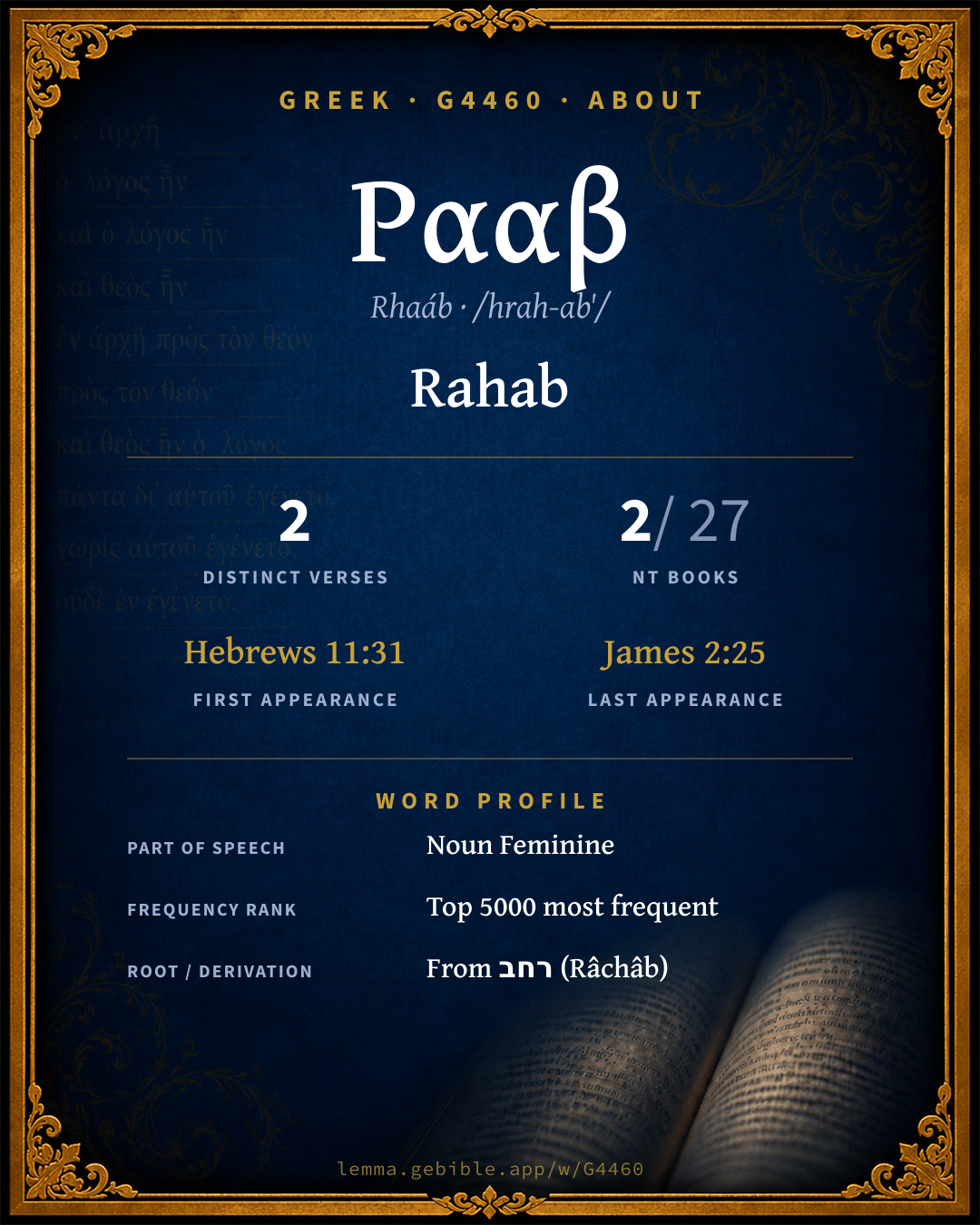
Ῥαάβ
Rahab
Thayer's lists 2 entries for ‘Rahab’ fuller range ↓
Full lexicon entry — Thayer's Greek Lexicon
From Thayer's Greek Lexicon
Where this word appears
Every verse where G4460 appears — 2 distinct verses across 2 books. Click any verse to open its interlinear word-by-word view. Verse text shown in the World English Bible for context — . Each verse’s Greek form is shown with its reference; the English is not keyword-highlighted, since the data carries no word-level English alignment. Use “Compare translations” on any verse to read it across multiple English versions. This concordance covers the Greek New Testament; Septuagint (Greek Old Testament) occurrences of this word are not indexed here.
Hebrews 1 verse
James 1 verse
About this entry
At a glance — auto-summarized from this page’s data, not written by a person. Every figure links to its source below. This summary describes the numbers; it doesn’t interpret them.
Ρααβ (Rhaáb) is a Greek name most often rendered “Rahab.” With only 2 verses it sits in the long tail of Greek New Testament vocabulary. It clusters heavily in Hebrews, which alone accounts for 50% of its uses. It first appears in Hebrews 11:31. For the data behind this summary, explore 2-verse concordance and the renderings breakdown below.
Gloss history
Strong's 1890 vs modern scholarship
About this word
Strong's G4460 catalogs a Greek word from the Greek New Testament.
These counts are not copied from any lexicon or concordance. They are computed here, from the morphology-tagged Greek New Testament. What Lemma adds →
- 2
- distinct verses
- The word appears in 2 distinct verses.
- 2 / 27
- NT books
- The word appears in 2 of 27 New Testament books.
- #2,678
- by frequency
- Top 5000 most frequent Greek words (rank 2,678 of 5,347 Greek words by occurrence).
View all 2 occurrences in the concordance →
By traditional corpus
Conventional, traditional groupings — biblical authorship is debated, so this is a traditional corpus grouping, not an authorship claim. Some books belong to more than one corpus (Luke is in both the Gospels and the Lukan corpus, and so on), so these shares overlap and need not total 100%. Each figure is a share of the word’s 2 distinct verses.
- Hebrews 1 verse · 50%
- General (Catholic) Epistles 1 verse · 50%
How translations render this word
Counts come from each version’s own published word-to-Strong’s tagging or interlinear alignment — an approximate guide to how each version renders this word, not a word-level alignment the data otherwise carries. Because each total is that version’s own tagged count, the per-version totals vary from one another and need not match the appearance or distinct-verse counts above. These counts may also differ from a printed concordance because Lemma counts each distinctly tagged rendering and does not collapse phrase taggings into a single head-word total. This is a fixed set of word-tagged versions (KJV, ASV, BSB, ULT) and does not change with the reading translation you choose elsewhere. Each version’s license is shown beside its name below (and on Sources).
- King James Version: Rahab 2×
- American Standard Version: Rahab 2×
- Berean Standard Bible: Rahab 2×
- unfoldingWord Literal Text: Rahab 2×
King James Version Public Domain
Renders G4460 across 2 tagged occurrences — most commonly:
American Standard Version Public Domain
Renders G4460 across 2 tagged occurrences — most commonly:
Berean Standard Bible Public Domain
Renders G4460 across 2 tagged occurrences — most commonly:
unfoldingWord Literal Text CC BY-SA 4.0
Renders G4460 across 2 tagged occurrences — most commonly:
Senses in Thayer's
The 2 senses Thayer's distinguishes for this word, in lexicon order (not ranked by frequency or importance). The full entry — with sub-senses — is in the Lexicon Entry tab.
- Rahab = "wide"
- a harlot of Jericho
Word origin
Derived from רחב (Râchâb) (H7343) — Rahab.
Same root — word family
Other Thayer's entries built from the same root as G4460, grouped by Strong’s listed origin. These share a root / origin per the lexicon — not necessarily a shared meaning. Each links to that word’s own entry.
Derives from
Proper names from this root
People and places named from this root — a name, not an additional meaning of the word.
Compare all same-root words → 2 of the same-root words are proper names (people or places). They share a root, not necessarily a meaning.
Bible dictionary
Public-domain dictionary articles matched to this entry by name (Rahab). A biblical name can be shared by more than one person or place, so an article may treat several.
Easton's Bible Dictionary · M. G. Easton, 1897
Insolence; pride, a poetical name applied to Egypt in Ps. 87:4; 89:10; Isa. 51:9, as "the proud one."
Rahab, (Heb. Rahab; i.e., "broad," "large"). When the Hebrews were encamped at Shittim, in the "Arabah" or Jordan valley opposite Jericho, ready to cross the river, Joshua, as a final preparation, sent out two spies to "spy the land." After five days they returned, having swum across the river, which at this season, the month Abib, overflowed its banks from the melting of the snow on Lebanon. The spies reported how it had fared with them (Josh. 2:1-7). They had been exposed to danger in Jericho, and had been saved by the fidelity of Rahab the harlot, to whose house they had gone for protection. When the city of Jericho fell (6:17-25), Rahab and her whole family were preserved according to the promise of the spies, and were incorporated among the Jewish people. She afterwards became the wife of Salmon, a prince of the tribe of Judah (Ruth 4:21; 1 Chr. 2:11; Matt. 1:5). "Rahab's being asked to bring out the spies to the soldiers (Josh. 2:3) sent for them, is in strict keeping with Eastern manners, which would not permit any man to enter a woman's house without her permission. The fact of her covering the spies with bundles of flax which lay on her house-roof (2:6) is an undesigned coincidence' which strictly corroborates the narrative. It was the time of the barley harvest, and flax and barley are ripe at the same time in the Jordan valley, so that the bundles of flax stalks might have been expected to be drying just then" (Geikie's Hours, etc., ii., 390).
Smith's Bible Dictionary · William Smith, 1863
a poetical name of Egypt, (Psalms 89:10; Isaiah 51:9) signifying "fierceness, insolence, pride." Rahab, as a name of Egypt, occurs once only without reference to the exodus: this is in (Psalms 87:4) In (Isaiah 30:7) the name is alluded to.
Hitchcock's Bible Names Dictionary · Roswell D. Hitchcock, 1869
proud; quarrelsome (applied to Egypt)
Classic public-domain reference works; full attribution on Sources.
Septuagint usage
The same Greek word Ρααβ appears 12 times in the Greek Old Testament (Septuagint), across 12 verses in 5 books.
- 12
- LXX occurrences
- Tagged occurrences of this Greek word in the Septuagint.
- 12
- verses
- Distinct Septuagint verses containing this word.
- 5 / 39
- OT books
- The word appears in 5 of the 39 Old Testament books.
Sample Septuagint occurrences
- Numbers 13:21 ρααβ
- Joshua 2:1 ρααβ
- Judges 18:28 ρααβ
- 2 Samuel 8:3 ρααβ
- Psalms 86:4 ρααβ
Septuagint occurrences (same lexeme)
Every verse where the same Strong’s number (G4460) appears in the Greek Septuagint. Verse text shown in the World English Bible for context; the Greek form is the matched word — the English is not keyword-highlighted.
- Numbers 13:21 ρααβ So they went up, and spied out the land from the wilderness of Zin to Rehob, to the entrance of Hamath.
- Joshua 2:1 ρααβ Joshua the son of Nun sent out of Shittim two men as spies secretly, saying, Go, view the land, and Jericho. They went and came into the house of a prostitute whose name was Rahab, and lay there.
- Joshua 2:3 ρααβ The king of Jericho sent to Rahab, saying, Bring forth the men who are come to you, who have entered into your house; for they have come to search out all the land.
- Joshua 6:17 ρααβ The city shall be devoted, even it and all that is therein, to Yahweh: only Rahab the prostitute shall live, she and all who are with her in the house, because she hid the messengers that we sent.
- Joshua 6:23 ρααβ The young men the spies went in, and brought out Rahab, and her father, and her mother, and her brothers, and all that she had; all her relatives also they brought out; and they set them outside of the camp of Israel.
- Joshua 6:25 ρααβ But Rahab the prostitute, and her father's household, and all that she had, did Joshua save alive; and she lived in the midst of Israel to this day, because she hid the messengers, whom Joshua sent to spy out Jericho.
- Joshua 19:28 ρααβ and Ebron, and Rehob, and Hammon, and Kanah, even to great Sidon;
- Joshua 21:31 ρααβ Helkath with its suburbs, and Rehob with its suburbs; four cities.
- Judges 18:28 ρααβ There was no deliverer, because it was far from Sidon, and they had no dealings with any man; and it was in the valley that lies by Beth Rehob. They built the city, and lived therein.
- 2 Samuel 8:3 ρααβ David struck also Hadadezer the son of Rehob, king of Zobah, as he went to recover his dominion at the River.
- 2 Samuel 8:12 ρααβ of Syria, and of Moab, and of the children of Ammon, and of the Philistines, and of Amalek, and of the spoil of Hadadezer, son of Rehob, king of Zobah.
- Psalms 86:4 ρααβ Bring joy to the soul of your servant, For to you, Lord, do I lift up my soul.
These are occurrences of the same Greek lexeme (G4460) in the Septuagint — not a translation of any one Hebrew word. The store carries no word-level Hebrew↔Greek alignment, so no Hebrew original is asserted here. Counts come from the recovered LXX Strong's tagging — high-frequency vocabulary is well covered, while rare or late forms may be untagged — so they reflect tagged occurrences and may slightly undercount.