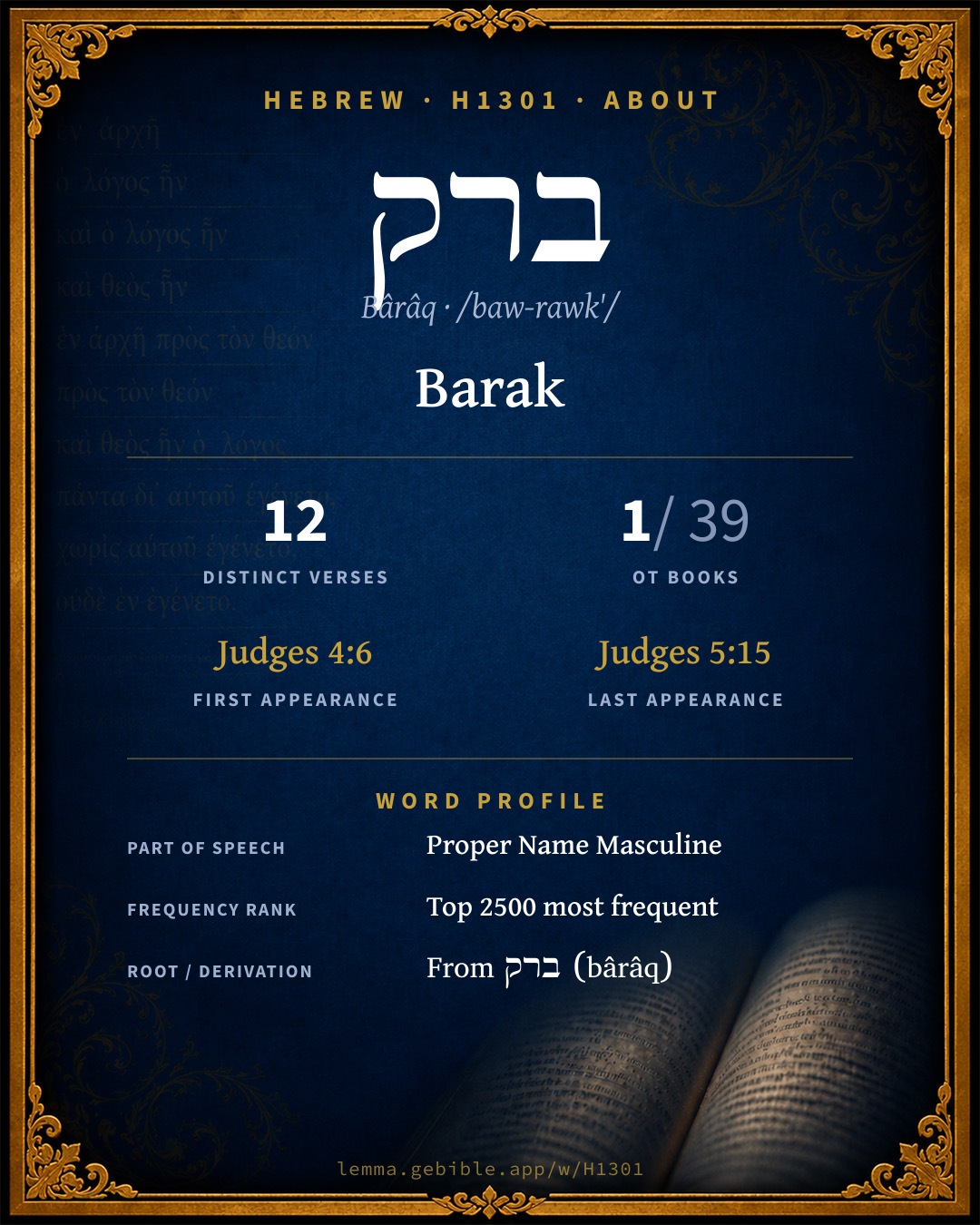
בָּרָק
Barak
BDB lists 2 entries for ‘Barak’ fuller range ↓
Full lexicon entry — Brown-Driver-Briggs (BDB)
From Brown-Driver-Briggs (BDB)
Where this word appears
Grammar key — what these labels mean
Part of speech
- Noun
- A naming word — a person, place, thing, or idea.
Noun type
- Proper
- A name of a specific person, place, or people (e.g. Abraham, Zion, Israel).
Every verse where H1301 appears — 12 distinct verses across 1 book. Click any verse to open its interlinear word-by-word view. Verse text shown in the World English Bible for context — . Each verse’s Hebrew form is shown with its reference; the English is not keyword-highlighted, since the data carries no word-level English alignment. Use “Compare translations” on any verse to read it across multiple English versions. This concordance covers the Hebrew Bible; Septuagint (Greek Old Testament) occurrences are not indexed here.
Judges 12 verses
- Judges 4:6 לְ/בָרָ֣ק prep + n Proper She sent and called Barak the son of Abinoam out of Kedesh-naphtali, and said to him, Hasn't Yahweh, the God of Israel, commanded, [saying], Go and draw to Mount Tabor, and take with you ten thousand men of the children of Naphtali and of the children of Zebulun?
- Judges 4:8 בָּרָ֔ק n Proper Barak said to her, If you will go with me, then I will go; but if you will not go with me, I will not go.
- Judges 4:9 בָּרָ֖ק n Proper She said, I will surely go with you: notwithstanding, the journey that you take shall not be for your honor; for Yahweh will sell Sisera into the hand of a woman. Deborah arose, and went with Barak to Kedesh.
- Judges 4:10 בָּרָ֜ק n Proper Barak called Zebulun and Naphtali together to Kedesh; and there went up ten thousand men at his feet: and Deborah went up with him.
- Judges 4:12 בָּרָ֥ק n Proper They told Sisera that Barak the son of Abinoam was gone up to Mount Tabor.
- Judges 4:14 בָּרָ֜ק בָּרָק֙ n Proper n Proper Deborah said to Barak, Up; for this is the day in which Yahweh has delivered Sisera into your hand; hasn't Yahweh gone out before you? So Barak went down from Mount Tabor, and ten thousand men after him.
- Judges 4:15 בָרָ֑ק n Proper Yahweh confused Sisera, and all his chariots, and all his host, with the edge of the sword before Barak; and Sisera alighted from his chariot, and fled away on his feet.
- Judges 4:16 וּ/בָרָ֗ק conj + n Proper But Barak pursued after the chariots, and after the host, to Harosheth of the Gentiles: and all the host of Sisera fell by the edge of the sword; there was not a man left.
- Judges 4:22 בָרָק֮ n Proper Behold, as Barak pursued Sisera, Jael came out to meet him, and said to him, Come, and I will show you the man whom you seek. He came to her; and, behold, Sisera lay dead, and the tent-pin was in his temples.
- Judges 5:1 וּ/בָרָ֖ק conj + n Proper Then sang Deborah and Barak the son of Abinoam on that day, saying,
- Judges 5:12 בָּרָ֛ק n Proper Awake, awake, Deborah; Awake, awake, utter a song: Arise, Barak, and lead away your captives, you son of Abinoam.
- Judges 5:15 בָּרָ֔ק n Proper The princes of Issachar were with Deborah; As was Issachar, so was Barak; Into the valley they rushed forth at his feet. By the watercourses of Reuben There were great resolves of heart.
About this entry
At a glance — auto-summarized from this page’s data, not written by a person. Every figure links to its source below. This summary describes the numbers; it doesn’t interpret them.
ברק — transliterated Bârâq — is a Hebrew name carrying the sense “Barak.” Its uses cluster heavily in Judges (100% of all occurrences). With 12 verses in 1 book, it is an uncommon word in the Hebrew Bible. Debuting at Judges 4:6, it then recurs through the corpus. Each statement above links to its evidence; the full detail follows below.
Gloss history
Strong's 1890 vs modern scholarship
About this word
Strong's H1301 catalogs a Hebrew word from the Hebrew Old Testament.
These counts are not copied from any lexicon or concordance. They are computed here, from the morphology-tagged Hebrew Old Testament. What Lemma adds →
- 12
- distinct verses
- The word appears in 12 distinct verses.
- 1 / 39
- OT books
- The word appears in 1 of 39 Old Testament books.
- #2,001
- by frequency
- Top 2500 most frequent Hebrew words (rank 2,001 of 8,640 Hebrew words by occurrence).
View all 12 occurrences in the concordance →
Most concentrated in
- Judges 12 verses 100%
By section of the Old Testament
By traditional corpus
Conventional, traditional groupings — biblical authorship is debated, so this is a traditional corpus grouping, not an authorship claim. Each share is this word’s portion of its verses in that division of the Hebrew canon. Each figure is a share of the word’s 12 distinct verses.
- Prophets (Nevi'im) 12 verses · 100%
How translations render this word
Counts come from each version’s own published word-to-Strong’s tagging or interlinear alignment — an approximate guide to how each version renders this word, not a word-level alignment the data otherwise carries. Because each total is that version’s own tagged count, the per-version totals vary from one another and need not match the appearance or distinct-verse counts above. These counts may also differ from a printed concordance because Lemma counts each distinctly tagged rendering and does not collapse phrase taggings into a single head-word total. This is a fixed set of word-tagged versions (KJV, ASV, BSB, ULT) and does not change with the reading translation you choose elsewhere. Each version’s license is shown beside its name below (and on Sources).
BDB lists this Strong’s number as 2 distinct words (homographs). Each count above pools all of them and is not split by sense — see the Senses section below. A low-frequency rendering may belong to a different one of those words, not the primary meaning.
- King James Version†: Barak 11×
- American Standard Version†: Barak 10×
- Berean Standard Bible†: Barak 10×
- unfoldingWord Literal Text†: Barak 13×
King James Version Public Domain
Renders H1301 across 13† tagged occurrences — most commonly:
Plus 2 renderings that appear only once — usually multi-word phrases or single function words the recovered tagging swept in, not distinct renderings.
American Standard Version Public Domain
Renders H1301 across 13† tagged occurrences — most commonly:
Plus 3 renderings that appear only once — usually multi-word phrases or single function words the recovered tagging swept in, not distinct renderings.
Berean Standard Bible Public Domain
Renders H1301 across 12† tagged occurrences — most commonly:
Plus 2 renderings that appear only once — usually multi-word phrases or single function words the recovered tagging swept in, not distinct renderings. Not rendered by a distinct English word in 1 further occurrence.
unfoldingWord Literal Text CC BY-SA 4.0
Renders H1301 across 13† tagged occurrences — most commonly:
Senses in the full BDB
What do BDB’s symbols mean?
BDB uses these scholarly abbreviations:
| Symbol | Meaning |
|---|---|
| 𝔊 | the Septuagint (the ancient Greek translation, LXX) |
| 𝔙 | the Vulgate (the Latin translation) |
| 𝔖 | the Syriac version (the Peshitta) |
| 𝔗 | the Targum (the Aramaic translation) |
| ψ | the Psalms |
| √ | root (the underlying root or stem) |
| ‖ | parallel passage (a synonymous or contrasted parallel) |
| † | the dagger: every passage where the word occurs is cited |
The 2 senses and sub-senses the full Brown-Driver-Briggs lexicon distinguishes for this word, in lexicon order (not ranked by frequency), with BDB’s own verbatim wording and sub-sense lettering. Shown in Hebrew script with BDB’s own scholarly abbreviations. The condensed entry is in the Lexicon Entry tab. See also the Forms in the corpus table below.
ברק I
- 1. lit. mostly pl. = lightnings, lightning-flashes Ex 19:16 ψ 18:15 (in theoph., on 2 S 22:15 v. infr.) 77:19; 97:4; 135:7 Jb 38:35 Je 10:13; 51:16; so in sim. of swift brightness Na 2:5, sg. only ψ 144:6 2 S 22:15 (where however read בְּרָקִים בָּרַק cf. בָּרַק—so 𝔊L Klo Che, cf. his crit. n. ψ 18:15), Ez 1:13 (in vision), and in sim. of brightness Dn 10:6; swift destruction Zc 9:14. e.g. Exodus 19:16
- 2. fig. (always sing.) of flashing arrow-head Jb 20:25, cf. ב׳ חרב Dt 32:41, ב׳ חנית Na 3:3 Hb 3:11; cf. glitter of weapon Ez 21:15, 20, 33. e.g. Job 20:25
ברק II m. (lightning-flash, cf. Pun. Barcas, surname of Hamilear, cf. NeposHamilcar 1, 1
Senses from the full Brown-Driver-Briggs lexicon (Brown, Driver, Briggs; Oxford 1906 — public domain), digitized via Sefaria, supplemented by the OpenScriptures HebrewLexicon (CC BY 4.0). Full attribution on Sources.
Word origin
I. n.m. Ez 1:13 lightning (chiefly in poetry) (Arabic بَرْقٌ, Assyrian birḳu COTGloss, ZimBP 76, 82 Aramaic בְּרַק, ܒܰܪܩܳܐ )—abs. ב׳ Jb 20:25 + 7 times + 2 S 22:15 (cf. infr.); cstr. בְּרַק Dt 32:41 + 2 times; pl. בְּרָקִים Ex 19:16 + 7 times, בְּרָקָיו ψ 97:4;—lightning,
II. n.pr.m. (lightning-flash, cf. Pun. Barcas, surname of Hamilear, cf. NeposHamilcar 1, 1; Sab. ברקם DHMZMG, 1875, 592; Palm. ברק VogPalm. 76) son of Abinoam, & leader of Israel Ju 4:6, 8, 9, 10, 12, 14(×2), 15, 16, 22; 5:1, 12, 15.
— Brown-Driver-Briggs (Oxford 1906, public domain), digitized via Sefaria, supplemented by the OpenScriptures HebrewLexicon (CC BY 4.0). See Sources.
Derived from ברק (bârâq) (H1300) — lightning.
Jastrow Dictionary
A second Hebrew/Aramaic lexicon for comparison, covering Aramaic and post-biblical (Talmudic, Targumic, Midrashic) usage that the biblical-Hebrew BDB does not. Matched by lemma rather than by Strong’s number, so a lemma may carry more than one Jastrow headword (shown separately below), and the entries cover usage well beyond the Bible.
בָּרַק
- , v. ברר) to be bright, shine, flash. B. Bath. 97ᵇ (יין) בּוֹרֵק white effervescent wine (not fully fermented; Var. בּוֹדֵק searching in the bowels, i.e. causing diarrhœa, v. בָּדַק); Tosef. Men. IX, 9 הַבּוֹרֵיק (sub. יין) the effervescent (wine), v. בָּארַג; Yoma 28ᵇ top, v. next w. Tosef. Ter. VII, 16 [read:] ב׳ והניחו if it was effervescent when he left it.
- 1. (cmp. (cmp. ברץ ברח) to cut through from end to end. Y. Kil. V, 29ᵈ bot. עד שיהא מַבְרִיק כדי וכ׳ until it (the ditch in the vineyard) passes through from end to end, wide enough for man and his tilling cattle.
- 2. (denom. of בָּרָק) to be affected by lightning, get blind (or get vermin). B. Mets. VI, 3, expl. ib. 78ᵃ אבזקת a. נהוריתא.
בְּרַק I
- , to shine, rise. Y. Yoma III, beg. 40ᵇ; Y. R. Hash. II, beg. 57ᵈ what is בורקי (Mish. Yoma III, 1)? It means בָּרֶקֶת, the rising light, as people say in Babylonia (בְּרַק ברוקא) בְּרוּק ברוקה the sparkling (star) shines, meaning אנהר מנהורא the light-giver (morning star) gives light. [Bab. Yoma 28ᵇ (hebr.) בָּרַק ברקאי.] Ber. 59ᵃ (expl. רעמים) ברקא תקיפא דבריק בעננא וכ׳ an intense lightning which flashes through the cloud and breaks pieces of hailstone, (Var. v. Rabb. D. S. a. l.).
- to send forth lightning (fulminare). Targ. Ps. CXLIV, 6.—Targ. II Esth. III, 8 מבריקין עיניהון their eyes sparkling (in defiance). [Ḥull. 112ᵃ דאבריק some ed., read דאבריה, v. בְּרָא.]
בָּרָק
- preced.) lightning. Lev. R. s. 31.—Pl. בְּרָקִים. Ber. IX, 2; a. fr.
בְּרַק II
- (b. h.) pr. n. pl. B’ne B’rak (Josh. XIX, 45, modern Ibn Ibrak) near Japho, seat of R. Akiba’s college. Snh. 32ᵇ. Lev. R. s. 21. Tosef. Sabb. III (IV), 3. e.g. Joshua 19:45
בְּרַק III
- 1. = h. בָּרָק. Targ. Deut. XXXII, 41 (Y. II בְּרָקָא); a. fr.—Ber. 59ᵃ ב׳ יחידאה a single flash (for vers. v. Rabb. D. S. a. l.); a. fr.—Pl. בְּרָקִין, בַּרְקִין, בַּרְקַיָּא, בַּרְקֵי. Targ. Ps. XVIII, 15; a. fr. [Y. R. Hash. II, beg. ברק ברקא, read בַּרְקַאי.] Ber. l. c. וברקיא ירוקתא some ed. (read ירוקרקי as Ms. M.). Ib. דבריק ברקי ומנהמי וכ׳ (read דברוק, v. also Rabb. D. S. a. l.) the lightnings break through and make the clouds rumble &c.
- 2. white cataract (v. בָּרַק Hif.), cmp. בַּרְקִית. Bekh. 38ᵇ וסימנך ברקא and thy sign (by which to remember which of the two affections of the eye is considered a blemish) take barka (meaning white and cataract, and like the cataract is the floating white spot in the eye a disqualifying blemish). V. next w.
A Dictionary of the Targumim, the Talmud Babli and Yerushalmi, and the Midrashic Literature (Marcus Jastrow; London, Luzac, 1903) — Public Domain. Digitized via Sefaria. Digitized via Sefaria. Full attribution on Sources.
Forms in the corpus
The 11 distinct written forms H1301 takes in the Hebrew Bible, most frequent first — each parse links to that state’s occurrences in the concordance. Hebrew forms include their vowel points and cantillation, so a single lemma takes many written forms.
| Form | Parsing | Example | Uses |
|---|---|---|---|
| בָּרָ֔ק | Noun, Proper | Judges 4:8 | 2 |
| בָּרָ֜ק | Noun, Proper | Judges 4:10 | 2 |
| בָרָ֑ק | Noun, Proper | Judges 4:15 | 1 |
| בָרָק֮ | Noun, Proper | Judges 4:22 | 1 |
| בָּרָ֖ק | Noun, Proper | Judges 4:9 | 1 |
| בָּרָ֛ק | Noun, Proper | Judges 5:12 | 1 |
| בָּרָ֥ק | Noun, Proper | Judges 4:12 | 1 |
| בָּרָק֙ | Noun, Proper | Judges 4:14 | 1 |
| וּ/בָרָ֖ק | Noun, Proper | Judges 5:1 | 1 |
| וּ/בָרָ֗ק | Noun, Proper | Judges 4:16 | 1 |
| לְ/בָרָ֣ק | Noun, Proper | Judges 4:6 | 1 |
Same root — word family
Other BDB entries built from the same root as H1301, grouped by Strong’s listed origin. These share a root / origin per the lexicon — not necessarily a shared meaning. Each links to that word’s own entry.
Derives from
Shares the same root
Derived from this word
Compare all same-root words → Showing 4 of 5 — not the complete family. They share a root, not necessarily a meaning.
Bible dictionary
Public-domain dictionary articles matched to this entry by name (Barak). A biblical name can be shared by more than one person or place, so an article may treat several.
Easton's Bible Dictionary · M. G. Easton, 1897
Lightning, the son of Abinoam (Judg. 4:6). At the summons of Deborah he made war against Jabin. She accompanied him into the battle, and gave the signal for the little army to make the attack; in which the host of Jabin was completely routed. The battle was fought (Judg. 4:16) in the plain of Jezreel (q.v.). This deliverance of Israel is commemorated in Judg. 5. Barak's faith is commended (Heb. 11:32). "The character of Barak, though pious, does not seem to have been heroic. Like Gideon, and in a sense Samson, he is an illustration of the words in Heb. 11:34, 'Out of weakness were made strong.'" (See DEBORAH.)
Smith's Bible Dictionary · William Smith, 1863
(lightning), son of Abinoam of Kedesh, a refuge city in Mount Naphtali, was incited by Deborah, a prophetess of Ephraim, to deliver Israel from the yolk of Jabin. Judges 4. He utterly routed the Canaanites int eh plain of Jezreel (Esdraelon). (B.C. 1291-1251.)
Hitchcock's Bible Names Dictionary · Roswell D. Hitchcock, 1869
thunder, or in vain
Classic public-domain reference works; full attribution on Sources.
Septuagint verse parallels
This word appears in 12 verses that also exist in the Greek Old Testament (Septuagint), out of the 12 Hebrew verses it occurs in. You can read those verses in Greek by switching the Old Testament edition to the Septuagint.
Read these verses in the Septuagint
This is a verse-level parallel only — the same verses exist in both the Hebrew and Greek Old Testaments. No word-level Hebrew↔Greek correspondence is claimed: the data carries no such alignment, so no Greek word is shown as this Hebrew word’s translation. Coverage is not total — the Septuagint omits the deuterocanon and renumbers the Psalms, so some Hebrew verses have no direct Greek parallel.