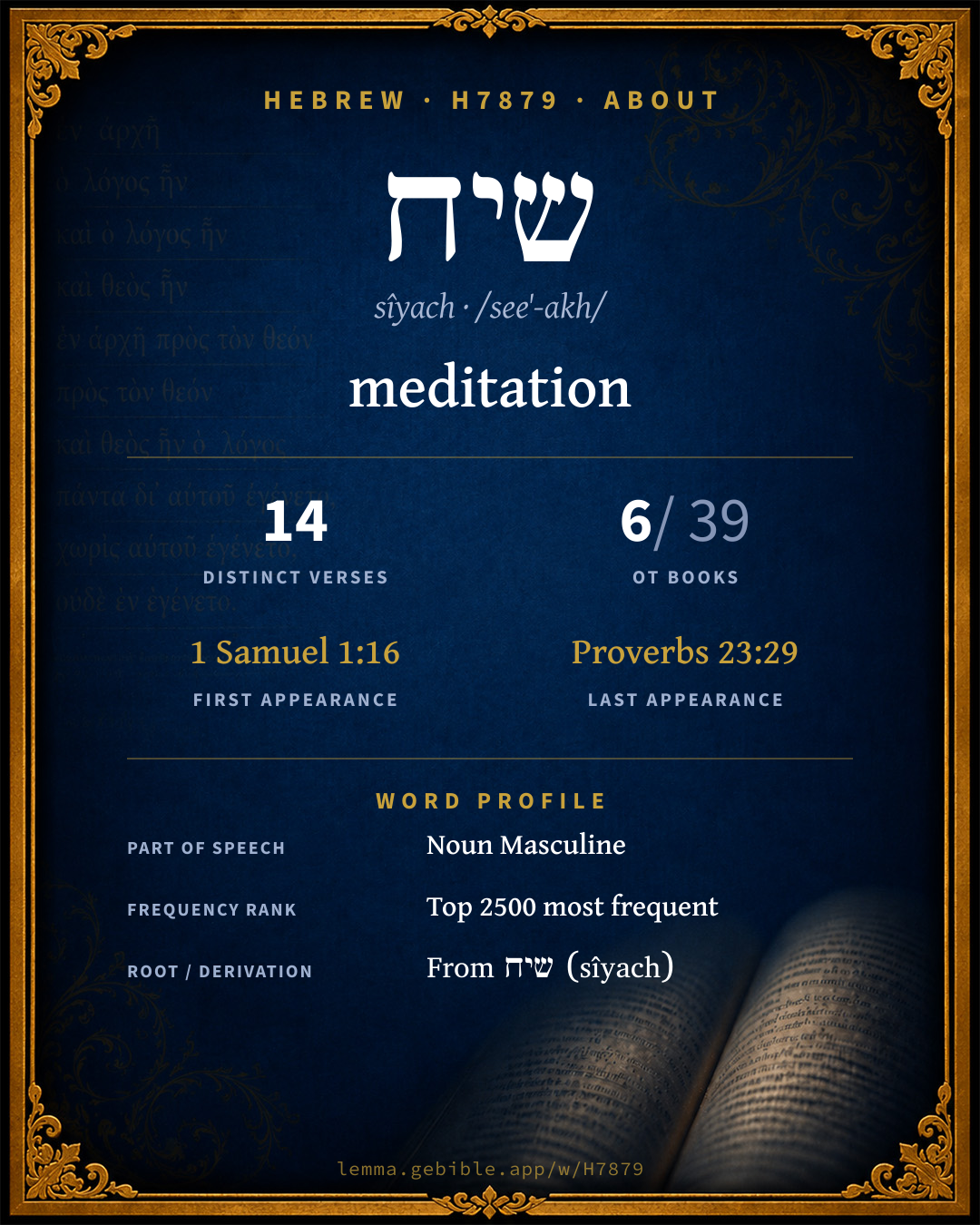
שִׂיחַ
meditation
also: complaint, musing fuller range ↓
Full lexicon entry — Brown-Driver-Briggs (BDB)
From Brown-Driver-Briggs (BDB)
Where this word appears
See every Construct-state word in the Hebrew Bible →
Grammar key — what these labels mean
Part of speech
- Noun
- A naming word — a person, place, thing, or idea.
Noun type
- Common
- A common noun — a general class of person, place, or thing (“king,” “city,” “water”), not a specific name.
State
- Construct
- A noun bound to a following noun in a possessive / “of” relationship (the construct chain).
- Absolute
- The independent form of a noun, not bound to a following word.
Gender
- Masculine
- Grammatically masculine.
Number
- Singular
- One.
Grammatical forms
- Noun, Common, Masculine, Singular, Construct 12 times (86%)
- Noun, Common, Masculine, Singular, Absolute 2 times (14%)
Parsed forms decoded from the imported morphology (morphhb / Westminster Leningrad Codex — WLC text public domain, morphhb tagging CC BY 4.0), counted across 14 parsed occurrences — not distinct verses.
Every verse where H7879 appears — 14 distinct verses across 6 books. Click any verse to open its interlinear word-by-word view. Verse text shown in the World English Bible for context — . Each verse’s Hebrew form is shown with its reference; the English is not keyword-highlighted, since the data carries no word-level English alignment. Use “Compare translations” on any verse to read it across multiple English versions. This concordance covers the Hebrew Bible; Septuagint (Greek Old Testament) occurrences are not indexed here.
1 Samuel 1 verse
1 Kings 1 verse
2 Kings 1 verse
Job 5 verses
- Job 7:13 בְ֝/שִׂיחִ֗/י prep + n c ms cs + sfx pers 1cs When I say, 'My bed shall comfort me, My couch shall ease my complaint;'
- Job 9:27 שִׂיחִ֑/י n c ms cs + sfx pers 1cs If I say, 'I will forget my complaint, I will put off my sad face, and cheer up;'
- Job 10:1 שִׂיחִ֑/י n c ms cs + sfx pers 1cs "My soul is weary of my life; I will give free course to my complaint. I will speak in the bitterness of my soul.
- Job 21:4 שִׂיחִ֑/י n c ms cs + sfx pers 1cs As for me, is my complaint to man? Why shouldn't I be impatient?
- Job 23:2 שִׂחִ֑/י n c ms cs + sfx pers 1cs "Even today is my complaint rebellious. His hand is heavy in spite of my groaning.
Psalms 5 verses
- Psalms 55:2 בְּ/שִׂיחִ֣/י prep + n c ms cs + sfx pers 1cs Attend to me, and answer me. I am restless in my complaint, and moan,
- Psalms 64:1 בְ/שִׂיחִ֑/י prep + n c ms cs + sfx pers 1cs Hear my voice, God, in my complaint. Preserve my life from fear of the enemy.
- Psalms 102:1 שִׂיחֽ/וֹ n c ms cs + sfx pers 3ms Hear my prayer, Yahweh! Let my cry come to you.
- Psalms 104:34 שִׂיחִ֑/י n c ms cs + sfx pers 1cs Let your meditation be sweet to him. I will rejoice in Yahweh.
- Psalms 142:2 שִׂיחִ֑/י n c ms cs + sfx pers 1cs I pour out my complaint before him. I tell him my troubles.
Proverbs 1 verse
About this entry
At a glance — auto-summarized from this page’s data, not written by a person. Every figure links to its source below. This summary describes the numbers; it doesn’t interpret them.
שיח — transliterated sîyach — is a Hebrew noun carrying the sense “meditation.” It first appears in 1 Samuel 1:16. With 14 verses in 6 books, it is an uncommon word in the Hebrew Bible. Its uses concentrate in Job (36% of all occurrences). It also covers “complaint” and “musing”, alongside “meditation” — see its full sense range. Each statement above links to its evidence; the full detail follows below.
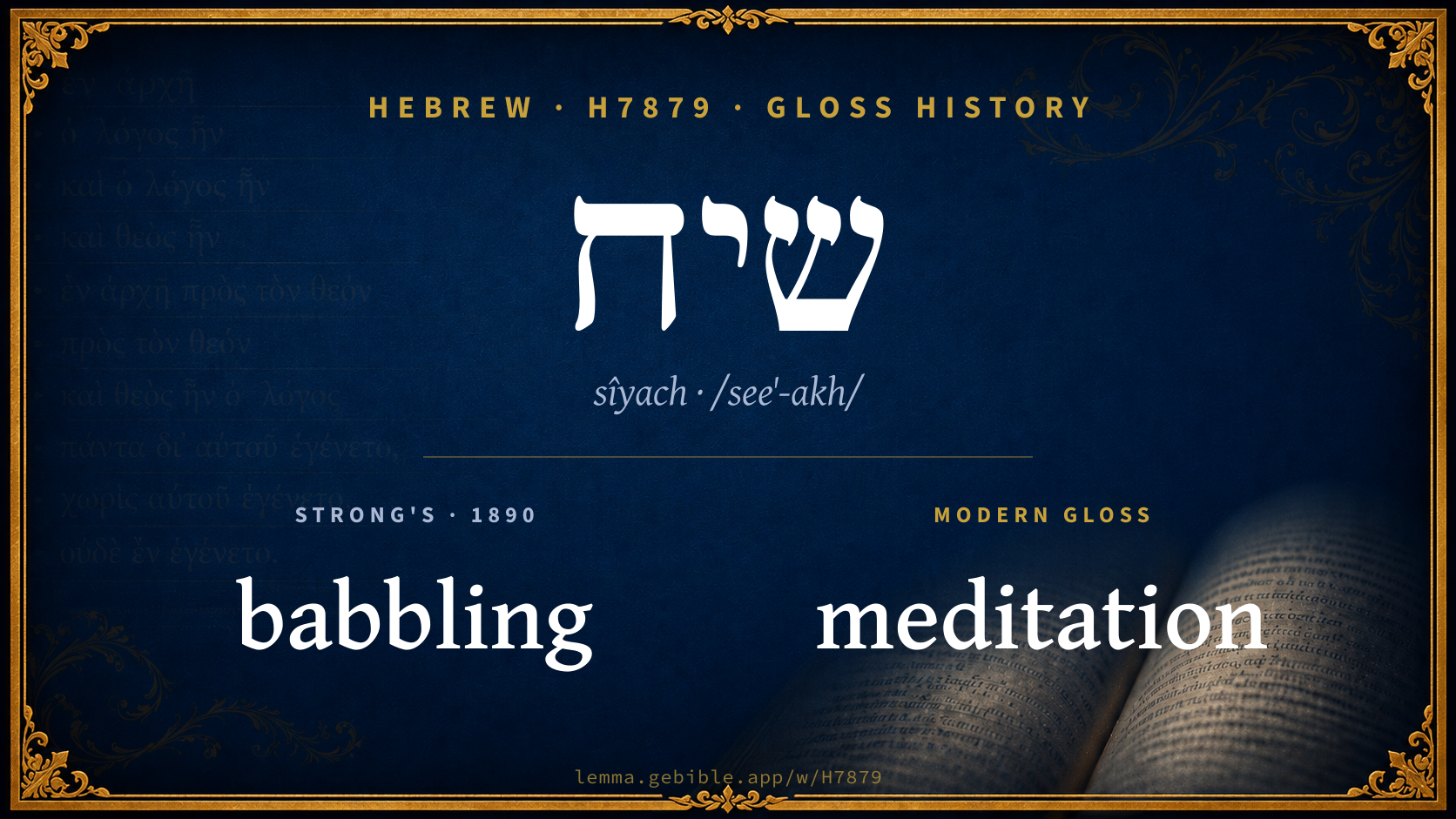
Gloss history
Strong's 1890 vs modern scholarship
About this word
Strong's H7879 catalogs a Hebrew word from the Hebrew Old Testament.
These counts are not copied from any lexicon or concordance. They are computed here, from the morphology-tagged Hebrew Old Testament. What Lemma adds →
- 14
- distinct verses
- The word appears in 14 distinct verses.
- 6 / 39
- OT books
- The word appears in 6 of 39 Old Testament books.
- #1,910
- by frequency
- Top 2500 most frequent Hebrew words (rank 1,910 of 8,640 Hebrew words by occurrence).
View all 14 occurrences in the concordance →
By section of the Old Testament
By traditional corpus
Conventional, traditional groupings — biblical authorship is debated, so this is a traditional corpus grouping, not an authorship claim. Each share is this word’s portion of its verses in that division of the Hebrew canon. Each figure is a share of the word’s 14 distinct verses.
- Writings (Ketuvim) 11 verses · 79%
- Prophets (Nevi'im) 3 verses · 21%
How translations render this word
Counts come from each version’s own published word-to-Strong’s tagging or interlinear alignment — an approximate guide to how each version renders this word, not a word-level alignment the data otherwise carries. Because each total is that version’s own tagged count, the per-version totals vary from one another and need not match the appearance or distinct-verse counts above. These counts may also differ from a printed concordance because Lemma counts each distinctly tagged rendering and does not collapse phrase taggings into a single head-word total. This is a fixed set of word-tagged versions (KJV, ASV, BSB, ULT) and does not change with the reading translation you choose elsewhere. Each version’s license is shown beside its name below (and on Sources).
BDB lists this Strong’s number as 3 distinct words (homographs). Each count above pools all of them and is not split by sense — see the Senses section below. A low-frequency rendering may belong to a different one of those words, not the primary meaning.
- King James Version†: Complaint 7×, Is my complaint 2×
- American Standard Version†: Complaint 6×
- Berean Standard Bible†: Complaint 8×
- unfoldingWord Literal Text†: Complaint 7×
King James Version Public Domain
Renders H7879 across 14† tagged occurrences — most commonly:
Plus 5 renderings that appear only once — usually multi-word phrases or single function words the recovered tagging swept in, not distinct renderings.
American Standard Version Public Domain
Renders H7879 across 13† tagged occurrences — most commonly:
Plus 7 renderings that appear only once — usually multi-word phrases or single function words the recovered tagging swept in, not distinct renderings.
Berean Standard Bible Public Domain
Renders H7879 across 14† tagged occurrences — most commonly:
Plus 6 renderings that appear only once — usually multi-word phrases or single function words the recovered tagging swept in, not distinct renderings.
unfoldingWord Literal Text CC BY-SA 4.0
Renders H7879 across 13† tagged occurrences — most commonly:
Plus 6 renderings that appear only once — usually multi-word phrases or single function words the recovered tagging swept in, not distinct renderings.
9 senses and sub-senses in the full BDB
What do BDB’s symbols mean?
BDB uses these scholarly abbreviations:
| Symbol | Meaning |
|---|---|
| 𝔊 | the Septuagint (the ancient Greek translation, LXX) |
| 𝔙 | the Vulgate (the Latin translation) |
| 𝔖 | the Syriac version (the Peshitta) |
| 𝔗 | the Targum (the Aramaic translation) |
| ψ | the Psalms |
| √ | root (the underlying root or stem) |
| ‖ | parallel passage (a synonymous or contrasted parallel) |
| † | the dagger: every passage where the word occurs is cited |
The 9 senses and sub-senses the full Brown-Driver-Briggs lexicon distinguishes for this word, in lexicon order (not ranked by frequency), with BDB’s own verbatim wording and sub-sense lettering. Shown in Hebrew script with BDB’s own scholarly abbreviations. The condensed entry is in the Lexicon Entry tab. See also the Forms in the corpus table below.
שיח I
- 1. plaint, complaint: Jb 7:13; 9:27; 10:1 (‖ מר נפשׁ), 21:4; 23:2 Pr 23:29 ψ 55:3 (‖ אָהִימָה); קוֹלִי בְּשִׂיחִי 64:2; שָׁפַךְ שׂ׳ לפני י׳ 102:1; 142:3. Foll. are dub.: e.g. Job 7:13
- 2. musing, 1 K 18:27 (E) of a god, ‖ שִׂיג לוֹ, (so RV; SS ‘nachdenken’; Buhl ‘beschäftigt sein’; AV talk); ψ 104:34 of man (Buhl SS. Bae ‘Rede, oder Gesang’).—Vid. also [שֵׂחַ] infr. e.g. 1 Kings 18:27
- 3. anxiety, trouble: מֵרֹב שִׂיחִי 1 S 1:16; (defined in MT by כַּעַס, cf. HPS; so Buhl SS, but perhaps = 1). e.g. 1 Samuel 1:16
- 4. the way in which he talks: שִׂיחוֹ 2 K 9:11. e.g. 2 Kings 9:11
שיח II denom. muse, complain, poet. talk (of)
Qal
- Impf. 3 ms. יָשִׂיחַ ψ 119:23; 3 fs. sf. תְּשִׂיחֶ֑ךָ Pr 6:22; 1 s. אָשִׂיחַ ψ 119:78 +, etc.; Imv. ms. שִׂיחַ Jb 12:8; mpl. שִׂיחוּ Ju 5:10 +; Inf. cstr. שִׂיחַ ψ 119:148;— e.g. Psalms 119:23
- 1. complain: ψ 55:18; 77:4 (both ‖ הָמָה), Jb 7:11 (בְּמַר נַפְשִׁי), + ψ 6:7 (read prob. אָשִׂיחָה for אַשְׂחֶה). e.g. Psalms 55:18
- 2. muse: עִם־לְבָבִי ψ 77:7; c. ב, meditate upon, study, God’s עֲלִילוֹת v 13 (‖ הָגָה); פִּקּוּדִים 119:15, 78; חֻקִּים v 23, 48; נִפְלָאוֹת v 27; אִמְרָה v 148; c. acc. דִּבְרֵי נִפְלְאֹתֶיךָ 145:5. e.g. Psalms 77:7
- 3.
- a. talk (about), sing (of): abs. Ju 5:10 (ode); c. ב rei, ψ 105:2 = 1 Ch 16:9 (‖ שִׁיר, זִמֵּר; so SS Gerber, but poss. = 2, so Dr), ψ 69:13 (ב pers. against; ‖ נְגִינוֹת, of mocking words). e.g. Judges 5:10
- b. c. sf. pers. talk (with) Pr 6:22 (del. Toy); c. לְ speak to Jb 12:8 (Di ‘sprich sinnend’; Hi Bu read שֶׁרֶץ; Kau חַיַּת (so Bu as altern.), Bö al. sub II. שִׂיחַ). Pôlʿel meditate, consider: Impf. 3 ms. יְשׂוֹחֵחַ Is 53:8 (abs.); 1 s. אֲשׂוֹחֵחַ ψ 143:5 (ב rei; ‖ הָגָה). e.g. Proverbs 6:22
שיח III [m.] bush, shrub, plant
Senses from the full Brown-Driver-Briggs lexicon (Brown, Driver, Briggs; Oxford 1906 — public domain), digitized via Sefaria, supplemented by the OpenScriptures HebrewLexicon (CC BY 4.0). Full attribution on Sources.
Word origin
I. n.m. ψ 104:34 complaint, musing;—abs. שׂ׳ 1 K 18:27; Pr 23:29; sf. שִׂיחִי 1 S 1:16 +, שִׂחִי Jb 23:2, שִׂיחוֹ 2 K 9:11 ψ 102:1;—
II. vb.denom. muse, complain, poet. talk (of);—
III. n.[m.] bush, shrub, plant;—שׂ׳ abs. coll. Jb 30:4, cstr. שׂ׳ הַשָּׂדֶה Gn 2:5 (J); pl. שִׂיחִים Jb 30:7, אַחַד הַשִּׂיחִם Gn 21:15 (E).
— Brown-Driver-Briggs (Oxford 1906, public domain), digitized via Sefaria, supplemented by the OpenScriptures HebrewLexicon (CC BY 4.0). See Sources.
Derived from שיח (sîyach) (H7878) — to meditate.
Jastrow Dictionary
A second Hebrew/Aramaic lexicon for comparison, covering Aramaic and post-biblical (Talmudic, Targumic, Midrashic) usage that the biblical-Hebrew BDB does not. Matched by lemma rather than by Strong’s number, so a lemma may carry more than one Jastrow headword (shown separately below), and the entries cover usage well beyond the Bible.
שִׂיחַ
- to think, talk, v. סוּחַ.
שֵׂיחַ
- thought, talk. Ḥag. 5ᵇ (ref. to Am. IV, 13) עבד שרבו … מה שֵׂיחוֹ תקנה יש לו is there a remedy (subterfuge) for a slave whose master can tell him what he thinks?; Yalk. Am. 542.—V. סִיחָה. e.g. Amos 4:13
שִׂיחַ ²
- (b. h.) plant, tree. — Pl. שִׂיחִין. B. Bath. 78ᵇ (play on סיחון, Num. XXI, 28) מקרית צדיקים שנקראו ש׳ from the city of the righteous who are named trees (as Ps. XCII, 13; v. Snh. 93ᵃ); Yalk. Num. 765. e.g. Numbers 21:28
שַׂיָּח
- (שוח = שָׂחָה) swimmer. — Pl. שַׂיָּחִין. Tosef. Ter. VII, 14 חבית של ש׳ ed. Zuck. (Var. שַׁיָּטִין; שועין, corr. acc.) the swimmers’ bottle, v. חָבִית; Y. ib. VIII, 45ᵈ bot. חבית ש׳ (insert של).
שָׁיֵחַ
- , v. שׁוּח ch.
שִׁיחַ
- (שׁוּחַ) ditch. B. Kam. V, 5, v. בּוֹר II. Erub. II, 5; a. fr.—Pl. שִׁיחִים, שִׁיחִין. B. Bath. III, 1. Tanḥ. Haăz. 1 כעקרב מוטל לארץ ולש׳ like a scorpion that lies on the ground and in ditches. B. Kam. 50ᵃ חופר בורות ש׳ וכ׳ digger of wells, ditches, and caves; Tosef. ib. VI, 5 חופר ש׳, v. נְחוּנְיָא; a. e.
שִׁיחַ ²
- , pit, cavity. Targ. Ps. XXXV, 7, a. e., v. שְׁיַיח.—Pl. שִׁיחִין, שִׁיחַיָּא, שִׁיחַיָּה. Targ. Zech. XIV, 10 שִׁיחֵי מלכא (h. text יקבי המלך), v. infra.—Pesik. Ronni, p. 143ᵃ; Yalk. Is. 334 (expl. יקבי המלך) עד ש׳ דיפו, v. יָפוֹ; Cant. R. to VII, 5.
A Dictionary of the Targumim, the Talmud Babli and Yerushalmi, and the Midrashic Literature (Marcus Jastrow; London, Luzac, 1903) — Public Domain. Digitized via Sefaria. Digitized via Sefaria. Full attribution on Sources.
Forms in the corpus
The 9 distinct written forms H7879 takes in the Hebrew Bible, most frequent first — each parse links to that state’s occurrences in the concordance. Hebrew forms include their vowel points and cantillation, so a single lemma takes many written forms.
| Form | Parsing | Example | Uses |
|---|---|---|---|
| שִׂיחִ֑/י | Noun, Common, Masculine, Singular, Construct | Job 9:27 | 5 |
| שִׂיחֽ/וֹ | Noun, Common, Masculine, Singular, Construct | 2 Kings 9:11 | 2 |
| בְ/שִׂיחִ֑/י | Noun, Common, Masculine, Singular, Construct | Psalms 64:1 | 1 |
| בְ֝/שִׂיחִ֗/י | Noun, Common, Masculine, Singular, Construct | Job 7:13 | 1 |
| בְּ/שִׂיחִ֣/י | Noun, Common, Masculine, Singular, Construct | Psalms 55:2 | 1 |
| שִׂ֗יחַ | Noun, Common, Masculine, Singular, Absolute | Proverbs 23:29 | 1 |
| שִׂ֧יחַ | Noun, Common, Masculine, Singular, Absolute | 1 Kings 18:27 | 1 |
| שִׂחִ֑/י | Noun, Common, Masculine, Singular, Construct | Job 23:2 | 1 |
| שִׂיחִ֛/י | Noun, Common, Masculine, Singular, Construct | 1 Samuel 1:16 | 1 |
Same root — word family
Other BDB entries built from the same root as H7879, grouped by Strong’s listed origin. These share a root / origin per the lexicon — not necessarily a shared meaning. Each links to that word’s own entry.
Derives from
Shares the same root
Derived from this word
Compare all same-root words → Showing 4 of 5 — not the complete family. They share a root, not necessarily a meaning.
Septuagint verse parallels
This word appears in 14 verses that also exist in the Greek Old Testament (Septuagint), out of the 14 Hebrew verses it occurs in. You can read those verses in Greek by switching the Old Testament edition to the Septuagint.
Read these verses in the Septuagint
This is a verse-level parallel only — the same verses exist in both the Hebrew and Greek Old Testaments. No word-level Hebrew↔Greek correspondence is claimed: the data carries no such alignment, so no Greek word is shown as this Hebrew word’s translation. Coverage is not total — the Septuagint omits the deuterocanon and renumbers the Psalms, so some Hebrew verses have no direct Greek parallel.