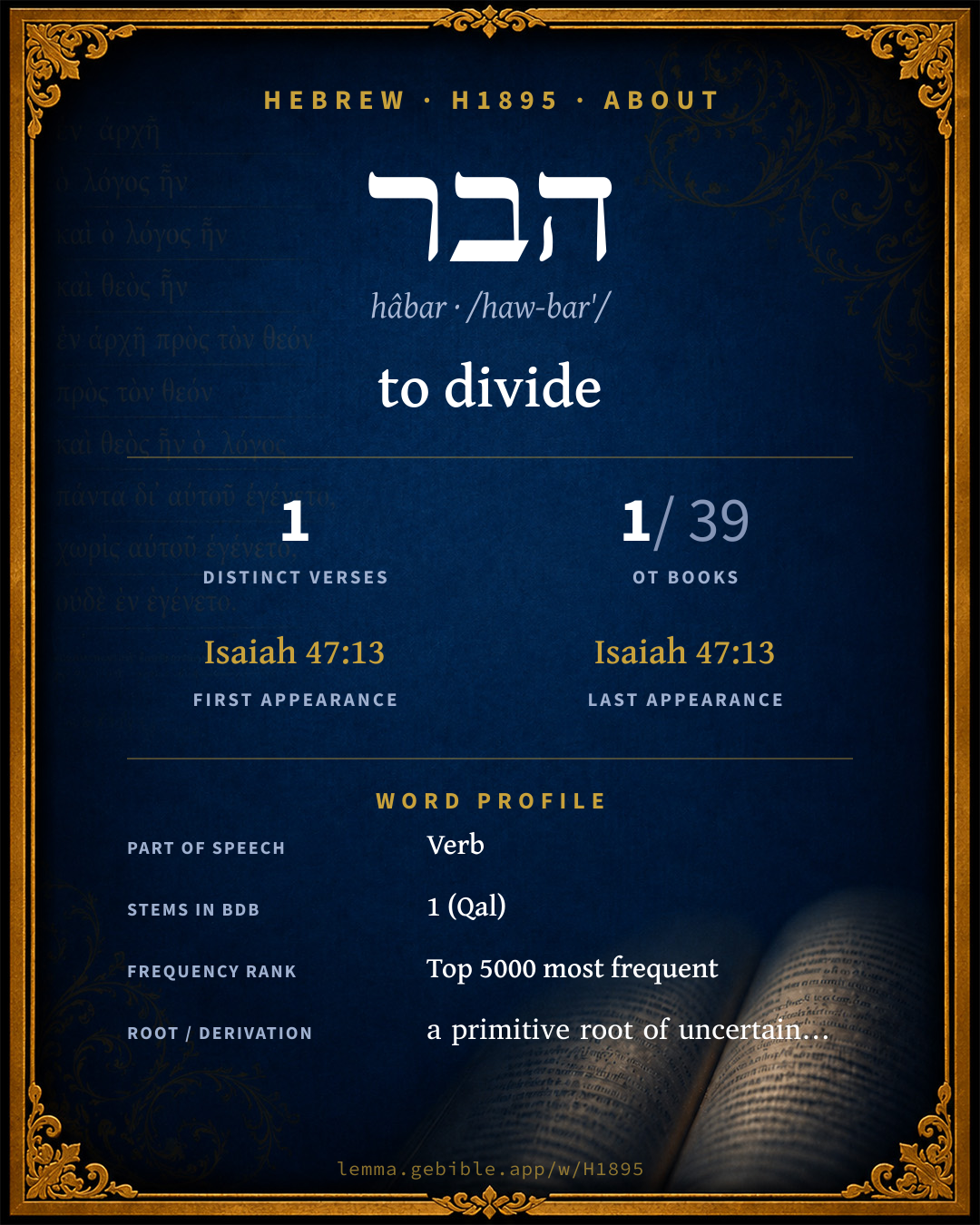
הָבַר
to divide
‘to divide’ is one of 2 main senses fuller range ↓
Full lexicon entry — Brown-Driver-Briggs (BDB)
From Brown-Driver-Briggs (BDB)
Where this word appears
Grammar key — what these labels mean
Part of speech
- Verb
- An action or state-of-being word.
Stem
- Qal
- The basic, simple active stem — the plain form of the verb (“he wrote”).
Form
- Perfect
- A completed action or state — Hebrew marks aspect (completeness) more than strict tense (“he wrote”).
- Participle Active
- A verbal adjective expressing ongoing or characteristic action (“writing / one who writes”).
State
- Construct
- A noun bound to a following noun in a possessive / “of” relationship (the construct chain).
Person
- 3rd Person
- The one spoken about (“he / she / it / they”).
Gender
- Common
- Either gender — not distinguished for this form.
- Masculine
- Grammatically masculine.
Number
- Plural
- More than one (in Hebrew, generally three or more).
Grammatical forms
- Verb, Qal, Perfect, 3rd Person, Common, Plural 1 time (50%)
- Verb, Qal, Participle Active, Masculine, Plural, Construct 1 time (50%)
Parsed forms decoded from the imported morphology (morphhb / Westminster Leningrad Codex — WLC text public domain, morphhb tagging CC BY 4.0), counted across 2 parsed occurrences — not distinct verses.
Every verse where H1895 appears — 1 distinct verse across 1 book. Click any verse to open its interlinear word-by-word view. Verse text shown in the World English Bible for context — . Each verse’s Hebrew form is shown with its reference; the English is not keyword-highlighted, since the data carries no word-level English alignment. Use “Compare translations” on any verse to read it across multiple English versions. This concordance covers the Hebrew Bible; Septuagint (Greek Old Testament) occurrences are not indexed here.
Isaiah 1 verse
About this entry
At a glance — auto-summarized from this page’s data, not written by a person. Every figure links to its source below. This summary describes the numbers; it doesn’t interpret them.
At its core, הבר (hâbar) means “to divide.” A scarce word — 1 verse in all of the Hebrew Bible. The word gravitates to Isaiah (100%). A true hapax — its single appearance is Isaiah 47:13. Not a single-sense word: explore its full sense range. Each statement above links to its evidence; the full detail follows below.
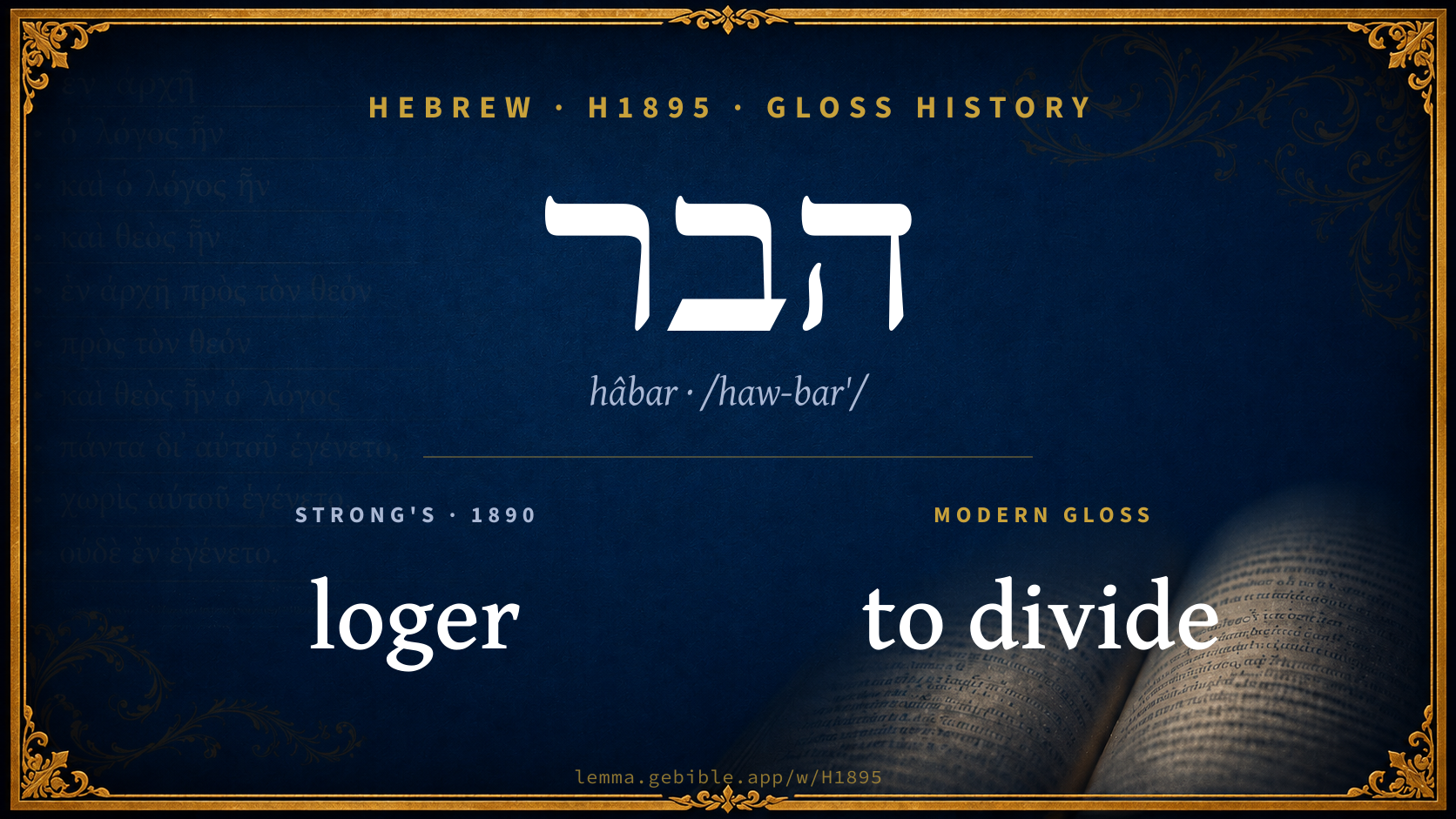
Gloss history
Strong's 1890 vs modern scholarship
About this word
Strong's H1895 catalogs a Hebrew word from the Hebrew Old Testament.
These counts are not copied from any lexicon or concordance. They are computed here, from the morphology-tagged Hebrew Old Testament. What Lemma adds →
- 1
- distinct verses
- The word appears in 1 distinct verse.
- 1 / 39
- OT books
- The word appears in 1 of 39 Old Testament books.
- #4,807
- by frequency
- Top 5000 most frequent Hebrew words (rank 4,807 of 8,640 Hebrew words by occurrence).
View all 1 occurrence in the concordance →
Most concentrated in
- Isaiah 1 verse 100%
By section of the Old Testament
By traditional corpus
Conventional, traditional groupings — biblical authorship is debated, so this is a traditional corpus grouping, not an authorship claim. Each share is this word’s portion of its verses in that division of the Hebrew canon. Each figure is a share of the word’s 1 distinct verse.
- Prophets (Nevi'im) 1 verse · 100%
How translations render this word
Counts come from each version’s own published word-to-Strong’s tagging or interlinear alignment — an approximate guide to how each version renders this word, not a word-level alignment the data otherwise carries. Because each total is that version’s own tagged count, the per-version totals vary from one another and need not match the appearance or distinct-verse counts above. These counts may also differ from a printed concordance because Lemma counts each distinctly tagged rendering and does not collapse phrase taggings into a single head-word total. This is a fixed set of word-tagged versions (KJV, ASV, BSB, ULT) and does not change with the reading translation you choose elsewhere. Each version’s license is shown beside its name below (and on Sources).
- King James Version: Let now the astrologers 1×
- American Standard Version: Let now the astrologers 1×
- Berean Standard Bible: Astrologers 1×
- unfoldingWord Literal Text: Dividers of 1×
King James Version Public Domain
Renders H1895 across 1 tagged occurrence — most commonly:
American Standard Version Public Domain
Renders H1895 across 1 tagged occurrence — most commonly:
Berean Standard Bible Public Domain
Renders H1895 across 1 tagged occurrence — most commonly:
unfoldingWord Literal Text CC BY-SA 4.0
Renders H1895 across 1 tagged occurrence — most commonly:
Senses in the full BDB
What do BDB’s symbols mean?
BDB uses these scholarly abbreviations:
| Symbol | Meaning |
|---|---|
| 𝔊 | the Septuagint (the ancient Greek translation, LXX) |
| 𝔙 | the Vulgate (the Latin translation) |
| 𝔖 | the Syriac version (the Peshitta) |
| 𝔗 | the Targum (the Aramaic translation) |
| ψ | the Psalms |
| √ | root (the underlying root or stem) |
| ‖ | parallel passage (a synonymous or contrasted parallel) |
| † | the dagger: every passage where the word occurs is cited |
The 1 sense the full Brown-Driver-Briggs lexicon distinguishes for this word, in lexicon order (not ranked by frequency), with BDB’s own verbatim wording and sub-sense lettering. Shown in Hebrew script with BDB’s own scholarly abbreviations. The condensed entry is in the Lexicon Entry tab. See also the Forms in the corpus table below.
Qal
- Is 47:13 Kt, they that divide the heavens, that gaze at the stars; ה׳ then refers to the distinguishing of signs of the zodiac, or other astrological division of the sky e.g. Isaiah 47:13
Senses from the full Brown-Driver-Briggs lexicon (Brown, Driver, Briggs; Oxford 1906 — public domain), digitized via Sefaria, supplemented by the OpenScriptures HebrewLexicon (CC BY 4.0). Full attribution on Sources.
Word origin
Origin: a primitive root of uncertain derivation
Jastrow Dictionary
A second Hebrew/Aramaic lexicon for comparison, covering Aramaic and post-biblical (Talmudic, Targumic, Midrashic) usage that the biblical-Hebrew BDB does not. Matched by lemma rather than by Strong’s number, so a lemma may carry more than one Jastrow headword (shown separately below), and the entries cover usage well beyond the Bible.
בַּר I
- [empty, open]
- 1. uncultivated ground, forest, prairie; opp. יישוב. Kil. VIII, 6. Ḥull. 80ᵃ שור הבר the ox of the prairie, buffalo. Ib. איל הב׳ forest ram. Y. Sabb. XIV, 14ᵇ bot. חזיר של ב׳ wild swine.
- 2. clear, visible, whence the outside, surface, opp. תוך. Yoma 72ᵇ a scholar שאין תוכו כבָרוֹ whose inside is not as his outside (who is insincere); Ber. 28ᵃ. Y. Pes. VII, 34ᵃ bot. תוך בר the inner parts of the Passover lamb must hang outside (not be put inside, v. R. Akiba in Mish. ib. VII, 1); Mekh. Bo, 6 תוך ובר (read תוכו בר); Pes. 74ᵃ R. Ish. called it תוך בר Ar. s. v. תך 2 (ed. תוך תוך, Var. in Rashi a. Ar. תוכברא q. v.).
בַּר
- 1. (= h. שָׂדֶה, יַעַר) forest, prairie &c. Targ. Ps. L, 10 sq. &c. Targ. Ps. L, 10 sq. Targ. O. Gen. III, 1; a. e.
- 2. (adj.) living in the forest &c., wild. Targ. Ps. l. c. Var. תרנגול ברא; Sabb. 78ᵃ תרנגולא ב׳ Ms. M. (ed. … לת) woodcock (hen of the prairie).—
- *3. peel. Ib. 139ᵇ ב׳ דתומא the peel of garlic; [Rashi, expl. צלע, must have read אברא].
- 4. (= h. חוּץ) outside, outdoors, street. Targ. Gen. XXXIV, 31 נפקת ב׳ a prostitute, v. חוּץ II; a. fr.—Y. Kil. IX, 32ᵇ מאן בעי לך לבר who wants thee outside? (an intimation to leave the room). Snh. 62ᵃ; 62ᵇ; Sabb. 106ᵃ, a. e. פוק תני לברא go out and teach it in the street (i.e. your tradition is rejected).—תנא ברא a Tannai not recorded in the Mishnah, v. בָּרַיְיתָא. M. Kat. 17ᵇ (Rashi: האי תנא דברייתא); B. Bath. 93ᵇ Ar. (ed. בתרא); cmp. בָּרָאָה.—4) (prep. a. adv.) outside; בר מן outside of, except, without. Targ. O. Gen. XIV, 24; a. fr.—Ber. 38ᵇ ב׳ מן דין וב׳ וכ׳ without this and without that, i.e. apart from these two arguments. Y. Erub. VII, end 24ᵈ ב׳ מדעתיה without his knowledge; a. fr.—Ḥull. 62ᵇ וסימניך ב̇ר̇ מיניה and thy mnemonical sign (as to צרדא a. ב̇ר̇דא, the one being forbidden, the other permitted) be: keep aloof from it (ב̇ר̇דא).—Trnsf. restriction (everywhere except …), proviso. Succ. 45ᵇ; Snh. 97ᵇ who enter the heavenly courts בב׳ with certain qualifications (by special grant), בלא ב׳ without any restrictions.—לְבַר, מִלְּבַר apart from, outside, exclusively. Cant. R. to VII, 8 לב׳ מישראל except the Israelites. Ḥull. 98ᵃ sixty one, בהדי דידה או … לב׳ מינה the one (egg) included or excluded? B. Bath. 90ᵇ שתותא מלב׳ the sixth part (as an addition) is outside, i.e. to each five portions one is added, an addition of twenty percent, opp. מִלְגֵו. B. Mets. 53ᵇ, v. חוּמְשָׁא.
בַּר II
- (b. h. בַּר poetic; ברי) son, offspring. Targ. Gen. IV, 25; a. v. fr.—ב׳ שמואל son of Sam.; … בְּרֵיה דר׳ son of … Ber. 3ᵃ. Ḥull. 11ᵃ; a. v. fr.—B. Mets. 110ᵃ … בְּרָהּ דבת the son of the daughter of … Sabb. 116ᵇ במקום ברא ברתא וכ׳ where there is a son, the daughter cannot inherit. Y. Shebi. IX, 39ᵃ bot. אמה דהן ילדת ב׳ this nan’s mother has born a son, i.e. she may be proud of him; Y. Ab. Zar. IV, 43ᵈ אית לאימיה ב׳ (not ואית); a. v. fr.—Pl. [בְּרִין, בְּרֵי. Targ. Y. Ex. X, 9 (some ed.). Targ. Ps. CXXVII, 5 Ms.] בְּנִין, בְּנֵי, בְּנַיָּא. Targ. Gen. V, 4 בְּנִין וּבְנָן sons and daughters; a. fr.—Keth. IV, 10 (in a marriage contract) בנין דכרין male issue, opp. בְּנָן נוקבין, ib. 11.—Ber. 10ᵃ ב׳ דמעלו good children. Y. B. Bath. VIII, 16ᵇ bot. אין הוון בנוי דהנייה (read בָּנַיי) if my children turn out well; a. v. fr.—בר בר, בר בת grandson. Esth. R. introd. (expl. נין ונכד) בר ובר בר (not וברבר) son and grandson; a. fr.
- [The meaning of בר in compounds is generally the same as of בן a. בעל, e.g. ב׳ אולפן a scholar, ב׳ אמודאי a diver, ב׳ שטיא a maniac, ב׳ דעת a rational being. בר בי רב, v. בֵּי. For compounds which are not self-evident, see the respective determinants.]
בַּר III
- clear, bright, clean, pure. Tosef. Kil. III, 6 (missing in ed. Zuckerm., v. Var. a. l.) שהוא בר ובקי וכ׳ who is clear and well-versed in &c. Num. R. s. 10 (ref. to ברי Prov. XXXI, 2, a. בר Ps. II, 12) the Law שהיא נקראת בר which is called bar (clear, pure, Ps. XIX, 9).—Pl. בָּרִים. Ib. e.g. Proverbs 31:2
בַּר IV
- v. בָּרַר) [sifted] grain. Ber. 55ᵃ כשם שא"א לבר בלא וכ׳ as there can be no grain without straw, so there is no dream without idle things; Ned. 8ᵃ
A Dictionary of the Targumim, the Talmud Babli and Yerushalmi, and the Midrashic Literature (Marcus Jastrow; London, Luzac, 1903) — Public Domain. Digitized via Sefaria. Digitized via Sefaria. Full attribution on Sources.
Forms in the corpus
The 2 distinct written forms H1895 takes in the Hebrew Bible, most frequent first — each parse links to that stem’s occurrences in the concordance. Hebrew forms include their vowel points and cantillation, so a single lemma takes many written forms.
| Form | Parsing | Example | Uses |
|---|---|---|---|
| הֹבְרֵ֣י | Verb, Qal, Participle Active, Masculine, Plural, Construct | Isaiah 47:13 | 1 |
| הברו | Verb, Qal, Perfect, 3rd Person, Common, Plural | Isaiah 47:13 | 1 |
Septuagint verse parallels
This word appears in 1 verse that also exists in the Greek Old Testament (Septuagint), out of the 1 Hebrew verse it occurs in. You can read those verses in Greek by switching the Old Testament edition to the Septuagint.
Read these verses in the Septuagint
This is a verse-level parallel only — the same verses exist in both the Hebrew and Greek Old Testaments. No word-level Hebrew↔Greek correspondence is claimed: the data carries no such alignment, so no Greek word is shown as this Hebrew word’s translation. Coverage is not total — the Septuagint omits the deuterocanon and renumbers the Psalms, so some Hebrew verses have no direct Greek parallel.