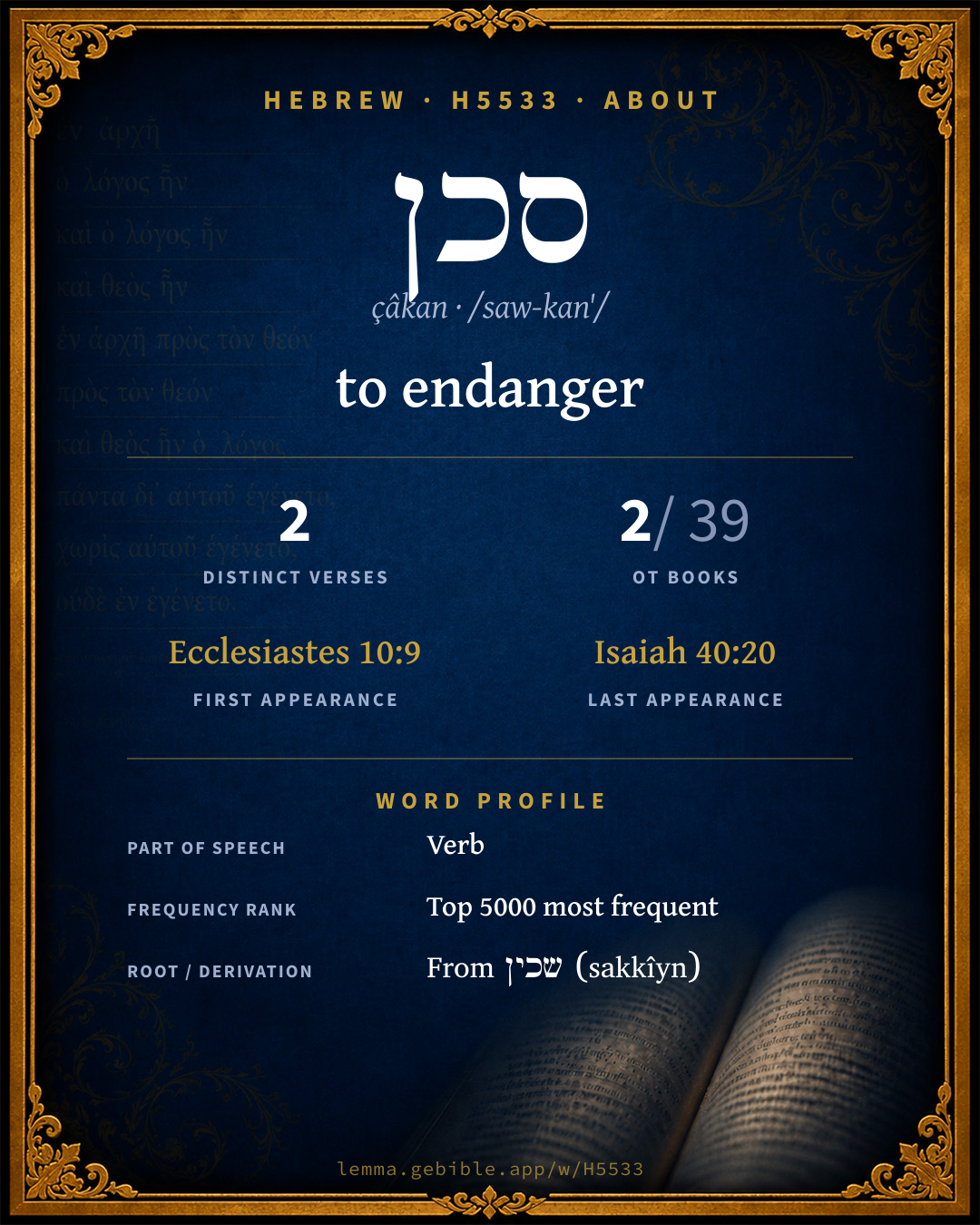
סָכַן
to endanger
‘to endanger’ is one of 2 main senses fuller range ↓
Full lexicon entry — Brown-Driver-Briggs (BDB)
From Brown-Driver-Briggs (BDB)
Where this word appears
See every Niphal verb in the Hebrew Bible →
Grammar key — what these labels mean
Part of speech
- Verb
- An action or state-of-being word.
Stem
- Pual
- The passive counterpart of the Piel.
- Niphal
- Usually the simple passive or reflexive of the Qal (“he was written”).
Form
- Participle Passive
- A verbal adjective expressing action received (“written”).
- Imperfect
- An incomplete, ongoing, or future action (“he will / would write”).
State
- Absolute
- The independent form of a noun, not bound to a following word.
Person
- 3rd Person
- The one spoken about (“he / she / it / they”).
Gender
- Masculine
- Grammatically masculine.
Number
- Singular
- One.
Grammatical forms
- Verb, Pual, Participle Passive, Masculine, Singular, Absolute 1 time (50%)
- Verb, Niphal, Imperfect, 3rd Person, Masculine, Singular 1 time (50%)
Parsed forms decoded from the imported morphology (morphhb / Westminster Leningrad Codex — WLC text public domain, morphhb tagging CC BY 4.0), counted across 2 parsed occurrences — not distinct verses.
Every verse where H5533 appears — 2 distinct verses across 2 books. Click any verse to open its interlinear word-by-word view. Verse text shown in the World English Bible for context — . Each verse’s Hebrew form is shown with its reference; the English is not keyword-highlighted, since the data carries no word-level English alignment. Use “Compare translations” on any verse to read it across multiple English versions. This concordance covers the Hebrew Bible; Septuagint (Greek Old Testament) occurrences are not indexed here.
Ecclesiastes 1 verse
Isaiah 1 verse
About this entry
At a glance — auto-summarized from this page’s data, not written by a person. Every figure links to its source below. This summary describes the numbers; it doesn’t interpret them.
At its core, סכן (çâkan) means “to endanger.” With only 2 verses it sits in the long tail of Hebrew Bible vocabulary. The word gravitates to Ecclesiastes (50%), then Isaiah. It first appears in Ecclesiastes 10:9. Ranging over 2 senses, it is not a single-sense word. Dig into 2-verse concordance and the renderings breakdown below.
Gloss history
Strong's 1890 vs modern scholarship
About this word
Strong's H5533 catalogs a Hebrew word from the Hebrew Old Testament.
These counts are not copied from any lexicon or concordance. They are computed here, from the morphology-tagged Hebrew Old Testament. What Lemma adds →
- 2
- distinct verses
- The word appears in 2 distinct verses.
- 2 / 39
- OT books
- The word appears in 2 of 39 Old Testament books.
- #4,807
- by frequency
- Top 5000 most frequent Hebrew words (rank 4,807 of 8,640 Hebrew words by occurrence).
View all 2 occurrences in the concordance →
Most concentrated in
- Ecclesiastes 1 verse 50%
- Isaiah 1 verse 50%
By section of the Old Testament
By traditional corpus
Conventional, traditional groupings — biblical authorship is debated, so this is a traditional corpus grouping, not an authorship claim. Each share is this word’s portion of its verses in that division of the Hebrew canon. Each figure is a share of the word’s 2 distinct verses.
- Prophets (Nevi'im) 1 verse · 50%
- Writings (Ketuvim) 1 verse · 50%
How translations render this word
Counts come from each version’s own published word-to-Strong’s tagging or interlinear alignment — an approximate guide to how each version renders this word, not a word-level alignment the data otherwise carries. Because each total is that version’s own tagged count, the per-version totals vary from one another and need not match the appearance or distinct-verse counts above. These counts may also differ from a printed concordance because Lemma counts each distinctly tagged rendering and does not collapse phrase taggings into a single head-word total. This is a fixed set of word-tagged versions (KJV, ASV, BSB, ULT) and does not change with the reading translation you choose elsewhere. Each version’s license is shown beside its name below (and on Sources).
BDB lists this Strong’s number as 2 distinct words (homographs). Each count above pools all of them and is not split by sense — see the Senses section below. A low-frequency rendering may belong to a different one of those words, not the primary meaning.
- King James Version†: He that is so impoverished 1×, Shall be endangered 1×
- American Standard Version†: He that is too impoverished 1×, Is endangered thereby 1×
- Berean Standard Bible†: Endangers himself 1×, One lacking 1×
- unfoldingWord Literal Text†: One impoverished 1×, Will be endangered 1×
King James Version Public Domain
Renders H5533 across 2† tagged occurrences — most commonly:
American Standard Version Public Domain
Renders H5533 across 2† tagged occurrences — most commonly:
Berean Standard Bible Public Domain
Renders H5533 across 2† tagged occurrences — most commonly:
unfoldingWord Literal Text CC BY-SA 4.0
Renders H5533 across 2† tagged occurrences — most commonly:
Senses in the full BDB
What do BDB’s symbols mean?
BDB uses these scholarly abbreviations:
| Symbol | Meaning |
|---|---|
| 𝔊 | the Septuagint (the ancient Greek translation, LXX) |
| 𝔙 | the Vulgate (the Latin translation) |
| 𝔖 | the Syriac version (the Peshitta) |
| 𝔗 | the Targum (the Aramaic translation) |
| ψ | the Psalms |
| √ | root (the underlying root or stem) |
| ‖ | parallel passage (a synonymous or contrasted parallel) |
| † | the dagger: every passage where the word occurs is cited |
The 0 senses and sub-senses the full Brown-Driver-Briggs lexicon distinguishes for this word, in lexicon order (not ranked by frequency), with BDB’s own verbatim wording and sub-sense lettering. Shown in Hebrew script with BDB’s own scholarly abbreviations. The condensed entry is in the Lexicon Entry tab. See also the Forms in the corpus table below.
סכן I incur danger
סכן II be poor
Senses from the full Brown-Driver-Briggs lexicon (Brown, Driver, Briggs; Oxford 1906 — public domain), digitized via Sefaria, supplemented by the OpenScriptures HebrewLexicon (CC BY 4.0). Full attribution on Sources.
Word origin
II. סָכַן vb. incur danger (late);— Niph. Ec 10:9
III. [ סָכַן ] vb. (so most) be poor, but v. infr.;— Pu. Is 40:20
— Brown-Driver-Briggs (Oxford 1906, public domain), digitized via Sefaria, supplemented by the OpenScriptures HebrewLexicon (CC BY 4.0). See Sources.
Derived from שכין (sakkîyn) (H7915) — knife.
Jastrow Dictionary
A second Hebrew/Aramaic lexicon for comparison, covering Aramaic and post-biblical (Talmudic, Targumic, Midrashic) usage that the biblical-Hebrew BDB does not. Matched by lemma rather than by Strong’s number, so a lemma may carry more than one Jastrow headword (shown separately below), and the entries cover usage well beyond the Bible.
סָכַן I
- Saf. of כון, כנן; cmp. Targ. Y. Num. XXII, 30) to arrange, manage.—Denom. (b. h.) סֹכֵן; מִסְכֵּן q. v.
- to supply (rations to the poor); to give niggardly.—Part. pass. מְסוּכָּן. Midr. Prov. ch. XXII, v. מִסְכֵֹּן I.
סְכַן
- ; Af. אַסְכֵּן to arrange. Targ. Ps. CXXXIX, 3 (h. text הסכנת).
- to be trained, prepared. Targ. Job XXXIV, 9 (h. text יסכן).
סָכַן II
- , Pi. סִכֵּן to be perplexed; to despair; to be in danger. Ber. I, 3 וסִכַּנְתִּי בעצמי וכ׳ and I despaired of my life on account of robbers (whom I met there); Y. ib. 3ᵇ bot. וסִיכַּ׳. Men. 64ᵇ בזוב סִיכְּנָה, v. זוֹב; בעינה ס׳ she was in danger of losing her eye-sight; בים ס׳ she was in danger of drowning in the sea.—Part. pass. מְסוּכָּן; f. מְסוּכֶּנֶת q. v.
- 1. to become confused, to be misled;
- 2. to be exposed to danger. Tosef. Meg. I, 3; Meg. 2ᵃ Var. הואיל ומִסְתַּכְּנִין בה, v. סָכַל II; Y. ib. I, 70ᵈ במקום שנכנסין וכ׳ (read: שמסתכנין, or שנִסְכָּנִין, Nif.) where people might be misled, they must read the M’gillah on the fourteenth; ר׳ יוסי בעי אם במקום שנכנסין אל יקראו וכ׳ (correct as above) R. José (taking מסתכנין in the sense of being in danger) objected, if danger to life is connected with reading the M’gillah, let them not read it at all.
סְכֵן
- Y. Shebi. IV, 35ᵇ top וסכין and got himself into trouble. Y. Ab. Zar. II, 40ᵈ bot. רחם … וס׳ fell in love with a woman …, and became dangerously ill.; Y. Sabb. XIV, 14ᵈ bot. Y. Ab. Zar. l. c. ומשתי ולא יִסְכַּן and let him drink it, that he may not get ill. Y. Shek. V, 48ᵈ בעינה סַכְנַת she was in danger of losing her eye-sight; בימה ס׳ she was in danger of drowning &c., v. preced. Y. Ab. Zar. III, 42ᶜ וסַכְנָן נפשתא (not וסכנתן) human lives were in danger; a. fr.
- to expose to danger; to hurt; to mislead, bring into trouble. Ber. 25ᵇ סַכַּנְתּוּן לברי you might have brought my son into trouble (by causing him to sin unawares). Sabb. 116ᵃ בעו לסַכּוּנֵיה they tried to give him trouble; a. fr.—Part. pass. מְסַכַּן; f. מְסַכְּנָא. Targ. II Sam. XXII, 5.—Y. Peah VIII, 21ᵃ top עד דהוא מצמית לון הוא מס׳ until he gets them together for a meeting, he might be in danger (of starving).
- to be exposed to danger, be hurt; to be in trouble. Targ. Y. Deut. XXV, 3. Targ. Ps. CXIX, 109.—Pes. 112ᵇ וא׳ ליה and he might be injured; ib. ומִסְתַּכֵּן. Keth. 61ᵃ אי לאו … אִסְתַּכְּנִי if he had not given it to me, I should have become seriously ill; a. e.
A Dictionary of the Targumim, the Talmud Babli and Yerushalmi, and the Midrashic Literature (Marcus Jastrow; London, Luzac, 1903) — Public Domain. Digitized via Sefaria. Digitized via Sefaria. Full attribution on Sources.
Forms in the corpus
The 2 distinct written forms H5533 takes in the Hebrew Bible, most frequent first — each parse links to that stem’s occurrences in the concordance. Hebrew forms include their vowel points and cantillation, so a single lemma takes many written forms.
| Form | Parsing | Example | Uses |
|---|---|---|---|
| הַֽ/מְסֻכָּ֣ן | Verb, Pual, Participle Passive, Masculine, Singular, Absolute | Isaiah 40:20 | 1 |
| יִסָּ֥כֶן | Verb, Niphal, Imperfect, 3rd Person, Masculine, Singular | Ecclesiastes 10:9 | 1 |
Septuagint verse parallels
This word appears in 2 verses that also exist in the Greek Old Testament (Septuagint), out of the 2 Hebrew verses it occurs in. You can read those verses in Greek by switching the Old Testament edition to the Septuagint.
Read these verses in the Septuagint
This is a verse-level parallel only — the same verses exist in both the Hebrew and Greek Old Testaments. No word-level Hebrew↔Greek correspondence is claimed: the data carries no such alignment, so no Greek word is shown as this Hebrew word’s translation. Coverage is not total — the Septuagint omits the deuterocanon and renumbers the Psalms, so some Hebrew verses have no direct Greek parallel.