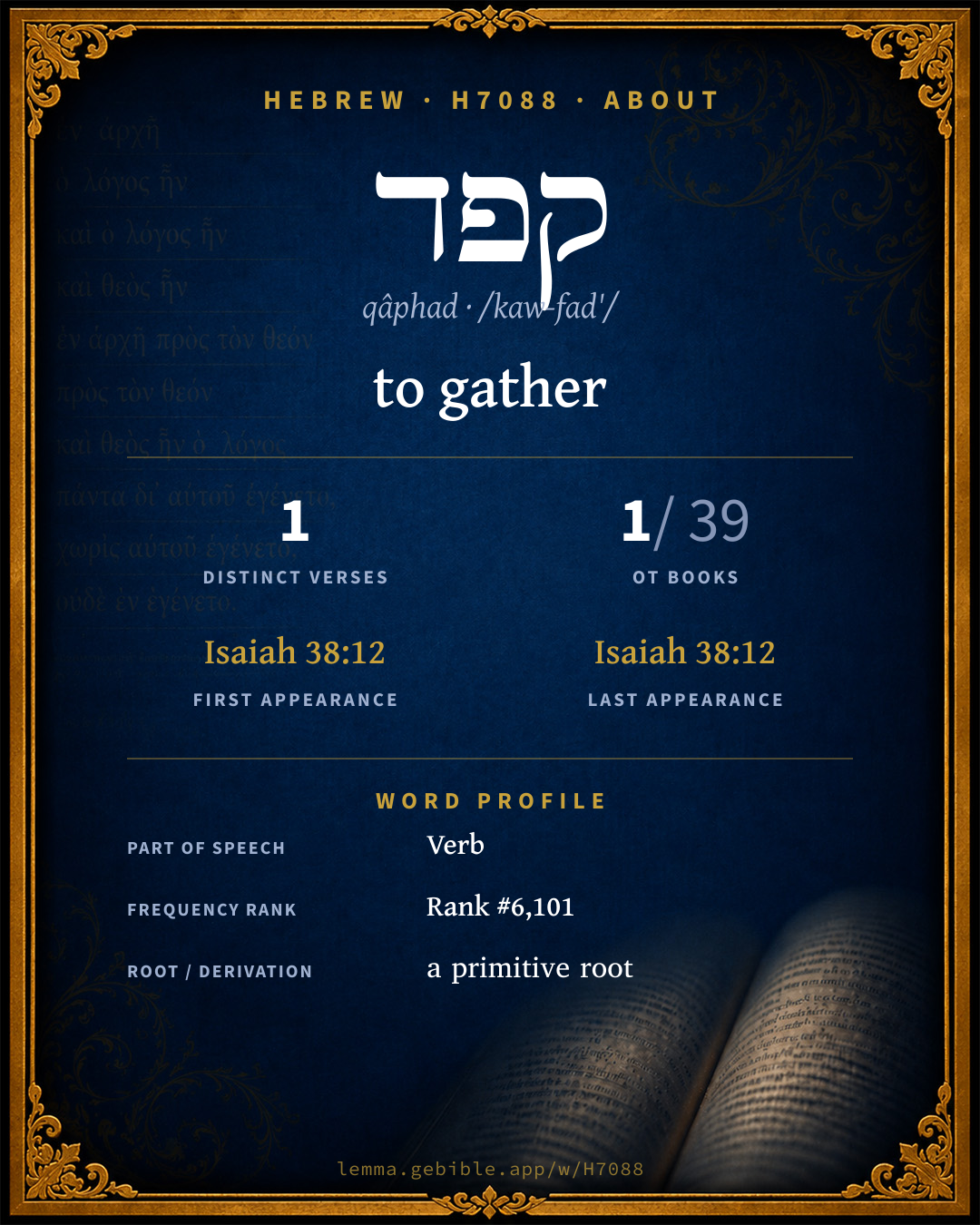
קָפַד
to gather
Full lexicon entry — Brown-Driver-Briggs (BDB)
From Brown-Driver-Briggs (BDB)
Where this word appears
Grammar key — what these labels mean
Part of speech
- Verb
- An action or state-of-being word.
Stem
- Piel
- An intensive or resultative active stem.
Form
- Perfect
- A completed action or state — Hebrew marks aspect (completeness) more than strict tense (“he wrote”).
Person
- 1st Person
- The speaker (“I / we”).
Gender
- Common
- Either gender — not distinguished for this form.
Number
- Singular
- One.
Every verse where H7088 appears — 1 distinct verse across 1 book. Click any verse to open its interlinear word-by-word view. Verse text shown in the World English Bible for context — . Each verse’s Hebrew form is shown with its reference; the English is not keyword-highlighted, since the data carries no word-level English alignment. Use “Compare translations” on any verse to read it across multiple English versions. This concordance covers the Hebrew Bible; Septuagint (Greek Old Testament) occurrences are not indexed here.
Isaiah 1 verse
About this entry
At a glance — auto-summarized from this page’s data, not written by a person. Every figure links to its source below. This summary describes the numbers; it doesn’t interpret them.
“to gather” is the headline sense of the Hebrew verb קפד (qâphad). It is rare — just 1 verse in the entire Hebrew Bible. More than three-quarters of its appearances fall in Isaiah. It occurs only once, in Isaiah 38:12. It shares a root with קפדה and קפוד. The sections below give every sense, occurrence, and version rendering.
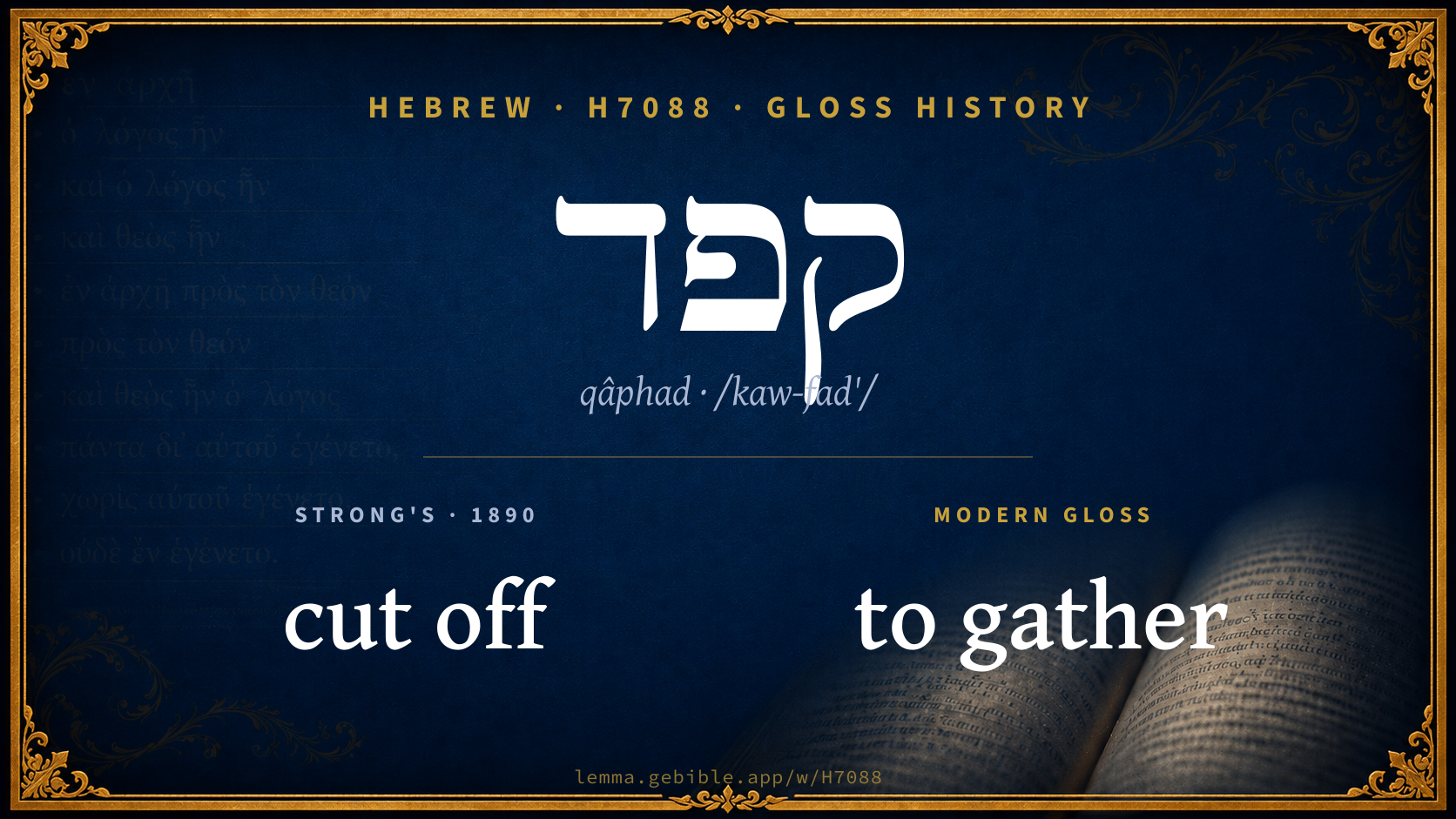
Gloss history
Strong's 1890 vs modern scholarship
About this word
Strong's H7088 catalogs a Hebrew word from the Hebrew Old Testament.
These counts are not copied from any lexicon or concordance. They are computed here, from the morphology-tagged Hebrew Old Testament. What Lemma adds →
- 1
- distinct verses
- The word appears in 1 distinct verse.
- 1 / 39
- OT books
- The word appears in 1 of 39 Old Testament books.
- #6,101
- by frequency
- Rank #6,101 (rank 6,101 of 8,640 Hebrew words by occurrence).
View all 1 occurrence in the concordance →
Most concentrated in
- Isaiah 1 verse 100%
By section of the Old Testament
By traditional corpus
Conventional, traditional groupings — biblical authorship is debated, so this is a traditional corpus grouping, not an authorship claim. Each share is this word’s portion of its verses in that division of the Hebrew canon. Each figure is a share of the word’s 1 distinct verse.
- Prophets (Nevi'im) 1 verse · 100%
How translations render this word
Counts come from each version’s own published word-to-Strong’s tagging or interlinear alignment — an approximate guide to how each version renders this word, not a word-level alignment the data otherwise carries. Because each total is that version’s own tagged count, the per-version totals vary from one another and need not match the appearance or distinct-verse counts above. These counts may also differ from a printed concordance because Lemma counts each distinctly tagged rendering and does not collapse phrase taggings into a single head-word total. This is a fixed set of word-tagged versions (KJV, ASV, BSB, ULT) and does not change with the reading translation you choose elsewhere. Each version’s license is shown beside its name below (and on Sources).
- King James Version: I have cut off 1×
- American Standard Version: I have rolled 1×
- Berean Standard Bible: I have rolled up 1×
- unfoldingWord Literal Text: I have rolled up 1×
King James Version Public Domain
Renders H7088 across 1 tagged occurrence — most commonly:
American Standard Version Public Domain
Renders H7088 across 1 tagged occurrence — most commonly:
Berean Standard Bible Public Domain
Renders H7088 across 1 tagged occurrence — most commonly:
unfoldingWord Literal Text CC BY-SA 4.0
Renders H7088 across 1 tagged occurrence — most commonly:
Senses in BDB
The 1 sense BDB distinguishes for this word, in lexicon order (not ranked by frequency or importance). The full entry — with sub-senses — is in the Lexicon Entry tab.
- (Piel) to gather together, roll up, harvest
Word origin
[ קָפַד ] vb. Pi. gather together, roll up;— Is 38:12
— Brown-Driver-Briggs (Oxford 1906, public domain), digitized via Sefaria, supplemented by the OpenScriptures HebrewLexicon (CC BY 4.0). See Sources.
Origin: a primitive root
Jastrow Dictionary
A second Hebrew/Aramaic lexicon for comparison, covering Aramaic and post-biblical (Talmudic, Targumic, Midrashic) usage that the biblical-Hebrew BDB does not. Matched by lemma rather than by Strong’s number, so a lemma may carry more than one Jastrow headword (shown separately below), and the entries cover usage well beyond the Bible.
קָפַד
- (b. h.) to contract, convolve, v. קוּפָּד.
- (cmp. קָצַף)
- 1. to be angry, lose temper. Taan. 20ᵇ מימי לא הִקְפַּדְתִּי וכ׳ never did I lose my temper in my house; Y. ib. III, end, 67ᵃ. Y. Ber. IV, 7ᵈ (prayer on entering the schoolhouse) שלא אַקְפִּיד … יַקְפִּידוּ וכ׳ that I may not get excited over my colleagues, and my colleagues may not get excited over me. Sabb. 31ᵃ והלל לא יַקְפִּיד and Hillel (I) shall not get impatient. Ab. d’R. N. ch. I מַקְפִּיד על דבריו, v. מָתַן. Ex. R. s. 6 ואף הוא מקפיד (not מקפידו) and he (Moses) also lost his temper. Ib. ואתה מקפיד על דברי and thou losest thy temper in spite of my word (that declared thee the most patient of men)?; a. fr.
- 2. to provoke, insult. Y. Keth. IV, 28ᵈ bot. ה׳ את וכ׳ he insulted an elder and struck him.
- 3. to be strict, particular; to care for, mind. Mikv. IX, 3; 7 כל המקפיד עליו הוצץ whatever one minds (on one’s body) causes a partition for immersion, v. חָצַץ I. B. Mets. 75ᵃ בני חבורה המַקְפִּידִין וכ׳ members of a party that are particular with one another (in lending and borrowing); Sabb. 149ᵃ. Ḥull. 107ᵇ שני אחין ומקפידין וכ׳ two brothers (taking separate meals at the same table) who are particular with each other. Gen. R. s. 65 לא היתה מַקְפֶּדֶת וכ׳ did not mind the pollution through idolatry; a. v. fr.
קְפַד
- , to be angry, sensitive; to be particular, care for, mind. Snh. 113ᵇ, v. קַפְדָּן. Ḥull. 107ᵃ קַפְדִּיתוּ אמנא are you particular about the condition of the vessel (used for ablution)? Ib. אמנא ואחזותא קַפְדִּינָן we are particular about the vessel and about the color (of the water), אשיעורא לא קַפְדִּינָן we are not so about the quantity. Sabb. 147ᵃ והוא דקָפֵיד עלייהו provided a person is particular about his garments’ being shaken before he puts them on; אנן לא קפדינן we do not care about it. Pes. 110ᵇ כל דקפיד קָפְדֵּי בהדיה וכ׳ he that minds (such practices) is strictly dealt with (suffers for disregarding them); he that does not care &c. Snh. 67ᵇ דקפיד אמנא שד a magician that is particular about the vessel he uses is a conjurer of demons; a. fr.
- same. Y. Sabb. I, 4ᵃ top מְקַפְּדִין, v. קוּרְיָיאָה
- 1. to be contracted, shortened. Targ. Is. XXXVIII, 12 (ed. Lag. איתקפלו). Ib. L, 2. Targ. Mic. II, 7.
- 2. to be angry, excited. Y. Ber. II, 5ᵇ top שמע … וא׳ עילוי Samuel heard of it and was angry with him. Kidd. 33ᵃ; a. fr.
- to provoke, insult. Y. B. Kam. VIII, end, 6ᶜ חד בר נש א׳ לר׳ וכ׳ (not איק׳) a man insulted R. Ḥ.
A Dictionary of the Targumim, the Talmud Babli and Yerushalmi, and the Midrashic Literature (Marcus Jastrow; London, Luzac, 1903) — Public Domain. Digitized via Sefaria. Digitized via Sefaria. Full attribution on Sources.
Same root — word family
Other BDB entries built from the same root as H7088, grouped by Strong’s listed origin. These share a root / origin per the lexicon — not necessarily a shared meaning. Each links to that word’s own entry.
Derived from this word
Compare all same-root words → They share a root, not necessarily a meaning.
Septuagint verse parallels
This word appears in 1 verse that also exists in the Greek Old Testament (Septuagint), out of the 1 Hebrew verse it occurs in. You can read those verses in Greek by switching the Old Testament edition to the Septuagint.
Read these verses in the Septuagint
This is a verse-level parallel only — the same verses exist in both the Hebrew and Greek Old Testaments. No word-level Hebrew↔Greek correspondence is claimed: the data carries no such alignment, so no Greek word is shown as this Hebrew word’s translation. Coverage is not total — the Septuagint omits the deuterocanon and renumbers the Psalms, so some Hebrew verses have no direct Greek parallel.