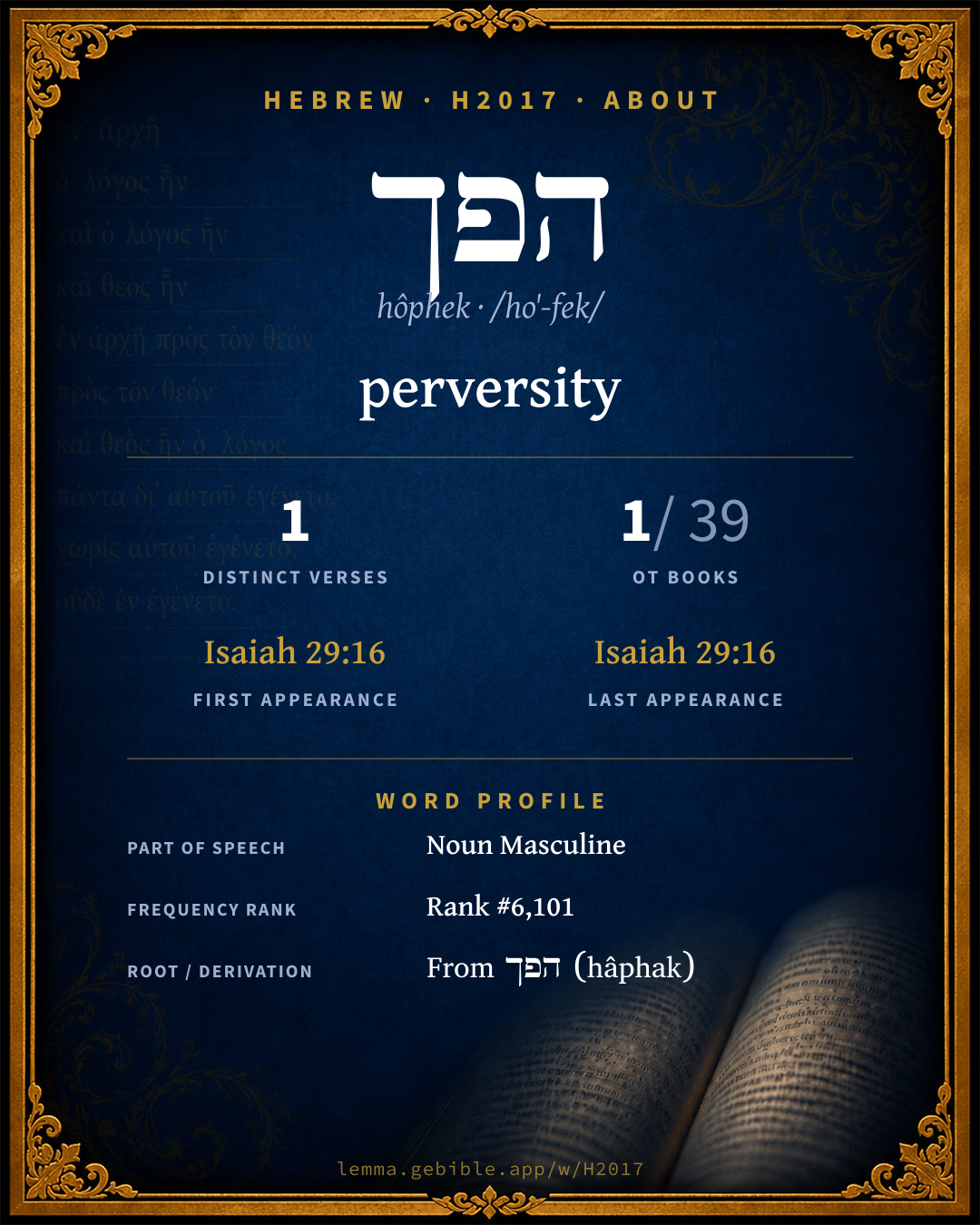
הֹפֶךְ
perversity
Full lexicon entry — Brown-Driver-Briggs (BDB)
From Brown-Driver-Briggs (BDB)
Where this word appears
Grammar key — what these labels mean
Part of speech
- Noun
- A naming word — a person, place, thing, or idea.
Noun type
- Common
- A common noun — a general class of person, place, or thing (“king,” “city,” “water”), not a specific name.
State
- Construct
- A noun bound to a following noun in a possessive / “of” relationship (the construct chain).
Gender
- Masculine
- Grammatically masculine.
Number
- Singular
- One.
Every verse where H2017 appears — 1 distinct verse across 1 book. Click any verse to open its interlinear word-by-word view. Verse text shown in the World English Bible for context — . Each verse’s Hebrew form is shown with its reference; the English is not keyword-highlighted, since the data carries no word-level English alignment. Use “Compare translations” on any verse to read it across multiple English versions. This concordance covers the Hebrew Bible; Septuagint (Greek Old Testament) occurrences are not indexed here.
Isaiah 1 verse
About this entry
At a glance — auto-summarized from this page’s data, not written by a person. Every figure links to its source below. This summary describes the numbers; it doesn’t interpret them.
At its core, הפך (hôphek) means “perversity.” With only 1 verse it sits in the long tail of Hebrew Bible vocabulary. Its uses cluster heavily in Isaiah (100% of all occurrences). Its lone occurrence is Isaiah 29:16. From the same root come הפך, הפך and הפכפך. Each statement above links to its evidence; the full detail follows below.
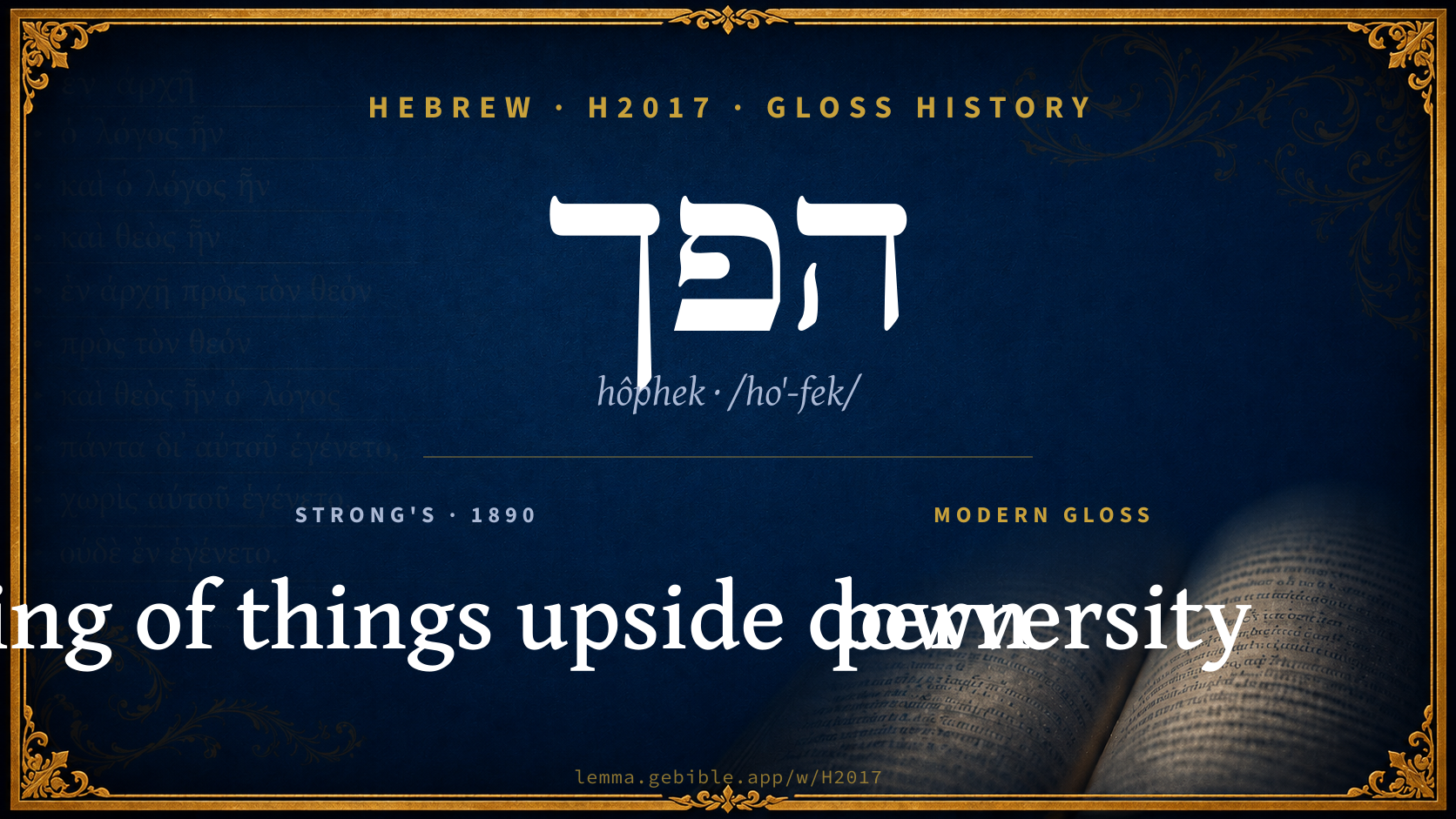
Gloss history
Strong's 1890 vs modern scholarship
About this word
Strong's H2017 catalogs a Hebrew word from the Hebrew Old Testament.
These counts are not copied from any lexicon or concordance. They are computed here, from the morphology-tagged Hebrew Old Testament. What Lemma adds →
- 1
- distinct verses
- The word appears in 1 distinct verse.
- 1 / 39
- OT books
- The word appears in 1 of 39 Old Testament books.
- #6,101
- by frequency
- Rank #6,101 (rank 6,101 of 8,640 Hebrew words by occurrence).
View all 1 occurrence in the concordance →
Most concentrated in
- Isaiah 1 verse 100%
By section of the Old Testament
By traditional corpus
Conventional, traditional groupings — biblical authorship is debated, so this is a traditional corpus grouping, not an authorship claim. Each share is this word’s portion of its verses in that division of the Hebrew canon. Each figure is a share of the word’s 1 distinct verse.
- Prophets (Nevi'im) 1 verse · 100%
How translations render this word
Counts come from each version’s own published word-to-Strong’s tagging or interlinear alignment — an approximate guide to how each version renders this word, not a word-level alignment the data otherwise carries. Because each total is that version’s own tagged count, the per-version totals vary from one another and need not match the appearance or distinct-verse counts above. These counts may also differ from a printed concordance because Lemma counts each distinctly tagged rendering and does not collapse phrase taggings into a single head-word total. This is a fixed set of word-tagged versions (KJV, ASV, BSB, ULT) and does not change with the reading translation you choose elsewhere. Each version’s license is shown beside its name below (and on Sources).
- King James Version: Surely your turning of things upside down 1×
- American Standard Version: Ye turn things upside down 1×
- Berean Standard Bible: You have turned things upside down 1×
- unfoldingWord Literal Text: Overturning 1×
King James Version Public Domain
Renders H2017 across 1 tagged occurrence — most commonly:
American Standard Version Public Domain
Renders H2017 across 1 tagged occurrence — most commonly:
Berean Standard Bible Public Domain
Renders H2017 across 1 tagged occurrence — most commonly:
unfoldingWord Literal Text CC BY-SA 4.0
Renders H2017 across 1 tagged occurrence — most commonly:
Senses in the full BDB
What do BDB’s symbols mean?
BDB uses these scholarly abbreviations:
| Symbol | Meaning |
|---|---|
| 𝔊 | the Septuagint (the ancient Greek translation, LXX) |
| 𝔙 | the Vulgate (the Latin translation) |
| 𝔖 | the Syriac version (the Peshitta) |
| 𝔗 | the Targum (the Aramaic translation) |
| ψ | the Psalms |
| √ | root (the underlying root or stem) |
| ‖ | parallel passage (a synonymous or contrasted parallel) |
| † | the dagger: every passage where the word occurs is cited |
The 2 senses and sub-senses the full Brown-Driver-Briggs lexicon distinguishes for this word, in lexicon order (not ranked by frequency), with BDB’s own verbatim wording and sub-sense lettering. Shown in Hebrew script with BDB’s own scholarly abbreviations. The condensed entry is in the Lexicon Entry tab.
- 1. the contrary, opposite thing Ez 16:34 e.g. Ezekiel 16:34
- 2. Is 29:16 Oh, your perversity! e.g. Isaiah 29:16
Senses from the full Brown-Driver-Briggs lexicon (Brown, Driver, Briggs; Oxford 1906 — public domain), digitized via Sefaria, supplemented by the OpenScriptures HebrewLexicon (CC BY 4.0). Full attribution on Sources.
Word origin
הֶ֫פֶךְ n.m. the contrary, contrariness, perversity
— Brown-Driver-Briggs (Oxford 1906, public domain), digitized via Sefaria, supplemented by the OpenScriptures HebrewLexicon (CC BY 4.0). See Sources.
Derived from הפך (hâphak) (H2015) — to overturn.
Jastrow Dictionary
A second Hebrew/Aramaic lexicon for comparison, covering Aramaic and post-biblical (Talmudic, Targumic, Midrashic) usage that the biblical-Hebrew BDB does not. Matched by lemma rather than by Strong’s number, so a lemma may carry more than one Jastrow headword (shown separately below), and the entries cover usage well beyond the Bible.
הָפַךְ
- (b. h.)
- 1. (act. verb) to turn; to change; to reverse; to pervert, subvert, destroy. Ex. R. s. 18 הָפְכָה המדינה שעבודה וכ׳ a country perverted the rules of forced labor for the captives (treating them inhumanely); ה׳ עליהם את הדין וכ׳ he changed the law against them and put them to death by night (against the Jewish law, v. Snh. IV, 1). Ib. ה׳ סדום He destroyed Sodom. Ber. 55ᵇ כשם שהָפַכְתָּ וכ׳ as thou didst turn the curse … into blessing, כן הֲפוֹךְ וכ׳ so do thou turn &c. B. Kam. III, 3 ההוֹפֵךְ את הגלל he who upturns (changes the place of) the dung (taking possession); a. v. fr.—Part. Pass. הָפוּךְ. Pes. 50ᵃ עולם ה׳ ראיתי וכ׳ I saw a reversed world, the uppermost below &c. Sabb. 108ᵇ הֲפוּכָה סדום וכ׳ Sodom is subverted and what is said about it is perverted. Sifra Thazr. Par. 3, ch. III הפוך, הפוכה when its color is changed; a. v. fr.—Y. Naz. V, end, 54ᵇ לשון הפוך, v. הֶפֶךְ.
- 2. (neut. verb) to change. Sifra ch. IV אי כולי ה׳ לבן if the whole of it has turned white. Neg. IV, 3; a. fr.
- 1. to be upturned, destroyed; to be changed. Yalk. Esth. 1056 כשנ׳ סדום when Sodom was subverted. Gen. R. s. 50 ומדינה נֶהְפֶּכֶת, v. אִדְרַבְלָא. Tanḥ. Sh’moth 25 נ׳ להם מן וכ׳ the voice turned around, as if coming from &c.; a. fr.
- 2. to roll about, v. Hithpa.
- 1. to reverse, pervert, turn. Gen. R. s. 20 שהי׳ דברים וכ׳ who spoke perversely of the Creator. Kidd. 59ᵃ עני מְהַפֵּךְ וכ׳ a poor man turns the cake, and another comes and takes it, i.e. one who buys away what another is negotiating for.
- 2. to scheme, v. infra.
- , Nithpa. נִתְהַפֵּךְ
- 1. to be changed, disguise one’s self. Gen. R. s. 21 end שהם מִתְהַפְּכִים they (the angels) assume various shapes.
- 2. to turn one’s self around. Ib. שהיא מִתְהַפֶּכֶת וכ׳ for it (the fiery sword) turns around man &c. Yeb. 35ᵃ; Keth. 37ᵃ מתהפכת she turns herself (makes violent motions). Ib. נִתְהַפְּכָה (Keth. l. c. נֶהֶפְכָה).—Tanḥ. Vayetsé 11 היה מ׳ עליו prevaricated (changing terms).
- 3. to scheme. Ruth R. introd. 3 שהוא מִתְהפֵּךְ ובא וכ׳ he (Esaw = Rome) schemes and comes against &c.; Yalk. Prov. 959 בא ומְהַפֵּךְ על וכ׳. Ib. שהם מִתְהַפְּכִים וכ׳; Ruth R. l. c. שמְהַפְּכִין.
הֲפַךְ
- , same (v. אֲפַךְ)
- 1. to turn, change. Targ. Ps. CV, 29; a. fr.—Y. Sabb. XVI, end, 15ᵈ ה׳ אפוי he turned his face off.
- 2. to overturn, destroy. Targ. Gen. XIX, 25; a. fr.
- 3. (neut. verb) to turn around. Targ. Prov. XXVI, 11; a. e.—Num. R. s. 12 כהדין ברנש … הָפוּךְ לאחוריו like one going down a ladder backwards; Y. R. Hash. II, 58ᵃ כאילין דסלקין בסולמא הֲפִיךְ like those who ascend a ladder backward; Yalk. Job 912 [read:] כהדין דסלקין בסולמא הפוך (v. Lattes Saggio p. 106).
- 4. (with ב) to be engaged in, to handle. Pes. 113ᵃ (prov.) הֲפוֹךְ בנבילתא ולא תֵיפוֹךְ וכ׳ deal in carcasses, but deal not in words (gossip, sophistry &c.). Y. B. Kam. IV, beg. 4ᵃ אנא הפך ומתהפך בדידי וכ׳ I turn around my stock of goods (selling and buying again), so that I reach thee in profits. Ab. V, 22 הֲפוֹךְ בה וכ׳ study it over and again; a. fr.—V. הֲפִיכָא.
- l) (= h. הֵשִׁיב) to turn; to bring back, restore; to turn off (wrath), to appease; to give in return, reply. Targ. Prov. XXV, 13.—Ib. XXIX, 8.—Ib. XXIV, 29 Ms. (ed. אַהֲפֵיךְ Af.).—Ib. 26.—2) to handle, be engaged in, barter, study (v. Pe. 4). Kidd. 59ᵃ דוה מְהַפֵּיךְ בההיא וכ׳ was negotiating about a field. Sabb. 119ᵃ כמה דלא מְהַפִּיכְנָא בזכותיה before I study what might be said in his favor. Pes. 40ᵃ דמְהַפְּכֵי כיפי who handle sheaves; כי מְהַפְּכִיתוּ הַפִּיכוּ וכ׳ (Ms. M. הפכיתו) when ye handle (them), handle them with the thought that they will be used for a religious purpose.—Part. pass. מְהַפַּךְ. Y. Maasr. III, end, 51ᵃ היא הפכה והיא מְהַפְּכָה it turns and is turned in all directions (studied over and again), but we can learn nothing from it.
- , v. supra.
- 1. to be turned, changed; to turn about, deal in &c. Targ. Lev. XIII, 3. Targ. Job XXX, 21; a. fr.—Y. Maasr. III, end, 51ᵃ, v. supra.
- 2. to roll about. Targ. Jud. VII, 13; a. e.
הֶפֶךְ
- preced. wds.)
- 1. reverse, opposite. לְשׁוֹן ה׳ a phrase which means the reverse (euphemism). Y. Naz. II, 51ᵈ bot. (ed. Krot. הפר, corr. acc.); ib. V, end, 54ᵇ לָשׁוֹן הָפוּךְ.
- 2. upturning (a pile), displacing. B. Kam. 29ᵇ כל ה׳ למטה וכ׳ the term ‘upturning’ means a movement within three cubits (Var. v. Rabb. D. S. a. l. note 80).
פַּךְ
- flask, jar with a narrow neck, v. טָפִי. Y. Hor. III, 47ᶜ bot. נמשחו מן הפך were anointed out of a flask, opp. קרן; Meg. 14ᵃ. Ib. (ref. to I Sam. II, 1) רמה קרני ולא רמה פַּכִּי ‘my horn is high’, but not ‘my flask is high.’ Tosef. Succ. III, 10 כמין פי הפך as if coming forth through the mouth of a flask, v. פִּכְפֵּךְ. Neg. XII, 5 חסה התורה … ועל פַּכֹּו the Torah has regard … even for a man’s flask; Sifra M’teorʿa, Neg., ch. III, Par. 5. Gen. R. s. 69, end שופע … כמלא פי הפך the oil was poured down for him from heaven in large drops as if coming out of a flask; Yalk. ib. 120; a. fr.—Pl. פַּכִּים, פַּכִּין. Sabb. 84ᵇ פ׳ קטנים small flasks (into which you cannot dip your finger); B. Kam. 25ᵇ. Ḥull. 91ᵃ (ref. to Gen. XXXII, 25) נשתייר על פ׳ קטנים he remained behind for the sake of some small jars. Kel. II, 2; a. fr. e.g. 1 Samuel 2:1
A Dictionary of the Targumim, the Talmud Babli and Yerushalmi, and the Midrashic Literature (Marcus Jastrow; London, Luzac, 1903) — Public Domain. Digitized via Sefaria. Digitized via Sefaria. Full attribution on Sources.
Same root — word family
Other BDB entries built from the same root as H2017, grouped by Strong’s listed origin. These share a root / origin per the lexicon — not necessarily a shared meaning. Each links to that word’s own entry.
Derives from
Shares the same root
- הפך hephek H2016 contrary
- הפכפך hăphakpak H2019 crooked
- מהפכה mahpêkâh H4114 overthrow
- מהפכת mahpeketh H4115 stocks
- תהפכה tahpukâh H8419 perversity
Compare all same-root words → Showing 4 of 7 — not the complete family. They share a root, not necessarily a meaning.
Septuagint verse parallels
This word appears in 1 verse that also exists in the Greek Old Testament (Septuagint), out of the 1 Hebrew verse it occurs in. You can read those verses in Greek by switching the Old Testament edition to the Septuagint.
Read these verses in the Septuagint
This is a verse-level parallel only — the same verses exist in both the Hebrew and Greek Old Testaments. No word-level Hebrew↔Greek correspondence is claimed: the data carries no such alignment, so no Greek word is shown as this Hebrew word’s translation. Coverage is not total — the Septuagint omits the deuterocanon and renumbers the Psalms, so some Hebrew verses have no direct Greek parallel.