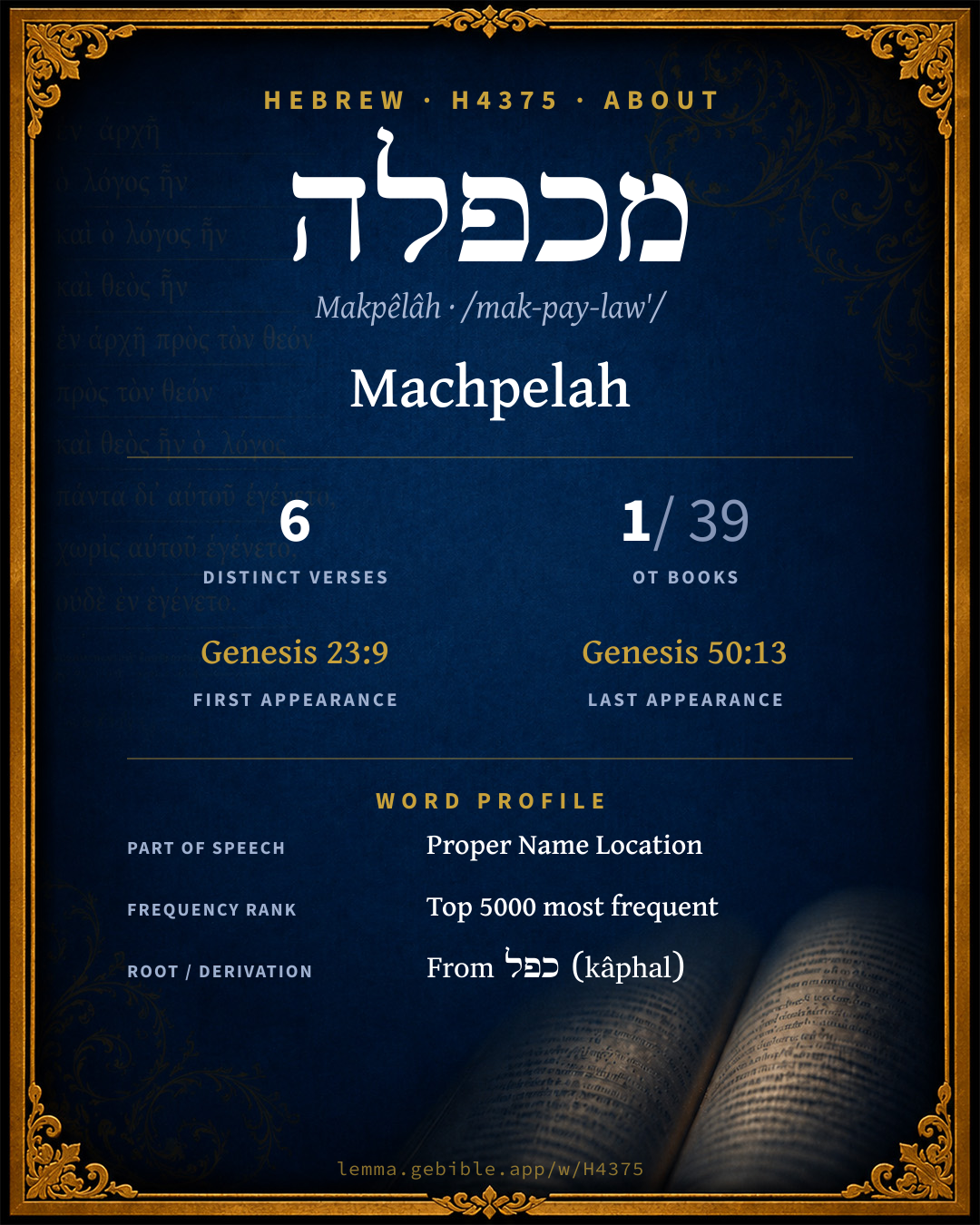
מַכְפֵּלָה
Machpelah
BDB lists 2 entries for ‘Machpelah’ fuller range ↓
Full lexicon entry — Brown-Driver-Briggs (BDB)
From Brown-Driver-Briggs (BDB)
Where this word appears
Grammar key — what these labels mean
Noun type
- Proper
- A name of a specific person, place, or people (e.g. Abraham, Zion, Israel).
Every verse where H4375 appears — 6 distinct verses across 1 book. Click any verse to open its interlinear word-by-word view. Verse text shown in the World English Bible for context — . Each verse’s Hebrew form is shown with its reference; the English is not keyword-highlighted, since the data carries no word-level English alignment. Use “Compare translations” on any verse to read it across multiple English versions. This concordance covers the Hebrew Bible; Septuagint (Greek Old Testament) occurrences are not indexed here.
Genesis 6 verses
- Genesis 23:9 הַ/מַּכְפֵּלָה֙ ptcl def.art + n Proper that he may give me the cave of Machpelah, which he has, which is in the end of his field. For the full price let him give it to me in the midst of you for a possession of a burying-place."
- Genesis 23:17 בַּ/מַּכְפֵּלָ֔ה prep det + n Proper So the field of Ephron, which was in Machpelah, which was before Mamre, the field, the cave which was therein, and all the trees that were in the field, that were in all the border of it round about, were made sure
- Genesis 23:19 הַ/מַּכְפֵּלָ֛ה ptcl def.art + n Proper After this, Abraham buried Sarah his wife in the cave of the field of Machpelah before Mamre (the same is Hebron), in the land of Canaan.
- Genesis 25:9 הַ/מַּכְפֵּלָ֑ה ptcl def.art + n Proper Isaac and Ishmael, his sons, buried him in the cave of Machpelah, in the field of Ephron, the son of Zohar the Hittite, which is before Mamre,
- Genesis 49:30 הַ/מַּכְפֵּלָ֛ה ptcl def.art + n Proper in the cave that is in the field of Machpelah, which is before Mamre, in the land of Canaan, which Abraham bought with the field from Ephron the Hittite as a burial place.
- Genesis 50:13 הַ/מַּכְפֵּלָ֑ה ptcl def.art + n Proper for his sons carried him into the land of Canaan, and buried him in the cave of the field of Machpelah, which Abraham bought with the field, for a possession of a burying-place, from Ephron the Hittite, before Mamre.
About this entry
At a glance — auto-summarized from this page’s data, not written by a person. Every figure links to its source below. This summary describes the numbers; it doesn’t interpret them.
מכפלה (Makpêlâh) is a Hebrew name most often rendered “Machpelah.” Genesis dominates its distribution — 6 of 6 verses. Spanning 6 verses in 1 book, it ranks among the uncommon words of the Hebrew Bible. Scripture first uses it in Genesis 23:9. The sections below give every occurrence and version rendering.
Gloss history
Strong's 1890 vs modern scholarship
About this word
Strong's H4375 catalogs a Hebrew word from the Hebrew Old Testament.
These counts are not copied from any lexicon or concordance. They are computed here, from the morphology-tagged Hebrew Old Testament. What Lemma adds →
- 6
- distinct verses
- The word appears in 6 distinct verses.
- 1 / 39
- OT books
- The word appears in 1 of 39 Old Testament books.
- #3,040
- by frequency
- Top 5000 most frequent Hebrew words (rank 3,040 of 8,640 Hebrew words by occurrence).
View all 6 occurrences in the concordance →
Most concentrated in
- Genesis 6 verses 100%
By section of the Old Testament
By traditional corpus
Conventional, traditional groupings — biblical authorship is debated, so this is a traditional corpus grouping, not an authorship claim. Each share is this word’s portion of its verses in that division of the Hebrew canon. Each figure is a share of the word’s 6 distinct verses.
- Torah (Pentateuch) 6 verses · 100%
How translations render this word
Counts come from each version’s own published word-to-Strong’s tagging or interlinear alignment — an approximate guide to how each version renders this word, not a word-level alignment the data otherwise carries. Because each total is that version’s own tagged count, the per-version totals vary from one another and need not match the appearance or distinct-verse counts above. These counts may also differ from a printed concordance because Lemma counts each distinctly tagged rendering and does not collapse phrase taggings into a single head-word total. This is a fixed set of word-tagged versions (KJV, ASV, BSB, ULT) and does not change with the reading translation you choose elsewhere. Each version’s license is shown beside its name below (and on Sources).
- King James Version: Machpelah 5×
- American Standard Version: Machpelah 5×
- Berean Standard Bible: Machpelah 6×
- unfoldingWord Literal Text: Machpelah 5×
King James Version Public Domain
Renders H4375 across 6 tagged occurrences — most commonly:
Plus 1 rendering that appears only once — usually multi-word phrases or single function words the recovered tagging swept in, not distinct renderings.
American Standard Version Public Domain
Renders H4375 across 6 tagged occurrences — most commonly:
Plus 1 rendering that appears only once — usually multi-word phrases or single function words the recovered tagging swept in, not distinct renderings.
Berean Standard Bible Public Domain
Renders H4375 across 6 tagged occurrences — most commonly:
unfoldingWord Literal Text CC BY-SA 4.0
Renders H4375 across 6 tagged occurrences — most commonly:
Plus 1 rendering that appears only once — usually multi-word phrases or single function words the recovered tagging swept in, not distinct renderings.
Senses in BDB
The 2 senses BDB distinguishes for this word, in lexicon order (not ranked by frequency or importance). The full entry — with sub-senses — is in the Lexicon Entry tab.
- Machpelah = "double" or " portion"
- the location of a burial cave for the patriarchs, near Hebron
Word origin
מַכְפֵּלָה n.pr.loc. near Hebron, where patriarchs and their wives were buried
— Brown-Driver-Briggs (Oxford 1906, public domain), digitized via Sefaria, supplemented by the OpenScriptures HebrewLexicon (CC BY 4.0). See Sources.
Derived from כפל (kâphal) (H3717) — to double.
Jastrow Dictionary
A second Hebrew/Aramaic lexicon for comparison, covering Aramaic and post-biblical (Talmudic, Targumic, Midrashic) usage that the biblical-Hebrew BDB does not. Matched by lemma rather than by Strong’s number, so a lemma may carry more than one Jastrow headword (shown separately below), and the entries cover usage well beyond the Bible.
מַכְפֵּלָה
- doubling, coupling. Erub. 53ᵃ היינו מ׳ that is the reason why it is called ‘double cave’. Ib. מאי מ׳ why is it called &c.?—Gen. R. s. 98 שמע ישראל אבינו ממערת המ׳ hear, oh Israel, our father of the double cave!; a. e.
A Dictionary of the Targumim, the Talmud Babli and Yerushalmi, and the Midrashic Literature (Marcus Jastrow; London, Luzac, 1903) — Public Domain. Digitized via Sefaria. Digitized via Sefaria. Full attribution on Sources.
Forms in the corpus
The 4 distinct written forms H4375 takes in the Hebrew Bible, most frequent first — each parse links to that state’s occurrences in the concordance. Hebrew forms include their vowel points and cantillation, so a single lemma takes many written forms.
| Form | Parsing | Example | Uses |
|---|---|---|---|
| הַ/מַּכְפֵּלָ֑ה | Noun, Proper | Genesis 25:9 | 2 |
| הַ/מַּכְפֵּלָ֛ה | Noun, Proper | Genesis 23:19 | 2 |
| בַּ/מַּכְפֵּלָ֔ה | Noun, Proper | Genesis 23:17 | 1 |
| הַ/מַּכְפֵּלָה֙ | Noun, Proper | Genesis 23:9 | 1 |
Same root — word family
Other BDB entries built from the same root as H4375, grouped by Strong’s listed origin. These share a root / origin per the lexicon — not necessarily a shared meaning. Each links to that word’s own entry.
Derives from
Shares the same root
Compare all same-root words → They share a root, not necessarily a meaning.
Bible dictionary
Public-domain dictionary articles matched to this entry by name (Machpelah). A biblical name can be shared by more than one person or place, so an article may treat several.
Easton's Bible Dictionary · M. G. Easton, 1897
Portion; double cave, the cave which Abraham bought, together with the field in which it stood, from Ephron the Hittite, for a family burying-place (Gen. 23). It is one of those Bible localities about the identification of which there can be no doubt. It was on the slope of a hill on the east of Hebron, "before Mamre." Here were laid the bodies of Abraham and Sarah, Isaac and Rebekah, Jacob and Leah (Gen. 23:19; 25:9; 49:31; 50:13). Over the cave an ancient Christian church was erected, probably in the time of Justinian, the Roman emperor. This church has been converted into a Mohammedan mosque. The whole is surrounded by the el-Haram i.e., "the sacred enclosure," about 200 feet long, 115 broad, and of an average height of about 50. This building, from the immense size of some of its stones, and the manner in which they are fitted together, is supposed by some to have been erected in the days of David or of Solomon, while others ascribe it to the time of Herod. It is looked upon as the most ancient and finest relic of Jewish architecture.
On the floor of the mosque are erected six large cenotaphs as monuments to the dead who are buried in the cave beneath. Between the cenotaphs of Isaac and Rebekah there is a circular opening in the floor into the cavern below, the cave of Machpelah. Here it may be that the body of Jacob, which was embalmed in Egypt, is still preserved (much older embalmed bodies have recently been found in the cave of Deir el-Bahari in Egypt, see PHARAOH), though those of the others there buried may have long ago mouldered into dust. The interior of the mosque was visited by the Prince of Wales in 1862 by a special favour of the Mohammedan authorities. An interesting account of this visit is given in Dean Stanley's Lectures on the Jewish Church. It was also visited in 1866 by the Marquis of Bute, and in 1869 by the late Emperor (Frederick) of Germany, then the Crown Prince of Prussia. In 1881 it was visited by the two sons of the Prince of Wales, accompanied by Sir C. Wilson and others. (See Palestine Quarterly Statement, October 1882).
Smith's Bible Dictionary · William Smith, 1863
(double, or a portion). [Hebron]
Hitchcock's Bible Names Dictionary · Roswell D. Hitchcock, 1869
double
Classic public-domain reference works; full attribution on Sources.
Septuagint verse parallels
This word appears in 6 verses that also exist in the Greek Old Testament (Septuagint), out of the 6 Hebrew verses it occurs in. You can read those verses in Greek by switching the Old Testament edition to the Septuagint.
Read these verses in the Septuagint
This is a verse-level parallel only — the same verses exist in both the Hebrew and Greek Old Testaments. No word-level Hebrew↔Greek correspondence is claimed: the data carries no such alignment, so no Greek word is shown as this Hebrew word’s translation. Coverage is not total — the Septuagint omits the deuterocanon and renumbers the Psalms, so some Hebrew verses have no direct Greek parallel.