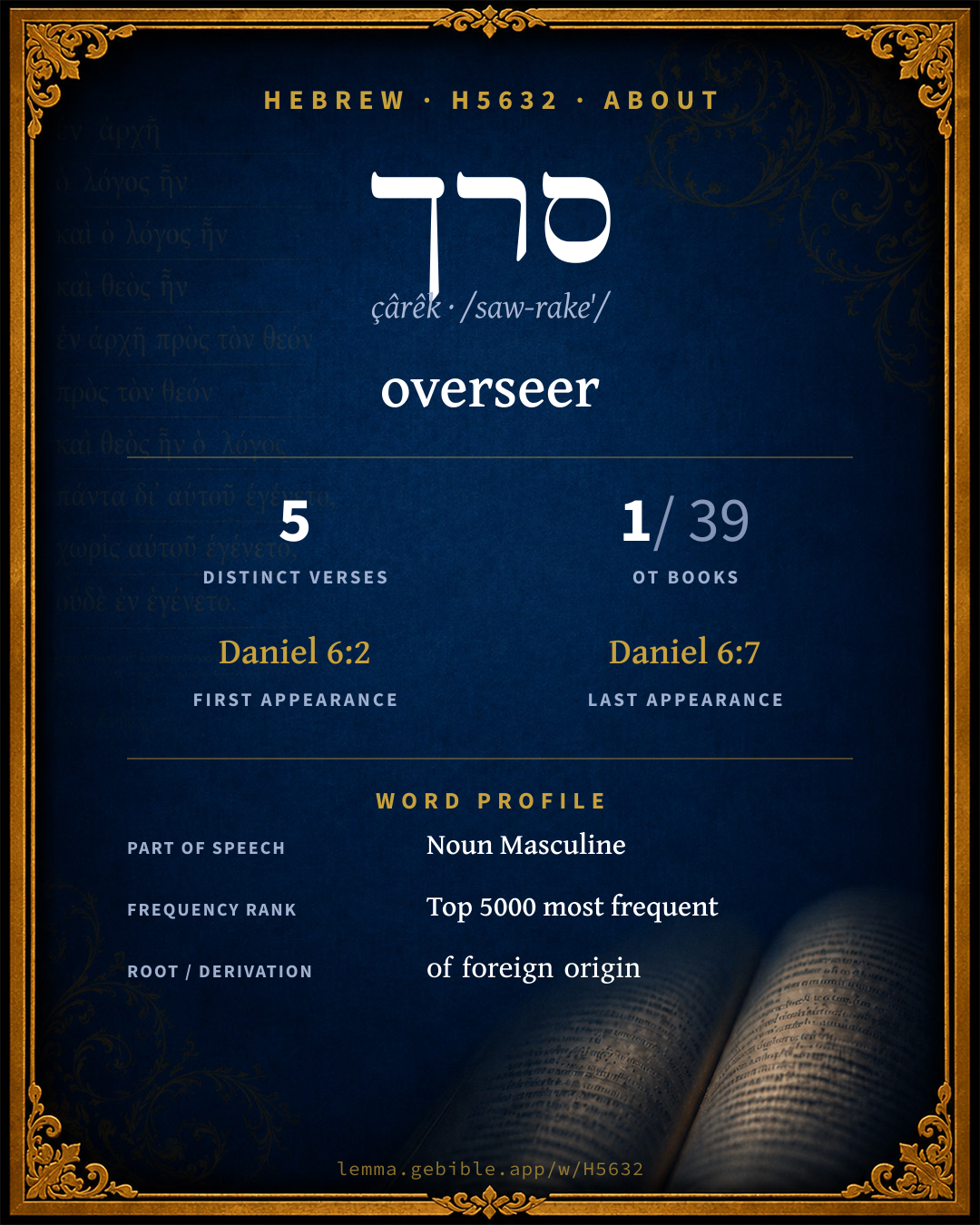
סָרֵךְ
overseer
Full lexicon entry — Brown-Driver-Briggs (BDB)
From Brown-Driver-Briggs (BDB)
Where this word appears
See every Absolute-state word in the Hebrew Bible →
Grammar key — what these labels mean
Part of speech
- Noun
- A naming word — a person, place, thing, or idea.
Noun type
- Common
- A common noun — a general class of person, place, or thing (“king,” “city,” “water”), not a specific name.
State
- Absolute
- The independent form of a noun, not bound to a following word.
- Construct
- A noun bound to a following noun in a possessive / “of” relationship (the construct chain).
Gender
- Masculine
- Grammatically masculine.
Number
- Plural
- More than one (in Hebrew, generally three or more).
Grammatical forms
- Particle, Definite Article 3 times (60%)
- Noun, Common, Masculine, Plural, Absolute 1 time (20%)
- Noun, Common, Masculine, Plural, Construct 1 time (20%)
Parsed forms decoded from the imported morphology (morphhb / Westminster Leningrad Codex — WLC text public domain, morphhb tagging CC BY 4.0), counted across 5 parsed occurrences — not distinct verses.
Every verse where H5632 appears — 5 distinct verses across 1 book. Click any verse to open its interlinear word-by-word view. Verse text shown in the World English Bible for context — . Each verse’s Hebrew form is shown with its reference; the English is not keyword-highlighted, since the data carries no word-level English alignment. Use “Compare translations” on any verse to read it across multiple English versions. This concordance covers the Hebrew Bible; Septuagint (Greek Old Testament) occurrences are not indexed here.
Daniel 5 verses
- Daniel 6:2 סָרְכִ֣ין n c mp and over them three presidents, of whom Daniel was one; that these satraps might give account to them, and that the king should have no damage.
- Daniel 6:3 סָרְכַיָּ֖/א n c mp det + ptcl def.art Then this Daniel was distinguished above the presidents and the satraps, because an excellent spirit was in him; and the king thought to set him over the whole realm.
- Daniel 6:4 סָֽרְכַיָּ֜/א n c mp det + ptcl def.art Then the presidents and the satraps sought to find occasion against Daniel as touching the kingdom; but they could find no occasion nor fault, because he was faithful, neither was there any error or fault found in him.
- Daniel 6:6 סָרְכַיָּ֤/א n c mp det + ptcl def.art Then these presidents and satraps assembled together to the king, and said thus to him, King Darius, live forever.
- Daniel 6:7 סָרְכֵ֣י n c mp cs All the presidents of the kingdom, the deputies and the satraps, the counselors and the governors, have consulted together to establish a royal statute, and to make a strong interdict, that whoever shall ask a petition of any god or man for thirty days, save of you, O king, he shall be cast into the den of lions.
About this entry
At a glance — auto-summarized from this page’s data, not written by a person. Every figure links to its source below. This summary describes the numbers; it doesn’t interpret them.
“overseer” is the headline sense of the Hebrew noun סרך (çârêk). With only 5 verses it sits in the long tail of Hebrew Bible vocabulary. It clusters heavily in Daniel, which alone accounts for 100% of its uses. First canonically at Daniel 6:2, it enters the text early. Translators differ — “presidents” in the King James Version, then “administrators” (Berean Standard Bible), as the renderings breakdown shows. See the sense tree, 5-verse concordance, and the renderings breakdown below.
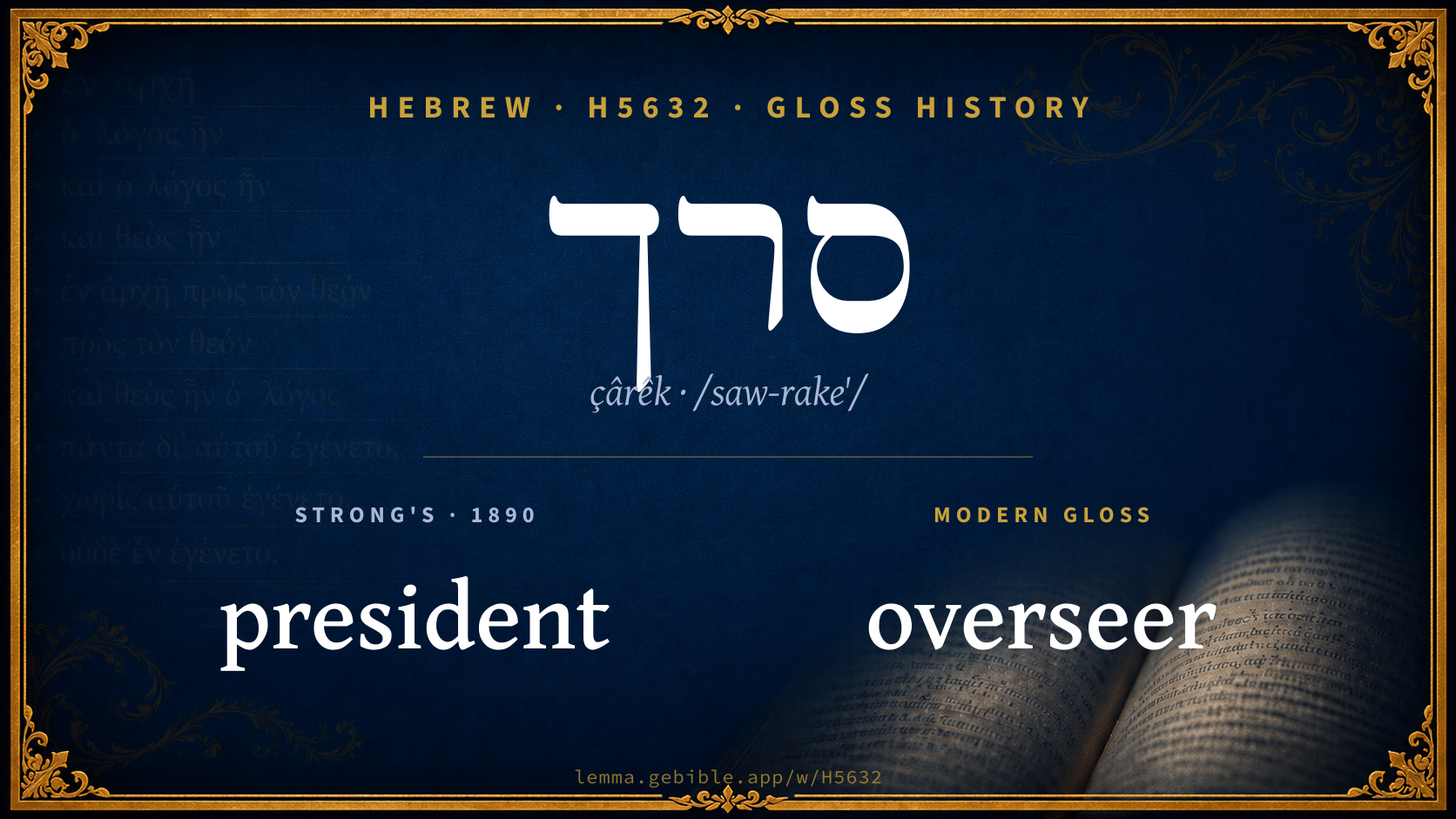
Gloss history
Strong's 1890 vs modern scholarship
About this word
Strong's H5632 catalogs a Hebrew word from the Hebrew Old Testament.
These counts are not copied from any lexicon or concordance. They are computed here, from the morphology-tagged Hebrew Old Testament. What Lemma adds →
- 5
- distinct verses
- The word appears in 5 distinct verses.
- 1 / 39
- OT books
- The word appears in 1 of 39 Old Testament books.
- #3,337
- by frequency
- Top 5000 most frequent Hebrew words (rank 3,337 of 8,640 Hebrew words by occurrence).
View all 5 occurrences in the concordance →
Most concentrated in
- Daniel 5 verses 100%
By section of the Old Testament
By traditional corpus
Conventional, traditional groupings — biblical authorship is debated, so this is a traditional corpus grouping, not an authorship claim. Each share is this word’s portion of its verses in that division of the Hebrew canon. Each figure is a share of the word’s 5 distinct verses.
- Writings (Ketuvim) 5 verses · 100%
How translations render this word
Counts come from each version’s own published word-to-Strong’s tagging or interlinear alignment — an approximate guide to how each version renders this word, not a word-level alignment the data otherwise carries. Because each total is that version’s own tagged count, the per-version totals vary from one another and need not match the appearance or distinct-verse counts above. These counts may also differ from a printed concordance because Lemma counts each distinctly tagged rendering and does not collapse phrase taggings into a single head-word total. This is a fixed set of word-tagged versions (KJV, ASV, BSB, ULT) and does not change with the reading translation you choose elsewhere. Each version’s license is shown beside its name below (and on Sources).
- King James Version: Presidents 5×
- American Standard Version: Presidents 5×
- Berean Standard Bible: Administrators 5×
- unfoldingWord Literal Text: High officials 4×
King James Version Public Domain
Renders H5632 across 5 tagged occurrences — most commonly:
American Standard Version Public Domain
Renders H5632 across 5 tagged occurrences — most commonly:
Berean Standard Bible Public Domain
Renders H5632 across 5 tagged occurrences — most commonly:
unfoldingWord Literal Text CC BY-SA 4.0
Renders H5632 across 5 tagged occurrences — most commonly:
Plus 1 rendering that appears only once — usually multi-word phrases or single function words the recovered tagging swept in, not distinct renderings.
Senses in BDB
The 1 sense BDB distinguishes for this word, in lexicon order (not ranked by frequency or importance). The full entry — with sub-senses — is in the Lexicon Entry tab.
- chief, overseer
Word origin
[ סָרֵךְ ] n.m. chief, overseer
— Brown-Driver-Briggs (Oxford 1906, public domain), digitized via Sefaria, supplemented by the OpenScriptures HebrewLexicon (CC BY 4.0). See Sources.
Origin: of foreign origin
Jastrow Dictionary
A second Hebrew/Aramaic lexicon for comparison, covering Aramaic and post-biblical (Talmudic, Targumic, Midrashic) usage that the biblical-Hebrew BDB does not. Matched by lemma rather than by Strong’s number, so a lemma may carry more than one Jastrow headword (shown separately below), and the entries cover usage well beyond the Bible.
סְרַךְ I
- (Saf. of ארך, cmp. סרג) to interweave, twist; trnsf. (corresp. to h. עָוַת) to confound; to wrong. Targ. Lam. III, 59; a. e. (interchanging with סְרַב II, q. v.).—Pes. 51ᵃ, v. next w.—Part. pass. סָרִיךְ, f. סְרִיכָא; pl. סְרִיכִין; סְרִיכָן intricate, perverted. Targ. Koh. X, 3. Ib. I, 15.
- 1. to subvert, wrong. Targ. Lam. III, 36 לסָרָכָא (ed. Vien. לסַרְכָא; ed. Lag. לסרבא; h. text לעַוֵּת).
- 2. to confound, v. next w.
סְרַךְ II
- (preced.; cmp. סָרַח I)
- 1. to clutch, hold fast, hang to. B. Bath. 86ᵇ שאני בהמה דסַרְכָא (Ms. R. דמְסָרְכָא Pa., v. Rabb. D. S. a. l. note
- 2. it is different with taking possession of an animal, because it clutches (the ground). Ḥull. 51ᵃ אית לה מידי למִיסְרַךְ the animal has something to clutch (when falling, so as to break the shock); והאי לית … למ׳ while this (kid) had nothing to cling to. Ib. top ליכא מידי למיסרך there is no object for the blood to hang to (around which to coagulate); כיון דאיכא מחט … מיסרך הוה סָרֵיךְ since a needle has been found there, if the perforation had taken place before slaughtering, blood would have clung round it; a. e.—Part. pass. סָרִיךְ; f. סְרִיכָא; pl. סְרִיכִין; סְרִיכָן. Gitt. 68ᵇ שוטה בחדא מילתא לא ס׳ an insane person does not cling to one fiction (he will betray his insanity in some other way than merely by repeating the same thing). Ḥull. 46ᵇ הני … דס׳ להדדי two lobes of the lungs which adhere to each other (by a membrane). Ned. 50ᵇ ואם אית כיבא ס׳ עלה if there be a sore in the bowels, it will cling to it (v. טְרוֹמִיטָא); a. e.—2) to confound, v. infra.
- same,
- 1. to clutch; (cmp. טָפַס) to climb. Bets. 11ᵃ סָרוּכֵי סָרוּךְ וסליקו they clutched and climbed up. B. Kam. 20ᵃ סריך סליק וכ׳ it climbed, came up and ate &c. Ib. לסרוכי ולמסלק (not לסרוכיה; Ms. F. למיסרך, v. Rabb. D. S. a. l. note 30) to climb up; a. e.
- 2. to cling to, adhere. Ḥull. 111ᵃ חלב סָרוּכֵי מְסָרֵיךְ (not סרוכיה) milk adheres (and penetrates), opp. מישרק שריק glides off. Ab. Zar. 22ᵇ מְסָרֵיךְ אבתרה (Ms. M. מִיסְרַךְ סָרֵיךְ) he clings to her (runs after her).
- 3. (v. preced.) to confound. Pes. 51ᵃ משום דמְסָרְכֵי מילתא (Ms. M. דסריכי; Ms. O. דמְסָרְבֵי מילתא במילתא, v. סְרַב II) because they confound one thing with another (if you permit them one thing, they will allow themselves another); הנך אינשי נמי סַרְכֵי מילתא (Ms. M. סְרִיכֵי, Ms. O. מסרבי מילתא במילתא) those people (ignorant Jews) will likewise confound &c.; a. e.
- to cling to. Ab. Zar. l. c. כרון דמִיסְּרִיךְ Rashi (ed. דמיגרי), v. גְּרֵי.
סֶרֶךְ
- (preced.) clinging to, following the example of; habit. Nidd. 67ᵇ משום ס׳ בתה because her daughter might follow her example (and make the mother’s exceptional act a rule for all occasions). Ḥull. 106ᵃ נטילת … משום ס׳ תרומה the washing of hands before a meal on secular food was introduced for the sake of uniformity with T’rumah (to make it a habit). Y. Yoma III, 40ᵇ bot., sq. טבילת ס׳ an immersion required merely for the sake of uniformity; Bab. ib. 30ᵃ ס׳ טבילה. Y. Bicc. III, 64ᵈ bot.; Y. Ḥag. II, 78ᵇ נטילת ס׳ washing of hands (before meals) for the sake of uniformity (v. supra).
A Dictionary of the Targumim, the Talmud Babli and Yerushalmi, and the Midrashic Literature (Marcus Jastrow; London, Luzac, 1903) — Public Domain. Digitized via Sefaria. Digitized via Sefaria. Full attribution on Sources.
Forms in the corpus
The 5 distinct written forms H5632 takes in the Hebrew Bible, most frequent first — each parse links to that state’s occurrences in the concordance. Hebrew forms include their vowel points and cantillation, so a single lemma takes many written forms.
| Form | Parsing | Example | Uses |
|---|---|---|---|
| סָֽרְכַיָּ֜/א | Particle, Definite Article | Daniel 6:4 | 1 |
| סָרְכִ֣ין | Noun, Common, Masculine, Plural, Absolute | Daniel 6:2 | 1 |
| סָרְכֵ֣י | Noun, Common, Masculine, Plural, Construct | Daniel 6:7 | 1 |
| סָרְכַיָּ֖/א | Particle, Definite Article | Daniel 6:3 | 1 |
| סָרְכַיָּ֤/א | Particle, Definite Article | Daniel 6:6 | 1 |
Septuagint verse parallels
This word appears in 5 verses that also exist in the Greek Old Testament (Septuagint), out of the 5 Hebrew verses it occurs in. You can read those verses in Greek by switching the Old Testament edition to the Septuagint.
Read these verses in the Septuagint
This is a verse-level parallel only — the same verses exist in both the Hebrew and Greek Old Testaments. No word-level Hebrew↔Greek correspondence is claimed: the data carries no such alignment, so no Greek word is shown as this Hebrew word’s translation. Coverage is not total — the Septuagint omits the deuterocanon and renumbers the Psalms, so some Hebrew verses have no direct Greek parallel.