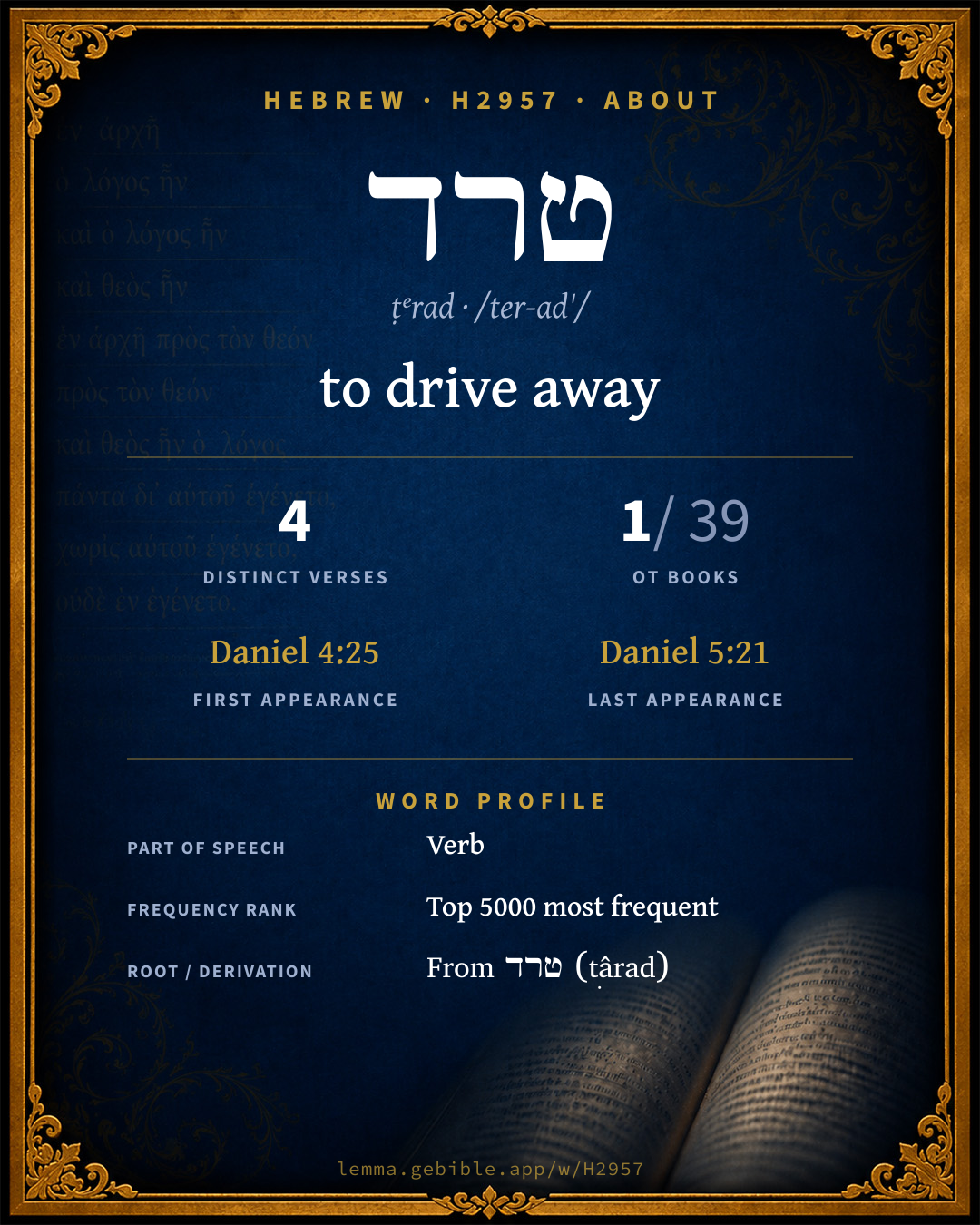
טְרַד
to drive away
Full lexicon entry — Brown-Driver-Briggs (BDB)
From Brown-Driver-Briggs (BDB)
Where this word appears
See every Qal verb in the Hebrew Bible →
Grammar key — what these labels mean
Part of speech
- Verb
- An action or state-of-being word.
Stem
- Qal Passive
- An archaic passive of the Qal, preserved in a few forms.
- Qal
- The basic, simple active stem — the plain form of the verb (“he wrote”).
Form
- Perfect
- A completed action or state — Hebrew marks aspect (completeness) more than strict tense (“he wrote”).
- Participle Active
- A verbal adjective expressing ongoing or characteristic action (“writing / one who writes”).
State
- Absolute
- The independent form of a noun, not bound to a following word.
Person
- 3rd Person
- The one spoken about (“he / she / it / they”).
Gender
- Masculine
- Grammatically masculine.
Number
- Singular
- One.
- Plural
- More than one (in Hebrew, generally three or more).
Grammatical forms
- Verb, Qal Passive, Perfect, 3rd Person, Masculine, Singular 2 times (50%)
- Verb, Qal, Participle Active, Masculine, Plural, Absolute 2 times (50%)
Parsed forms decoded from the imported morphology (morphhb / Westminster Leningrad Codex — WLC text public domain, morphhb tagging CC BY 4.0), counted across 4 parsed occurrences — not distinct verses.
Every verse where H2957 appears — 4 distinct verses across 1 book. Click any verse to open its interlinear word-by-word view. Verse text shown in the World English Bible for context — . Each verse’s Hebrew form is shown with its reference; the English is not keyword-highlighted, since the data carries no word-level English alignment. Use “Compare translations” on any verse to read it across multiple English versions. This concordance covers the Hebrew Bible; Septuagint (Greek Old Testament) occurrences are not indexed here.
Daniel 4 verses
- Daniel 4:25 טָֽרְדִ֣ין Qal ptcp.act mp that you shall be driven from men, and your dwelling shall be with the animals of the field, and you shall be made to eat grass as oxen, and shall be wet with the dew of the sky, and seven times shall pass over you; until you know that the Most High rules in the kingdom of men, and gives it to whoever he will.
- Daniel 4:32 טָֽרְדִ֜ין Qal ptcp.act mp and you shall be driven from men; and they dwelling shall be with the animals of the field; you shall be made to eat grass as oxen; and seven times shall pass over you; until you know that the Most High rules in the kingdom of men, and gives it to whoever he will.
- Daniel 4:33 טְרִ֔יד Qal Passive pf 3ms The same hour was the thing fulfilled on Nebuchadnezzar: and he was driven from men, and ate grass as oxen, and his body was wet with the dew of the sky, until his hair was grown like eagles' [feathers], and his nails like birds' [claws].
- Daniel 5:21 טְרִ֜יד Qal Passive pf 3ms and he was driven from the sons of men, and his heart was made like the animals', and his dwelling was with the wild donkeys; he was fed with grass like oxen, and his body was wet with the dew of the sky; until he knew that the Most High God rules in the kingdom of men, and that he sets up over it whoever he will.
About this entry
At a glance — auto-summarized from this page’s data, not written by a person. Every figure links to its source below. This summary describes the numbers; it doesn’t interpret them.
“to drive away” is the headline sense of the Hebrew verb טרד (ṭᵉrad). With only 4 verses it sits in the long tail of Hebrew Bible vocabulary. It clusters heavily in Daniel, which alone accounts for 100% of its uses. First canonically at Daniel 4:25, it enters the text early. From the same root come טרד and מטרד. See the sense tree, 4-verse concordance, and the renderings breakdown below.
Gloss history
Strong's 1890 vs modern scholarship
About this word
Strong's H2957 catalogs a Hebrew word from the Hebrew Old Testament.
These counts are not copied from any lexicon or concordance. They are computed here, from the morphology-tagged Hebrew Old Testament. What Lemma adds →
- 4
- distinct verses
- The word appears in 4 distinct verses.
- 1 / 39
- OT books
- The word appears in 1 of 39 Old Testament books.
- #3,696
- by frequency
- Top 5000 most frequent Hebrew words (rank 3,696 of 8,640 Hebrew words by occurrence).
View all 4 occurrences in the concordance →
Most concentrated in
- Daniel 4 verses 100%
By section of the Old Testament
By traditional corpus
Conventional, traditional groupings — biblical authorship is debated, so this is a traditional corpus grouping, not an authorship claim. Each share is this word’s portion of its verses in that division of the Hebrew canon. Each figure is a share of the word’s 4 distinct verses.
- Writings (Ketuvim) 4 verses · 100%
How translations render this word
Counts come from each version’s own published word-to-Strong’s tagging or interlinear alignment — an approximate guide to how each version renders this word, not a word-level alignment the data otherwise carries. Because each total is that version’s own tagged count, the per-version totals vary from one another and need not match the appearance or distinct-verse counts above. These counts may also differ from a printed concordance because Lemma counts each distinctly tagged rendering and does not collapse phrase taggings into a single head-word total. This is a fixed set of word-tagged versions (KJV, ASV, BSB, ULT) and does not change with the reading translation you choose elsewhere. Each version’s license is shown beside its name below (and on Sources).
- King James Version: He was driven 2×, They shall drive 2×
- American Standard Version: He was driven 2×, Thou shalt be driven 2×
- Berean Standard Bible: He was driven away 2×, You will be driven away 2×
- unfoldingWord Literal Text: He was driven away 2×
King James Version Public Domain
Renders H2957 across 4 tagged occurrences — most commonly:
American Standard Version Public Domain
Renders H2957 across 4 tagged occurrences — most commonly:
Berean Standard Bible Public Domain
Renders H2957 across 4 tagged occurrences — most commonly:
unfoldingWord Literal Text CC BY-SA 4.0
Renders H2957 across 4 tagged occurrences — most commonly:
Plus 2 renderings that appear only once — usually multi-word phrases or single function words the recovered tagging swept in, not distinct renderings.
Senses in BDB
The 1 sense BDB distinguishes for this word, in lexicon order (not ranked by frequency or importance). The full entry — with sub-senses — is in the Lexicon Entry tab.
- (Peal) to drive away, drive from, chase away
Word origin
[ טְרַד ] vb. chase away
— Brown-Driver-Briggs (Oxford 1906, public domain), digitized via Sefaria, supplemented by the OpenScriptures HebrewLexicon (CC BY 4.0). See Sources.
Derived from טרד (ṭârad) (H2956) — to drip.
Jastrow Dictionary
A second Hebrew/Aramaic lexicon for comparison, covering Aramaic and post-biblical (Talmudic, Targumic, Midrashic) usage that the biblical-Hebrew BDB does not. Matched by lemma rather than by Strong’s number, so a lemma may carry more than one Jastrow headword (shown separately below), and the entries cover usage well beyond the Bible.
טָרַד
- [to move, shake,]
- 1. to be running, to drip. Nidd. 49ᵇ היה טוֹרֵד וכ׳ if the liquid drips drop after drop. Bekh. 44ᵃ (עיניו) טוֹרְדוֹת running eyes (more than דלף); [Ar.: restless, constantly twinkling; oth. opin.: shutting with great trouble, v. infra).
- 2. (of waves) to carry. Tosef. Yeb. XIV, 5 שמא גל טורד אותו וכ׳ (v. ed. Zuck. note) perhaps a wave carries and lands him. Ib. טְרָדַנִי גל לחבירו one wave carried me to the other; (Y. ib. XVI, 15ᵈ top טרפני).
- 3. to make homeless, banish (cmp. טִלְטֵל). Lam. R. to I, 21 טְרָדָהּ חוץ וכ׳ he sent her out of the palace. Gen. R. s. 83 (play on מ̇הי̇טב̇אל בת מט̇ר̇ד̇) שהיו מט̇יב̇ין … ואח"כ טו̇רְדִין וכ׳ they dressed her for her husband and then led her away from her husband. Kidd. 31ᵃ וטוֹרְדוֹ מן העולם and drives him (his father) out of the world (makes him desperate). Midr. Till. to Ps. XXXI, beg. וט׳ אותם מן העולם and drove them into despair, a. fr.—3) to weary, make unsteady. Snh. 22ᵇ; Erub. 64ᵇ דרך טוֹרְדָתוֹ (Taan. 17ᵇ מַטְרִידָתוֹ Hif., Ms. M. everywhere מַטְרַחְתּוֹ, v. טָרַח) walking makes him unsteady (feel the wine).
- 4. to stir up (dregs), trouble. Sabb. 139ᵇ. Nidd. 25ᵃ, sq. מים … וטוֹרְדִין וכ׳ water is strong (is in commotion) and stirs the mass up, opp. מצחצחו makes it clear.—Part. pass. טָרוּד, f. טְרוּדָה; pl. טְרוּדִים, דִין …, טְרוּדוֹת a) busily engaged, troubled, anxious. Gen. R. l. c. (play on מטרד, v. supra) ט׳ היו וכ׳ they were anxious for a living. Y. Ber. IX, 13ᶜ bot. טרודין Asheri to Ber. IX, 13 (ed. Krot. טורדין) uninterrupted lightnings; a. fr.—b) banished. Num. R. s. 7, v. מַטְלוֹן.
- 1. to be troubled, agitated, confused. Num. R. s. 20; Tanḥ. Balak 11, end היה נִטְרָד he became confused, opp. שפוי.
- 2. to be banished. Deut. R. s. 2 יִטָּרֵד למטלון he shall be sent into exile. Deut. R. s. 6 תִּיטָּרֵד וכ׳; a. fr.
- to weary. Taan. 17ᵇ, v. supra.
טְרַד I
- 1. to trouble, stir up, keep in commotion. B. Bath. 168ᵇ הוו קא טַרְדֵּי ליה they were troubling him (begging persistently).—Part. pass. טָרִיד, f. טְרִידָא; pl. טְרִידִין, טְרִידָן. Targ. Is. LVII, 20 (h. text נגרש). Targ. Nah. II, 5 ברקין ט׳, v. preced.—Ber. 16ᵇ הכא ט׳ in the one case his mind is preoccupied. Erub. 68ᵃ טְרִידְנָא בגירסאי I am engrossed in my studies. Snh. 108ᵇ [read:] דהות טריד (or דטְרִידַת; Ms. F., טְרִיחַת, v. Rabb. D. S. a. l. note 9) that thou wert troubled (in my behalf); Yalk. Job 917 [read:] חמית דטרידת וכ׳; a. fr.
- 2. to banish, expel. Targ. Y. Gen. III, 24; a. fr.—
- 1. to be banished. Targ. Prov. XXV, 5. Targ. Y. Gen. XXVII, 45; a. e.
- 2. to be troubled. Ber. 35ᵇ; Yalk. Deut. 863 דלא תִיטַּרְדּוּ וכ׳ that you may not be troubled about support &c.
- 3. to quarrel. Arakh. 16ᵇ אתי לאִיטְּרוּדֵי he may get into a quarrel.
טְרַד II
- (cmp. טרק a. נְטַר) to guard, lock up, bolt. Targ. Y. Gen. XIX, 6 Ar. a. Levita (ed. אחד). Targ. Y. Ex. XIV, 3; a. e.—Lam. R. to I, 1 ט׳ תרעא (חד מירו׳) רבתי locked the door. Ib. to I, 18 טְרוֹדוּ תרעין shut the doors closely.—Y. Keth. VII, 31ᶜ תרעה טָרִיד if her door is found locked, contrad. to מוגף, v. גּוּף I.
- to be locked. Targ. Y. II, Gen. XLIX, 1.
A Dictionary of the Targumim, the Talmud Babli and Yerushalmi, and the Midrashic Literature (Marcus Jastrow; London, Luzac, 1903) — Public Domain. Digitized via Sefaria. Digitized via Sefaria. Full attribution on Sources.
Forms in the corpus
The 4 distinct written forms H2957 takes in the Hebrew Bible, most frequent first — each parse links to that stem’s occurrences in the concordance. Hebrew forms include their vowel points and cantillation, so a single lemma takes many written forms.
| Form | Parsing | Example | Uses |
|---|---|---|---|
| טְרִ֔יד | Verb, Qal Passive, Perfect, 3rd Person, Masculine, Singular | Daniel 4:33 | 1 |
| טְרִ֜יד | Verb, Qal Passive, Perfect, 3rd Person, Masculine, Singular | Daniel 5:21 | 1 |
| טָֽרְדִ֜ין | Verb, Qal, Participle Active, Masculine, Plural, Absolute | Daniel 4:32 | 1 |
| טָֽרְדִ֣ין | Verb, Qal, Participle Active, Masculine, Plural, Absolute | Daniel 4:25 | 1 |
Same root — word family
Other BDB entries built from the same root as H2957, grouped by Strong’s listed origin. These share a root / origin per the lexicon — not necessarily a shared meaning. Each links to that word’s own entry.
Derives from
Proper names from this root
People and places named from this root — a name, not an additional meaning of the word.
Compare all same-root words → 1 of the same-root words is a proper name (a person or place). They share a root, not necessarily a meaning.
Septuagint verse parallels
This word appears in 1 verse that also exists in the Greek Old Testament (Septuagint), out of the 4 Hebrew verses it occurs in. You can read those verses in Greek by switching the Old Testament edition to the Septuagint.
Read these verses in the Septuagint
This is a verse-level parallel only — the same verses exist in both the Hebrew and Greek Old Testaments. No word-level Hebrew↔Greek correspondence is claimed: the data carries no such alignment, so no Greek word is shown as this Hebrew word’s translation. Coverage is not total — the Septuagint omits the deuterocanon and renumbers the Psalms, so some Hebrew verses have no direct Greek parallel.