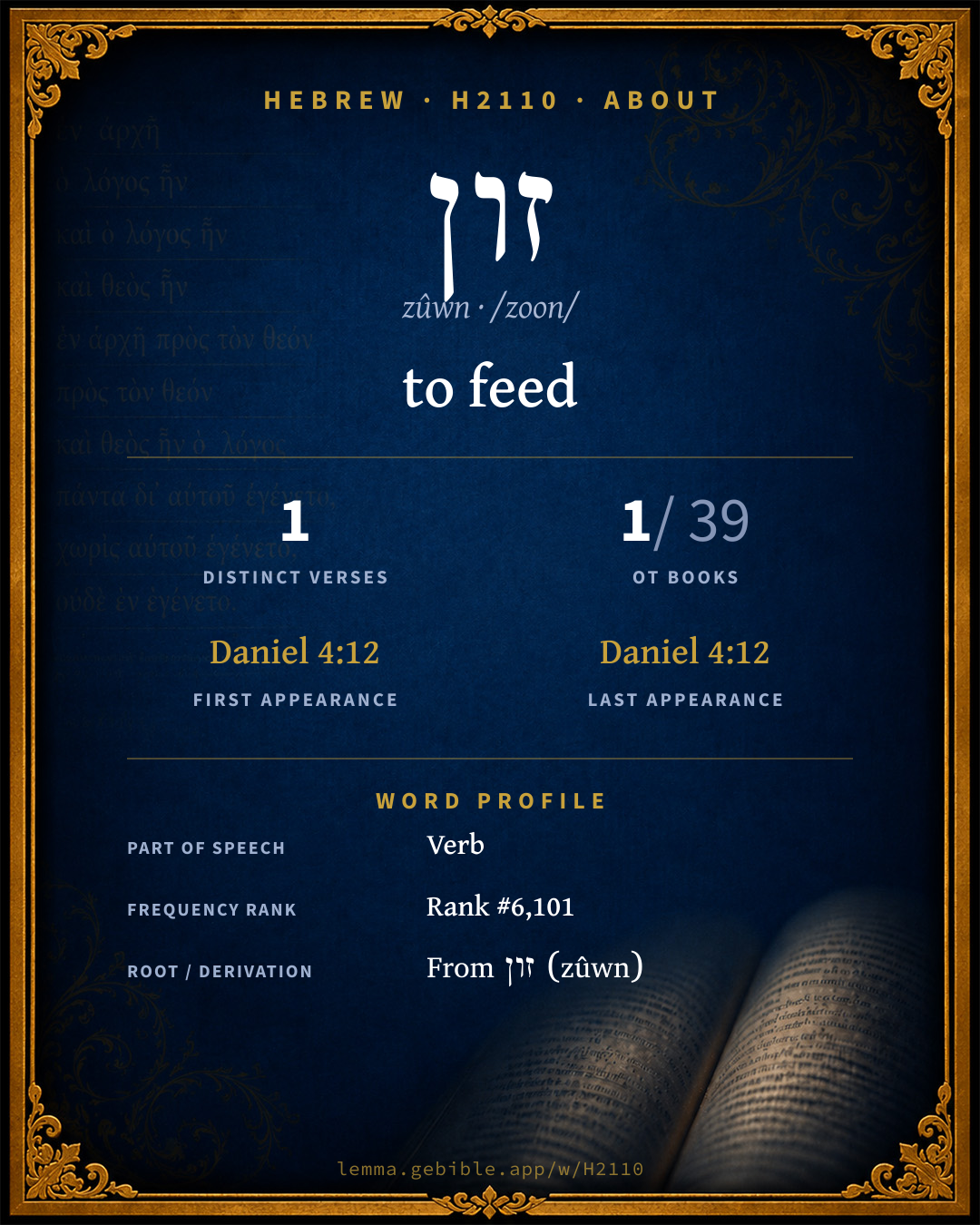
זוּן
to feed
‘to feed’ is one of 2 main senses fuller range ↓
Full lexicon entry — Brown-Driver-Briggs (BDB)
From Brown-Driver-Briggs (BDB)
Where this word appears
Grammar key — what these labels mean
Part of speech
- Verb
- An action or state-of-being word.
Form
- Imperfect
- An incomplete, ongoing, or future action (“he will / would write”).
Person
- 3rd Person
- The one spoken about (“he / she / it / they”).
Gender
- Masculine
- Grammatically masculine.
Number
- Singular
- One.
Every verse where H2110 appears — 1 distinct verse across 1 book. Click any verse to open its interlinear word-by-word view. Verse text shown in the World English Bible for context — . Each verse’s Hebrew form is shown with its reference; the English is not keyword-highlighted, since the data carries no word-level English alignment. Use “Compare translations” on any verse to read it across multiple English versions. This concordance covers the Hebrew Bible; Septuagint (Greek Old Testament) occurrences are not indexed here.
Daniel 1 verse
About this entry
At a glance — auto-summarized from this page’s data, not written by a person. Every figure links to its source below. This summary describes the numbers; it doesn’t interpret them.
The Hebrew verb זון centers on the idea of “to feed.” A scarce word — 1 verse in all of the Hebrew Bible. Daniel dominates its distribution — 1 of 1 verses. Found nowhere else but Daniel 4:12. BDB distinguishes 2 senses for it. Dig into 1-verse concordance and the renderings breakdown below.
Gloss history
Strong's 1890 vs modern scholarship
About this word
Strong's H2110 catalogs a Hebrew word from the Hebrew Old Testament.
These counts are not copied from any lexicon or concordance. They are computed here, from the morphology-tagged Hebrew Old Testament. What Lemma adds →
- 1
- distinct verses
- The word appears in 1 distinct verse.
- 1 / 39
- OT books
- The word appears in 1 of 39 Old Testament books.
- #6,101
- by frequency
- Rank #6,101 (rank 6,101 of 8,640 Hebrew words by occurrence).
View all 1 occurrence in the concordance →
Most concentrated in
- Daniel 1 verse 100%
By section of the Old Testament
By traditional corpus
Conventional, traditional groupings — biblical authorship is debated, so this is a traditional corpus grouping, not an authorship claim. Each share is this word’s portion of its verses in that division of the Hebrew canon. Each figure is a share of the word’s 1 distinct verse.
- Writings (Ketuvim) 1 verse · 100%
How translations render this word
Counts come from each version’s own published word-to-Strong’s tagging or interlinear alignment — an approximate guide to how each version renders this word, not a word-level alignment the data otherwise carries. Because each total is that version’s own tagged count, the per-version totals vary from one another and need not match the appearance or distinct-verse counts above. These counts may also differ from a printed concordance because Lemma counts each distinctly tagged rendering and does not collapse phrase taggings into a single head-word total. This is a fixed set of word-tagged versions (KJV, ASV, BSB, ULT) and does not change with the reading translation you choose elsewhere. Each version’s license is shown beside its name below (and on Sources).
- King James Version: Was fed 1×
- American Standard Version: Was fed 1×
- Berean Standard Bible: Was fed 1×
- unfoldingWord Literal Text: Was fed 1×
King James Version Public Domain
Renders H2110 across 1 tagged occurrence — most commonly:
American Standard Version Public Domain
Renders H2110 across 1 tagged occurrence — most commonly:
Berean Standard Bible Public Domain
Renders H2110 across 1 tagged occurrence — most commonly:
unfoldingWord Literal Text CC BY-SA 4.0
Renders H2110 across 1 tagged occurrence — most commonly:
Senses in BDB
The 2 senses BDB distinguishes for this word, in lexicon order (not ranked by frequency or importance). The full entry — with sub-senses — is in the Lexicon Entry tab.
- to feed
- (Ithpeel) to feed oneself
Word origin
[ זוּן ] vb. feed;— Hithpe. be fed: Dn 4:9
— Brown-Driver-Briggs (Oxford 1906, public domain), digitized via Sefaria, supplemented by the OpenScriptures HebrewLexicon (CC BY 4.0). See Sources.
Derived from זון (zûwn) (H2109) — to feed.
Jastrow Dictionary
A second Hebrew/Aramaic lexicon for comparison, covering Aramaic and post-biblical (Talmudic, Targumic, Midrashic) usage that the biblical-Hebrew BDB does not. Matched by lemma rather than by Strong’s number, so a lemma may carry more than one Jastrow headword (shown separately below), and the entries cover usage well beyond the Bible.
זוּן
- (cmp. זוד) to provide, outfit; to sustain, esp. to feed. Gitt. I, 6 שלא לָזוּן את וכ׳ not to sustain his slave. Ib. 12ᵃ איני זָנְךָ I will not support thee. Y. Keth. V, 29ᵈ top שתהא זוֹנְתוֹ ומפרנסתי (for זָנְתוֹ) that she should provide for all his wants. Sabb. 104ᵃ ז"ח ז̇ן … וח̇ן וכ׳ He supports and graces thee; a. fr.—Ber. 35ᵇ, a. e. כל הזן עלי I vow abstinence from whatever sustains the body.—Trnsf. to feed the eye, to derive pleasure from a sight (mostly of an illicit sight). Ohol. XIII, 4 one makes an opening in the wall לזון את עיניו for the sake of enjoying a view; Tosef. ib. XIV, 4. Pes. 26ᵃ כדי שלא יָזוּנוּ עיניהם וכ׳ that the laborers might not look at the Holy of Holies. Lev. R. s. 20 לא זן עיניו מן וכ׳ did not look at the Divine Majesty. Lev. R. s. 23, end ואינו זן וכ׳ and does not allow his eye to rest on an obscenity; a. fr.
- to be fed, sustained. Gitt. 12ᵇ נ׳ מן הצדקה must be supported from the public charity. Ib. (distinction betw. נ׳ a. התפרנס, v. פַּרְנֵס). Taan. 24ᵇ. Keth. XI, 1 נִיזּוֹנֶת מנכסי וכ׳ must be supported from the estate &c.
- to bless with plenty. Keth. 10ᵇ, v. זוּחַ II.
- to outfit, decorate; to gird, arm (cmp. זָוָוא I, a. P. Sm. 1102 sq.) Lev. R. s. 34 (ref. to יחליץ, Is. LVIII, 11) ישמוט יְזַיֵּין וכ׳ it has the meanings of ‘he will loosen’, ‘he will arm’, ‘he will rescue’, ‘he will give rest’.—Part. pass. מְזוּיָּן, מְזוּיָּין. B. Kam. 57ᵃ לסטים מ׳ a robber in arms; טוען טענת ל׳ מ׳ he pleads that he has been robbed by &c. Ib. 58ᵃ; a. e.—Pl. מְזוּיָּנִין. Ex. R. s. 20 (expl. חמשים, Ex. XXIII, 8) שעלו מ׳ they went out fully equipped; Mekh. B’shall., beg.; a. e. e.g. Isaiah 58:11
- to arm one’s self, to fight. Tanḥ. Ki Thabo 3 מִזְדַּיֵּין על וכ׳ He goes to war in defense of him &c.
זוּן I
- , to support, nourish. Targ. Gen. XLVII, 12 (h. text כלכל); a. fr.—Bets. 32ᵇ ומֵיזַן לא זָנוּ ליה Ms. M. (ed. זַיְּנוּהוּ Pa.) and they also refused to assist him (from the charities).—Part. זָיֵין. Ber. 35ᵇ משחא ז׳ oil nourishes, contrad. to סעיד to satisfy. Num. R. s. 9 אהין זָ׳ ומפרנס this one feeds and supports (his wife). Yalk. Lev. 665 והוה ז׳ להון וכ׳ (Lev. R. s. 34 מפרנס) and he supported them as long as they lived; a. fr.
- 1. same. Bets. 32ᵇ, v. supra. Y. Yeb. IV, 6ᵇ אנא מְזַיְּינָנָא ירהי I shall supply the wants of the household during my month (one month every year). Bab. ib. 65ᵃ אית ליה למְזַיְּינִינְהִי (some ed. למיז׳, read לימז׳) he has the means to support all of them; a. e.
- 2. to equip, arm, decorate. Targ. Y. Gen. XIV, 14 (O. זריז, h. text וירק).—Part. pass. מְזַיַּין, מְזַיַּן. Targ. Gen. XLIX, 19; a. e.
- to be supported, managed. Ib. XLI, 40 (h. text ישק). Targ. Koh. III, 22.—Keth. IV, 11 (in a marriage deed) ומִיתַּזְנָן and shall be supported.
- to be equipped, armed. Targ. Joel II, 9 (h. text ישקו). Targ. Y. II, Num. XXXI, 3.
זוּן II
- (cmp. preced.) [to gird, tie], (cmp. אסר) to detain.—Denom. זְיוּנָא, זְיָינָא.
זֶוֶן
- (cmp. זָוָוא a. זַיִן) girdle, laborer’s apron. Kel. XXVI, 3. Cmp. זַוְנִיתָא.—[זונים, v. זוֹנִי.]
A Dictionary of the Targumim, the Talmud Babli and Yerushalmi, and the Midrashic Literature (Marcus Jastrow; London, Luzac, 1903) — Public Domain. Digitized via Sefaria. Digitized via Sefaria. Full attribution on Sources.
Same root — word family
Other BDB entries built from the same root as H2110, grouped by Strong’s listed origin. These share a root / origin per the lexicon — not necessarily a shared meaning. Each links to that word’s own entry.
Derives from
Shares the same root
Proper names from this root
People and places named from this root — a name, not an additional meaning of the word.
Compare all same-root words → Showing 4 of 6 — not the complete family. 1 of the same-root words is a proper name (a person or place). They share a root, not necessarily a meaning.
Septuagint verse parallels
This word appears in 1 verse that also exists in the Greek Old Testament (Septuagint), out of the 1 Hebrew verse it occurs in. You can read those verses in Greek by switching the Old Testament edition to the Septuagint.
Read these verses in the Septuagint
This is a verse-level parallel only — the same verses exist in both the Hebrew and Greek Old Testaments. No word-level Hebrew↔Greek correspondence is claimed: the data carries no such alignment, so no Greek word is shown as this Hebrew word’s translation. Coverage is not total — the Septuagint omits the deuterocanon and renumbers the Psalms, so some Hebrew verses have no direct Greek parallel.