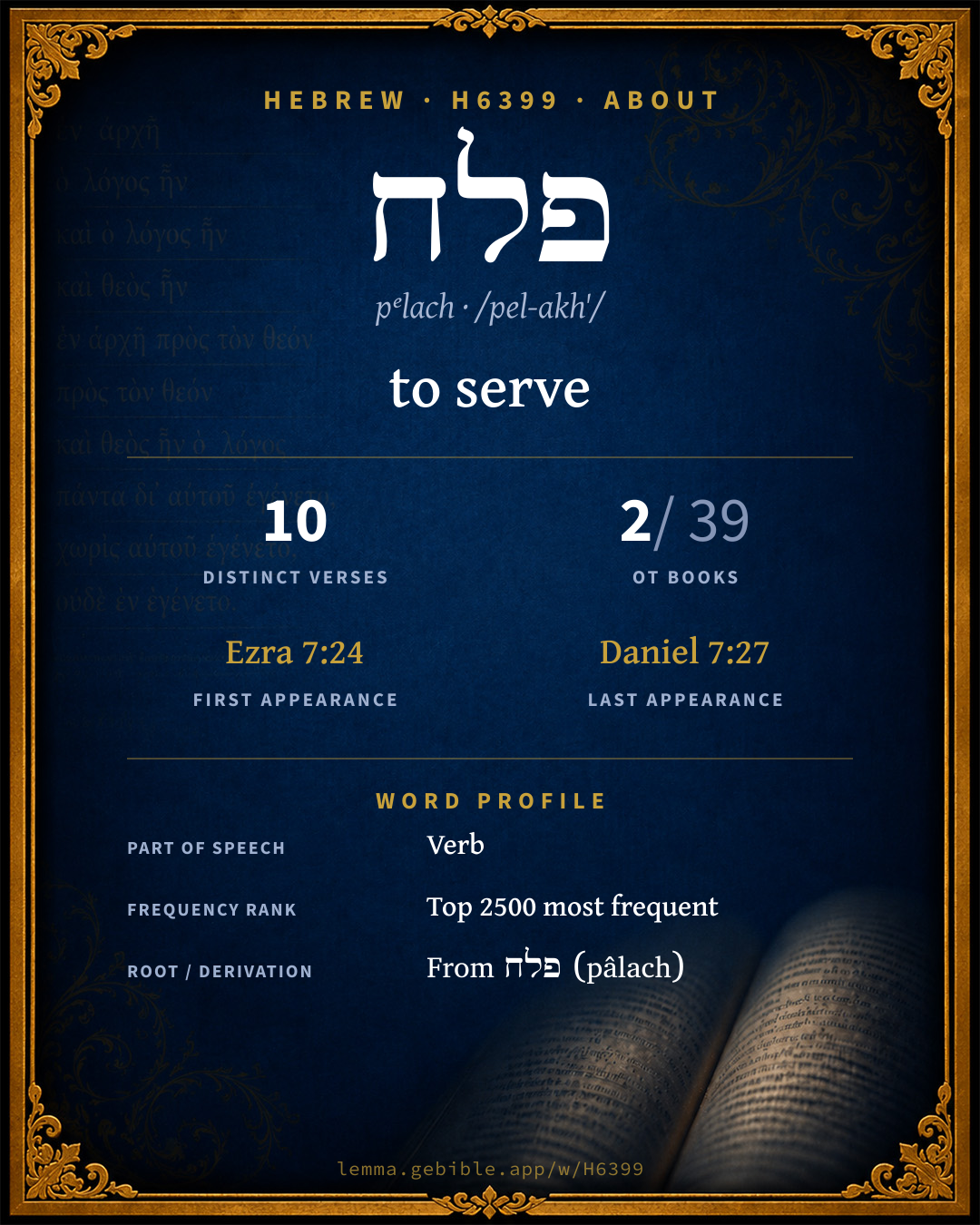
פְּלַח
to serve
also: worship, revere, minister for, pay reverence to fuller range ↓
Full lexicon entry — Brown-Driver-Briggs (BDB)
From Brown-Driver-Briggs (BDB)
Where this word appears
Grammar key — what these labels mean
Part of speech
- Verb
- An action or state-of-being word.
Stem
- Qal
- The basic, simple active stem — the plain form of the verb (“he wrote”).
Form
- Participle Active
- A verbal adjective expressing ongoing or characteristic action (“writing / one who writes”).
- Imperfect
- An incomplete, ongoing, or future action (“he will / would write”).
State
- Absolute
- The independent form of a noun, not bound to a following word.
- Construct
- A noun bound to a following noun in a possessive / “of” relationship (the construct chain).
Person
- 3rd Person
- The one spoken about (“he / she / it / they”).
Gender
- Masculine
- Grammatically masculine.
Number
- Plural
- More than one (in Hebrew, generally three or more).
- Singular
- One.
Grammatical forms
- Verb, Qal, Participle Active, Masculine, Plural, Absolute 4 times (40%)
- Verb, Qal, Imperfect, 3rd Person, Masculine, Plural 3 times (30%)
- Verb, Qal, Participle Active, Masculine, Singular, Absolute 2 times (20%)
- Verb, Qal, Participle Active, Masculine, Plural, Construct 1 time (10%)
Parsed forms decoded from the imported morphology (morphhb / Westminster Leningrad Codex — WLC text public domain, morphhb tagging CC BY 4.0), counted across 10 parsed occurrences — not distinct verses.
Every verse where H6399 appears — 10 distinct verses across 2 books. Click any verse to open its interlinear word-by-word view. Verse text shown in the World English Bible for context — . Each verse’s Hebrew form is shown with its reference; the English is not keyword-highlighted, since the data carries no word-level English alignment. Use “Compare translations” on any verse to read it across multiple English versions. This concordance covers the Hebrew Bible; Septuagint (Greek Old Testament) occurrences are not indexed here.
Ezra 1 verse
Daniel 9 verses
- Daniel 3:12 פָלְחִ֔ין Qal ptcp.act mp There are certain Jews whom you have appointed over the affairs of the province of Babylon: Shadrach, Meshach, and Abednego; these men, O king, have not regarded you: they don't serve your gods, nor worship the golden image which you have set up.
- Daniel 3:14 פָּֽלְחִ֔ין Qal ptcp.act mp Nebuchadnezzar answered them, Is it on purpose, Shadrach, Meshach, and Abednego, that you don't serve my god, nor worship the golden image which I have set up?
- Daniel 3:17 פָֽלְחִ֔ין Qal ptcp.act mp If it be [so], our God whom we serve is able to deliver us from the burning fiery furnace; and he will deliver us out of your hand, O king.
- Daniel 3:18 פָֽלְחִ֔ין Qal ptcp.act mp But if not, be it known to you, O king, that we will not serve your gods, nor worship the golden image which you have set up.
- Daniel 3:28 יִפְלְח֤וּן Qal impf 3mp Nebuchadnezzar spoke and said, Blessed be the God of Shadrach, Meshach, and Abednego, who has sent his angel, and delivered his servants who trusted in him, and have changed the king's word, and have yielded their bodies, that they might not serve nor worship any god, except their own God.
- Daniel 6:16 פָּֽלַֽח Qal ptcp.act ms Then the king commanded, and they brought Daniel, and cast him into the den of lions. [Now] the king spoke and said to Daniel, Your God whom you serve continually, he will deliver you.
- Daniel 6:20 פָּֽלַֽח Qal ptcp.act ms When he came near to the den to Daniel, he cried with a lamentable voice; the king spoke and said to Daniel, Daniel, servant of the living God, is your God, whom you serve continually, able to deliver you from the lions?
- Daniel 7:14 יִפְלְח֑וּן Qal impf 3mp There was given him dominion, and glory, and a kingdom, that all the peoples, nations, and languages should serve him: his dominion is an everlasting dominion, which shall not pass away, and his kingdom that which shall not be destroyed.
- Daniel 7:27 יִפְלְח֖וּן Qal impf 3mp The kingdom and the dominion, and the greatness of the kingdoms under the whole the sky, shall be given to the people of the saints of the Most High: his kingdom is an everlasting kingdom, and all dominions shall serve and obey him.
About this entry
At a glance — auto-summarized from this page’s data, not written by a person. Every figure links to its source below. This summary describes the numbers; it doesn’t interpret them.
פלח — transliterated pᵉlach — is a Hebrew verb carrying the sense “to serve.” More than three-quarters of its appearances fall in Daniel. The Hebrew Bible uses it across 10 verses — uncommon. Debuting at Ezra 7:24, it then recurs through the corpus. BDB distinguishes 3 senses; alongside “to serve” it spans “worship”, “revere”, and “minister for”. Dig into 10-verse concordance and the renderings breakdown below.
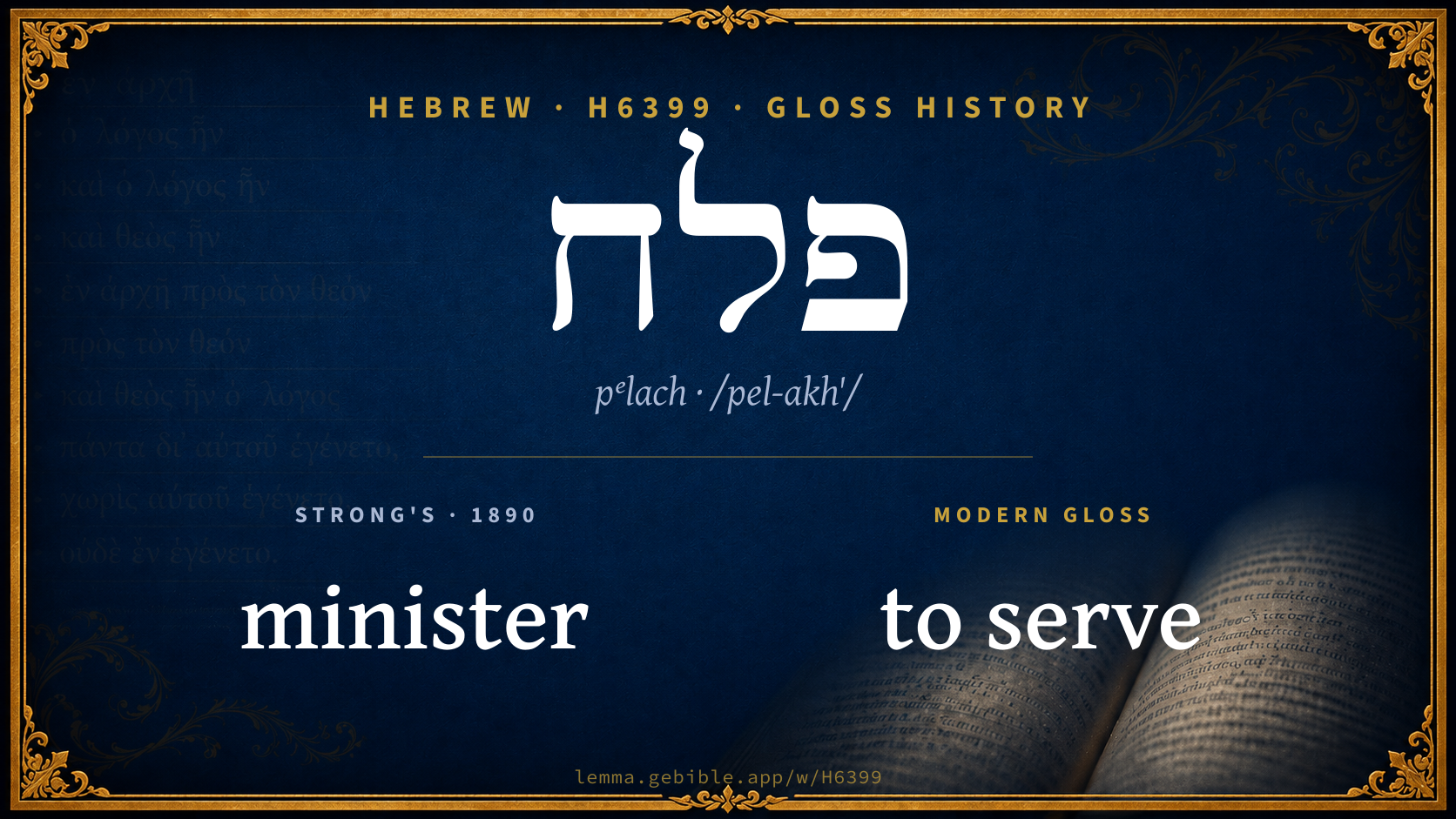
Gloss history
Strong's 1890 vs modern scholarship
About this word
Strong's H6399 catalogs a Hebrew word from the Hebrew Old Testament.
These counts are not copied from any lexicon or concordance. They are computed here, from the morphology-tagged Hebrew Old Testament. What Lemma adds →
- 10
- distinct verses
- The word appears in 10 distinct verses.
- 2 / 39
- OT books
- The word appears in 2 of 39 Old Testament books.
- #2,342
- by frequency
- Top 2500 most frequent Hebrew words (rank 2,342 of 8,640 Hebrew words by occurrence).
View all 10 occurrences in the concordance →
By traditional corpus
Conventional, traditional groupings — biblical authorship is debated, so this is a traditional corpus grouping, not an authorship claim. Each share is this word’s portion of its verses in that division of the Hebrew canon. Each figure is a share of the word’s 10 distinct verses.
- Writings (Ketuvim) 10 verses · 100%
How translations render this word
Counts come from each version’s own published word-to-Strong’s tagging or interlinear alignment — an approximate guide to how each version renders this word, not a word-level alignment the data otherwise carries. Because each total is that version’s own tagged count, the per-version totals vary from one another and need not match the appearance or distinct-verse counts above. These counts may also differ from a printed concordance because Lemma counts each distinctly tagged rendering and does not collapse phrase taggings into a single head-word total. This is a fixed set of word-tagged versions (KJV, ASV, BSB, ULT) and does not change with the reading translation you choose elsewhere. Each version’s license is shown beside its name below (and on Sources).
- King James Version: Serve 4×
- American Standard Version: Serve 4×
- Berean Standard Bible: Serve 6×
- unfoldingWord Literal Text: Serve 7×
King James Version Public Domain
Renders H6399 across 10 tagged occurrences — most commonly:
Plus 6 renderings that appear only once — usually multi-word phrases or single function words the recovered tagging swept in, not distinct renderings.
American Standard Version Public Domain
Renders H6399 across 10 tagged occurrences — most commonly:
Plus 6 renderings that appear only once — usually multi-word phrases or single function words the recovered tagging swept in, not distinct renderings.
Berean Standard Bible Public Domain
Renders H6399 across 10 tagged occurrences — most commonly:
Plus 4 renderings that appear only once — usually multi-word phrases or single function words the recovered tagging swept in, not distinct renderings.
unfoldingWord Literal Text CC BY-SA 4.0
Renders H6399 across 12 tagged occurrences — most commonly:
Plus 5 renderings that appear only once — usually multi-word phrases or single function words the recovered tagging swept in, not distinct renderings.
Senses in BDB
The 3 senses BDB distinguishes for this word, in lexicon order (not ranked by frequency or importance). The full entry — with sub-senses — is in the Lexicon Entry tab.
- to serve, worship, revere, minister for, pay reverence to
(Peal)
- to pay reverence to
- to serve
Word origin
[ פְּלַח ] vb. pay reverence to, serve (deity)
— Brown-Driver-Briggs (Oxford 1906, public domain), digitized via Sefaria, supplemented by the OpenScriptures HebrewLexicon (CC BY 4.0). See Sources.
Derived from פלח (pâlach) (H6398) — to cleave.
Jastrow Dictionary
A second Hebrew/Aramaic lexicon for comparison, covering Aramaic and post-biblical (Talmudic, Targumic, Midrashic) usage that the biblical-Hebrew BDB does not. Matched by lemma rather than by Strong’s number, so a lemma may carry more than one Jastrow headword (shown separately below), and the entries cover usage well beyond the Bible.
פָּלַח
- (b. h.) to split; to dig, till; to cut out. Ex. R. s. 27 על מנת לפוֹלְחָהּ will you take this field with the condition that you will till it?; a. e.—2) to work for, serve, v. פּוֹלֵחַ.—3) to worship. Tosef. Ab. Zar. I, 4 אינו אסור אלא לפוֹלְחִין בלבד it is forbidden to deal with those only who worship (on the Calendæ), contrad. to עושין who observe it as a holiday; (Ab. Zar. 8ᵃ לעובריה; Y. ib. I, 39ᶜ top לפלחין בה, Chald.).
פְּלַח
- 1. to till, work. Targ. Ex. XX, 9 (Y. ed. Vien. Pa.). Targ. Prov. X, 5 (h. text אגר). Targ. Gen. IV, 12; a. fr.—3) to serve (man or deity); to worship. Ib. XIV, 4. Ib. XVII, 1 (h. text התהלך); a. fr.—Y. Ab. Zar. I, 39ᶜ top לפָלְחִין בה, v. preced. Ib. נשי דפלחין כפלחין the wives of those who worship (on the Roman festivals) are to be treated like those who worship. Ib. כפלחין היא (not כפלחון), v. שָׁמְרַיִין. Bab. Ab. Zar. 11ᵃ פָּלְחֵי בה לע"א they worship the idol on it (the anniversary of death). Ib. 22ᵇ אם איתא דפַלְחֵיה וכ׳ if he had worshipped it, he would not sell it. Snh. 102ᵇ מ"כ פַּלְחִיתוּ לע"א why do you worship idols? Gitt. 57ᵇ פְּלַח לע"א worship (bow down) to &c.!; a. fr.—4) פ׳ ב־ [to work with,] to compel to serve or work, to subject. Targ. Lev. XXV, 39. Targ. O. ib. 43. Targ. O. Gen. XV, 14; a. fr.—5) to split, distribute. Ab. Zar. 18ᵃ bot. פלגא פְלַח ופלגא וכ׳ one half distribute (as bribe), and one half be thine.
- same, to dig, till, work. Targ. Y. Ex. XX, 9 (v. supra). Targ. Ps. CXLI, 7. Targ. Is. XXXII, 17; a. e.
- to make work, to subject, rule. Targ. O. Ex. I, 13. Targ. I Kings V, 4; a. fr.
- 1. to be worked, tilled; (with ב) to be worked with. Targ. Deut. XXI, 3. Targ. O. ib. 4. Targ. Ez. XXXVI, 9; a. e.
- 2. to break through, be born. Targ. Job XXXIX, 3.
פֶּלַח
- c. (b. h.; preced. wds.) segment, slice; (sub. רכב) millstone. Yalk. Num. 787 הכהו בגוש … או בפ׳ של דבילה if he killed a man with a lump of salt or a slice of a fig-cake.—Pl. פְּלָחוֹת, constr. פִּלְחֵי. Dem. V, 5 פ׳ דבלה slices of &c. Yalk. l. c. שיכו אותו … ובפ׳ that they may kill him (the murderer) with stones, arrows or millstones.—V. פֶּלֶךְ.
A Dictionary of the Targumim, the Talmud Babli and Yerushalmi, and the Midrashic Literature (Marcus Jastrow; London, Luzac, 1903) — Public Domain. Digitized via Sefaria. Digitized via Sefaria. Full attribution on Sources.
Forms in the corpus
The 8 distinct written forms H6399 takes in the Hebrew Bible, most frequent first — each parse links to that stem’s occurrences in the concordance. Hebrew forms include their vowel points and cantillation, so a single lemma takes many written forms.
| Form | Parsing | Example | Uses |
|---|---|---|---|
| פָֽלְחִ֔ין | Verb, Qal, Participle Active, Masculine, Plural, Absolute | Daniel 3:17 | 2 |
| פָּֽלַֽח | Verb, Qal, Participle Active, Masculine, Singular, Absolute | Daniel 6:16 | 2 |
| וּ/פָ֣לְחֵ֔י | Verb, Qal, Participle Active, Masculine, Plural, Construct | Ezra 7:24 | 1 |
| יִפְלְח֑וּן | Verb, Qal, Imperfect, 3rd Person, Masculine, Plural | Daniel 7:14 | 1 |
| יִפְלְח֖וּן | Verb, Qal, Imperfect, 3rd Person, Masculine, Plural | Daniel 7:27 | 1 |
| יִפְלְח֤וּן | Verb, Qal, Imperfect, 3rd Person, Masculine, Plural | Daniel 3:28 | 1 |
| פָלְחִ֔ין | Verb, Qal, Participle Active, Masculine, Plural, Absolute | Daniel 3:12 | 1 |
| פָּֽלְחִ֔ין | Verb, Qal, Participle Active, Masculine, Plural, Absolute | Daniel 3:14 | 1 |
Same root — word family
Other BDB entries built from the same root as H6399, grouped by Strong’s listed origin. These share a root / origin per the lexicon — not necessarily a shared meaning. Each links to that word’s own entry.
Derives from
Shares the same root
Derived from this word
Compare all same-root words → They share a root, not necessarily a meaning.
Septuagint verse parallels
This word appears in 10 verses that also exist in the Greek Old Testament (Septuagint), out of the 10 Hebrew verses it occurs in. You can read those verses in Greek by switching the Old Testament edition to the Septuagint.
Read these verses in the Septuagint
This is a verse-level parallel only — the same verses exist in both the Hebrew and Greek Old Testaments. No word-level Hebrew↔Greek correspondence is claimed: the data carries no such alignment, so no Greek word is shown as this Hebrew word’s translation. Coverage is not total — the Septuagint omits the deuterocanon and renumbers the Psalms, so some Hebrew verses have no direct Greek parallel.