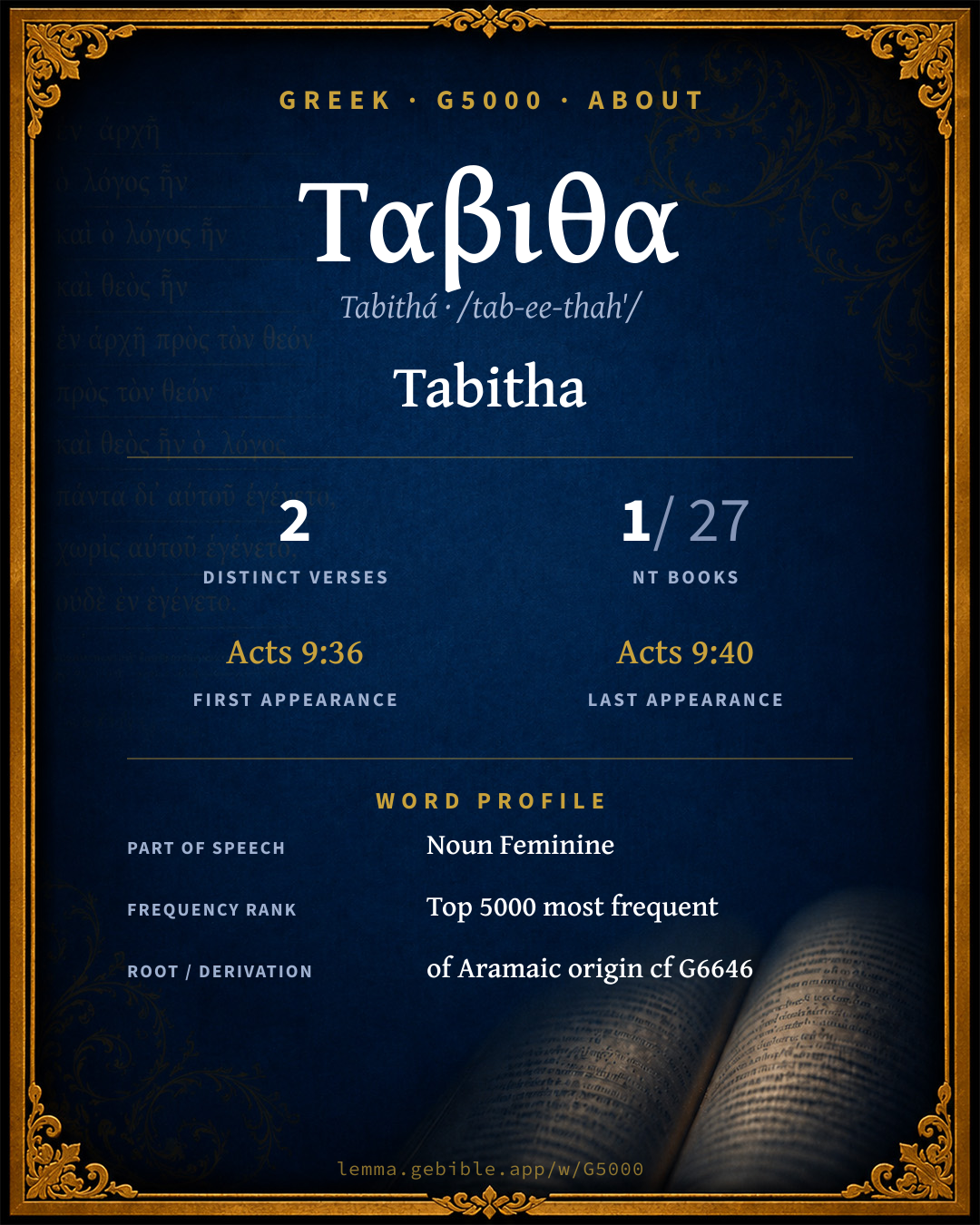
Ταβιθά
Tabitha
Thayer's lists 2 entries for ‘Tabitha’ fuller range ↓
Full lexicon entry — Thayer's Greek Lexicon
From Thayer's Greek Lexicon
Where this word appears
Every verse where G5000 appears — 2 distinct verses across 1 book. Click any verse to open its interlinear word-by-word view. Verse text shown in the World English Bible for context — . Each verse’s Greek form is shown with its reference; the English is not keyword-highlighted, since the data carries no word-level English alignment. Use “Compare translations” on any verse to read it across multiple English versions. This concordance covers the Greek New Testament; Septuagint (Greek Old Testament) occurrences of this word are not indexed here.
Acts 2 verses
- Acts 9:36 Ταβιθά n proper indecl Now there was at Joppa a certain disciple named Tabitha, which when translated, means Dorcas. This woman was full of good works and acts of mercy which she did.
- Acts 9:40 Ταβιθά n proper indecl Peter put them all out, and kneeled down and prayed. Turning to the body, he said, "Tabitha, get up!" She opened her eyes, and when she saw Peter, she sat up.
About this entry
At a glance — auto-summarized from this page’s data, not written by a person. Every figure links to its source below. This summary describes the numbers; it doesn’t interpret them.
At its core, Ταβιθα (Tabithá) means “Tabitha.” It occurs a mere 2 verses across Scripture. The word gravitates to Acts (100%). Scripture first uses it in Acts 9:36. Each statement above links to its evidence; the full detail follows below.
Gloss history
Strong's 1890 vs modern scholarship
About this word
Strong's G5000 catalogs a Greek word from the Greek New Testament.
These counts are not copied from any lexicon or concordance. They are computed here, from the morphology-tagged Greek New Testament. What Lemma adds →
- 2
- distinct verses
- The word appears in 2 distinct verses.
- 1 / 27
- NT books
- The word appears in 1 of 27 New Testament books.
- #2,678
- by frequency
- Top 5000 most frequent Greek words (rank 2,678 of 5,347 Greek words by occurrence).
View all 2 occurrences in the concordance →
Most concentrated in
- Acts 2 verses 100%
By section of the New Testament
By traditional corpus
Conventional, traditional groupings — biblical authorship is debated, so this is a traditional corpus grouping, not an authorship claim. Some books belong to more than one corpus (Luke is in both the Gospels and the Lukan corpus, and so on), so these shares overlap and need not total 100%. Each figure is a share of the word’s 2 distinct verses.
- Lukan (Luke–Acts) 2 verses · 100%
How translations render this word
Counts come from each version’s own published word-to-Strong’s tagging or interlinear alignment — an approximate guide to how each version renders this word, not a word-level alignment the data otherwise carries. Because each total is that version’s own tagged count, the per-version totals vary from one another and need not match the appearance or distinct-verse counts above. These counts may also differ from a printed concordance because Lemma counts each distinctly tagged rendering and does not collapse phrase taggings into a single head-word total. This is a fixed set of word-tagged versions (KJV, ASV, BSB, ULT) and does not change with the reading translation you choose elsewhere. Each version’s license is shown beside its name below (and on Sources).
- King James Version: Tabitha 2×
- American Standard Version: Tabitha 2×
- Berean Standard Bible: Tabitha 2×
- unfoldingWord Literal Text: Tabitha 2×
King James Version Public Domain
Renders G5000 across 2 tagged occurrences — most commonly:
American Standard Version Public Domain
Renders G5000 across 2 tagged occurrences — most commonly:
Berean Standard Bible Public Domain
Renders G5000 across 2 tagged occurrences — most commonly:
unfoldingWord Literal Text CC BY-SA 4.0
Renders G5000 across 2 tagged occurrences — most commonly:
Senses in Thayer's
The 2 senses Thayer's distinguishes for this word, in lexicon order (not ranked by frequency or importance). The full entry — with sub-senses — is in the Lexicon Entry tab.
- Tabitha = "female gazelle"
- the name of the woman that Peter raised from the dead
Word origin
Origin: of Aramaic origin cf G6646
Of Chaldee origin (compare [ H6646 ]); the gazelle ; Tabitha (that is Tabjetha ) a Christian female : - Tabitha.
— Strong’s Exhaustive Concordance (1890), public domain.
Bible dictionary
Public-domain dictionary articles matched to this entry by name (Tabitha). A biblical name can be shared by more than one person or place, so an article may treat several.
Easton's Bible Dictionary · M. G. Easton, 1897
(in Greek called Dorcas), gazelle, a disciple at Joppa. She was distinguished for her alms-deeds and good works. Peter, who was sent for from Lydda on the occasion of her death, prayed over the dead body, and said, "Tabitha, arise." And she opened her eyes and sat up; and Peter "gave her his hand, and raised her up; and calling the saints and widows, he presented her alive" (Acts 9:36-43).
Smith's Bible Dictionary · William Smith, 1863
(gazelle), also called Dorcas by St. Luke, a female disciple of Joppa, "full of good works" among which that of making clothes for the poor is specifically mentioned. While St. Peter was at the neighboring town of Lydda, Tabitha, died; upon which the disciples at Joppa sent an urgent message to the apostle begging him to come to them without delay. Upon his arrival Peter found the deceased already prepared for burial, and laid out in an upper chamber, where she was surrounded by the recipients and the tokens of her charity after the example of our Saviour in the house of Jairus, (Matthew 9:25; Mark 5:40) "Peter put them all forth," prayed for the divine assistance, and then commanded Tabitha to arise. Comp. (Mark 5:41; Luke 8:51) She opened-her eyes and sat up, and then, assisted by the apostle, rose from her couch. This great miracle, as we are further told produced an extraordinary effect in Joppa, and was the occasion of many conversions there. (Acts 9:38-42) The name "Tabitha" is an Aramaic word signifying a "female gazelle." St. Luke gives "Dorcas" as the Greek equivalent of the name.
Hitchcock's Bible Names Dictionary · Roswell D. Hitchcock, 1869
clear-sighted; a roe-deer
Classic public-domain reference works; full attribution on Sources.