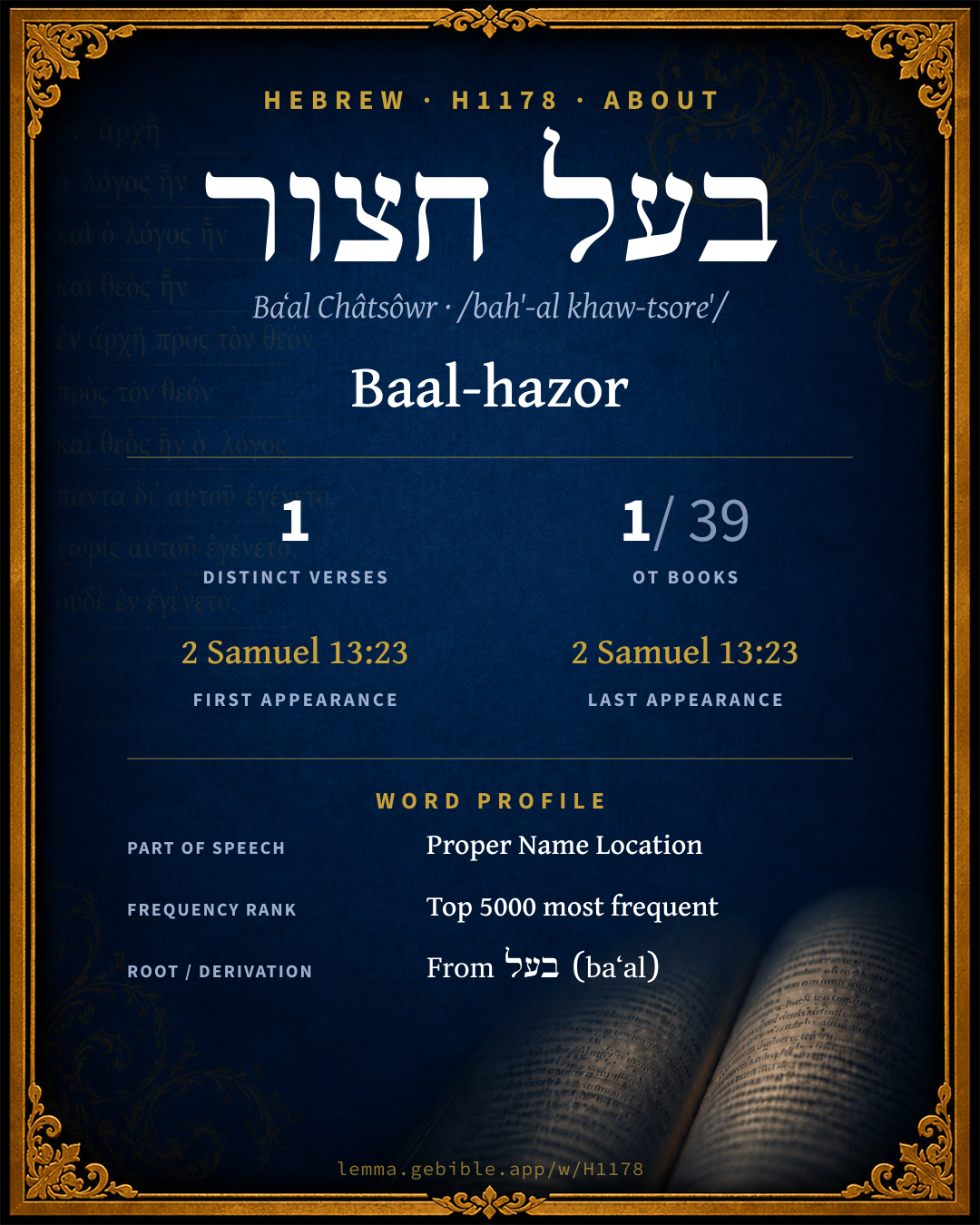
בַּ֫עַל חָצוֹר
Baal-hazor
BDB lists 2 entries for ‘Baal-hazor’ fuller range ↓
Full lexicon entry — Brown-Driver-Briggs (BDB)
From Brown-Driver-Briggs (BDB)
Where this word appears
Grammar key — what these labels mean
Part of speech
- Noun
- A naming word — a person, place, thing, or idea.
Noun type
- Proper
- A name of a specific person, place, or people (e.g. Abraham, Zion, Israel).
Every verse where H1178 appears — 1 distinct verse across 1 book. Click any verse to open its interlinear word-by-word view. Verse text shown in the World English Bible for context — . Each verse’s Hebrew form is shown with its reference; the English is not keyword-highlighted, since the data carries no word-level English alignment. Use “Compare translations” on any verse to read it across multiple English versions. This concordance covers the Hebrew Bible; Septuagint (Greek Old Testament) occurrences are not indexed here.
2 Samuel 1 verse
About this entry
At a glance — auto-summarized from this page’s data, not written by a person. Every figure links to its source below. This summary describes the numbers; it doesn’t interpret them.
At its core, בעל חצור (Baʻal Châtsôwr) means “Baal-hazor.” A scarce word — 1 verse in all of the Hebrew Bible. Its uses cluster heavily in 2 Samuel (100% of all occurrences). Its lone occurrence is 2 Samuel 13:23. Dig into 1-verse concordance and the renderings breakdown below.
Gloss history
Strong's 1890 vs modern scholarship
About this word
Strong's H1178 catalogs a Hebrew word from the Hebrew Old Testament.
These counts are not copied from any lexicon or concordance. They are computed here, from the morphology-tagged Hebrew Old Testament. What Lemma adds →
- 1
- distinct verses
- The word appears in 1 distinct verse.
- 1 / 39
- OT books
- The word appears in 1 of 39 Old Testament books.
- #4,807
- by frequency
- Top 5000 most frequent Hebrew words (rank 4,807 of 8,640 Hebrew words by occurrence).
View all 1 occurrence in the concordance →
Most concentrated in
- 2 Samuel 1 verse 100%
By section of the Old Testament
By traditional corpus
Conventional, traditional groupings — biblical authorship is debated, so this is a traditional corpus grouping, not an authorship claim. Each share is this word’s portion of its verses in that division of the Hebrew canon. Each figure is a share of the word’s 1 distinct verse.
- Prophets (Nevi'im) 1 verse · 100%
How translations render this word
Counts come from each version’s own published word-to-Strong’s tagging or interlinear alignment — an approximate guide to how each version renders this word, not a word-level alignment the data otherwise carries. Because each total is that version’s own tagged count, the per-version totals vary from one another and need not match the appearance or distinct-verse counts above. These counts may also differ from a printed concordance because Lemma counts each distinctly tagged rendering and does not collapse phrase taggings into a single head-word total. This is a fixed set of word-tagged versions (KJV, ASV, BSB, ULT) and does not change with the reading translation you choose elsewhere. Each version’s license is shown beside its name below (and on Sources).
- King James Version: Baalhazor 1×
- American Standard Version: Baal-hazor 1×
- Berean Standard Bible: Baal-hazor 1×
- unfoldingWord Literal Text: Baal hazor 2×
King James Version Public Domain
Renders H1178 across 1 tagged occurrence — most commonly:
American Standard Version Public Domain
Renders H1178 across 1 tagged occurrence — most commonly:
Berean Standard Bible Public Domain
Renders H1178 across 1 tagged occurrence — most commonly:
unfoldingWord Literal Text CC BY-SA 4.0
Renders H1178 across 2 tagged occurrences — most commonly:
Senses in BDB
The 2 senses BDB distinguishes for this word, in lexicon order (not ranked by frequency or importance). The full entry — with sub-senses — is in the Lexicon Entry tab.
- Baal-hazor = "lord of the village"
- a town on the border between Ephraim and Benjamin…
Word origin
בַּ֫עַל חָצוֹר n.pr.loc. ( possessor of a court ) city on the border of Ephraim and Benjamin
— Brown-Driver-Briggs (Oxford 1906, public domain), digitized via Sefaria, supplemented by the OpenScriptures HebrewLexicon (CC BY 4.0). See Sources.
Derived from בעל (baʻal) (H1167) — husband.
Jastrow Dictionary
A second Hebrew/Aramaic lexicon for comparison, covering Aramaic and post-biblical (Talmudic, Targumic, Midrashic) usage that the biblical-Hebrew BDB does not. Matched by lemma rather than by Strong’s number, so a lemma may carry more than one Jastrow headword (shown separately below), and the entries cover usage well beyond the Bible.
בָּעַל
- , v. בָּעָה, to enter into, take possession) [in b. h. to be master, protect;] to have sexual intercourse (both legal or illicit), to embrace a woman. Kidd. 9ᵇ וּבְעָלָהּ מלמד וכ׳ ‘and he embraced her’ (Deut. XXIV, 1), this intimates that woman can be acquired as wife by intercourse, v. בִּיאָה.—בּוֹעֵל lover, adulterer, contrad. to בַּעַל husband. Sot. V, 1, a. fr. כשם שאסורה לַבַּעַל … לַבּוֹעֵל as well as the woman suspected of adultery is forbidden to her husband (who must separate himself from her), so is she forbidden to the lover (who cannot marry her after leaving her husband). Yeb. 103ᵃ שבע בעילות ב׳ וכ׳ that wicked man had seven sexual connections &c.; a. fr.—Part. pass. f. בְּעוּלָה one no longer a virgin, opp. to בתולה; married woman, opp. to ארוסה, v. אָרַס. Keth. 10ᵇ; a. fr.—Pl. בְּעוּלוֹת. Y. Kidd. I, 58ᵇ bot.; a. fr. e.g. Deuteronomy 24:1
- she had intercourse. Keth. 5ᵃ נישאת … ונִבְעֶלֶת וכ׳ is married on the fourth day and embraced in the night of the fifth day of the week. Ib. 3ᵇ תִּיבָּעֵל לטפסר וכ׳ must first be surrendered to the (Roman) officer (jus primæ noctis); a. fr.—Masc. נִבְעַל (of the hermaphrodite). Tosef. Bicc. II, 5; Y. Yeb. VIII, 9ᵈ bot.
בְּעַל
- Targ. O. Deut. XXI, 13; a. fr.—Keth. 6ᵇ דבעי למִיבְעַל because he is anxious to perform his marital duty. Ib. דטריד דלא בעיל he is excited because he has not &c.; a. fr.
- , part. pass. f. מְבַעֲלָא married, having had intercourse. Targ. Ruth I, 12; a. e.
- as preced. Nif. Yoma 19ᵇ ואִבְּעוּל כמה וכ׳, (Ms. M. ואיבעיל) and how many virgins have been seduced (to-day) in Nahardea!
בַּעַל
- preced.)
- 1. husband. Kidd. I, 1 and she becomes her own master בגט ובמיתת הב׳ through a letter of divorce or on the husband’s death; a. v. fr.
- 2. the idol Baal. Y. Ab. Zar. III, 43ᵃ bot. ב׳ ראש גוייה הוה וכ׳ the Baal was the phallus and had the shape of a bean [read וכאפון].
- 3. [the fructifier,] rain (v. Taan. 6ᵇ; cmp. Is. LV, 10). בֵּית בַּ׳ a field sufficiently watered by rain and requiring no artificial irrigation. Tosef. M. Kat. I, 1 שדה (בית) הב׳. B. Bath. III, 1. Tosef. Succ. II, 7 ערבה של ב׳ (sub. בית) a willow in a naturally watered field. Ib. Shebi. II, 4 בשל ב׳ (= בשדה של ב׳), opp. של שוקי. Num. R. s. 16 the Egyptian gods של שקר הם (read שקי) are gods of artificial drainage, but those of Canaan של ב׳ הם are gods of rain; (Tanḥ. Sh’laḥ 13, through misunderstanding, שקר … בעליכח. e.g. Isaiah 55:10
- 4. (mostly in compounds) owner of, master of, possessed of, given to &c.; e.g. ב׳ אבידה owner of a lost object; ב׳ אגדה master of Agadah, lecturer; ב׳ דין opponent in court; v. infra. Pes. 86ᵇ ב׳ השם אני I am so named.—Pl. בְּעָלִים, בְּעָלִין owners; mostly as sing. owner. B. Mets. VIII, 1; a. fr. [Y. Dem. III, 23ᵇ bot. לבלעין, read לבעלין.]
- He who knows man’s thoughts. Snh. 19ᵇ.—Ib. בעלי מ׳ those entertaining considerations (of fear), hesitating to do justice.—ב׳ שיבה gray-haired. Ned. III, 8.—ב׳ תשובה repentant sinner. Succ. 53ᵃ; a. fr.—ב׳ תשובות a man of many objections or excuses. Gen. R. s. 20 beg.—[For other compounds, not self-evident, see the respective determinants.]
עֹל
- , v. עוֹל
A Dictionary of the Targumim, the Talmud Babli and Yerushalmi, and the Midrashic Literature (Marcus Jastrow; London, Luzac, 1903) — Public Domain. Digitized via Sefaria. Digitized via Sefaria. Full attribution on Sources.
Forms in the corpus
The 2 distinct written forms H1178 takes in the Hebrew Bible, most frequent first — each parse links to that state’s occurrences in the concordance. Hebrew forms include their vowel points and cantillation, so a single lemma takes many written forms.
| Form | Parsing | Example | Uses |
|---|---|---|---|
| בְּ/בַ֥עַל | Noun, Proper | 2 Samuel 13:23 | 1 |
| חָצ֖וֹר | Noun, Proper | 2 Samuel 13:23 | 1 |
Same root — word family
Other BDB entries built from the same root as H1178, grouped by Strong’s listed origin. These share a root / origin per the lexicon — not necessarily a shared meaning. Each links to that word’s own entry.
Derives from
Shares the same root
Proper names from this root
People and places named from this root — a name, not an additional meaning of the word.
- בעל Baʻal H1168 Baal
- בעל המון Baʻal Hâmôwn H1174 Baal-hamon
- בעל חנן Baʻal Chânân H1177 Baal-hanan
- בעל חרמון Baʻal Chermôwn H1179 Baal-hermon
- בעלי Baʻălîy H1180 Baali
- בעליה Bᵉʻalyâh H1183 Bealiah
- בעלי יהודה Baʻălêy Yᵉhûwdâh H1184 Baale-Judah
- בעל פרצים Baʻal Pᵉrâtsîym H1188 Baal-perazim
- בעל תמר Baʻal Tâmâr H1193 Baal-tamar
Compare all same-root words → Showing 4 of 13 — not the complete family. 9 of the same-root words are proper names (people or places). They share a root, not necessarily a meaning.
Bible dictionary
Public-domain dictionary articles matched to this entry by name (Baal-hazor). A biblical name can be shared by more than one person or place, so an article may treat several.
Easton's Bible Dictionary · M. G. Easton, 1897
Having a courtyard, or Baal's village, the place on the borders of Ephraim and Benjamin where Absalom held the feast of sheep-shearing when Amnon was assassinated (2 Sam. 13:23). Probably it is the same with Hazor (Neh. 11:33), now Tell' Asur, 5 miles north-east of Bethel.
Classic public-domain reference works; full attribution on Sources.
Septuagint verse parallels
This word appears in 1 verse that also exists in the Greek Old Testament (Septuagint), out of the 1 Hebrew verse it occurs in. You can read those verses in Greek by switching the Old Testament edition to the Septuagint.
Read these verses in the Septuagint
This is a verse-level parallel only — the same verses exist in both the Hebrew and Greek Old Testaments. No word-level Hebrew↔Greek correspondence is claimed: the data carries no such alignment, so no Greek word is shown as this Hebrew word’s translation. Coverage is not total — the Septuagint omits the deuterocanon and renumbers the Psalms, so some Hebrew verses have no direct Greek parallel.