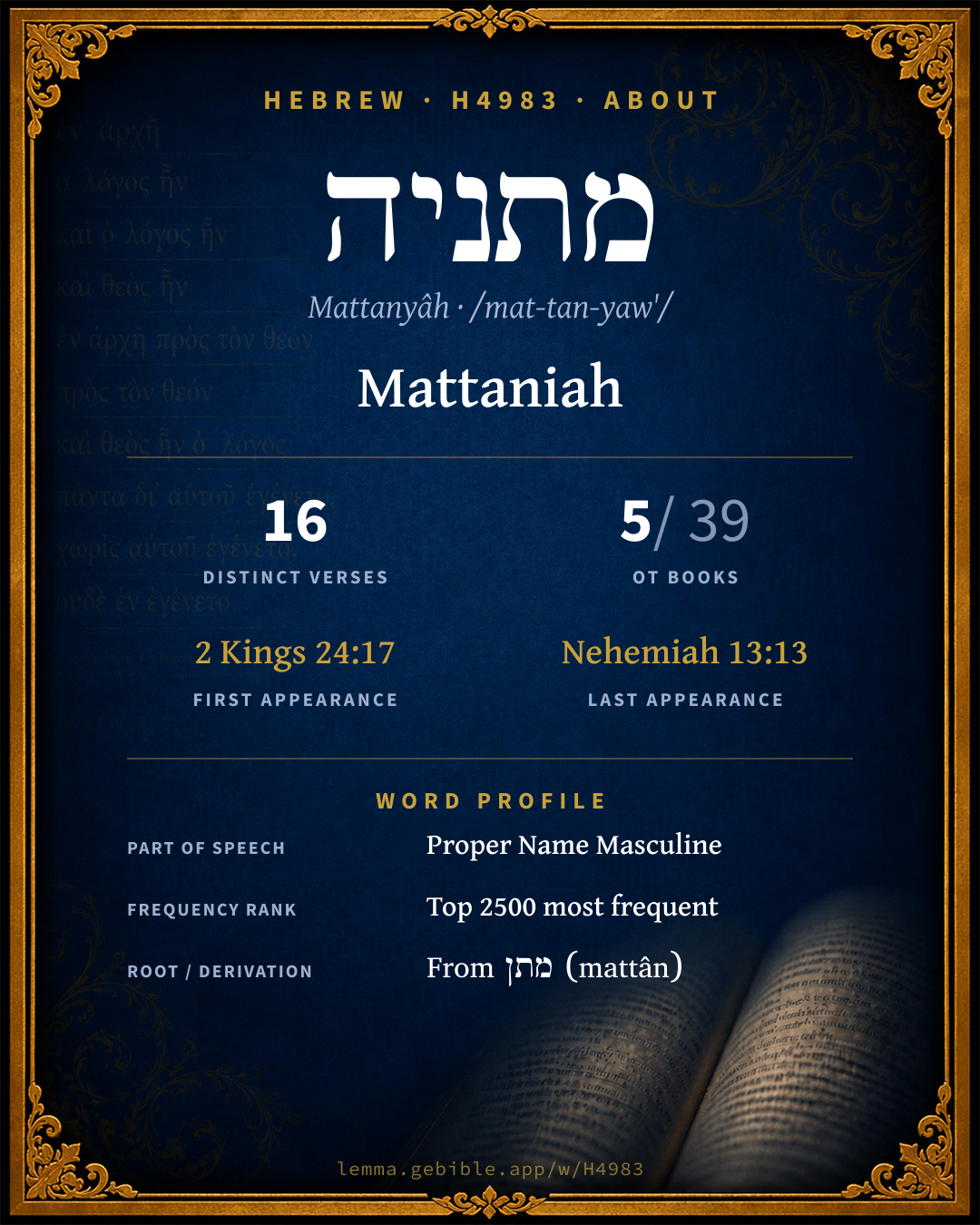
מַתַּנְיָ֫הוּ
Mattaniah
BDB lists 10 entries for ‘Mattaniah’ fuller range ↓
Full lexicon entry — Brown-Driver-Briggs (BDB)
From Brown-Driver-Briggs (BDB)
Where this word appears
Grammar key — what these labels mean
Part of speech
- Noun
- A naming word — a person, place, thing, or idea.
Noun type
- Proper
- A name of a specific person, place, or people (e.g. Abraham, Zion, Israel).
Every verse where H4983 appears — 16 distinct verses across 5 books. Click any verse to open its interlinear word-by-word view. Verse text shown in the World English Bible for context — . Each verse’s Hebrew form is shown with its reference; the English is not keyword-highlighted, since the data carries no word-level English alignment. Use “Compare translations” on any verse to read it across multiple English versions. This concordance covers the Hebrew Bible; Septuagint (Greek Old Testament) occurrences are not indexed here.
2 Kings 1 verse
1 Chronicles 3 verses
- 1 Chronicles 9:15 וּ/מַתַּנְיָה֙ conj + n Proper and Bakbakkar, Heresh, and Galal, and Mattaniah the son of Mica, the son of Zichri, the son of Asaph,
- 1 Chronicles 25:4 מַתַּנְיָ֡הוּ n Proper Of Heman; the sons of Heman: Bukkiah, Mattaniah, Uzziel, Shebuel, and Jerimoth, Hananiah, Hanani, Eliathah, Giddalti, and Romamti-ezer, Joshbekashah, Mallothi, Hothir, Mahazioth.
- 1 Chronicles 25:16 מַתַּנְיָ֔הוּ n Proper the ninth to Mattaniah, his sons and his brothers, twelve:
2 Chronicles 2 verses
- 2 Chronicles 20:14 מַתַּנְיָ֛ה n Proper Then on Jahaziel the son of Zechariah, the son of Benaiah, the son of Jeiel, the son of Mattaniah, the Levite, of the sons of Asaph, came the Spirit of Yahweh in the midst of the assembly;
- 2 Chronicles 29:13 וּ/מַתַּנְיָֽהוּ conj + n Proper and of the sons of Elizaphan, Shimri and Jeuel; and of the sons of Asaph, Zechariah and Mattaniah;
Ezra 4 verses
- Ezra 10:26 מַתַּנְיָ֤ה n Proper Of the sons of Elam: Mattaniah, Zechariah, and Jehiel, and Abdi, and Jeremoth, and Elijah.
- Ezra 10:27 מַתַּנְיָ֣ה n Proper Of the sons of Zattu: Elioenai, Eliashib, Mattaniah, and Jeremoth, and Zabad, and Aziza.
- Ezra 10:30 מַתַּנְיָ֣ה n Proper Of the sons of Pahath-moab: Adna, and Chelal, Benaiah, Maaseiah, Mattaniah, Bezalel, and Binnui, and Manasseh.
- Ezra 10:37 מַתַּנְיָ֥ה n Proper Mattaniah, Mattenai, and Jaasu,
Nehemiah 6 verses
- Nehemiah 11:17 וּ/מַתַּנְיָ֣ה conj + n Proper and Mattaniah the son of Mica, the son of Zabdi, the son of Asaph, who was the chief to begin the thanksgiving in prayer, and Bakbukiah, the second among his brothers; and Abda the son of Shammua, the son of Galal, the son of Jeduthun.
- Nehemiah 11:22 מַתַּנְיָ֖ה n Proper The overseer also of the Levites at Jerusalem was Uzzi the son of Bani, the son of Hashabiah, the son of Mattaniah, the son of Mica, of the sons of Asaph, the singers, over the business of the house of God.
- Nehemiah 12:8 מַתַּנְיָ֑ה n Proper Moreover the Levites: Jeshua, Binnui, Kadmiel, Sherebiah, Judah, [and] Mattaniah, who was over the thanksgiving, he and his brothers.
- Nehemiah 12:25 מַתַּנְיָ֧ה n Proper Mattaniah, and Bakbukiah, Obadiah, Meshullam, Talmon, Akkub, were porters keeping the watch at the store-houses of the gates.
- Nehemiah 12:35 מַתַּנְיָה֙ n Proper and certain of the priests' sons with trumpets: Zechariah the son of Jonathan, the son of Shemaiah, the son of Mattaniah, the son of Micaiah, the son of Zaccur, the son of Asaph;
- Nehemiah 13:13 מַתַּנְיָ֑ה n Proper I made treasurers over the treasuries, Shelemiah the priest, and Zadok the scribe, and of the Levites, Pedaiah: and next to them was Hanan the son of Zaccur, the son of Mattaniah; for they were counted faithful, and their business was to distribute to their brothers.
About this entry
At a glance — auto-summarized from this page’s data, not written by a person. Every figure links to its source below. This summary describes the numbers; it doesn’t interpret them.
At its core, מתניה (Mattanyâh) means “Mattaniah.” Scripture first uses it in 2 Kings 24:17. Spanning 16 verses in 5 books, it ranks among the uncommon words of the Hebrew Bible. Its uses concentrate in Nehemiah (38% of all occurrences). Dig into 16-verse concordance and the renderings breakdown below.
Gloss history
Strong's 1890 vs modern scholarship
About this word
Strong's H4983 catalogs a Hebrew word from the Hebrew Old Testament.
These counts are not copied from any lexicon or concordance. They are computed here, from the morphology-tagged Hebrew Old Testament. What Lemma adds →
- 16
- distinct verses
- The word appears in 16 distinct verses.
- 5 / 39
- OT books
- The word appears in 5 of 39 Old Testament books.
- #1,752
- by frequency
- Top 2500 most frequent Hebrew words (rank 1,752 of 8,640 Hebrew words by occurrence).
View all 16 occurrences in the concordance →
Most concentrated in
- Nehemiah 6 verses 38%
- Ezra 4 verses 25%
- 1 Chronicles 3 verses 19%
By section of the Old Testament
By traditional corpus
Conventional, traditional groupings — biblical authorship is debated, so this is a traditional corpus grouping, not an authorship claim. Each share is this word’s portion of its verses in that division of the Hebrew canon. Each figure is a share of the word’s 16 distinct verses.
- Writings (Ketuvim) 15 verses · 94%
- Prophets (Nevi'im) 1 verse · 6%
How translations render this word
Counts come from each version’s own published word-to-Strong’s tagging or interlinear alignment — an approximate guide to how each version renders this word, not a word-level alignment the data otherwise carries. Because each total is that version’s own tagged count, the per-version totals vary from one another and need not match the appearance or distinct-verse counts above. These counts may also differ from a printed concordance because Lemma counts each distinctly tagged rendering and does not collapse phrase taggings into a single head-word total. This is a fixed set of word-tagged versions (KJV, ASV, BSB, ULT) and does not change with the reading translation you choose elsewhere. Each version’s license is shown beside its name below (and on Sources).
BDB lists this Strong’s number as 2 distinct words (homographs). Each count above pools all of them and is not split by sense — see the Senses section below. A low-frequency rendering may belong to a different one of those words, not the primary meaning.
- King James Version†: Mattaniah 15×
- American Standard Version†: Mattaniah 15×
- Berean Standard Bible†: Mattaniah 15×
- unfoldingWord Literal Text†: Mattaniah 16×
King James Version Public Domain
Renders H4983 across 16† tagged occurrences — most commonly:
Plus 1 rendering that appears only once — usually multi-word phrases or single function words the recovered tagging swept in, not distinct renderings.
American Standard Version Public Domain
Renders H4983 across 16† tagged occurrences — most commonly:
Plus 1 rendering that appears only once — usually multi-word phrases or single function words the recovered tagging swept in, not distinct renderings.
Berean Standard Bible Public Domain
Renders H4983 across 16† tagged occurrences — most commonly:
Plus 1 rendering that appears only once — usually multi-word phrases or single function words the recovered tagging swept in, not distinct renderings.
unfoldingWord Literal Text CC BY-SA 4.0
Renders H4983 across 16† tagged occurrences — most commonly:
13 senses and sub-senses in the full BDB
What do BDB’s symbols mean?
BDB uses these scholarly abbreviations:
| Symbol | Meaning |
|---|---|
| 𝔊 | the Septuagint (the ancient Greek translation, LXX) |
| 𝔙 | the Vulgate (the Latin translation) |
| 𝔖 | the Syriac version (the Peshitta) |
| 𝔗 | the Targum (the Aramaic translation) |
| ψ | the Psalms |
| √ | root (the underlying root or stem) |
| ‖ | parallel passage (a synonymous or contrasted parallel) |
| † | the dagger: every passage where the word occurs is cited |
The 13 senses and sub-senses the full Brown-Driver-Briggs lexicon distinguishes for this word, in lexicon order (not ranked by frequency), with BDB’s own verbatim wording and sub-sense lettering. Shown in Hebrew script with BDB’s own scholarly abbreviations. The condensed entry is in the Lexicon Entry tab. See also the Forms in the corpus table below.
מתניה I i, ii. מַתָּנָה, מַתְּנַי, מַתַּנְיָה(וּ) v. נתן.
מתניה II m. (cf. GrayProp. N. 294, No. 82)
- 1. מַתַּנְיָה, last king of Judah, name changed to Zedekiah 2 K 24:17. e.g. 2 Kings 24:17
- 2. מַתַּנְיָ֫הוּ, Levite name:
- a. son of Heman 1 Ch 25:4. e.g. 1 Chronicles 25:4
- b. Asaphite 1 Ch 25:16. e.g. 1 Chronicles 25:16
- c. id., 2 Ch 29:13 (Hezekiah’s time). e.g. 2 Chronicles 29:13
- 3. מַתַּנְיָה, Levite name:
- a. Asaphite 1 Ch 9:15; Ne 11:17, 22; 12:8, 35, perhaps = 2 b, c (but much confusion and uncertainty; e.g. מ׳ is of Hezekiah’s time 2 Ch 29:13, and 4th generation before Neh., Ne 11:22; 12:35; while contemp. of Zerub. 12:8 and of Neh. 11:17). e.g. 1 Chronicles 9:15
- b. other Levites: (1) 2 Ch 20:14, (2) Ne 12:25, (3) 13:13. e.g. 2 Chronicles 20:14
- 4. מַתַּנְיָה, name of several who took strange wives:
- a. Ezr 10:26. e.g. Ezra 10:26
- b. v 27. e.g. Ezra 10:27
- c. v 30. e.g. Ezra 10:30
- d. v 37. e.g. Ezra 10:37
Senses from the full Brown-Driver-Briggs lexicon (Brown, Driver, Briggs; Oxford 1906 — public domain), digitized via Sefaria, supplemented by the OpenScriptures HebrewLexicon (CC BY 4.0). Full attribution on Sources.
Word origin
n.pr.m. (cf. GrayProp. N. 294, No. 82);—𝔊 Μαθθας, Μανθανιας, Ματθανιας, etc.;—
— Brown-Driver-Briggs (Oxford 1906, public domain), digitized via Sefaria, supplemented by the OpenScriptures HebrewLexicon (CC BY 4.0). See Sources.
Derived from מתן (mattân) (H4976) — gifts.
Jastrow Dictionary
A second Hebrew/Aramaic lexicon for comparison, covering Aramaic and post-biblical (Talmudic, Targumic, Midrashic) usage that the biblical-Hebrew BDB does not. Matched by lemma rather than by Strong’s number, so a lemma may carry more than one Jastrow headword (shown separately below), and the entries cover usage well beyond the Bible.
מַתַּנְיָה
- (b. h.) pr. n. m. Mattaniah,
- 1. original name of Zedekiah, king of Judah. Pesik. R. s. 26; a. e.—2) name of an Amora. Y. Bets. I, 60ᶜ bot. Y. Keth. IV, 28ᵈ bot.; a. e.
A Dictionary of the Targumim, the Talmud Babli and Yerushalmi, and the Midrashic Literature (Marcus Jastrow; London, Luzac, 1903) — Public Domain. Digitized via Sefaria. Digitized via Sefaria. Full attribution on Sources.
Forms in the corpus
The 13 distinct written forms H4983 takes in the Hebrew Bible, most frequent first — each parse links to that state’s occurrences in the concordance. Hebrew forms include their vowel points and cantillation, so a single lemma takes many written forms.
| Form | Parsing | Example | Uses |
|---|---|---|---|
| מַתַּנְיָ֑ה | Noun, Proper | Nehemiah 12:8 | 2 |
| מַתַּנְיָ֣ה | Noun, Proper | Ezra 10:27 | 2 |
| מַתַּנְיָ֥ה | Noun, Proper | Ezra 10:37 | 2 |
| וּ/מַתַּנְיָ֣ה | Noun, Proper | Nehemiah 11:17 | 1 |
| וּ/מַתַּנְיָֽהוּ | Noun, Proper | 2 Chronicles 29:13 | 1 |
| וּ/מַתַּנְיָה֙ | Noun, Proper | 1 Chronicles 9:15 | 1 |
| מַתַּנְיָ֔הוּ | Noun, Proper | 1 Chronicles 25:16 | 1 |
| מַתַּנְיָ֖ה | Noun, Proper | Nehemiah 11:22 | 1 |
| מַתַּנְיָ֛ה | Noun, Proper | 2 Chronicles 20:14 | 1 |
| מַתַּנְיָ֡הוּ | Noun, Proper | 1 Chronicles 25:4 | 1 |
| מַתַּנְיָ֤ה | Noun, Proper | Ezra 10:26 | 1 |
| מַתַּנְיָ֧ה | Noun, Proper | Nehemiah 12:25 | 1 |
| מַתַּנְיָה֙ | Noun, Proper | Nehemiah 12:35 | 1 |
Same root — word family
Other BDB entries built from the same root as H4983, grouped by Strong’s listed origin. These share a root / origin per the lexicon — not necessarily a shared meaning. Each links to that word’s own entry.
Derives from
Shares the same root
Proper names from this root
People and places named from this root — a name, not an additional meaning of the word.
Compare all same-root words → Showing 4 of 6 — not the complete family. 2 of the same-root words are proper names (people or places). They share a root, not necessarily a meaning.
Bible dictionary
Public-domain dictionary articles matched to this entry by name (Mattaniah). A biblical name can be shared by more than one person or place, so an article may treat several.
Easton's Bible Dictionary · M. G. Easton, 1897
Gift of Jehovah. (1.) A Levite, son of Heman, the chief of the ninth class of temple singers (1 Chr. 25:4, 16).
(2.) A Levite who assisted in purifying the temple at the reformation under Hezekiah (2 Chr. 29:13).
(3.) The original name of Zedekiah (q.v.), the last of the kings of Judah (2 Kings 24:17). He was the third son of Josiah, who fell at Megiddo. He succeeded his nephew Jehoiakin.
Smith's Bible Dictionary · William Smith, 1863
(gift of Jehovah).
+ The original name of Zedekiah king of Judah, which was changed when Nebuchadnezzar placed him on the throne. (2 Kings 24:17) + A Levite singer of the sons of Asaph. (1 Chronicles 9:15) He was leader of the temple choir after its restoration, (Nehemiah 11:17; 12:8) in the time of Nehemiah, and took part in the musical service which accompanied the dedication of the wall of Jerusalem. (Nehemiah 12:25,35) + A descendant of Asaph, and ancestor of Jahaziel the Levite, in the reign of Jehoshaphat. (2 Chronicles 20:14) + One of the sons of Elam. (Ezra 10:26) + One of the sons of Zattu. (Ezra 10:27) + A descendant of Pahath-moab, (Ezra 10:30) and + One of the sons of Bani. (Ezra 10:37) who all put away their foreign wives at Ezra's command. + A Levite, father of Zaccur and ancestor of Hanan the under-treasurer who had charge of the offerings for the Levites in the time of Nehemiah. (Nehemiah 13:13) + One of the fourteen sons of Heman, whose office it was to blow the horns in the temple service appointed by David. (1 Chronicles 25:4,16) + A descendant of Asaph the Levite minstrel, who assisted in the purification of the temple in the reign of Hezekiah. (2 Chronicles 29:13)
Hitchcock's Bible Names Dictionary · Roswell D. Hitchcock, 1869
gift, or hope, of the Lord
Classic public-domain reference works; full attribution on Sources.
Septuagint verse parallels
This word appears in 10 verses that also exist in the Greek Old Testament (Septuagint), out of the 16 Hebrew verses it occurs in. You can read those verses in Greek by switching the Old Testament edition to the Septuagint.
Read these verses in the Septuagint
This is a verse-level parallel only — the same verses exist in both the Hebrew and Greek Old Testaments. No word-level Hebrew↔Greek correspondence is claimed: the data carries no such alignment, so no Greek word is shown as this Hebrew word’s translation. Coverage is not total — the Septuagint omits the deuterocanon and renumbers the Psalms, so some Hebrew verses have no direct Greek parallel.