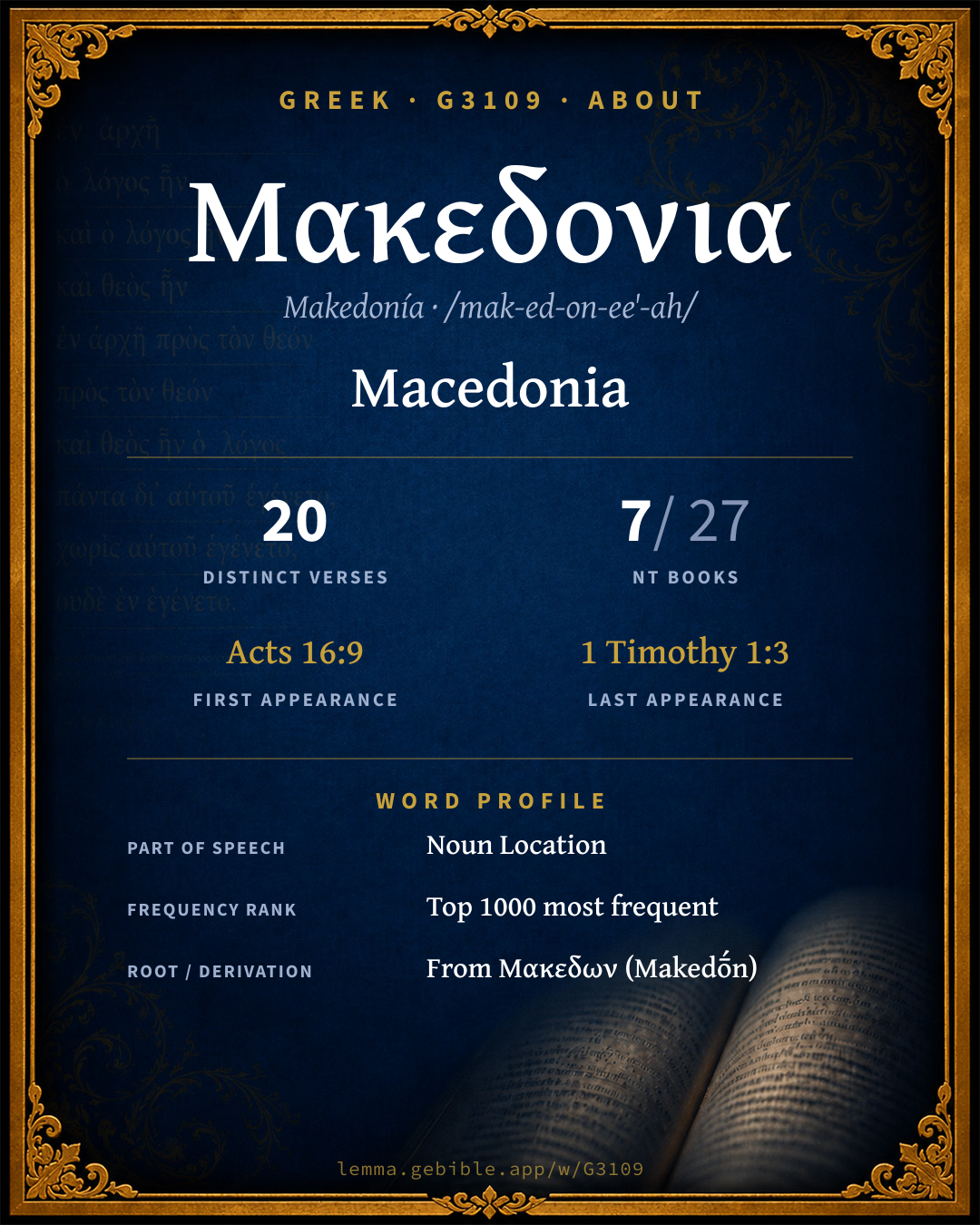
Μακεδονία
Macedonia
Thayer's lists 2 entries for ‘Macedonia’ fuller range ↓
Full lexicon entry — Thayer's Greek Lexicon
From Thayer's Greek Lexicon
Where this word appears
See every Accusative-case word in the Greek New Testament →
Grammar key — what these labels mean
Part of speech
- Noun
- A naming word — a person, place, thing, or idea.
Case
- Accusative
- The case of the direct object and of extent.
- Genitive
- The case of source, possession, or “of” — answers “whose / from what.”
- Dative
- The case of the indirect object, means, or location — “to / for / with / in.”
- Nominative
- The case of the subject (and the predicate nominative).
Gender
- Feminine
- Grammatically feminine.
Number
- Singular
- One.
Grammatical forms
- Noun, Accusative, Singular, Feminine 11 times (50%)
- Noun, Genitive, Singular, Feminine 7 times (32%)
- Noun, Dative, Singular, Feminine 3 times (14%)
- Noun, Nominative, Singular, Feminine 1 time (5%)
Parsed forms decoded from the imported morphology (Robinson–Tischendorf, public domain), counted across 22 parsed occurrences — not distinct verses.
Every verse where G3109 appears — 20 distinct verses across 7 books. Click any verse to open its interlinear word-by-word view. Verse text shown in the World English Bible for context — . Each verse’s Greek form is shown with its reference; the English is not keyword-highlighted, since the data carries no word-level English alignment. Use “Compare translations” on any verse to read it across multiple English versions. This concordance covers the Greek New Testament; Septuagint (Greek Old Testament) occurrences of this word are not indexed here.
Acts 8 verses
- Acts 16:9 Μακεδονίαν n acc sg fem A vision appeared to Paul in the night. There was a man of Macedonia standing, begging him, and saying, "Come over into Macedonia and help us."
- Acts 16:10 Μακεδονίαν n acc sg fem When he had seen the vision, immediately we sought to go out to Macedonia, concluding that the Lord had called us to preach the Gospel to them.
- Acts 16:12 Μακεδονίας n gen sg fem and from there to Philippi, which is a city of Macedonia, the foremost of the district, a Roman colony. We were staying some days in this city.
- Acts 18:5 Μακεδονίας n gen sg fem But when Silas and Timothy came down from Macedonia, Paul was compelled by the Spirit, testifying to the Jews that Jesus was the Christ.
- Acts 19:21 Μακεδονίαν n acc sg fem Now after these things had ended, Paul determined in the spirit, when he had passed through Macedonia and Achaia, to go to Jerusalem, saying, "After I have been there, I must also see Rome."
- Acts 19:22 Μακεδονίαν n acc sg fem Having sent into Macedonia two of those who ministered to him, Timothy and Erastus, he himself stayed in Asia for a while.
- Acts 20:1 Μακεδονίαν n acc sg fem After the uproar had ceased, Paul sent for the disciples, took leave of them, and departed to go into Macedonia.
- Acts 20:3 Μακεδονίας n gen sg fem When he had spent three months there, and a plot was made against him by Jews as he was about to set sail for Syria, he determined to return through Macedonia.
Romans 1 verse
1 Corinthians 1 verse
2 Corinthians 5 verses
- 2 Corinthians 1:16 Μακεδονίαν Μακεδονίας n acc sg fem n gen sg fem and by you to pass into Macedonia, and again from Macedonia to come to you, and to be sent forward by you on my journey to Judea.
- 2 Corinthians 2:13 Μακεδονίαν n acc sg fem I had no relief for my spirit, because I didn't find Titus, my brother, but taking my leave of them, I went out into Macedonia.
- 2 Corinthians 7:5 Μακεδονίαν n acc sg fem For even when we had come into Macedonia, our flesh had no relief, but we were afflicted on every side. Fightings were outside. Fear was inside.
- 2 Corinthians 8:1 Μακεδονίας n gen sg fem Moreover, brothers, we make known to you the grace of God which has been given in the assemblies of Macedonia;
- 2 Corinthians 11:9 Μακεδονίας n gen sg fem When I was present with you and was in need, I wasn't a burden on anyone, for the brothers, when they came from Macedonia, supplied the measure of my need. In everything I kept myself from being burdensome to you, and I will continue to do so.
Philippians 1 verse
1 Thessalonians 3 verses
- 1 Thessalonians 1:7 Μακεδονίᾳ n dat sg fem so that you became an example to all who believe in Macedonia and in Achaia.
- 1 Thessalonians 1:8 Μακεδονίᾳ n dat sg fem For from you has sounded forth the word of the Lord, not only in Macedonia and Achaia, but also in every place your faith toward God has gone forth; so that we need not to say anything.
- 1 Thessalonians 4:10 Μακεδονίᾳ n dat sg fem for indeed you do it toward all the brothers who are in all Macedonia. But we exhort you, brothers, that you abound more and more;
1 Timothy 1 verse
About this entry
At a glance — auto-summarized from this page’s data, not written by a person. Every figure links to its source below. This summary describes the numbers; it doesn’t interpret them.
“Macedonia” is the headline sense of the Greek name Μακεδονια (Makedonía). Scripture first uses it in Acts 16:9. With 20 verses in 7 books, it is an uncommon word in the Greek New Testament. It concentrates in Acts, which alone accounts for 40% of its uses. The sections below give every occurrence and version rendering.
Gloss history
Strong's 1890 vs modern scholarship
About this word
Strong's G3109 catalogs a Greek word from the Greek New Testament.
These counts are not copied from any lexicon or concordance. They are computed here, from the morphology-tagged Greek New Testament. What Lemma adds →
- 20
- distinct verses
- The word appears in 20 distinct verses.
- 7 / 27
- NT books
- The word appears in 7 of 27 New Testament books.
- #586
- by frequency
- Top 1000 most frequent Greek words (rank 586 of 5,347 Greek words by occurrence).
View all 20 occurrences in the concordance →
Most concentrated in
- Acts 8 verses 40%
- 2 Corinthians 5 verses 25%
- 1 Thessalonians 3 verses 15%
By section of the New Testament
By traditional corpus
Conventional, traditional groupings — biblical authorship is debated, so this is a traditional corpus grouping, not an authorship claim. Some books belong to more than one corpus (Luke is in both the Gospels and the Lukan corpus, and so on), so these shares overlap and need not total 100%. Each figure is a share of the word’s 20 distinct verses.
- Pauline corpus 12 verses · 60%
- Lukan (Luke–Acts) 8 verses · 40%
How translations render this word
Counts come from each version’s own published word-to-Strong’s tagging or interlinear alignment — an approximate guide to how each version renders this word, not a word-level alignment the data otherwise carries. Because each total is that version’s own tagged count, the per-version totals vary from one another and need not match the appearance or distinct-verse counts above. These counts may also differ from a printed concordance because Lemma counts each distinctly tagged rendering and does not collapse phrase taggings into a single head-word total. This is a fixed set of word-tagged versions (KJV, ASV, BSB, ULT) and does not change with the reading translation you choose elsewhere. Each version’s license is shown beside its name below (and on Sources).
- King James Version: Macedonia 22×
- American Standard Version: Macedonia 22×
- Berean Standard Bible: Macedonia 22×
- unfoldingWord Literal Text: Macedonia 22×
King James Version Public Domain
Renders G3109 across 22 tagged occurrences — most commonly:
American Standard Version Public Domain
Renders G3109 across 22 tagged occurrences — most commonly:
Berean Standard Bible Public Domain
Renders G3109 across 22 tagged occurrences — most commonly:
unfoldingWord Literal Text CC BY-SA 4.0
Renders G3109 across 22 tagged occurrences — most commonly:
Senses in Thayer's
The 2 senses Thayer's distinguishes for this word, in lexicon order (not ranked by frequency or importance). The full entry — with sub-senses — is in the Lexicon Entry tab.
- Macedonia = "extended land"
- a country bounded on the south by Thessaly and Epirus…
Word origin
Derived from Μακεδων (Makedṓn) (G3110) — Macedonian.
From G3110 ; Macedonia a region of Greece : - Macedonia.
— Strong’s Exhaustive Concordance (1890), public domain.
Forms in the corpus
The 4 distinct written forms G3109 takes in the Greek New Testament, most frequent first — each parse links to that case’s occurrences in the concordance.
| Form | Parsing | Example | Uses |
|---|---|---|---|
| Μακεδονίαν Makedonían | Noun, Accusative, Singular, Feminine | Acts 16:9 | 11 |
| Μακεδονίας Makedonías | Noun, Genitive, Singular, Feminine | Acts 16:12 | 7 |
| Μακεδονίᾳ Makedonía | Noun, Dative, Singular, Feminine | 1 Thessalonians 1:7 | 3 |
| Μακεδονία Makedonía | Noun, Nominative, Singular, Feminine | Romans 15:26 | 1 |
Bible dictionary
Public-domain dictionary articles matched to this entry by name (Macedonia). A biblical name can be shared by more than one person or place, so an article may treat several.
Easton's Bible Dictionary · M. G. Easton, 1897
In New Testament times, was a Roman province lying north of Greece. It was governed by a propraetor with the title of proconsul. Paul was summoned by the vision of the "man of Macedonia" to preach the gospel there (Acts 16:9). Frequent allusion is made to this event (18:5; 19:21; Rom. 15:26; 2 Cor. 1:16; 11:9; Phil. 4:15). The history of Paul's first journey through Macedonia is given in detail in Acts 16:10-17:15. At the close of this journey he returned from Corinth to Syria. He again passed through this country (20:1-6), although the details of the route are not given. After many years he probably visited it for a third time (Phil. 2:24; 1 Tim. 1:3). The first convert made by Paul in Europe was (Acts 16:13-15) Lydia (q.v.), a "seller of purple," residing in Philippi, the chief city of the eastern division of Macedonia.
Smith's Bible Dictionary · William Smith, 1863
(extended land), a large and celebrated country lying north of Greece, the first part of Europe which received the gospel directly from St. Paul, and an important scene of his subsequent missionary labors and those of his companions. It was bounded by the range of Haemus or the Balkan northward, by the chain of Pindus westward, by the Cambunian hills southward, by which it is separated from Thessaly, an is divided on the east from Thrace by a less definite mountain boundary running southward from Haemus. Of the space thus enclosed, two of the most remarkable physical features are two great plains, one watered by the Axius, which comes to the sea, at the Thermaic Gulf, not far from Thessalonica; the other by the Strymon, which after passing near Philippi, flows out below Amphipolis. Between the mouths of these two rivers a remarkable peninsula projects, dividing itself into three points, on the farthest of which Mount Athos rises nearly into the region of perpetual snow. Across the neck of this peninsula St. Paul travelled more than once with his companions. This general sketch sufficiently describes the Macedonia which was ruled over by Philip and Alexander and which the Romans conquered from Perseas. At first the conquered country was divided by Aemilius Paulus into four districts, but afterward was made one province and centralized under the jurisdiction of a proconsul, who resided at Thessalonica. The character of the Christians of Macedonia is set before us in Scripture in a very favorable light. The candor of the Bereans is highly commented, (Acts 17:11) the Thessalonians were evidently objects of St. Paul's peculiar affection, (1 Thessalonians 2:8,17-20; 3:10) and the Philippians, besides their general freedom from blame, are noted as remarkable for their liberality and self-denial. (Philemon 4:10; 14-19) see 2Cor 9:2; 11:9
Hitchcock's Bible Names Dictionary · Roswell D. Hitchcock, 1869
burning; adoration
Classic public-domain reference works; full attribution on Sources.