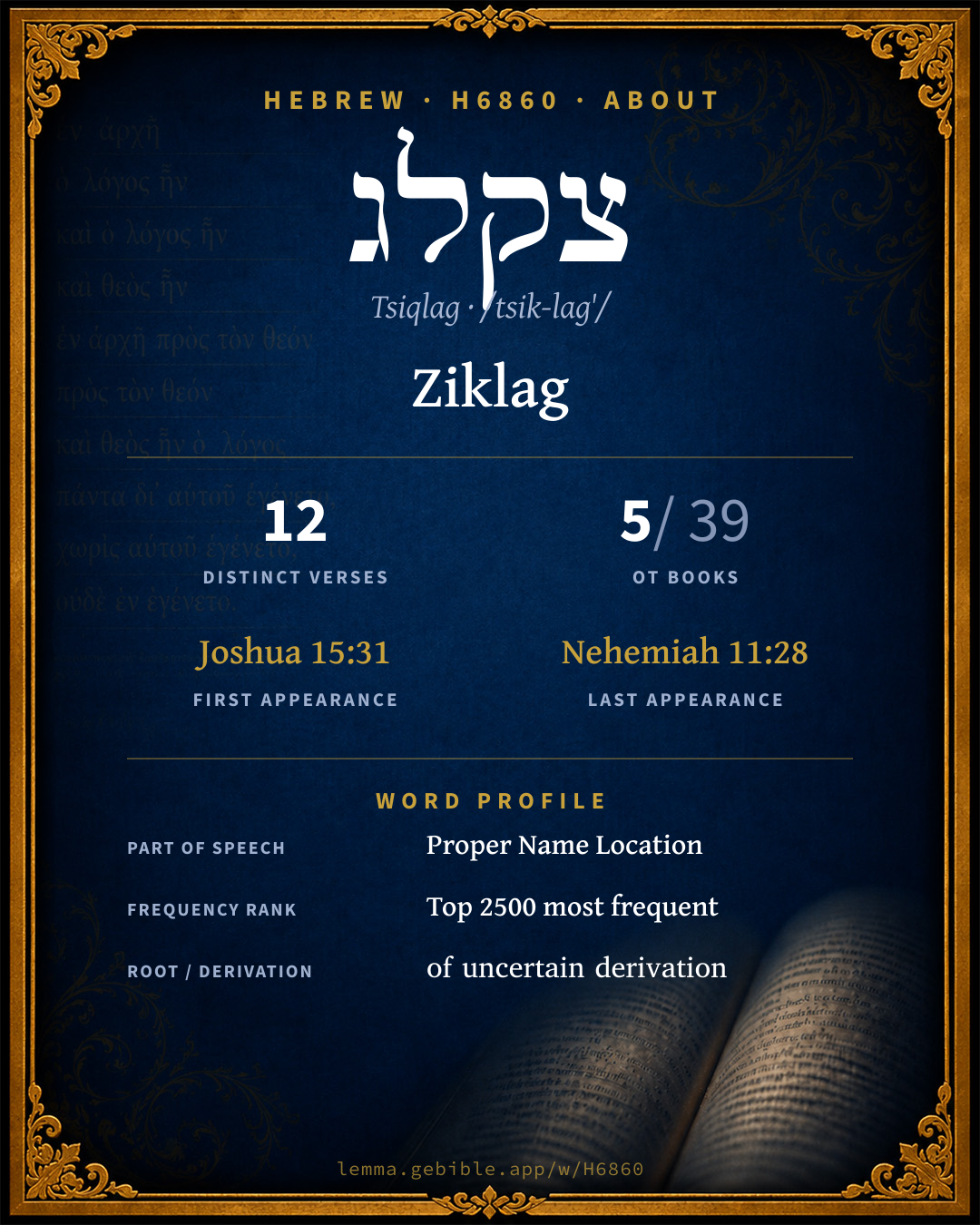
צִקְלַג
Ziklag
BDB lists 2 entries for ‘Ziklag’ fuller range ↓
Full lexicon entry — Brown-Driver-Briggs (BDB)
From Brown-Driver-Briggs (BDB)
Where this word appears
Grammar key — what these labels mean
Part of speech
- Noun
- A naming word — a person, place, thing, or idea.
Noun type
- Proper
- A name of a specific person, place, or people (e.g. Abraham, Zion, Israel).
Every verse where H6860 appears — 12 distinct verses across 5 books. Click any verse to open its interlinear word-by-word view. Verse text shown in the World English Bible for context — . Each verse’s Hebrew form is shown with its reference; the English is not keyword-highlighted, since the data carries no word-level English alignment. Use “Compare translations” on any verse to read it across multiple English versions. This concordance covers the Hebrew Bible; Septuagint (Greek Old Testament) occurrences are not indexed here.
Joshua 2 verses
1 Samuel 4 verses
- 1 Samuel 27:6 צִֽקְלָ֑ג צִֽקְלַג֙ n Proper n Proper Then Achish gave him Ziklag that day: why Ziklag pertains to the kings of Judah to this day.
- 1 Samuel 30:1 צִֽקְלַ֖ג צִ֣קְלַ֔ג צִ֣קְלַ֔ג n Proper n Proper n Proper It happened, when David and his men were come to Ziklag on the third day, that the Amalekites had made a raid on the South, and on Ziklag, and had struck Ziklag, and burned it with fire,
- 1 Samuel 30:14 צִקְלַ֖ג n Proper We made a raid on the South of the Cherethites, and on that which belongs to Judah, and on the South of Caleb; and we burned Ziklag with fire.
- 1 Samuel 30:26 צִ֣קְלַ֔ג n Proper When David came to Ziklag, he sent of the spoil to the elders of Judah, even to his friends, saying, Behold, a present for you of the spoil of the enemies of Yahweh:
2 Samuel 2 verses
- 2 Samuel 1:1 בְּ/צִקְלָ֖ג prep + n Proper It happened after the death of Saul, when David was returned from the slaughter of the Amalekites, and David had abode two days in Ziklag;
- 2 Samuel 4:10 בְּ/צִֽקְלָ֑ג prep + n Proper when one told me, saying, Behold, Saul is dead, thinking to have brought good news, I took hold of him, and killed him in Ziklag, which was the reward I gave him for his news.
1 Chronicles 3 verses
- 1 Chronicles 4:30 וּ/בְ/צִֽיקְלָֽג conj + prep + n Proper and at Bethuel, and at Hormah, and at Ziklag,
- 1 Chronicles 12:1 לְ/צִ֣יקְלַ֔ג prep + n Proper Now these are those who came to David to Ziklag, while he yet kept himself close because of Saul the son of Kish; and they were among the mighty men, his helpers in war.
- 1 Chronicles 12:20 צִֽיקְלַ֗ג n Proper As he went to Ziklag, there fell to him of Manasseh, Adnah, and Jozabad, and Jediael, and Michael, and Jozabad, and Elihu, and Zillethai, captains of thousands who were of Manasseh.
Nehemiah 1 verse
About this entry
At a glance — auto-summarized from this page’s data, not written by a person. Every figure links to its source below. This summary describes the numbers; it doesn’t interpret them.
צקלג — transliterated Tsiqlag — is a Hebrew name carrying the sense “Ziklag.” Its earliest occurrence is Joshua 15:31. Spanning 12 verses in 5 books, it ranks among the uncommon words of the Hebrew Bible. Its uses concentrate in 1 Samuel (33% of all occurrences). See 12-verse concordance and the renderings breakdown below.
Gloss history
Strong's 1890 vs modern scholarship
About this word
Strong's H6860 catalogs a Hebrew word from the Hebrew Old Testament.
These counts are not copied from any lexicon or concordance. They are computed here, from the morphology-tagged Hebrew Old Testament. What Lemma adds →
- 12
- distinct verses
- The word appears in 12 distinct verses.
- 5 / 39
- OT books
- The word appears in 5 of 39 Old Testament books.
- #1,836
- by frequency
- Top 2500 most frequent Hebrew words (rank 1,836 of 8,640 Hebrew words by occurrence).
View all 12 occurrences in the concordance →
Most concentrated in
- 1 Samuel 4 verses 33%
- 1 Chronicles 3 verses 25%
- Joshua 2 verses 17%
By section of the Old Testament
By traditional corpus
Conventional, traditional groupings — biblical authorship is debated, so this is a traditional corpus grouping, not an authorship claim. Each share is this word’s portion of its verses in that division of the Hebrew canon. Each figure is a share of the word’s 12 distinct verses.
- Prophets (Nevi'im) 8 verses · 67%
- Writings (Ketuvim) 4 verses · 33%
How translations render this word
Counts come from each version’s own published word-to-Strong’s tagging or interlinear alignment — an approximate guide to how each version renders this word, not a word-level alignment the data otherwise carries. Because each total is that version’s own tagged count, the per-version totals vary from one another and need not match the appearance or distinct-verse counts above. These counts may also differ from a printed concordance because Lemma counts each distinctly tagged rendering and does not collapse phrase taggings into a single head-word total. This is a fixed set of word-tagged versions (KJV, ASV, BSB, ULT) and does not change with the reading translation you choose elsewhere. Each version’s license is shown beside its name below (and on Sources).
- King James Version: Ziklag 14×
- American Standard Version: Ziklag 13×
- Berean Standard Bible: Ziklag 13×
- unfoldingWord Literal Text: Ziklag 15×
King James Version Public Domain
Renders H6860 across 15 tagged occurrences — most commonly:
Plus 1 rendering that appears only once — usually multi-word phrases or single function words the recovered tagging swept in, not distinct renderings.
American Standard Version Public Domain
Renders H6860 across 15 tagged occurrences — most commonly:
Plus 2 renderings that appear only once — usually multi-word phrases or single function words the recovered tagging swept in, not distinct renderings.
Berean Standard Bible Public Domain
Renders H6860 across 13 tagged occurrences — most commonly:
Not rendered by a distinct English word in 2 further occurrences.
unfoldingWord Literal Text CC BY-SA 4.0
Renders H6860 across 15 tagged occurrences — most commonly:
Senses in BDB
The 2 senses BDB distinguishes for this word, in lexicon order (not ranked by frequency or importance). The full entry — with sub-senses — is in the Lexicon Entry tab.
- Ziklag = "winding"
- a town in the south of Judah…
Word origin
and (1 Ch 12:1, 21 צִיק׳) n.pr.loc. (צִֽקְלָ֑ג 1 S 27:6 a +, צִֽקְלָג֖ 2 S 2:1, צִיקְלָ֔ג 1 Ch 12:1);—assigned to Judah Jos 15:31, to Simeon 19:5; Philistine city given to David 1 S 27:6(×2); 30:1(×3), 14, 26; 2 S 1:1; 4:10; 1 Ch 4:30; 12:1, 21 (van d. H. v 20); Σεκελακ, Σικελαγ, etc.; usually identified with Zuheilikah, 19 miles SW. from Bêt Jibrin, 11 miles ESE. from Gaza (cf. BuhlGeogr. 185).
— Brown-Driver-Briggs (Oxford 1906, public domain), digitized via Sefaria, supplemented by the OpenScriptures HebrewLexicon (CC BY 4.0). See Sources.
Origin: of uncertain derivation
Jastrow Dictionary
A second Hebrew/Aramaic lexicon for comparison, covering Aramaic and post-biblical (Talmudic, Targumic, Midrashic) usage that the biblical-Hebrew BDB does not. Matched by lemma rather than by Strong’s number, so a lemma may carry more than one Jastrow headword (shown separately below), and the entries cover usage well beyond the Bible.
צִקְלָג
- (b. h.) pr. n. pl. Siklag, a Judæan town in possession of the Philistines. Gitt. 7ᵃ, v. לְגִימָה.
A Dictionary of the Targumim, the Talmud Babli and Yerushalmi, and the Midrashic Literature (Marcus Jastrow; London, Luzac, 1903) — Public Domain. Digitized via Sefaria. Digitized via Sefaria. Full attribution on Sources.
Forms in the corpus
The 12 distinct written forms H6860 takes in the Hebrew Bible, most frequent first — each parse links to that state’s occurrences in the concordance. Hebrew forms include their vowel points and cantillation, so a single lemma takes many written forms.
| Form | Parsing | Example | Uses |
|---|---|---|---|
| צִ֣קְלַ֔ג | Noun, Proper | 1 Samuel 30:1 | 3 |
| וְ/צִֽקְלַ֥ג | Noun, Proper | Joshua 15:31 | 2 |
| בְּ/צִֽקְלָ֑ג | Noun, Proper | 2 Samuel 4:10 | 1 |
| בְּ/צִקְלָ֖ג | Noun, Proper | 2 Samuel 1:1 | 1 |
| וּ/בְ/צִֽיקְלָֽג | Noun, Proper | 1 Chronicles 4:30 | 1 |
| וּ/בְ/צִֽקְלַ֥ג | Noun, Proper | Nehemiah 11:28 | 1 |
| לְ/צִ֣יקְלַ֔ג | Noun, Proper | 1 Chronicles 12:1 | 1 |
| צִֽיקְלַ֗ג | Noun, Proper | 1 Chronicles 12:20 | 1 |
| צִֽקְלַ֖ג | Noun, Proper | 1 Samuel 30:1 | 1 |
| צִֽקְלַג֙ | Noun, Proper | 1 Samuel 27:6 | 1 |
| צִֽקְלָ֑ג | Noun, Proper | 1 Samuel 27:6 | 1 |
| צִקְלַ֖ג | Noun, Proper | 1 Samuel 30:14 | 1 |
Bible dictionary
Public-domain dictionary articles matched to this entry by name (Ziklag). A biblical name can be shared by more than one person or place, so an article may treat several.
Easton's Bible Dictionary · M. G. Easton, 1897
A town in the Negeb, or south country of Judah (Josh. 15:31), in the possession of the Philistines when David fled to Gath from Ziph with all his followers. Achish, the king, assigned him Ziklag as his place of residence. There he dwelt for over a year and four months. From this time it pertained to the kings of Judah (1 Sam. 27:6). During his absence with his army to join the Philistine expedition against the Israelites (29:11), it was destroyed by the Amalekites (30:1, 2), whom David, however, pursued and utterly routed, returning all the captives (1 Sam. 30:26-31). Two days after his return from this expedition, David received tidings of the disastrous battle of Gilboa and of the death of Saul (2 Sam. 1:1-16). He now left Ziklag and returned to Hebron, along with his two wives, Ahinoam and Abigail, and his band of 600 men. It has been identified with Asluj, a heap of ruins south of Beersheba. Conder, however, identifies it with Khirbet Zuheilikah, ruins found on three hills half a mile apart, some seventeen miles north-west of Beersheba, on the confines of Philistia, Judah, and Amalek.
Smith's Bible Dictionary · William Smith, 1863
(winding), a place which possesses a special interest from its having been the residence and the private property of David. It is first mentioned in the catalogue of the towns of Judah in (Joshua 15:31) and occurs, in the same connection among the places which were allotted out of the territory of Judah to Simeon. (Joshua 19:5) We next encounter it in the possession of the Philistines (1 Samuel 27:6) when it was, at David's request, bestowed upon him by Achish king of Gath. He resided there for a year and four months. (1 Samuel 27:6,7; 30:14,26; 1 Chronicles 12:1,20) It was there he received the news of Saul's death. (2 Samuel 1:1; 4:10) He then relinquished it for Hebron. (2 Samuel 2:1) Ziklag is finally mentioned as being reinhabited by the people of Judah after their return from captivity. (Nehemiah 11:28) The situation of the town is difficult to determine, and we only know for certain that it was in the south country.
Hitchcock's Bible Names Dictionary · Roswell D. Hitchcock, 1869
measure pressed down
Classic public-domain reference works; full attribution on Sources.
Septuagint verse parallels
This word appears in 11 verses that also exist in the Greek Old Testament (Septuagint), out of the 12 Hebrew verses it occurs in. You can read those verses in Greek by switching the Old Testament edition to the Septuagint.
Read these verses in the Septuagint
This is a verse-level parallel only — the same verses exist in both the Hebrew and Greek Old Testaments. No word-level Hebrew↔Greek correspondence is claimed: the data carries no such alignment, so no Greek word is shown as this Hebrew word’s translation. Coverage is not total — the Septuagint omits the deuterocanon and renumbers the Psalms, so some Hebrew verses have no direct Greek parallel.