
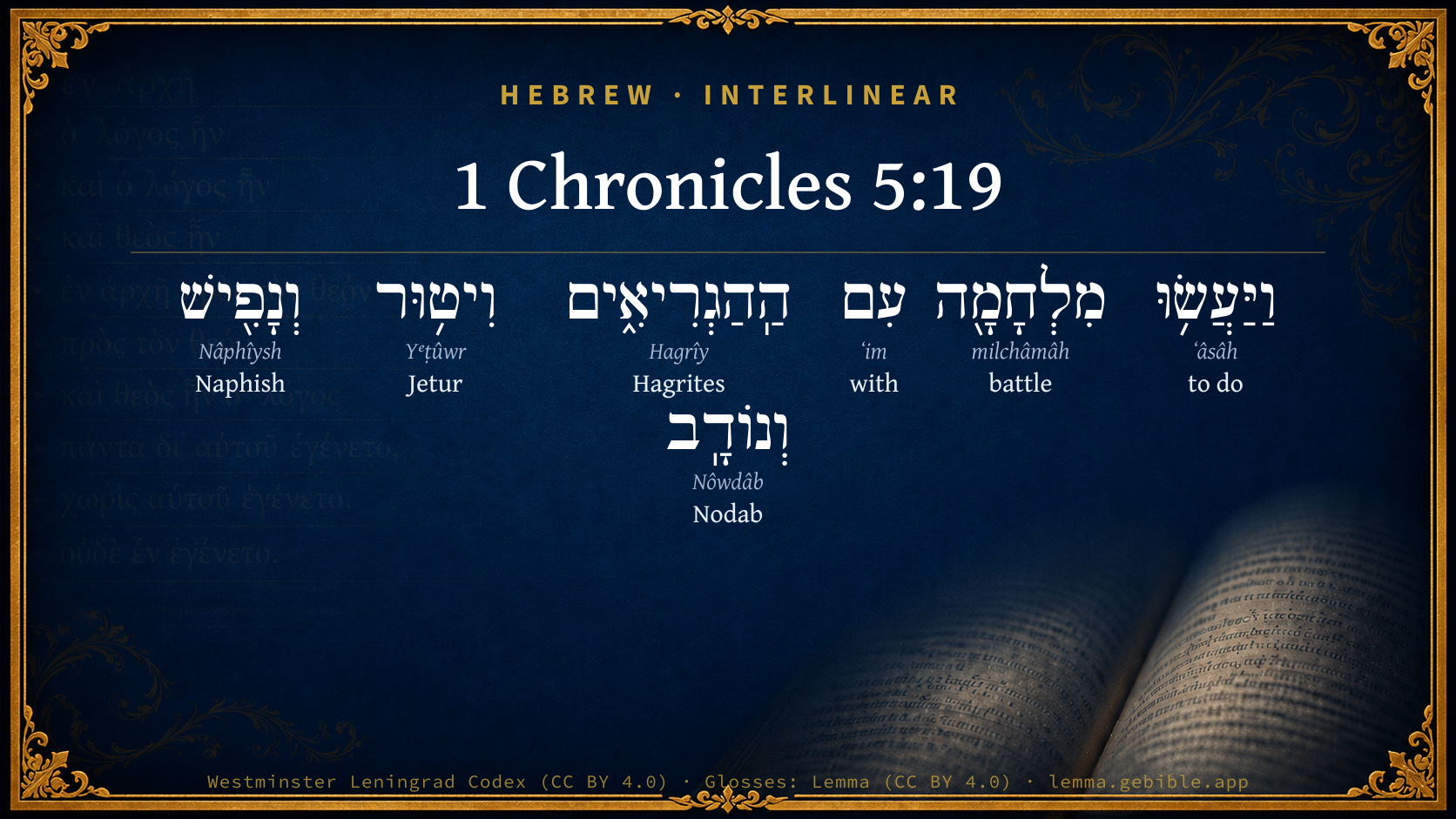
1 Chronicles 5:19

Hebrew (Westminster Leningrad Codex) 1 Chronicles 5:19 appears in the Hebrew Old Testament. The text above is from the Westminster Leningrad Codex. Each word links to its Strong’s number, a concise gloss, and parsing drawn from the Open Scriptures Hebrew Bible morphology. Click any word for its full Brown-Driver-Briggs (BDB) entry.
Download image
Cite this verse

1 Chronicles 5:19 (World English Bible). Public Domain. Lemma interlinear Bible study tool, https://lemma.gebible.app/v/1-chronicles/5/19.

Show BibTeX & RIS
BibTeX
RIS
English Translation
They made war with the Hagrites, with Jetur, and Naphish, and Nodab.
World English Bible · Public Domain
Highlights
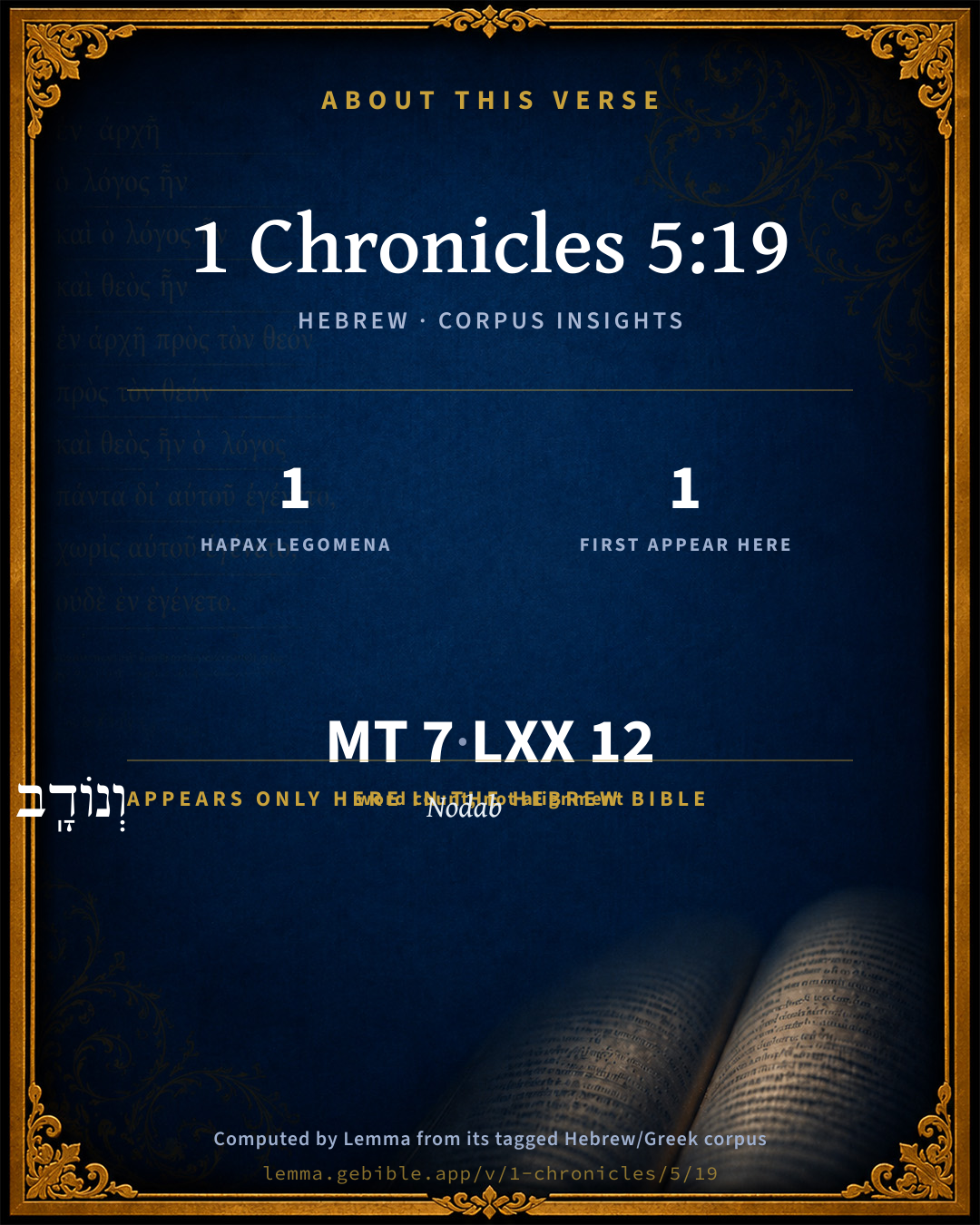
  • 1 hapax legomenon — only here in the Hebrew Bible
  • 1 first appearance in the Hebrew Bible
Full analysis ↓
Download a study sheet

One document with this verse’s original text, its word-by-word gloss line, the meaning frame, cross-references with their text, attributed commentary, and full source and license credits — printable, and it pastes into notes with its structure intact.

This verse Autodidact and up

Study sheet (.html) Plain text (.txt)

A passage Seminary Student

Up to 50 verses in one chapter. A passage sheet keeps up to 6 commentary sources and 12 cross-references per verse, in the order this page ranks them, and says so on the sheet whenever that leaves anything out. Ask for a single verse and you get the Autodidact verse sheet above.

Everything on this page stays free to read, with no account — the sheet is a download of what is already on screen, not access to it.

Want to remove ads? Support Godless Engineer
Compare translations 3

The same verse in 3 English versions, stacked beneath the original-language interlinear above. Click any original word for its lexicon entry.

Each is an independent rendering of the whole verse — the interlinear is not word-aligned to these translations.

Highlighted words mark where these versions differ — a whole-verse word diff, not a word-by-word alignment.

  • World English Bible Public Domain
    They made war with the Hagrites, with Jetur, and Naphish, and Nodab.
  • King James Version Public Domain
    And they made war with the Hagarites, with Jetur, and Nephish, and Nodab.
  • unfoldingWord Literal Text CC BY-SA 4.0
    And they made war with the Hagrites and Jetur and Naphish and Nodab.

unfoldingWord Literal Text — © unfoldingWord, licensed CC BY-SA 4.0. Word-aligned USFM3 via Door43 (git.door43.org/unfoldingWord/en_ult).

Versions to compare (up to 4)

3 of 4 selected

Show all 18 translations

Every available English version of this verse, each an independent rendering of the whole verse.

  • World English Bible Public Domain
    They made war with the Hagrites, with Jetur, and Naphish, and Nodab.
  • Berean Standard Bible Public Domain
    They waged war against the Hagrites, as well as Jetur, Naphish, and Nodab.
  • Majority Standard Bible Public Domain
    They waged war against the Hagrites, as well as Jetur, Naphish, and Nodab.
  • King James Version Public Domain
    And they made war with the Hagarites, with Jetur, and Nephish, and Nodab.
  • American Standard Version (1901) Public Domain
    And they made war with the Hagrites, with Jetur, and Naphish, and Nodab.
  • Revised Version (1885) Public Domain
    And they made war with the Hagrites, with Jetur, and Naphish, and Nodab.
  • Geneva Bible (1599) Public Domain
    And they made warre with the Hagarims, with Ietur, and Naphish, and Nodab.
  • Douay-Rheims (1899) Public Domain
    They fought against the Agarites: but the Itureans, and Naphis, and Nodab,
  • Young's Literal Translation Public Domain
    And they make war with the Hagarites, and Jetur, and Naphish, and Nodab,
  • Literal Standard Version CC BY-SA 4.0
    And they make war with the Hagarites, and Jetur, and Naphish, and Nodab,
  • Unlocked Literal Bible CC BY-SA 4.0
    They attacked the Hagrites, Jetur, Naphish, and Nodab.
  • unfoldingWord Literal Text CC BY-SA 4.0
    And they made war with the Hagrites and Jetur and Naphish and Nodab.
  • Darby Bible Public Domain
    And they made war with the Hagarites, with Jetur, and Naphish, and Nodab;
  • World Messianic Bible Public Domain
    They made war with the Hagrites, with Jetur, and Naphish, and Nodab.
  • Webster's Bible Public Domain
    And they made war with the Hagarites, with Jetur, and Nephish, and Nodab.
  • Free Bible Version CC BY-SA 4.0
    They went to war against the Hagrites, Jetur, Naphish, and Nodab.
  • Bible in Basic English Public Domain
    And they went to war against the Hagarites, with Jetur and Naphish and Nodab.
  • JPS Tanakh (1917) Public Domain
    And they made war with the Hagrites, with Jetur, and Naphish, and Nodab.

Literal Standard Version (2020), Covenant Press — licensed CC BY-SA 4.0. Text via the HelloAO Bible API (eBible.org). Unlocked Literal Bible (unfoldingWord) — licensed CC BY-SA 4.0. Text via the HelloAO Bible API (eBible.org). unfoldingWord Literal Text — © unfoldingWord, licensed CC BY-SA 4.0. Word-aligned USFM3 via Door43 (git.door43.org/unfoldingWord/en_ult). Free Bible Version, Dr. Jonathan Gallagher — licensed CC BY-SA 4.0. Text via the HelloAO Bible API (eBible.org).

Word by word

More ways to search: Search by grammar → Find every occurrence → Compare this word →

Practice this passage: Drill this verse → Learn its vocabulary →

About this verse

These counts appear in no published source. They are computed here, from the morphology-tagged text and Lemma’s own curated glosses. What Lemma adds →

7
words
7
distinct lemmas
Historical
section

Notable vocabulary

1 hapax legomenon — a word that appears only here in the entire Hebrew Bible:

  • וְנוֹדָֽב Nodab H5114

First appearance in Scripture

This word makes its first canonical appearance in the Hebrew Bible here:

  • וְנוֹדָֽב Nodab H5114

Shared distinctive vocabulary

וִיט֥וּר Jetur H3195 occurs in 3 verses of the Hebrew Bible. Also found in:

Grammatical profile

  • 1 verb
  • 5 nouns
  • 1 preposition

Verb forms

  • וַיַּעֲשׂ֥וּ Qal · Sequential Imperfect

Hebrew & Septuagint length

In English translation the verse runs 12 words from the Hebrew and 13 from the Septuagint (LXX English) — closely comparable.

A rough comparison of the two English renderings, which tokenize alike — not a word-level alignment.

Word counts can differ between the Hebrew and the Greek without any difference in meaning — e.g. the Hebrew direct-object marker אֵת has no separate Greek word, and Greek often adds the article ὁ.

In the original languages it is 7 Hebrew tokens and 12 Greek tokens — but the two are counted differently (Hebrew bundles its prefixes and suffixes into one token; the Greek is in lemma form), so that isn’t a like-for-like length.

Cross-references

3

Topical passages linked to 1 Chronicles 5:19 in the Treasury of Scripture Knowledge — connected by theme and wording, ordered by reader-vote popularity; previews shown in the World English Bible.

  • 1 Chronicles 1:31 Jetur, Naphish, and Kedemah. These are the sons of Ishmael.
  • Genesis 25:15 Hadad, Tema, Jetur, Naphish, and Kedemah.
  • 1 Chronicles 5:10 In the days of Saul, they made war with the Hagrites, who fell by their hand; and they lived in their tents throughout all the [land] east of Gilead.

Cross-references courtesy of OpenBible.info (CC BY 4.0).

Hebrew and Greek witnesses Masoretic Hebrew ↔ Greek Septuagint

The same verse in the two great witnesses to the Old Testament, shown verse-for-verse.

These are two independent witnesses, not word-aligned to each other, and the Septuagint is shown in lemma (dictionary) form.

Hebrew 1 Chronicles 5:19 Masoretic · Westminster Leningrad Codex

וַיַּעֲשׂ֥וּ מִלְחָמָ֖ה עִם הַֽהַגְרִיאִ֑ים וִיט֥וּר וְנָפִ֖ישׁ וְנוֹדָֽב

They made war with the Hagrites, with Jetur, and Naphish, and Nodab.

World English Bible · Public Domain

Greek LXX 1 Chronicles 5:19 Septuagint · lemma form

καί ποιέω πόλεμος μετά ὁ αγαρηνός καί ιτουραῖος καί ναφισαῖος καί ναδαβαῖος

And they made war with the Agarenes, and Itureans, and Naphiseans, and Nadabeans,

LXX2012 (modern English Septuagint) · Public Domain

On this verse, Haydock's Catholic Bible Commentary discusses the Septuagint’s reading. Read the note in Commentary ↓

Hebrew: Westminster Leningrad Codex (CC BY 4.0). Greek: Septuagint (public domain); English from LXX2012 (modern English Septuagint) (Public Domain). How the Septuagint differs from the Hebrew →

Commentary

Notes on 1 Chronicles 5:19 from classic Christian and Jewish commentators (each source and its license shown beneath its notes). The classic Christian expositions comment on the surrounding passage and are grouped to its opening verse, so a note may address several verses; the Jewish commentaries on the Tanakh (Rashi and others) are per-verse, so they appear only where the commentator wrote on this verse.

Lemma curates 59 commentaries, every one of them public domain or Creative Commons licensed, each selected and text-cleaned for this edition rather than reprinted as found. About our sources →

Trapp's Complete Commentary

John Trapp

1Ch 5:19 And they made war with the Hagarites, with Jetur, and Nephish, and Nodab.

Ver. 19. And they made war with the Hagarites.] See 1Ch 5:10.

John Trapp, A Commentary or Exposition upon All the Books of the Old and New Testament (1647–1656) — public domain. Text from a community e-Sword module.

Geneva Bible (1599)

Geneva Bible translators

These twain were the sons of Ishmael, Gen. 25:15.

Geneva Bible (1599) marginal notes — public domain. Text via Bolls.life.

Adam Clarke's Commentary

Verse 19. They made war with the Hagarites] This is probably the same war that is mentioned 1Ch 5:10. Those called Hagarites in the text are everywhere denominated by the Targum הונגראיי Hongaraai, Hongarites.

Adam Clarke's Commentary on the Bible (1810–1826) — public domain. Text from a community e-Sword/MySword module.

The Cambridge Bible for Schools and Colleges

gen. ed. J. J. S. Perowne

19. the Hagarites] R.V. the Hagrites (cp. 1Ch_5:10; 1Ch_5:20).

Jetur, and Naphish, and Nodab] Jetur, Naphish, Kedemah are given as sons of Ishmael in 1Ch_1:31.

The Cambridge Bible for Schools and Colleges (gen. ed. J. J. S. Perowne; Cambridge University Press, 1878–1918) — public domain. Text from a community e-Sword module.

John Gill's Exposition

And they took away their cattle,.... Which they brought with them, and they found in their camp when they fled, or in their fields:

of their camels fifty thousand; with which Arabia abounded, and were fit to travel with in those hot and desert countries, being strong to carry burdens, and able to bear much thirst. The Arabians, as Diodorus Siculus (a) reports, brought up camels, for almost all the uses of life; as for the sake of their milk and flesh to feed upon, as well as for carrying burdens in common; and which in time of war they loaded with provisions for the army, and fought upon, one of them carrying two archers with their backs to each other, the one to meet the enemy in front, the other to annoy those that pursued them; and so the Parthians made use of camels both to fight on, and to carry provisions for their soldiers (b):

and of sheep two hundred and fifty thousand; which these Hagarites kept both for food and clothing, and some of them might be now taken with them to supply their army; the Spartans carried sheep with them in their expeditions, as sacrifices to their gods (c); but it need not be supposed that these creatures, and those that follow, were in such large numbers with the Hagarites in the battle, but were afterwards found, partly in their camp, and partly in the places inhabited by them:

and of asses two thousand; used to ride on, and carry loads, and also to plough with; and in all these lay the wealth of men in those times and countries, see Job 1:1.

and of men one hundred thousand; so that they took captive above as many more as their army consisted of.

(a) Bibliothec. l. 2. p. 137. & l. 3. p. 178. Vid. Plin. l. 8. c. l8. (b) Tacit. Annal. l. 15. c. 12. Herodian. l. 4. c. 28, 30. (c) Pausan. Boeotica, sive, l. 9. p. 561.

John Gill's Exposition of the Whole Bible (1746–1763) — public domain (CC PDM 1.0). Text via the HelloAO Bible API.

Albert Barnes' Notes on the Bible

Jetur no doubt gave his name to the important tribe of the Ituraeans who inhabited the region southwest of the Damascene plain, between Gaulonitis (Jaulan) and the Ledjah. This tribe was noted for its thievish habits, and was regarded as savage and warlike.

Albert Barnes' Notes on the Bible (1834–1885) — public domain. Text from a community e-Sword/MySword module.

Haydock's Catholic Bible Commentary

But, &c. Hebrew, "and Jetur, &c., (20) and they were helped by God against them." (Haydock) --- Septuagint, "they prevailed over them, and the Agarites," &c. The ancient, or higher Iturea, lay between Hermon and Manasses; but the lower, which Josephus includes under this name, took in the deserted possessions of that half tribe. (Calmet) --- The former (Haydock) extended from Jordan by Libanus, to the mountains of Tyre. (Menochius) --- And Naphis, sons of Ismael, Genesis xxv. 13. (Haydock)

George Leo Haydock (1774–1849), Haydock's Catholic Family Bible and Commentary, 1859 edition — public domain. Excludes Psalms (Douay-Rheims chapter numbering differs from Protestant) and Deuterocanonical books (Catholic canon only).

Matthew Poole's English Annotations

i.e. With the posterity of Jetur, &c., who were Ishmeelites, as appears from Gen 25:15.

Matthew Poole's English Annotations on the Holy Bible (1683–1685) — public domain. Text from a community e-Sword/MySword module.

Whedon's Commentary on the Bible

Daniel D. Whedon

19. Jetur, and Nephish, and Nodab — These seem to have been clans of Hagarites, corresponding with the tribes of Reuben, Gad, and Manasseh among the Israelites. Jetur and Nephish are named in the genealogy of 1Ch_1:29-31, and of Gen_25:13-15.

Daniel D. Whedon (gen. ed.), Commentary on the Old and New Testaments (1874–1909) — public domain. Text from a community e-Sword module.

The Pulpit Commentary

The name of Nodab we have not elsewhere; but those of Jetur and Nephish are names from the very origin of the tribe of Ishmael (Gen_25:13-16; 1Ch_1:29-31) It would be possible to consider them here as in apposition with the description, the Hagarites (respecting whom see note on ver. 10); but they may more probably be regarded as favourite names, still repeated in the descendants of the tribe. The people of Nephish have not made their mark deep on the page of ethnographic history; but the people of Jetur have done so. Their stinted territory appears in the name Ituraea. (Luk_3:1) Their people reappear also (Josephus, "Ant.," 13. e. 11, 3; Strabo, 16:518, 520). Nor is it an unnoticeable contribution to the truth of our history here to put, side by side with the description of the qualities and of the arms and weapons of warfare of the Manassites and their helpers of Reuben and Gad (ver. 18), those of the Ituraeans, their antagonists (Virgil, "Georg.," 2:448; Cicero, "Philippians," 2:44; Luean, "Pharsalia," 7:230; see Smith"s "Bible Dictionary," 1:905).

The Pulpit Commentary (1880–1919), ed. H.D.M. Spence-Jones & Joseph S. Exell — public domain. Text from a community e-Sword module.

Keil & Delitzsch

C. F. Keil & F. Delitzsch

And they took away their cattle,.... Which they brought with them, and they found in their camp when they fled, or in their fields:

of their camels fifty thousand; with which Arabia abounded, and were fit to travel with in those hot and desert countries, being strong to carry burdens, and able to bear much thirst. The Arabians, as Diodorus Siculus (a) reports, brought up camels, for almost all the uses of life; as for the sake of their milk and flesh to feed upon, as well as for carrying burdens in common; and which in time of war they loaded with provisions for the army, and fought upon, one of them carrying two archers with their backs to each other, the one to meet the enemy in front, the other to annoy those that pursued them; and so the Parthians made use of camels both to fight on, and to carry provisions for their soldiers (b):

and of sheep two hundred and fifty thousand; which these Hagarites kept both for food and clothing, and some of them might be now taken with them to supply their army; the Spartans carried sheep with them in their expeditions, as sacrifices to their gods (c); but it need not be supposed that these creatures, and those that follow, were in such large numbers with the Hagarites in the battle, but were afterwards found, partly in their camp, and partly in the places inhabited by them:

and of asses two thousand; used to ride on, and carry loads, and also to plough with; and in all these lay the wealth of men in those times and countries, see Job 1:1.

and of men one hundred thousand; so that they took captive above as many more as their army consisted of.

(a) Bibliothec. l. 2. p. 137. & l. 3. p. 178. Vid. Plin. l. 8. c. l8. (b) Tacit. Annal. l. 15. c. 12. Herodian. l. 4. c. 28, 30. (c) Pausan. Boeotica, sive, l. 9. p. 561.

Keil & Delitzsch — Biblical Commentary on the Old Testament (1861–1891) — public domain (CC PDM 1.0). Text via the HelloAO Bible API. (Old Testament only.)

Rashi

Rabbi Shlomo Yitzchaki (Rashi)

and Jetur and Naphish They were sons of Ishmael (Gen. 25:14).

Rashi on the Tanakh — English translations: “The Judaica Press complete Tanach with Rashi, translated by A. J. Rosenberg” (CC BY 4.0); “Pentateuch with Rashi's commentary by M. Rosenbaum and A.M. Silbermann, 1929-1934” (public domain); “The Metsudah Tanach series, Lakewood, N.J” (CC BY 4.0); and “The Book of Joshua, Metsudah Publications, 1997” (CC BY 4.0). Text via Sefaria.

Lesson kit

Teaching starters — assembled from the data on this page, not authored interpretation. Every prompt links to the verse data it draws on. Edit before teaching.

1 Chronicles, in the Historical, opens this verse with 7 words (7 distinct Hebrew lemmas). Its most distinctive word is Nôwdâb (“Nodab”). A historical commentator’s framing appears above. Read the whole chapter for the surrounding context.

Discussion questions

  1. The word Nôwdâb carries the sense “Nodab.” How does it shape the verse?
  2. This verse holds 1 word here found nowhere else in the Hebrew Bible. What might the rare word draw attention to?
  3. The word “Nodab” first appears here in Scripture. What is being introduced at this debut?
  4. Genesis 25:15 shares the word «Jetur» with this verse. How do the two illuminate each other?
  5. These translations render this verse differently; the difference is in the English rendering, not the original. What questions does that raise?
  6. The verb «וַיַּעֲשׂ֥וּ» is Qal Sequential Imperfect. How does its form color the action?
  7. Reading how Trapp's Complete Commentary and Geneva Bible (1599) read this verse, where do the two commentators agree and where do they part?

Things to notice

Reading settings

Reading text

Shown beneath each verse's original-language words.

Old Testament
Old Testament edition

Read the OT as the Masoretic Hebrew (MT) or the Greek Septuagint (LXX).

English shown for the Greek Septuagint (in the Hebrew ↔ Greek comparison).

Comparing translations? Open the Compare panel on any verse page to stack up to four side by side.