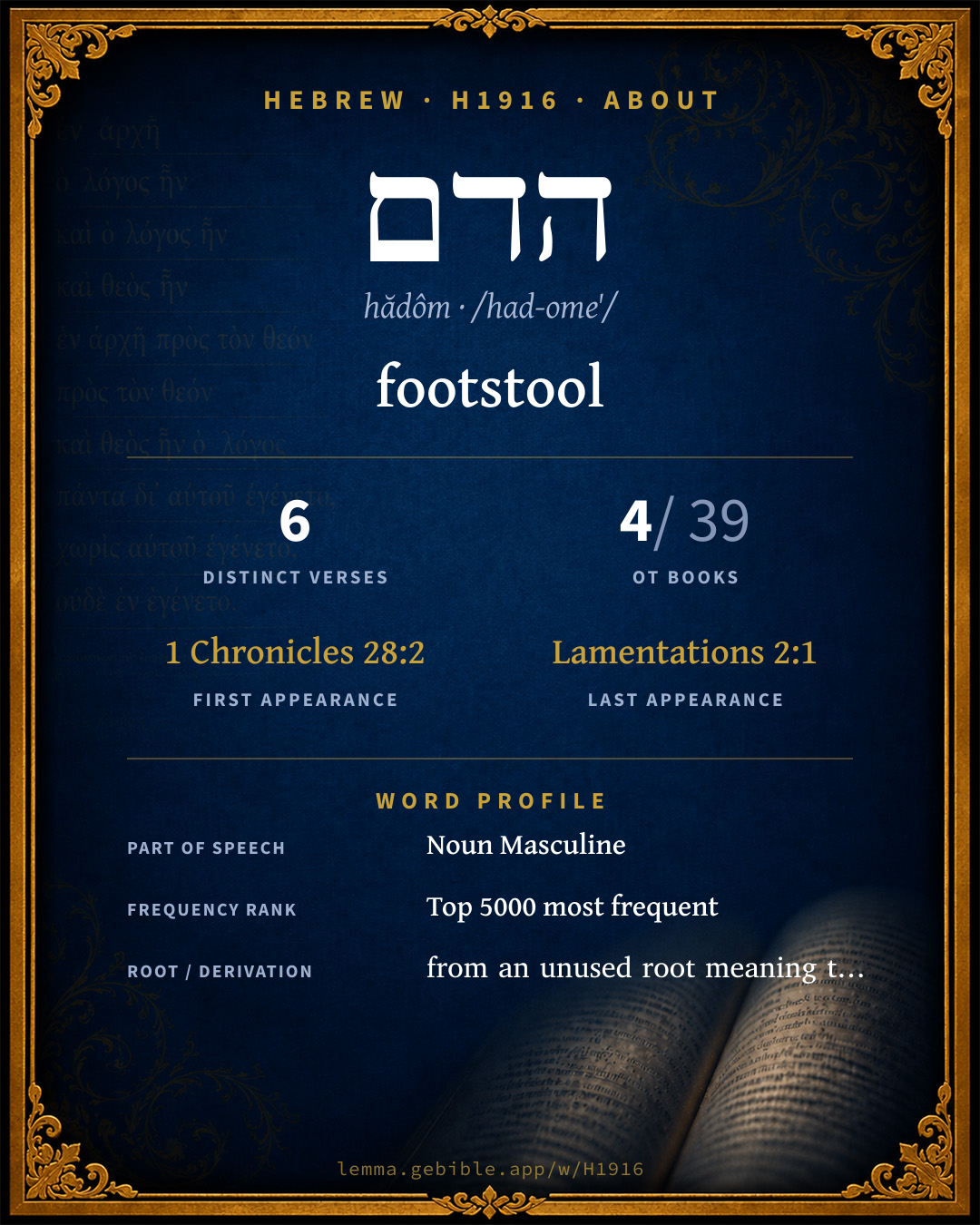
הֲדֹם
footstool
Full lexicon entry — Brown-Driver-Briggs (BDB)
From Brown-Driver-Briggs (BDB)
Where this word appears
See every Construct-state word in the Hebrew Bible →
Grammar key — what these labels mean
Part of speech
- Noun
- A naming word — a person, place, thing, or idea.
Noun type
- Common
- A common noun — a general class of person, place, or thing (“king,” “city,” “water”), not a specific name.
State
- Construct
- A noun bound to a following noun in a possessive / “of” relationship (the construct chain).
- Absolute
- The independent form of a noun, not bound to a following word.
Gender
- Masculine
- Grammatically masculine.
Number
- Singular
- One.
Grammatical forms
- Noun, Common, Masculine, Singular, Construct 5 times (83%)
- Noun, Common, Masculine, Singular, Absolute 1 time (17%)
Parsed forms decoded from the imported morphology (morphhb / Westminster Leningrad Codex — WLC text public domain, morphhb tagging CC BY 4.0), counted across 6 parsed occurrences — not distinct verses.
Every verse where H1916 appears — 6 distinct verses across 4 books. Click any verse to open its interlinear word-by-word view. Verse text shown in the World English Bible for context — . Each verse’s Hebrew form is shown with its reference; the English is not keyword-highlighted, since the data carries no word-level English alignment. Use “Compare translations” on any verse to read it across multiple English versions. This concordance covers the Hebrew Bible; Septuagint (Greek Old Testament) occurrences are not indexed here.
1 Chronicles 1 verse
Psalms 3 verses
- Psalms 99:5 לַ/הֲדֹ֥ם prep + n c ms cs Exalt Yahweh our God. Worship at his footstool. He is Holy!
- Psalms 110:1 הֲדֹ֣ם n c ms Yahweh says to my Lord, "Sit at my right hand, Until I make your enemies your footstool for your feet."
- Psalms 132:7 לַ/הֲדֹ֥ם prep + n c ms cs "We will go into his dwelling place. We will worship at his footstool.
Isaiah 1 verse
Lamentations 1 verse
About this entry
At a glance — auto-summarized from this page’s data, not written by a person. Every figure links to its source below. This summary describes the numbers; it doesn’t interpret them.
“footstool” is the headline sense of the Hebrew noun הדם (hădôm). It clusters heavily in Psalms, which alone accounts for 50% of its uses. It turns up in 6 verses across 4 books, an uncommon footprint. Its earliest occurrence is 1 Chronicles 28:2. It clusters with הדם under a shared root. The sections below give every sense, occurrence, and version rendering.
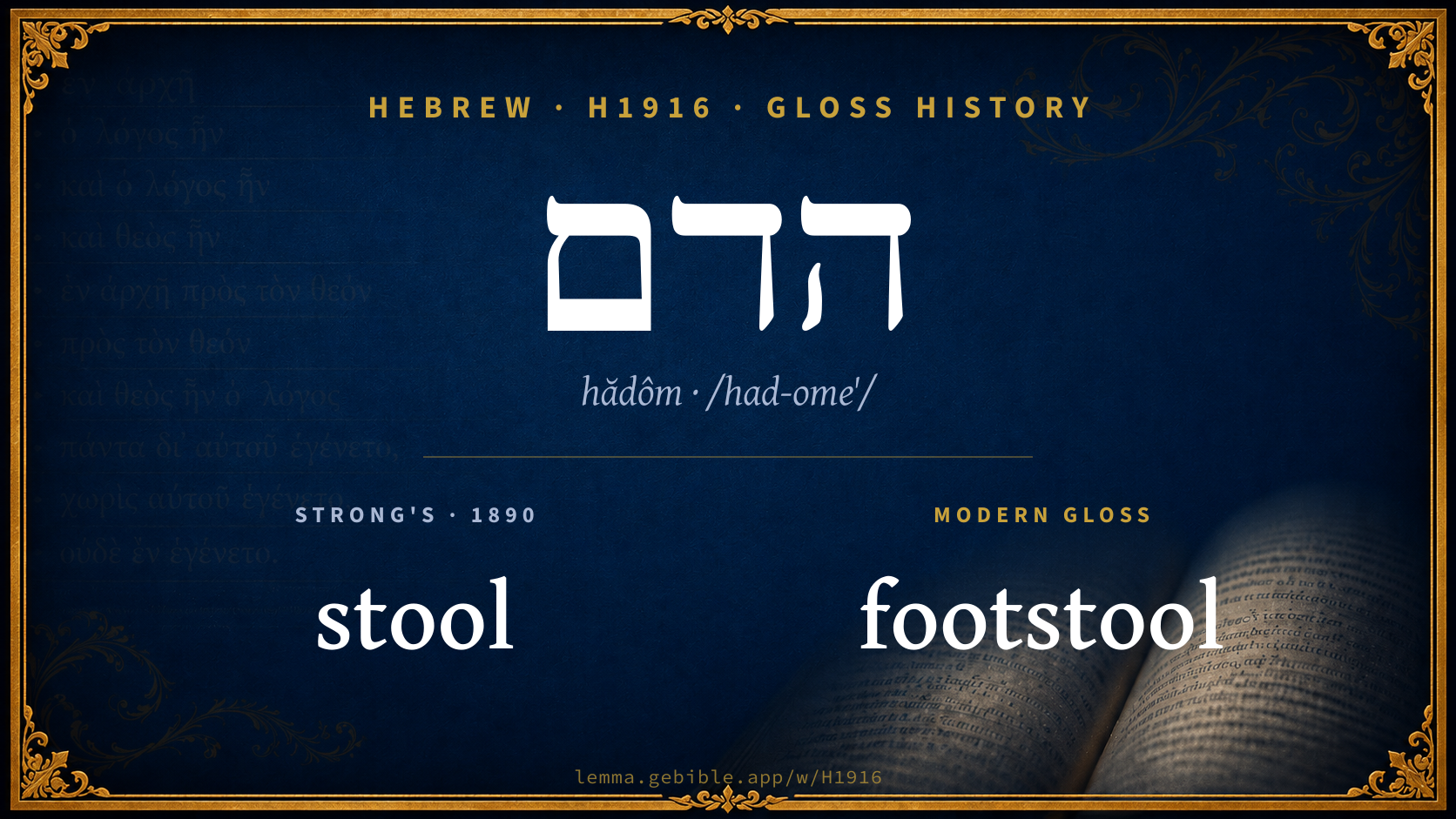
Gloss history
Strong's 1890 vs modern scholarship
About this word
Strong's H1916 catalogs a Hebrew word from the Hebrew Old Testament.
These counts are not copied from any lexicon or concordance. They are computed here, from the morphology-tagged Hebrew Old Testament. What Lemma adds →
- 6
- distinct verses
- The word appears in 6 distinct verses.
- 4 / 39
- OT books
- The word appears in 4 of 39 Old Testament books.
- #3,040
- by frequency
- Top 5000 most frequent Hebrew words (rank 3,040 of 8,640 Hebrew words by occurrence).
View all 6 occurrences in the concordance →
Most concentrated in
- Psalms 3 verses 50%
- 1 Chronicles 1 verse 17%
- Isaiah 1 verse 17%
By section of the Old Testament
By traditional corpus
Conventional, traditional groupings — biblical authorship is debated, so this is a traditional corpus grouping, not an authorship claim. Each share is this word’s portion of its verses in that division of the Hebrew canon. Each figure is a share of the word’s 6 distinct verses.
- Writings (Ketuvim) 5 verses · 83%
- Prophets (Nevi'im) 1 verse · 17%
How translations render this word
Counts come from each version’s own published word-to-Strong’s tagging or interlinear alignment — an approximate guide to how each version renders this word, not a word-level alignment the data otherwise carries. Because each total is that version’s own tagged count, the per-version totals vary from one another and need not match the appearance or distinct-verse counts above. These counts may also differ from a printed concordance because Lemma counts each distinctly tagged rendering and does not collapse phrase taggings into a single head-word total. This is a fixed set of word-tagged versions (KJV, ASV, BSB, ULT) and does not change with the reading translation you choose elsewhere. Each version’s license is shown beside its name below (and on Sources).
BDB lists this Strong’s number as 2 distinct words (homographs). Each count above pools all of them and is not split by sense — see the Senses section below. A low-frequency rendering may belong to a different one of those words, not the primary meaning.
- King James Version†: Footstool 4×
- American Standard Version†: Footstool 4×
- Berean Standard Bible†: Footstool 4×
- unfoldingWord Literal Text†: Footstool 2×, Footstool of 2×
King James Version Public Domain
Renders H1916 across 4† tagged occurrences — most commonly:
Not rendered by a distinct English word in 2 further occurrences.
American Standard Version Public Domain
Renders H1916 across 4† tagged occurrences — most commonly:
Berean Standard Bible Public Domain
Renders H1916 across 6† tagged occurrences — most commonly:
Plus 2 renderings that appear only once — usually multi-word phrases or single function words the recovered tagging swept in, not distinct renderings.
unfoldingWord Literal Text CC BY-SA 4.0
Renders H1916 across 6† tagged occurrences — most commonly:
Plus 2 renderings that appear only once — usually multi-word phrases or single function words the recovered tagging swept in, not distinct renderings.
Senses in the full BDB
What do BDB’s symbols mean?
BDB uses these scholarly abbreviations:
| Symbol | Meaning |
|---|---|
| 𝔊 | the Septuagint (the ancient Greek translation, LXX) |
| 𝔙 | the Vulgate (the Latin translation) |
| 𝔖 | the Syriac version (the Peshitta) |
| 𝔗 | the Targum (the Aramaic translation) |
| ψ | the Psalms |
| √ | root (the underlying root or stem) |
| ‖ | parallel passage (a synonymous or contrasted parallel) |
| † | the dagger: every passage where the word occurs is cited |
The 0 senses and sub-senses the full Brown-Driver-Briggs lexicon distinguishes for this word, in lexicon order (not ranked by frequency), with BDB’s own verbatim wording and sub-sense lettering. Shown in Hebrew script with BDB’s own scholarly abbreviations. The condensed entry is in the Lexicon Entry tab. See also the Forms in the corpus table below.
הדם I (√ of foll., cf. Arabic هَدَمَ overthrow, overturn, cast down).
הדם II stool, footstool, always joined with רַגְלַיִם
Senses from the full Brown-Driver-Briggs lexicon (Brown, Driver, Briggs; Oxford 1906 — public domain), digitized via Sefaria, supplemented by the OpenScriptures HebrewLexicon (CC BY 4.0). Full attribution on Sources.
Word origin
I. (√ of foll., cf. Arabic هَدَمَ overthrow, overturn, cast down).
I. n.m. stool, footstool, always joined with רַגְלַיִם; only in poet. and late writings, (properly something cast down, low)—ה׳ abs. ψ 110:1 (or cstr. bef. לְ, cf. Ges§ 130, 1); cstr. La 2:1 + 4 times:—footstool, never lit., usually of י׳ Is 66:1 הַשָּׁמַיִם כִּסְאִי וְהָאָרֶץ ה׳ רַגְלַי; elsewhere with ref. to sanctuary ה׳ רַגְלָיו (cf. מְקוֹם רַגְלַי Is 60:13) La 2:1, or perhaps of ark (as place on which God rests) ψ 99:5; 132:7, בֵּית מְנוּחָה לַאֲרוֹן בְּרִית־י׳ וְלַה׳ רַגְלֵי אֱלֹהֵינוּ 1 Ch 28:2; of conquest of enemies of Messianic king by Yahweh’s agency אָשִׁית אֹיְבֶיךָ הֲדֹם לְרַגְלֶיךָ ψ 110:1.
— Brown-Driver-Briggs (Oxford 1906, public domain), digitized via Sefaria, supplemented by the OpenScriptures HebrewLexicon (CC BY 4.0). See Sources.
Origin: from an unused root meaning to stamp upon
Jastrow Dictionary
A second Hebrew/Aramaic lexicon for comparison, covering Aramaic and post-biblical (Talmudic, Targumic, Midrashic) usage that the biblical-Hebrew BDB does not. Matched by lemma rather than by Strong’s number, so a lemma may carry more than one Jastrow headword (shown separately below), and the entries cover usage well beyond the Bible.
דָּם
- , constr. דַּם (b. h.; דום or דמם, cmp. דבב) liquid; blood; life. Men. 44ᵃ בדָמוֹ (not בדמה, v. Rabb. D. S. a. l. note) with the juice of the purple shell.—Sabb. 31ᵇ רביעית ד׳ וכ׳ one fourth of a Log of blood did I (the Lord) put in your body (the smallest quantity required to sustain life, v. Sot. 5ᵃ). Snh. 72ᵇ (ref. to Gen. IX, 6) הצל דָּמוֹ וכ׳ save the life of the one (who is pursued) at the expense of the life of the other (the pursuer).—דַּם ברית = ד׳ של מילה the blood lost at circumcision. Tosef. Sabb. XV (XVI), 9 צריך להטיף … ד׳ ב׳ he must cause the blood of the covenant to flow from him (even if born without preputium). Ib. 8; a. fr.—Pes. 16ᵇ ד׳ שהנפש וכ׳ the blood with which life escapes when cutting the animal’s throat is called a fluid (with regard to levitical purity, v. כָּשַׁר); a. v. fr.—Pl. דָּמִים. Keth. 9ᵇ טענת ד׳ complaint of absence of the token of virginity.—שְׁפִיכוּת ד׳ (abbr. ש"ד) murder. Yoma 67ᵇ; a. fr.—Midd. III, 1, a. e. ד׳ העליונים blood sprinkled against the upper part of the altar, opp. ד׳ התחתונים.—Snh. VIII, 6, a. fr. (with ref. to Ex. XXII, 1) יש לו ד׳ his blood is revenged, אין לו ד׳ may be killed with impunity. Ib. 72ᵃ בד׳ קננהו he acquired possession of them by risking his life.—[דָּמִים equivalent, v. דָּמִים.) e.g. Genesis 9:6
דָּם ²
- 1. blood; life. Targ. O. Gen. IV, 10. Targ. ib. IX, 6; a. fr.—B. Bath. 58ᵇ בריש כל מרעין אנא ד׳ וכ׳ at the head of all diseases (chief cause of physical disorders) am I, the blood. Yoma 82ᵇ, a. e. מאי חזית דד׳ דידך וכ׳ what right hast thou to assume that thy blood is redder than thy neighbor’s (you have no right to commit murder even under compulsion). Kidd. 81ᵃ נשויתיה (שויתי) לָדָמָךְ וכ׳ I should have valued thy life two M’ah, i.e. I should not have spared thee; Pes. 112ᵇ Ms. M. (ed. סכנתיך, v. Rabb. D. S. a. l. note 200, a. note 3). Keth. 60ᵇ bot. על דמא דחמרא Ar. s. v. גרדן (ed. רמא) on the blood of an ass.—Pl. דְּמֶי. Targ. Gen. IV, 11; a. fr.—Gitt. 57ᵇ, v. דְּמֵי I.
- 2. congestion. Ab. Zar. 28ᵇ; Bets. 22ᵃ ד׳ דמעתא וכ׳ congestion of the eye, tears &c. Gitt. 68ᵇ לד׳ דרישא for congestion of the head (head-ache). [דְּמֵי equivalent, v. דָּמִין.] V. אִדְמָא.
הֲדַם
- , Pa. (אַדֵּם) הַדֵּם
- 1. to dissect, dismember, tear to pieces. Targ. Jud. XIV, 6. Ib. XIX, 29; XX, 6 (v. Ar. ed. Koh. s. v.); a. e.—Ab. Zar. 38ᵇ דילמא הַדּוּמֵי הַדְּמוּהָ וכ׳ Ms. M. a. Ar. (ed. אדמויי אַדְּמוּהָ, read אַדּוּמֵי) perhaps they carved the bird and then put it into the pot. Erub. 30ᵃ הַדּוּמֵי נִיהַדְּמֵיה shall we cut him apart?—Bets. 24ᵇ דאַדִּימֵי (ed. Sonc. a. Ven. דהַדִּימֵי, v. Rabb. D. S. a. l. note) fish that were dissected (Rashi: red, v. אֲדִימָּא).
- 2. אֲהַדֵּם (denom. of next w.) to arrange the parts of an animal. Gitt. 67ᵇ אֲהַדְּמוּ לי הַדָּמֵי דחיותא arrange before me the limbs of the (dissected) animal.
הַדָּם
- (v. preced.) part, member.—Pl. הַדָּמִין, הַדָּמֵי. Dan. II, 5; III, 29.—Gitt. 67ᵇ, v. preced. e.g. Daniel 2:5
A Dictionary of the Targumim, the Talmud Babli and Yerushalmi, and the Midrashic Literature (Marcus Jastrow; London, Luzac, 1903) — Public Domain. Digitized via Sefaria. Digitized via Sefaria. Full attribution on Sources.
Forms in the corpus
The 4 distinct written forms H1916 takes in the Hebrew Bible, most frequent first — each parse links to that state’s occurrences in the concordance. Hebrew forms include their vowel points and cantillation, so a single lemma takes many written forms.
| Form | Parsing | Example | Uses |
|---|---|---|---|
| הֲדֹ֣ם | Noun, Common, Masculine, Singular, Absolute | Psalms 110:1 | 2 |
| לַ/הֲדֹ֥ם | Noun, Common, Masculine, Singular, Construct | Psalms 99:5 | 2 |
| הֲדֹם | Noun, Common, Masculine, Singular, Construct | Lamentations 2:1 | 1 |
| וְ/לַ/הֲדֹם֙ | Noun, Common, Masculine, Singular, Construct | 1 Chronicles 28:2 | 1 |
Same root — word family
Other BDB entries built from the same root as H1916, grouped by Strong’s listed origin. These share a root / origin per the lexicon — not necessarily a shared meaning. Each links to that word’s own entry.
Derived from this word
Compare all same-root words → They share a root, not necessarily a meaning.
Septuagint verse parallels
This word appears in 5 verses that also exist in the Greek Old Testament (Septuagint), out of the 6 Hebrew verses it occurs in. You can read those verses in Greek by switching the Old Testament edition to the Septuagint.
Read these verses in the Septuagint
This is a verse-level parallel only — the same verses exist in both the Hebrew and Greek Old Testaments. No word-level Hebrew↔Greek correspondence is claimed: the data carries no such alignment, so no Greek word is shown as this Hebrew word’s translation. Coverage is not total — the Septuagint omits the deuterocanon and renumbers the Psalms, so some Hebrew verses have no direct Greek parallel.