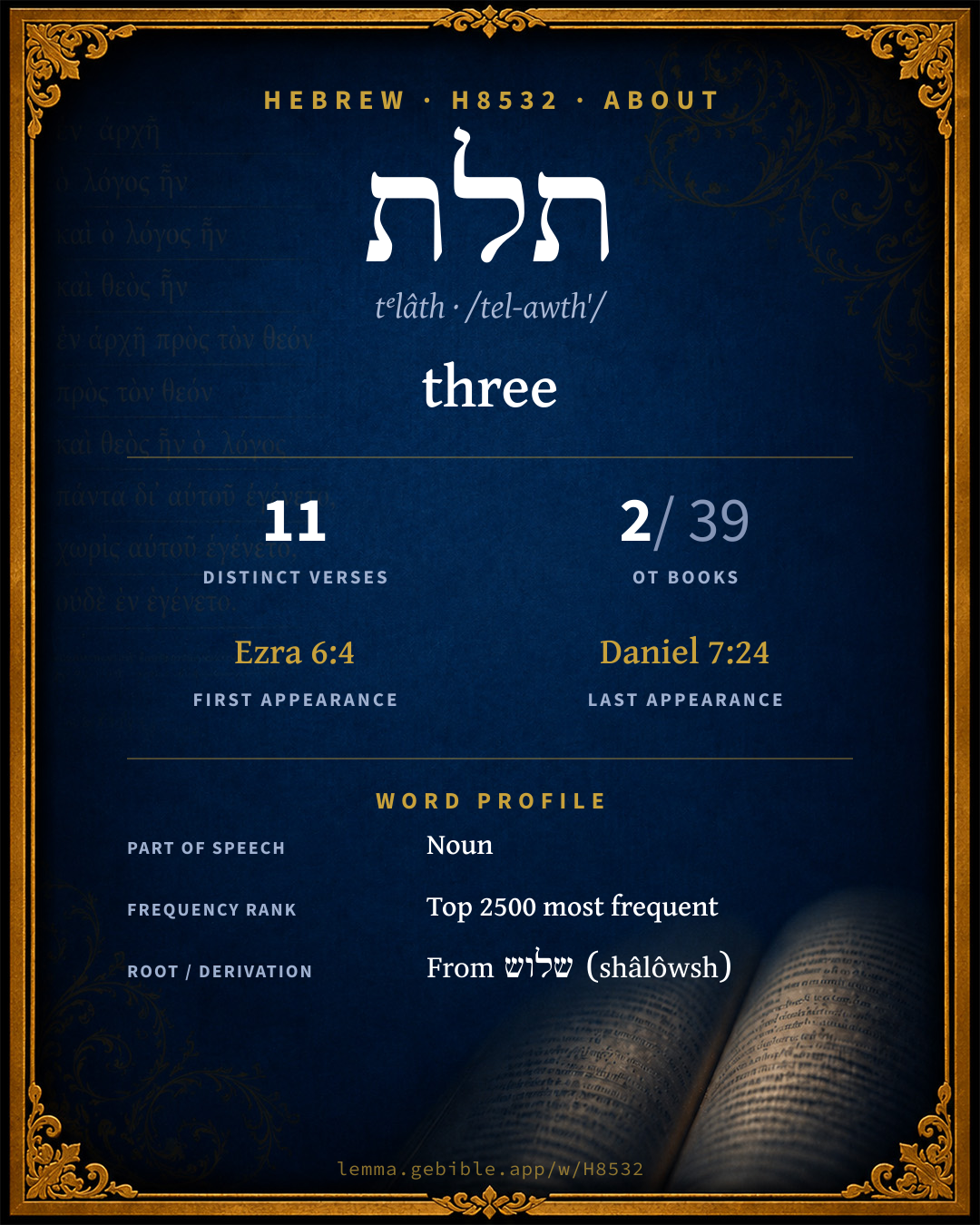
תְּלָת
three
‘three’ is one of 3 main senses fuller range ↓
Full lexicon entry — Brown-Driver-Briggs (BDB)
From Brown-Driver-Briggs (BDB)
Where this word appears
See every Absolute-state word in the Hebrew Bible →
Grammar key — what these labels mean
Part of speech
- Adjective
- A word that describes or qualifies a noun.
State
- Absolute
- The independent form of a noun, not bound to a following word.
- Construct
- A noun bound to a following noun in a possessive / “of” relationship (the construct chain).
Gender
- Both
- Attested as both masculine and feminine.
- Masculine
- Grammatically masculine.
Number
- Singular
- One.
10 distinct verses where H8532 appears in the Absolute state, across 2 books. Filtered view — show all forms. Click any verse to open its interlinear word-by-word view. Verse text shown in the World English Bible for context — . Each verse’s Hebrew form is shown with its reference; the English is not keyword-highlighted, since the data carries no word-level English alignment. Use “Compare translations” on any verse to read it across multiple English versions. This concordance covers the Hebrew Bible; Septuagint (Greek Old Testament) occurrences are not indexed here.
Ezra 2 verses
- Ezra 6:4 תְּלָתָ֔א adj Cardinal number bs with three courses of great stones, and a course of new timber: and let the expenses be given out of the king's house.
- Ezra 6:15 תְּלָתָ֖ה adj Ordinal number bs This house was finished on the third day of the month Adar, which was in the sixth year of the reign of Darius the king.
Daniel 8 verses
- Daniel 3:24 תְּלָתָ֜א adj Cardinal number ms Then Nebuchadnezzar the king was astonished, and rose up in haste: he spoke and said to his counselors, Didn't we cast three men bound into the midst of the fire? They answered the king, True, O king.
- Daniel 6:2 תְּלָתָ֔א adj Cardinal number ms and over them three presidents, of whom Daniel was one; that these satraps might give account to them, and that the king should have no damage.
- Daniel 6:10 תְּלָתָ֨ה adj Cardinal number bs When Daniel knew that the writing was signed, he went into his house (now his windows were open in his chamber toward Jerusalem) and he kneeled on his knees three times a day, and prayed, and gave thanks before his God, as he did before.
- Daniel 6:13 תְּלָתָה֙ adj Cardinal number bs Then answered they and said before the king, That Daniel, who is of the children of the captivity of Judah, doesn't regard you, O king, nor the interdict that you have signed, but makes his petition three times a day.
- Daniel 7:5 וּ/תְלָ֥ת conj + Adjective Cardinal number bs Behold, another animal, a second, like a bear; and it was raised up on one side, and three ribs were in its mouth between its teeth: and they said thus to it, Arise, devour much flesh.
- Daniel 7:8 וּ/תְלָ֗ת conj + Adjective Cardinal number bs I considered the horns, and, behold, there came up among them another horn, a little one, before which three of the first horns were plucked up by the roots: and, behold, in this horn were eyes like the eyes of a man, and a mouth speaking great things.
- Daniel 7:20 תְּלָ֑ת adj Cardinal number bs and concerning the ten horns that were on its head, and the other [horn] which came up, and before which three fell, even that horn that had eyes, and a mouth that spoke great things, whose look was more stout than its fellows.
- Daniel 7:24 וּ/תְלָתָ֥ה conj + Adjective Cardinal number bs As for the ten horns, out of this kingdom shall ten kings arise: and another shall arise after them; and he shall be diverse from the former, and he shall put down three kings.
About this entry
At a glance — auto-summarized from this page’s data, not written by a person. Every figure links to its source below. This summary describes the numbers; it doesn’t interpret them.
תלת — transliterated tᵉlâth — is a Hebrew noun carrying the sense “three.” Its uses cluster heavily in Daniel (82% of all occurrences). Spanning 11 verses in 2 books, it ranks among the uncommon words of the Hebrew Bible. Scripture first uses it in Ezra 6:4. Catalogued under 3 senses, its meaning is not single-sense. See the sense tree, 11-verse concordance, and the renderings breakdown below.
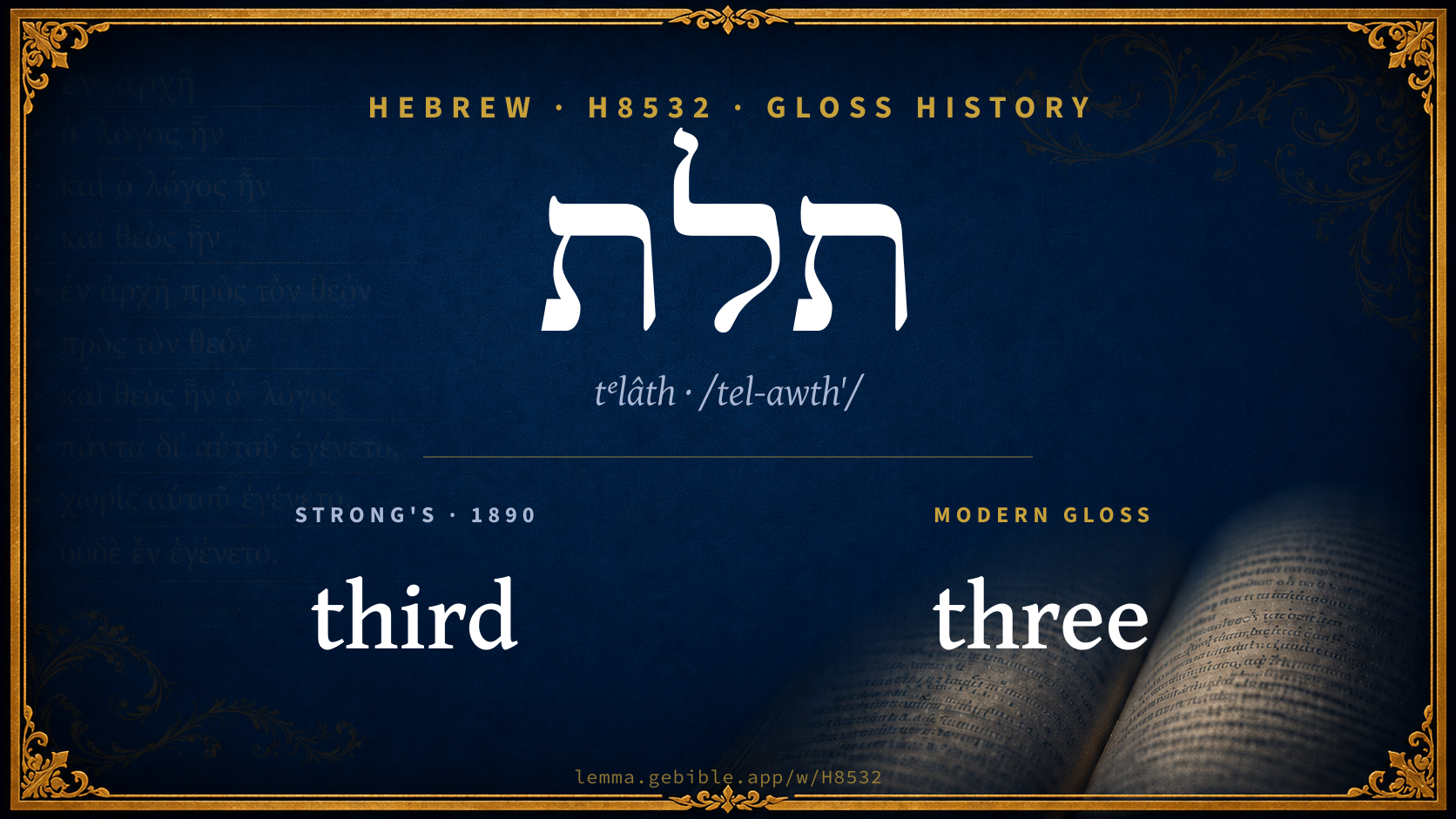
Gloss history
Strong's 1890 vs modern scholarship
About this word
Strong's H8532 catalogs a Hebrew word from the Hebrew Old Testament.
These counts are not copied from any lexicon or concordance. They are computed here, from the morphology-tagged Hebrew Old Testament. What Lemma adds →
- 11
- distinct verses
- The word appears in 11 distinct verses.
- 2 / 39
- OT books
- The word appears in 2 of 39 Old Testament books.
- #2,210
- by frequency
- Top 2500 most frequent Hebrew words (rank 2,210 of 8,640 Hebrew words by occurrence).
View all 11 occurrences in the concordance →
By traditional corpus
Conventional, traditional groupings — biblical authorship is debated, so this is a traditional corpus grouping, not an authorship claim. Each share is this word’s portion of its verses in that division of the Hebrew canon. Each figure is a share of the word’s 11 distinct verses.
- Writings (Ketuvim) 11 verses · 100%
How translations render this word
Counts come from each version’s own published word-to-Strong’s tagging or interlinear alignment — an approximate guide to how each version renders this word, not a word-level alignment the data otherwise carries. Because each total is that version’s own tagged count, the per-version totals vary from one another and need not match the appearance or distinct-verse counts above. These counts may also differ from a printed concordance because Lemma counts each distinctly tagged rendering and does not collapse phrase taggings into a single head-word total. This is a fixed set of word-tagged versions (KJV, ASV, BSB, ULT) and does not change with the reading translation you choose elsewhere. Each version’s license is shown beside its name below (and on Sources).
- King James Version: Three 8×
- American Standard Version: Three 9×
- Berean Standard Bible: Three 8×
- unfoldingWord Literal Text: Three 11×
King James Version Public Domain
Renders H8532 across 11 tagged occurrences — most commonly:
Plus 3 renderings that appear only once — usually multi-word phrases or single function words the recovered tagging swept in, not distinct renderings.
American Standard Version Public Domain
Renders H8532 across 11 tagged occurrences — most commonly:
Plus 2 renderings that appear only once — usually multi-word phrases or single function words the recovered tagging swept in, not distinct renderings.
Berean Standard Bible Public Domain
Renders H8532 across 11 tagged occurrences — most commonly:
Plus 3 renderings that appear only once — usually multi-word phrases or single function words the recovered tagging swept in, not distinct renderings.
unfoldingWord Literal Text CC BY-SA 4.0
Renders H8532 across 12 tagged occurrences — most commonly:
Plus 1 rendering that appears only once — usually multi-word phrases or single function words the recovered tagging swept in, not distinct renderings.
Senses in BDB
The 3 senses BDB distinguishes for this word, in lexicon order (not ranked by frequency or importance). The full entry — with sub-senses — is in the Lexicon Entry tab.
- three
- three (cardinal number)
- third (ordinal number)
Word origin
Derived from שלוש (shâlôwsh) (H7969) — three.
Jastrow Dictionary
A second Hebrew/Aramaic lexicon for comparison, covering Aramaic and post-biblical (Talmudic, Targumic, Midrashic) usage that the biblical-Hebrew BDB does not. Matched by lemma rather than by Strong’s number, so a lemma may carry more than one Jastrow headword (shown separately below), and the entries cover usage well beyond the Bible.
תַּלֵּת
- (denom. of next w.)
- 1. to divide into three parts. Targ. Deut. XIX, 3.
- 2. to do a third time. Targ. I Kings XVIII, 34.—Part. pass. מְתַלַּת; f. מְתַלְּתָא; pl. מְתַלְּתִין; מְתַלְּתַן divided into three, having three stories. Targ. Ez. XLII, 3; 6 (not מִתַּ׳).
- to be done a third time. Targ. Y. Deut. XXVII, 26.
תְּלַת
- = h. שָׁלשׁ, three; בת׳ on the third (day &c.). Targ. O. Gen. XV, 9 תְּלָתָה ed. Berl. (oth. ed. תִּלְתָּא, read תְּלָתָא); Targ. Y. ib. בר תלת שנין (h. text משלש). Targ. Num. XII, 4. Ib. XXIX, 3; a. v. fr.—Sabb. 87ᵃ בת׳ (sub. בשבא) on the third day of the week. Ib. 36ᵃ הני ת׳ מילי וכ׳, v. שְׁנֵי. Meg. 6ᵇ ת׳ מאה וכ׳, v. תָּגָא; a. v. fr.—תלת עסר (תלתא), ת׳ עשר, ת׳ עשרה, תְּלֵיסַר, תְּלֵיסְרֵי, תִּלְתֵּיסַר thirteen. Targ. Num. XXIX, 13, sq. Targ. Gen. XIV, 4; a. fr.—Ber. 4ᵃ באורתא דת׳ וכ׳, v. נֵגְהָא. Keth. 67ᵇ דלא … תליסרי שנין whom he had not seen for thirteen years. Y. Kil. IX, 32ᵇ לסוף תלת עשרתי וכ׳ at the end of thirteen years and thirty days; a. fr.—Pl. תְּלָתִין thirty. Targ. Gen. V, 3; a. v. fr.—Sabb. 98ᵇ. Y. Kil. l. c. כל אינון תַּלְתּוֹיֵי יומיא all these thirty days. Ib. לסוף … ותַלְתָּתוֹי יומייא, v. supra; Y. Keth. XII, 35ᵃ bot. תַּלְתִּיתֵי; ib. תְּלֵיתִיתֵי. Y. Shebi. IX, 38ᵈ bot. תְּלָתִים שנין thirty years; a. fr.
A Dictionary of the Targumim, the Talmud Babli and Yerushalmi, and the Midrashic Literature (Marcus Jastrow; London, Luzac, 1903) — Public Domain. Digitized via Sefaria. Digitized via Sefaria. Full attribution on Sources.
Forms in the corpus
The 10 distinct written forms H8532 takes in the Hebrew Bible, most frequent first — each parse links to that state’s occurrences in the concordance. Hebrew forms include their vowel points and cantillation, so a single lemma takes many written forms.
| Form | Parsing | Example | Uses |
|---|---|---|---|
| תְּלָתָ֔א | Adjective, Cardinal number, Both, Singular, Absolute | Ezra 6:4 | 2 |
| וּ/תְלָ֗ת | Adjective, Cardinal number, Both, Singular, Absolute | Daniel 7:8 | 1 |
| וּ/תְלָ֥ת | Adjective, Cardinal number, Both, Singular, Absolute | Daniel 7:5 | 1 |
| וּ/תְלָתָ֥ה | Adjective, Cardinal number, Both, Singular, Absolute | Daniel 7:24 | 1 |
| תְּלָ֑ת | Adjective, Cardinal number, Both, Singular, Absolute | Daniel 7:20 | 1 |
| תְּלָ֣תֵּ/ה֔וֹן | Adjective, Cardinal number, Masculine, Singular, Construct | Daniel 3:23 | 1 |
| תְּלָתָ֖ה | Adjective, Ordinal number, Both, Singular, Absolute | Ezra 6:15 | 1 |
| תְּלָתָ֜א | Adjective, Cardinal number, Masculine, Singular, Absolute | Daniel 3:24 | 1 |
| תְּלָתָ֨ה | Adjective, Cardinal number, Both, Singular, Absolute | Daniel 6:10 | 1 |
| תְּלָתָה֙ | Adjective, Cardinal number, Both, Singular, Absolute | Daniel 6:13 | 1 |
Same root — word family
Other BDB entries built from the same root as H8532, grouped by Strong’s listed origin. These share a root / origin per the lexicon — not necessarily a shared meaning. Each links to that word’s own entry.
Derives from
Shares the same root
Derived from this word
Compare all same-root words → Showing 4 of 8 — not the complete family. They share a root, not necessarily a meaning.
Septuagint verse parallels
This word appears in 11 verses that also exist in the Greek Old Testament (Septuagint), out of the 11 Hebrew verses it occurs in. You can read those verses in Greek by switching the Old Testament edition to the Septuagint.
Read these verses in the Septuagint
This is a verse-level parallel only — the same verses exist in both the Hebrew and Greek Old Testaments. No word-level Hebrew↔Greek correspondence is claimed: the data carries no such alignment, so no Greek word is shown as this Hebrew word’s translation. Coverage is not total — the Septuagint omits the deuterocanon and renumbers the Psalms, so some Hebrew verses have no direct Greek parallel.