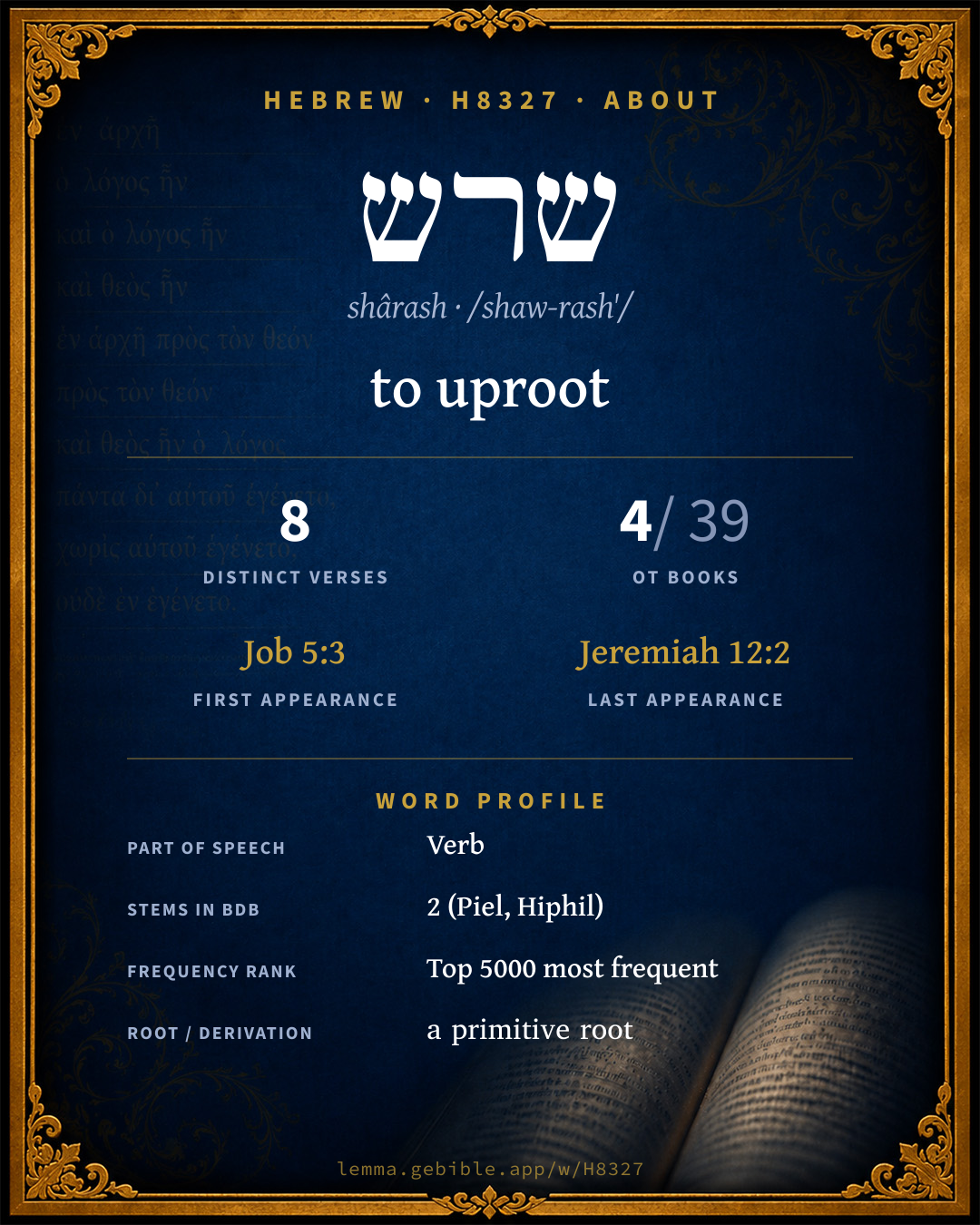
שָׁרַשׁ
to uproot
‘to uproot’ is one of 6 main senses fuller range ↓
Full lexicon entry — Brown-Driver-Briggs (BDB)
From Brown-Driver-Briggs (BDB)
Where this word appears
See every Hiphil verb in the Hebrew Bible →
Grammar key — what these labels mean
Part of speech
- Verb
- An action or state-of-being word.
Stem
- Hiphil
- The causative active stem (“he caused / brought about”).
- Piel
- An intensive or resultative active stem. Here: ‘deal with the roots’
- Pual
- The passive counterpart of the Piel.
Form
- Sequential Imperfect
- An imperfect with prefixed waw — the standard past-narrative form (waw-consecutive imperfect).
- Sequential Perfect
- A perfect with prefixed waw continuing a preceding imperfect or command (waw-consecutive perfect).
- Perfect
- A completed action or state — Hebrew marks aspect (completeness) more than strict tense (“he wrote”).
- Imperfect
- An incomplete, ongoing, or future action (“he will / would write”).
- Participle Active
- A verbal adjective expressing ongoing or characteristic action (“writing / one who writes”).
State
- Absolute
- The independent form of a noun, not bound to a following word.
Person
- 3rd Person
- The one spoken about (“he / she / it / they”).
Gender
- Feminine
- Grammatically feminine.
- Masculine
- Grammatically masculine.
- Common
- Either gender — not distinguished for this form.
Number
- Singular
- One.
- Plural
- More than one (in Hebrew, generally three or more).
Every verse where H8327 appears in the Book of Isaiah — 2 distinct verses. Click any verse to open its interlinear word-by-word view. Verse text shown in the World English Bible for context — . Each verse’s Hebrew form is shown with its reference; the English is not keyword-highlighted, since the data carries no word-level English alignment. Use “Compare translations” on any verse to read it across multiple English versions. This concordance covers the Hebrew Bible; Septuagint (Greek Old Testament) occurrences are not indexed here.
Isaiah
- Isaiah 27:6 יַשְׁרֵ֣שׁ Hiphil impf 3ms In days to come shall Jacob take root; Israel shall blossom and bud; and they shall fill the surface of the world with fruit.
- Isaiah 40:24 שֹׁרֵ֥שׁ Poel pf 3ms Yes, they have not been planted; yes, they have not been sown; yes, their stock has not taken root in the earth: moreover he blows on them, and they wither, and the whirlwind takes them away as stubble.
About this entry
At a glance — auto-summarized from this page’s data, not written by a person. Every figure links to its source below. This summary describes the numbers; it doesn’t interpret them.
At its core, שרש (shârash) means “to uproot.” It first appears in Job 5:3. Spanning 8 verses in 4 books, it ranks among the uncommon words of the Hebrew Bible. Its uses concentrate in Job (38% of all occurrences). The verb spans 2 stems, from Piel to Hiphil. Dig into 8-verse concordance and the renderings breakdown below.
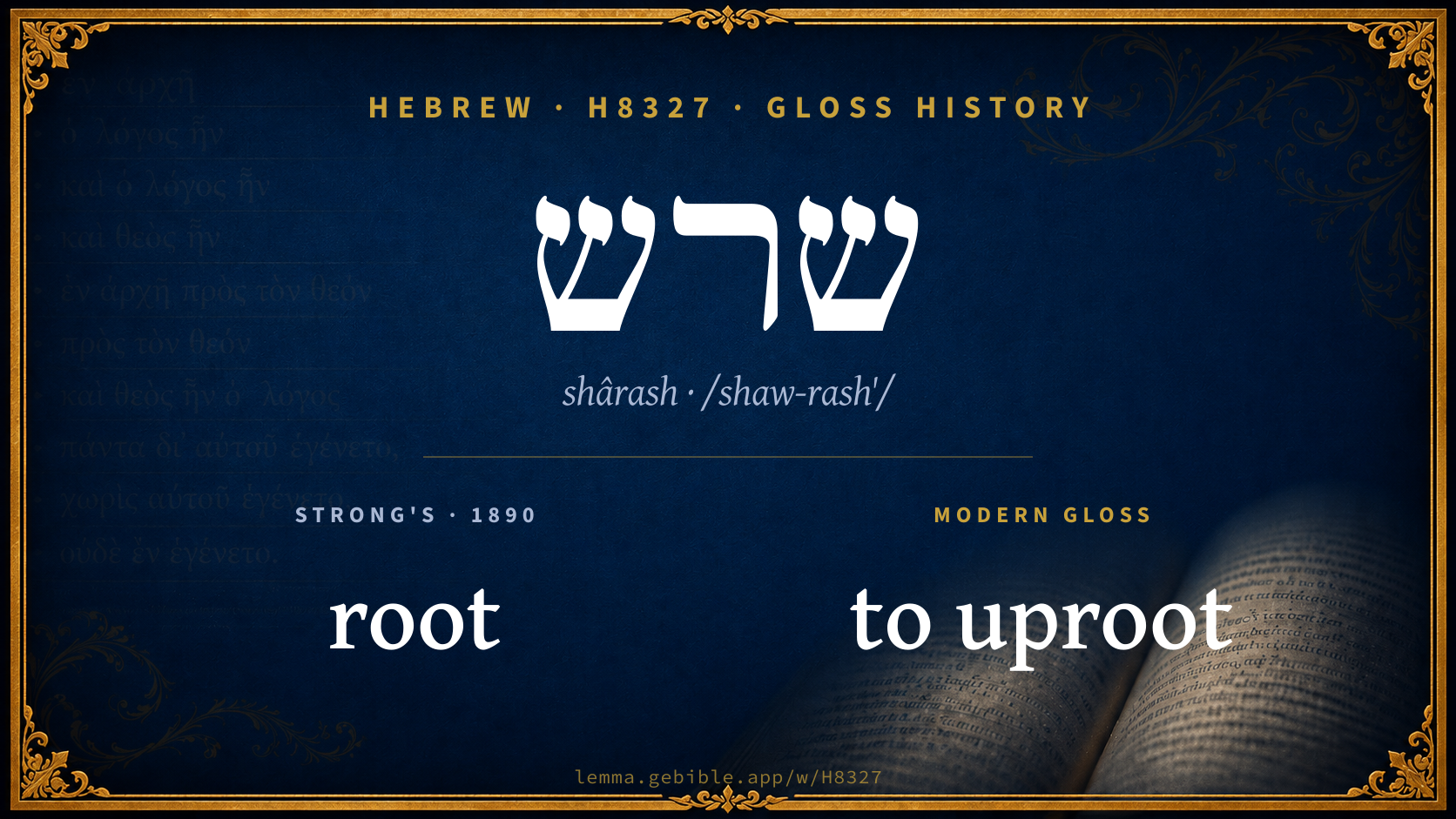
Gloss history
Strong's 1890 vs modern scholarship
About this word
Strong's H8327 catalogs a Hebrew word from the Hebrew Old Testament.
These counts are not copied from any lexicon or concordance. They are computed here, from the morphology-tagged Hebrew Old Testament. What Lemma adds →
- 8
- distinct verses
- The word appears in 8 distinct verses.
- 4 / 39
- OT books
- The word appears in 4 of 39 Old Testament books.
- #2,625
- by frequency
- Top 5000 most frequent Hebrew words (rank 2,625 of 8,640 Hebrew words by occurrence).
View all 8 occurrences in the concordance →
By section of the Old Testament
By traditional corpus
Conventional, traditional groupings — biblical authorship is debated, so this is a traditional corpus grouping, not an authorship claim. Each share is this word’s portion of its verses in that division of the Hebrew canon. Each figure is a share of the word’s 8 distinct verses.
- Writings (Ketuvim) 5 verses · 63%
- Prophets (Nevi'im) 3 verses · 38%
How translations render this word
Counts come from each version’s own published word-to-Strong’s tagging or interlinear alignment — an approximate guide to how each version renders this word, not a word-level alignment the data otherwise carries. Because each total is that version’s own tagged count, the per-version totals vary from one another and need not match the appearance or distinct-verse counts above. These counts may also differ from a printed concordance because Lemma counts each distinctly tagged rendering and does not collapse phrase taggings into a single head-word total. This is a fixed set of word-tagged versions (KJV, ASV, BSB, ULT) and does not change with the reading translation you choose elsewhere. Each version’s license is shown beside its name below (and on Sources).
- King James Version: Be rooted out 1×, Root 1×, Root thee out 1×
- American Standard Version: Let the produce of my field be rooted out 1×, Root thee out 1×, Stock hath not taken root 1×
- Berean Standard Bible: Be uprooted 1×, He will uproot you 1×, Taken root 1×
- unfoldingWord Literal Text: Rooted 2×
King James Version Public Domain
Renders H8327 across 8 tagged occurrences — most commonly:
American Standard Version Public Domain
Renders H8327 across 8 tagged occurrences — most commonly:
Berean Standard Bible Public Domain
Renders H8327 across 8 tagged occurrences — most commonly:
unfoldingWord Literal Text CC BY-SA 4.0
Renders H8327 across 11 tagged occurrences — most commonly:
Plus 9 renderings that appear only once — usually multi-word phrases or single function words the recovered tagging swept in, not distinct renderings.
Senses in the full BDB
Hebrew verbs can shift meaning by stem (binyan): Qal is the basic action, Niphal is often passive or reflexive, Piel often intensifies or makes it factitive, and Hiphil is typically causative. The senses below are grouped under the stem BDB assigns to each.
What do BDB’s symbols mean?
BDB uses these scholarly abbreviations:
| Symbol | Meaning |
|---|---|
| 𝔊 | the Septuagint (the ancient Greek translation, LXX) |
| 𝔙 | the Vulgate (the Latin translation) |
| 𝔖 | the Syriac version (the Peshitta) |
| 𝔗 | the Targum (the Aramaic translation) |
| ψ | the Psalms |
| √ | root (the underlying root or stem) |
| ‖ | parallel passage (a synonymous or contrasted parallel) |
| † | the dagger: every passage where the word occurs is cited |
The 4 senses and sub-senses the full Brown-Driver-Briggs lexicon distinguishes for this word, in lexicon order (not ranked by frequency), with BDB’s own verbatim wording and sub-sense lettering. Shown in Hebrew script with BDB’s own scholarly abbreviations. The condensed entry is in the Lexicon Entry tab. See also the Forms in the corpus table below.
Piel
- = deal with the roots;—
- 1. root up, out: Pf. 3 ms. sf. consec. וְשֵׁרֶשְׁךָ ψ 52:7 he shall root thee up from (מִן) the land of the living; of fire (burn) roots, root: Impf. 3 fs. תְּשָׁרֵשׁ בְּ Jb 31:12 fire (fig.) roots at all my increase. Pu. Impf. 3 mpl. יְשֹׁרָשׁוּ 31:8 be rooted up (of produce). e.g. Psalms 52:7
- 2. Poʿēl take root, establish oneself firmly: Pf. 3 ms. שֹׁרֵשׁ בָּאָרֶץ גִּזְעָם Is 40:24 (fig. of princes, etc.). Poʿal id.: Pf. 3 mpl. שֹׁרָ֔שׁוּ Je 12:2 (fig. of wicked). e.g. Isaiah 40:24
Hiphil
- id.: Impf. 3 ms. יַשְׁרֵשׁ Is 27:6 (fig. of Isr.); 3 fs. וַתַּשְׁרֵשׁ ψ 80:10 (id.; c. acc. cogn.); Pt. מַשְׁרִישׁ Jb 5:3 (fig. of pers.). e.g. Isaiah 27:6
Senses from the full Brown-Driver-Briggs lexicon (Brown, Driver, Briggs; Oxford 1906 — public domain), digitized via Sefaria, supplemented by the OpenScriptures HebrewLexicon (CC BY 4.0). Full attribution on Sources.
Word origin
Origin: a primitive root
Jastrow Dictionary
A second Hebrew/Aramaic lexicon for comparison, covering Aramaic and post-biblical (Talmudic, Targumic, Midrashic) usage that the biblical-Hebrew BDB does not. Matched by lemma rather than by Strong’s number, so a lemma may carry more than one Jastrow headword (shown separately below), and the entries cover usage well beyond the Bible.
שֹׁרֶשׁ
- , v. שָׁרָר) [chain, knot,] root. — Pl. שֳׁרָשִׁים, שֳׁרָשִׁין; constr. שָׁרְשֵׁי, שׁוֹרְשֵׁי. B. Bath. V, 4 העולה … ומן הש׳ וכ׳ that which shoots forth out of the trunk, or out of the roots, belongs to the landowner (v. גֶּזַע), expl. ib. 82ᵃ כל שאינו … זהו מן הש׳ that which does not see the light of day (when it shoots forth) is out of the roots’. Y. Ab. Zar. III, 43ᵃ top; Y. Taan. I, 64ᵇ ש׳ חטה the roots of wheat; ש׳ תאנה of fig-trees. Tosef. Shebi. VII, 17; ‘Uktsin I, 4, v. קוֹלָס. Ab. III, 17 וְשֳׁרָשָׁיו מרובין whose roots are many; a. fr.
שֹׁרֶשׁ ²
- Targ. Y. II, Deut. XXIX, 17. Targ. Job XIV, 8 (Ms. pl.).—Pl. שָׁרְשִׁין, שִׁוֹ׳. Ib. XVIII, 16. Targ. Is. LIII, 2. Targ. Ps. LXXX, 10 שׁוֹרָשֵׁיהוֹן (Ms. שׁוֹרְשְׁיָיהָא).
שָׁרַשׁ
- (b. h.), Hif. הִשְׁרִישׁ (denom. of שֹׁרֶשׁ) to take root. Shebi. II, 7 שהִשְׁרִישׁוּ לפני וכ׳ which have taken root before the New Year; R. Hash. 13ᵇ. Ib.; Tosef. Shebi. II, 5 ומקצתו ה׳ לאחר וכ׳ and part of which took root after the New Year; a. fr.
- to uproot, tear out. Ib. 11, sq. אין … לשָׁרֵשׁ וכ׳ we do not force him to tear out &c. Shebi. IV, 4 יְשָׁרֵשׁ he must take it out with the root, opp. יגום, v. גָּמַם. B. Bath. 80ᵇ חופר ומְשָׁרֵשׁ he has the right to dig and take them out with the roots; Taan. 25ᵇ חופר … ומְשָׁרֵישׁ.
- 1. to be uprooted, plucked out. Tanḥ. M’tsorʿa 2 (ref. to Ps. LII, 7) דואג נ׳ וכ׳ Doeg was rooted out of the life of this world and of the hereafter. e.g. Psalms 52:7
- 2. (of roots) to spread. Num. R. s. 144 (ref. to Koh. XII, 11) כשם … מִשְׁתָּרְשִׁים … ומשתרשים וכ׳ as roots of a tree spread in all directions, so the words of the Law enter and penetrate the whole body; (Pesik. R. s. 3 משתילים). e.g. Ecclesiastes 12:11
- 3. (v. next w.) to gain, profit (cmp. רָוַח). B. Kam. 67ᵇ sq. מפני שנ׳ בחטא because he became the gainer in sin (he gained possession of the stolen object by a change of form or ownership, v. שִׁינּוּי); אילימא לפני יאוש מי איכא נ׳ if you mean (that he slaughtered or sold it) before the owner had given it up (v. יֵאוּשׁ): there is no gain in sin in the case (since he has not gained possession through the change).
שְׁרַשׁ
- Af. אַשְׁרֵישׁ same, to take root. Men. 68ᵇ מהנך דאַשְׁרוּשׁ וכ׳ of that barley that has taken root before the ʿOmer time. Gitt. 22ᵃ בדאשרוש כולי וכ׳ when the planted trees have taken root, all agree (that they are subject to tithes); a. e.
- 1. to cause to take root, plant. Targ. Ps. LXXX, 10.
- 2. to uproot, tear out. Targ. Koh. III, 2.
- (v. P. Sm. 4340) [to expand,] to bring profit, benefit. M. Kat. 12ᵃ כיון … שָׁרָשׁוּיְי … מְשָׁרְשׁוּ ליה וכ׳ since they receive no wages, they (by working for him during the festive week) only intend to benefit him.
- to be uprooted. B. Bath. 82ᵃ למחפר ולמִשְּׁרַשׁ קיימי ed. (Ms. M. לחפור ולשרש Hebr.) they are liable to be dug for and taken out (when they cease to bear fruit). Ib. למיחפר ולשרש (corr. acc., or לחפור ולשרש).
- to be profitable; א׳ ל־ to profit. Gitt. 35ᵃ א׳ לה מקום דינר (Rashi אשתרש) she saved as much dough (in the bread which she gave away) as would have been in the space which was occupied by the Denar (that came into it). Ib. 44ᵃ; Ḥull. 131ᵃ קא מִשְׁתָּרְשֵׁי ליה he is benefited (by being released from a debt). B. Mets. 42ᵇ והא קא משתרשי ליה but did he not have the benefit (of using his neighbor’s cuscuta for brewing and saving his own? why, then, should he not indemnify his neighbor?). Keth. 108ᵃ הא קא משתרשי ליה is he (for whom the debt was paid) not benefited? (better הא קא מְשָׁרְשֵׁי ליה does he who pays the debt for him not benefit him?, v. supra).
A Dictionary of the Targumim, the Talmud Babli and Yerushalmi, and the Midrashic Literature (Marcus Jastrow; London, Luzac, 1903) — Public Domain. Digitized via Sefaria. Digitized via Sefaria. Full attribution on Sources.
Forms in the corpus
The 8 distinct written forms H8327 takes in the Hebrew Bible, most frequent first — each parse links to that stem’s occurrences in the concordance. Hebrew forms include their vowel points and cantillation, so a single lemma takes many written forms.
| Form | Parsing | Example | Uses |
|---|---|---|---|
| וְ/שֵֽׁרֶשְׁ/ךָ֨ | Verb, Piel, Sequential Perfect, 3rd Person, Masculine, Singular | Psalms 52:5 | 1 |
| וַ/תַּשְׁרֵ֥שׁ | Verb, Hiphil, Sequential Imperfect, 3rd Person, Feminine, Singular | Psalms 80:9 | 1 |
| יְשֹׁרָֽשׁוּ | Verb, Pual, Imperfect, 3rd Person, Masculine, Plural | Job 31:8 | 1 |
| יַשְׁרֵ֣שׁ | Verb, Hiphil, Imperfect, 3rd Person, Masculine, Singular | Isaiah 27:6 | 1 |
| מַשְׁרִ֑ישׁ | Verb, Hiphil, Participle Active, Masculine, Singular, Absolute | Job 5:3 | 1 |
| שֹׁרֵ֥שׁ | Verb, Poel, Perfect, 3rd Person, Masculine, Singular | Isaiah 40:24 | 1 |
| שֹׁרָ֔שׁוּ | Verb, Poal, Perfect, 3rd Person, Common, Plural | Jeremiah 12:2 | 1 |
| תְשָׁרֵֽשׁ | Verb, Piel, Imperfect, 3rd Person, Feminine, Singular | Job 31:12 | 1 |
Same root — word family
Other BDB entries built from the same root as H8327, grouped by Strong’s listed origin. These share a root / origin per the lexicon — not necessarily a shared meaning. Each links to that word’s own entry.
Derived from this word
- שרש sheresh H8328 root
- שרשה sharshâh H8331 chain
- שרשו shᵉrôshûw H8332 uprooting
- שרשרה sharshᵉrâh H8333 chain
Compare all same-root words → Showing 4 of 5 — not the complete family. They share a root, not necessarily a meaning.
Septuagint verse parallels
This word appears in 8 verses that also exist in the Greek Old Testament (Septuagint), out of the 8 Hebrew verses it occurs in. You can read those verses in Greek by switching the Old Testament edition to the Septuagint.
Read these verses in the Septuagint
This is a verse-level parallel only — the same verses exist in both the Hebrew and Greek Old Testaments. No word-level Hebrew↔Greek correspondence is claimed: the data carries no such alignment, so no Greek word is shown as this Hebrew word’s translation. Coverage is not total — the Septuagint omits the deuterocanon and renumbers the Psalms, so some Hebrew verses have no direct Greek parallel.