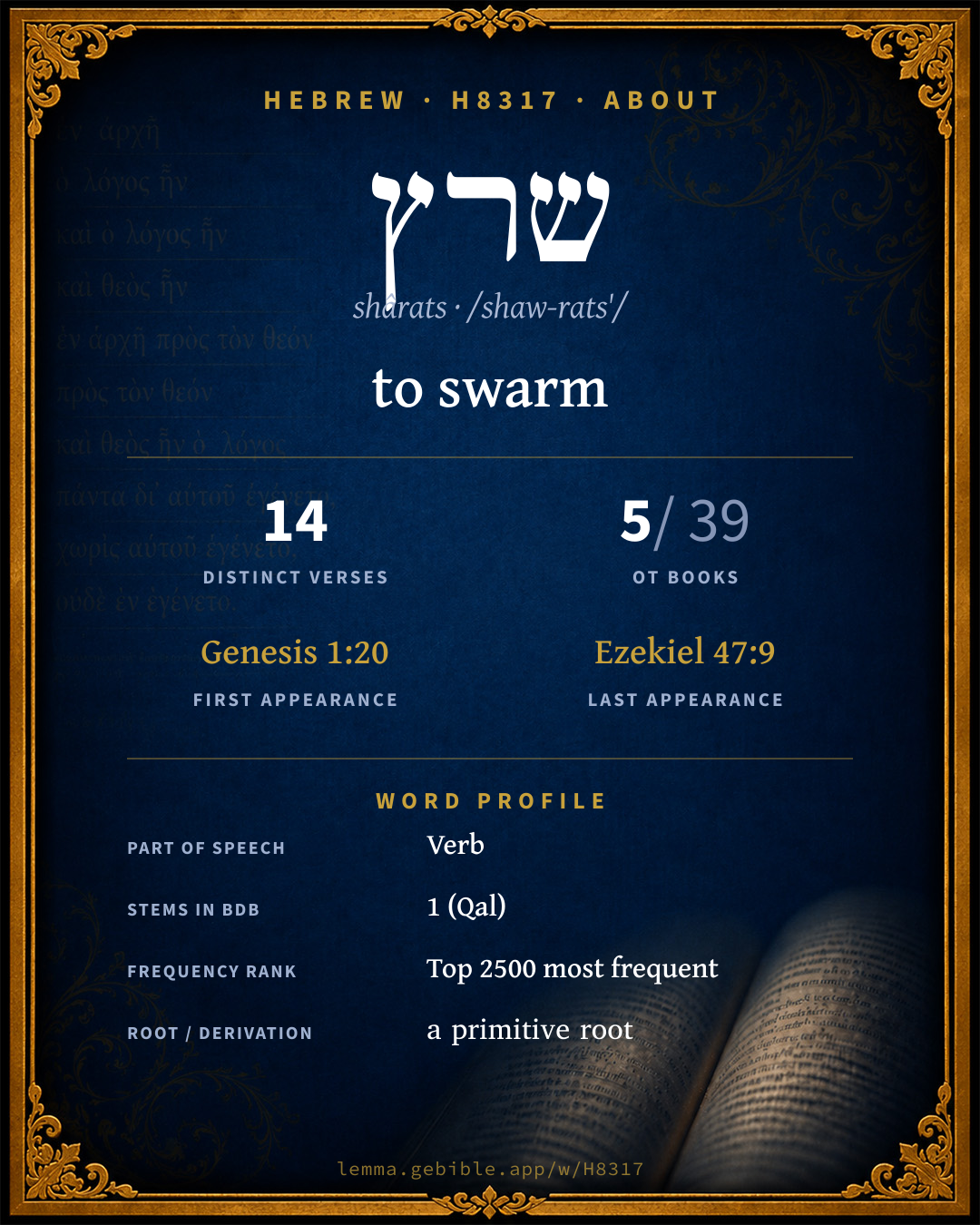
שָׁרַץ
to swarm
‘to swarm’ is one of 2 main senses fuller range ↓
Full lexicon entry — Brown-Driver-Briggs (BDB)
From Brown-Driver-Briggs (BDB)
Where this word appears
Grammar key — what these labels mean
Part of speech
- Verb
- An action or state-of-being word.
Stem
- Qal
- The basic, simple active stem — the plain form of the verb (“he wrote”). Here: ‘swarm’
Form
- Participle Active
- A verbal adjective expressing ongoing or characteristic action (“writing / one who writes”).
- Sequential Perfect
- A perfect with prefixed waw continuing a preceding imperfect or command (waw-consecutive perfect).
- Sequential Imperfect
- An imperfect with prefixed waw — the standard past-narrative form (waw-consecutive imperfect).
- Imperfect
- An incomplete, ongoing, or future action (“he will / would write”).
- Perfect
- A completed action or state — Hebrew marks aspect (completeness) more than strict tense (“he wrote”).
- Imperative
- A direct command (“write!”).
State
- Absolute
- The independent form of a noun, not bound to a following word.
Person
- 3rd Person
- The one spoken about (“he / she / it / they”).
- 2nd Person
- The one addressed (“you”).
Gender
- Masculine
- Grammatically masculine.
- Common
- Either gender — not distinguished for this form.
- Feminine
- Grammatically feminine.
Number
- Singular
- One.
- Plural
- More than one (in Hebrew, generally three or more).
Every verse where H8317 appears in the Book of Ezekiel — 1 distinct verse. Click any verse to open its interlinear word-by-word view. Verse text shown in the World English Bible for context — . Each verse’s Hebrew form is shown with its reference; the English is not keyword-highlighted, since the data carries no word-level English alignment. Use “Compare translations” on any verse to read it across multiple English versions. This concordance covers the Hebrew Bible; Septuagint (Greek Old Testament) occurrences are not indexed here.
Ezekiel
About this entry
At a glance — auto-summarized from this page’s data, not written by a person. Every figure links to its source below. This summary describes the numbers; it doesn’t interpret them.
At its core, שרץ (shârats) means “to swarm.” First canonically at Genesis 1:20, it enters the text early. With 14 verses in 5 books, it is an uncommon word in the Hebrew Bible. Its uses concentrate in Genesis (36% of all occurrences). Carrying more than one sense, it rewards its full sense range. Each statement above links to its evidence; the full detail follows below.
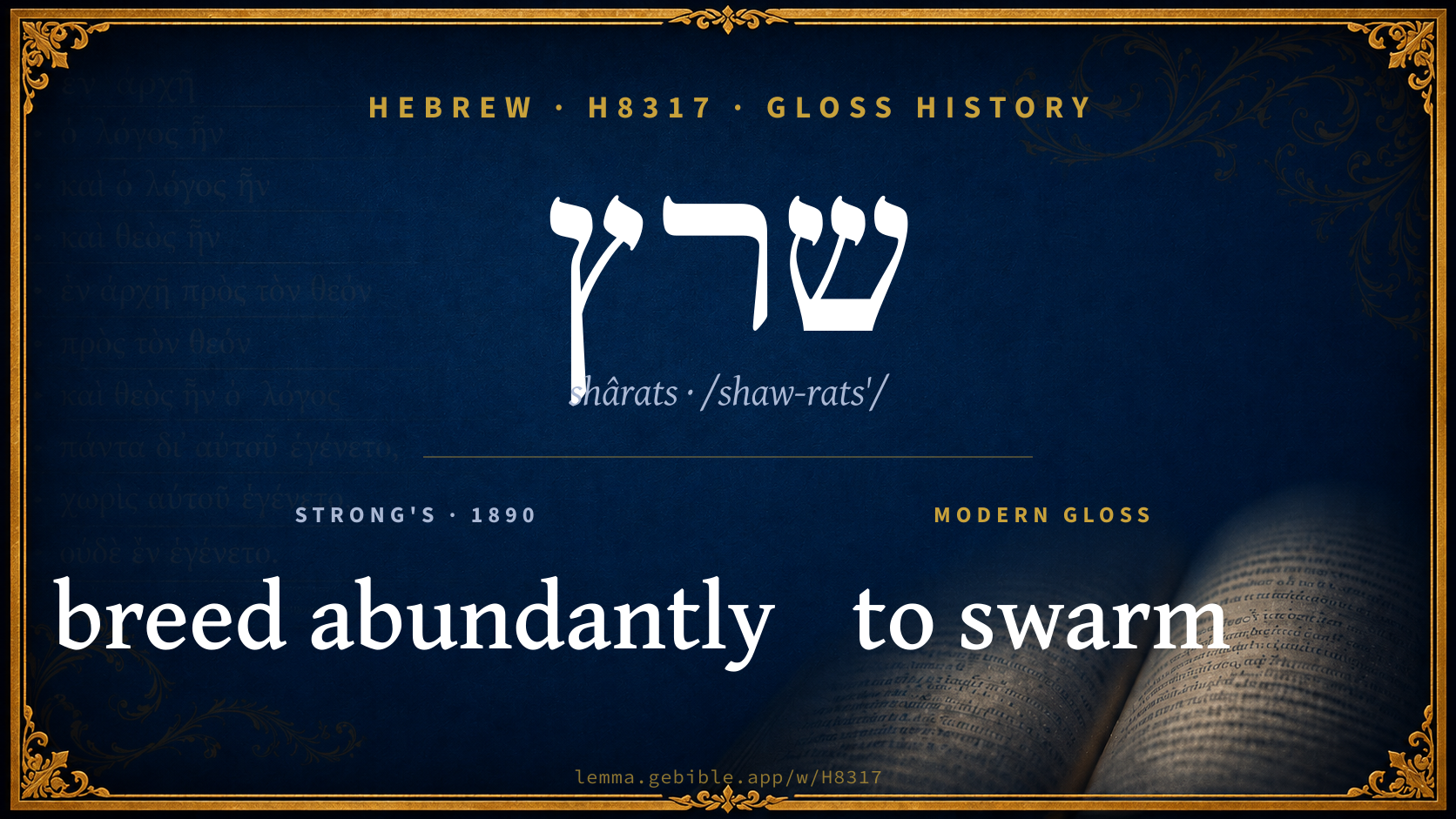
Gloss history
Strong's 1890 vs modern scholarship
About this word
Strong's H8317 catalogs a Hebrew word from the Hebrew Old Testament.
These counts are not copied from any lexicon or concordance. They are computed here, from the morphology-tagged Hebrew Old Testament. What Lemma adds →
- 14
- distinct verses
- The word appears in 14 distinct verses.
- 5 / 39
- OT books
- The word appears in 5 of 39 Old Testament books.
- #1,910
- by frequency
- Top 2500 most frequent Hebrew words (rank 1,910 of 8,640 Hebrew words by occurrence).
View all 14 occurrences in the concordance →
By section of the Old Testament
By traditional corpus
Conventional, traditional groupings — biblical authorship is debated, so this is a traditional corpus grouping, not an authorship claim. Each share is this word’s portion of its verses in that division of the Hebrew canon. Each figure is a share of the word’s 14 distinct verses.
- Torah (Pentateuch) 12 verses · 86%
- Prophets (Nevi'im) 1 verse · 7%
- Writings (Ketuvim) 1 verse · 7%
How translations render this word
Counts come from each version’s own published word-to-Strong’s tagging or interlinear alignment — an approximate guide to how each version renders this word, not a word-level alignment the data otherwise carries. Because each total is that version’s own tagged count, the per-version totals vary from one another and need not match the appearance or distinct-verse counts above. These counts may also differ from a printed concordance because Lemma counts each distinctly tagged rendering and does not collapse phrase taggings into a single head-word total. This is a fixed set of word-tagged versions (KJV, ASV, BSB, ULT) and does not change with the reading translation you choose elsewhere. Each version’s license is shown beside its name below (and on Sources).
- King James Version: Creepeth 4×, Bring forth abundantly 2×, Creep 2×
- American Standard Version: Creepeth 4×, Creep 2×, Swarmed 2×
- Berean Standard Bible: Moves 2×, Teemed 2×
- unfoldingWord Literal Text: One swarming 3×
King James Version Public Domain
Renders H8317 across 16 tagged occurrences — most commonly:
Plus 8 renderings that appear only once — usually multi-word phrases or single function words the recovered tagging swept in, not distinct renderings.
American Standard Version Public Domain
Renders H8317 across 17 tagged occurrences — most commonly:
Plus 7 renderings that appear only once — usually multi-word phrases or single function words the recovered tagging swept in, not distinct renderings.
Berean Standard Bible Public Domain
Renders H8317 across 12 tagged occurrences — most commonly:
Plus 8 renderings that appear only once — usually multi-word phrases or single function words the recovered tagging swept in, not distinct renderings. Not rendered by a distinct English word in 2 further occurrences.
unfoldingWord Literal Text CC BY-SA 4.0
Renders H8317 across 16 tagged occurrences — most commonly:
Plus 13 renderings that appear only once — usually multi-word phrases or single function words the recovered tagging swept in, not distinct renderings.
Senses in the full BDB
What do BDB’s symbols mean?
BDB uses these scholarly abbreviations:
| Symbol | Meaning |
|---|---|
| 𝔊 | the Septuagint (the ancient Greek translation, LXX) |
| 𝔙 | the Vulgate (the Latin translation) |
| 𝔖 | the Syriac version (the Peshitta) |
| 𝔗 | the Targum (the Aramaic translation) |
| ψ | the Psalms |
| √ | root (the underlying root or stem) |
| ‖ | parallel passage (a synonymous or contrasted parallel) |
| † | the dagger: every passage where the word occurs is cited |
The 3 senses and sub-senses the full Brown-Driver-Briggs lexicon distinguishes for this word, in lexicon order (not ranked by frequency), with BDB’s own verbatim wording and sub-sense lettering. Shown in Hebrew script with BDB’s own scholarly abbreviations. The condensed entry is in the Lexicon Entry tab. See also the Forms in the corpus table below.
Qal
- Pf. 3 ms. שׁ׳ ψ 105:30, שָֽׁרְצוּ Gn 1:21, etc.; Impf. 3 ms. יִשְׁרֹץ Ez 47:9, etc.; Imv. mpl. שִׁרְצוּ Gn 9:7; Pt. הַשֹּׁרֵץ 7:21 +, f. הַשֹּׁרֶ֫צֶת Lv 11:46; Hex mostly P:— e.g. Psalms 105:30
- 1. swarm, teem with (acc. animal), subj. water Gn 1:20, 21, cf. Ex 7:28 (J), land ψ 105:30. e.g. Genesis 1:20
- 2. swarm, subj. animal Gn 8:17 (+ פָּרָה, רָבָה), Ez 47:9, הַשֹּׁרֵץ Gn 7:21; Lv 11:29 (P). 41, 42, 46 (J) (all עַל־הָאָרֶץ), v 43; subj. men Gn 9:7 (+ פָּרָה, רָבָה), Ex 1:7 (id., + עָצַם). e.g. Genesis 8:17
Senses from the full Brown-Driver-Briggs lexicon (Brown, Driver, Briggs; Oxford 1906 — public domain), digitized via Sefaria, supplemented by the OpenScriptures HebrewLexicon (CC BY 4.0). Full attribution on Sources.
Word origin
vb. swarm, teem (NH id.; Aramaic ܫܪܰܨ crawl, ܫܶܪܨܳܐ = שֶׁרֶץ, so שִׁרְצָא (rare); Ethiopic ሠረጸ: germinate, sprout);—
— Brown-Driver-Briggs (Oxford 1906, public domain), digitized via Sefaria, supplemented by the OpenScriptures HebrewLexicon (CC BY 4.0). See Sources.
Origin: a primitive root
Jastrow Dictionary
A second Hebrew/Aramaic lexicon for comparison, covering Aramaic and post-biblical (Talmudic, Targumic, Midrashic) usage that the biblical-Hebrew BDB does not. Matched by lemma rather than by Strong’s number, so a lemma may carry more than one Jastrow headword (shown separately below), and the entries cover usage well beyond the Bible.
שָׁרַץ
- to bring forth moving creatures. Midr. Till. to Ps. CXVII המים … והן שׁוֹרְצִין the waters are the work of his hand, and they beget life.
- same, to cast young, breed. Ex. R. s. 10 צפרדע … הִשְׁרִיצָה וכ׳ there was one frog, and it bred and filled the land &c.; Snh. 67ᵇ; Yalk. Ex. 183. Lev. R. s. 13 מה … מַשְׁרֶצֶת וכ׳ as the scorpion casts sixty at a time &c.; a. e.
שֶׁרֶץ
- Shaf. of רוץ) moving creature, esp. unclean reptile. Tosef. Taan. I, 8 אם יהא הש׳ בידו וכ׳ if a man has a reptile in his hand, he cannot become clean, even if he bathe &c.; השליך הש׳ וכ׳ when he throws the reptile out of his hand, a bath in a basin of forty S’ah avails him (fasting without restitution is of no avail); Y. ib. II, beg. 65ᵃ; Bab. ib. 16ᵃ. Erub. 13ᵇ היה מטהר את הש׳ וכ׳ could prove a reptile to be clean with one hundred and fifty reasons (was a dialectician). Snh. 17ᵃ אין … לטהר ש׳ וכ׳ none could be seated in the Sanhedrin, unless he could prove the cleanness of a reptile from Biblical texts; a. fr.—Pl. שְׁרָצִים. Sabb. XIV, 1 שמנה ש׳ וכ׳ the eight reptiles mentioned in the Torah (Lev. XI, 29, sq.). Yoma 22ᵇ, v. פַּרְנָס; a. fr.—פרשת ש׳ the section treating of unclean animals, in Sifra Sh’mini. e.g. Leviticus 11:29
A Dictionary of the Targumim, the Talmud Babli and Yerushalmi, and the Midrashic Literature (Marcus Jastrow; London, Luzac, 1903) — Public Domain. Digitized via Sefaria. Digitized via Sefaria. Full attribution on Sources.
Forms in the corpus
The 11 distinct written forms H8317 takes in the Hebrew Bible, most frequent first — each parse links to that stem’s occurrences in the concordance. Hebrew forms include their vowel points and cantillation, so a single lemma takes many written forms.
| Form | Parsing | Example | Uses |
|---|---|---|---|
| הַ/שֹּׁרֵ֣ץ | Verb, Qal, Participle Active, Masculine, Singular, Absolute | Genesis 7:21 | 4 |
| הַ/שֹּׁרֵ֑ץ | Verb, Qal, Participle Active, Masculine, Singular, Absolute | Leviticus 11:43 | 1 |
| הַ/שֹּׁרֶ֥צֶת | Verb, Qal, Participle Active, Feminine, Singular, Absolute | Leviticus 11:46 | 1 |
| וְ/שָׁרַ֣ץ | Verb, Qal, Sequential Perfect, 3rd Person, Masculine, Singular | Exodus 8:3 | 1 |
| וְ/שָֽׁרְצ֣וּ | Verb, Qal, Sequential Perfect, 3rd Person, Common, Plural | Genesis 8:17 | 1 |
| וַֽ/יִּשְׁרְצ֛וּ | Verb, Qal, Sequential Imperfect, 3rd Person, Masculine, Plural | Exodus 1:7 | 1 |
| יִשְׁרְצ֣וּ | Verb, Qal, Imperfect, 3rd Person, Masculine, Plural | Genesis 1:20 | 1 |
| יִשְׁרֹ֡ץ | Verb, Qal, Imperfect, 3rd Person, Masculine, Singular | Ezekiel 47:9 | 1 |
| שִׁרְצ֥וּ | Verb, Qal, Imperative, 2nd Person, Masculine, Plural | Genesis 9:7 | 1 |
| שָׁרְצ֨וּ | Verb, Qal, Perfect, 3rd Person, Common, Plural | Genesis 1:21 | 1 |
| שָׁרַ֣ץ | Verb, Qal, Perfect, 3rd Person, Masculine, Singular | Psalms 105:30 | 1 |
Same root — word family
Other BDB entries built from the same root as H8317, grouped by Strong’s listed origin. These share a root / origin per the lexicon — not necessarily a shared meaning. Each links to that word’s own entry.
Derived from this word
Compare all same-root words → They share a root, not necessarily a meaning.
Septuagint verse parallels
This word appears in 14 verses that also exist in the Greek Old Testament (Septuagint), out of the 14 Hebrew verses it occurs in. You can read those verses in Greek by switching the Old Testament edition to the Septuagint.
Read these verses in the Septuagint
This is a verse-level parallel only — the same verses exist in both the Hebrew and Greek Old Testaments. No word-level Hebrew↔Greek correspondence is claimed: the data carries no such alignment, so no Greek word is shown as this Hebrew word’s translation. Coverage is not total — the Septuagint omits the deuterocanon and renumbers the Psalms, so some Hebrew verses have no direct Greek parallel.