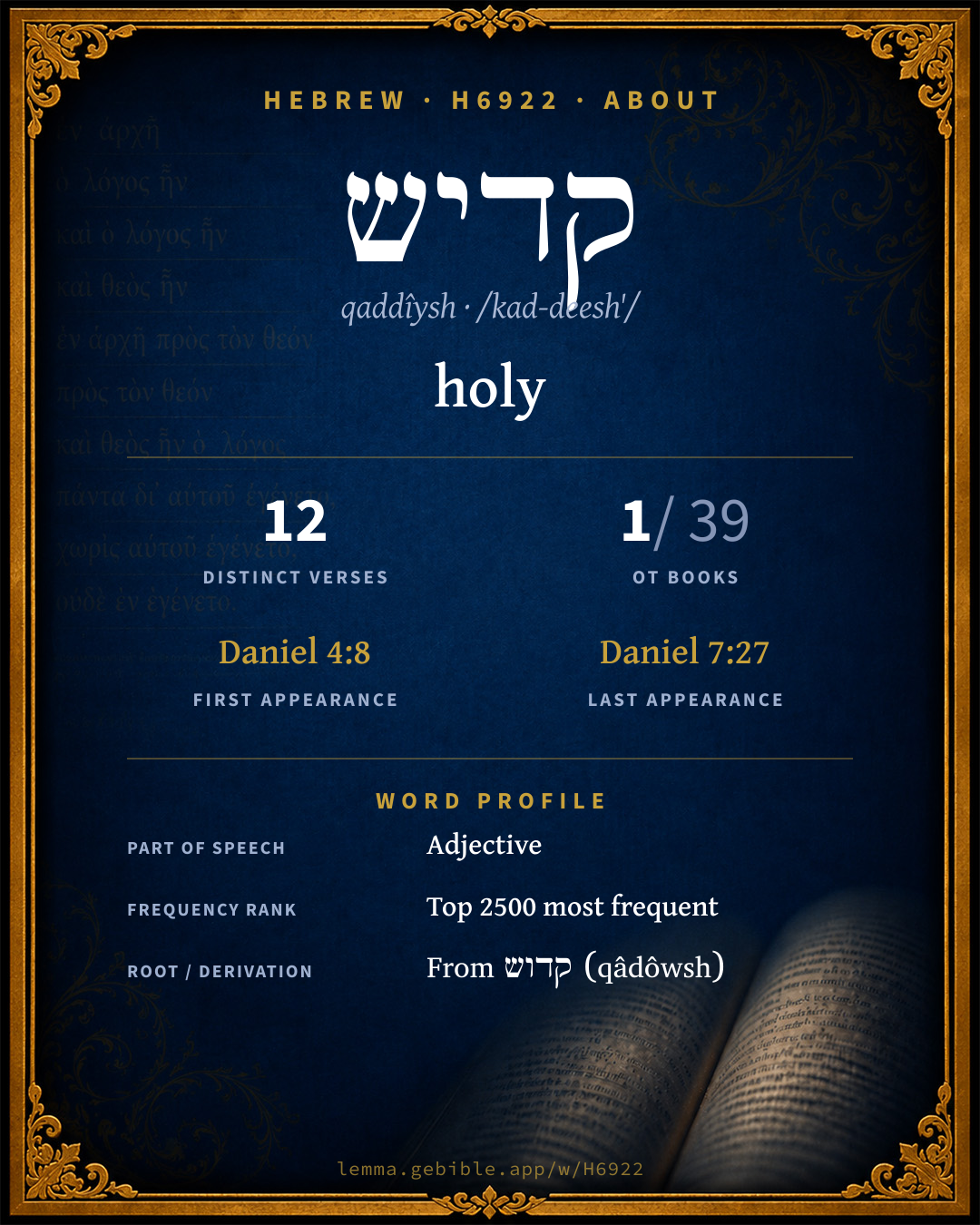
קַדִּישׁ
holy
‘holy’ is one of 2 main senses fuller range ↓
Full lexicon entry — Brown-Driver-Briggs (BDB)
From Brown-Driver-Briggs (BDB)
Where this word appears
See every Absolute-state word in the Hebrew Bible →
Grammar key — what these labels mean
Part of speech
- Adjective
- A word that describes or qualifies a noun.
State
- Absolute
- The independent form of a noun, not bound to a following word.
- Construct
- A noun bound to a following noun in a possessive / “of” relationship (the construct chain).
Gender
- Masculine
- Grammatically masculine.
Number
- Plural
- More than one (in Hebrew, generally three or more).
- Singular
- One.
9 distinct verses where H6922 appears in the Absolute state, across 1 book. Filtered view — show all forms. Click any verse to open its interlinear word-by-word view. Verse text shown in the World English Bible for context — . Each verse’s Hebrew form is shown with its reference; the English is not keyword-highlighted, since the data carries no word-level English alignment. Use “Compare translations” on any verse to read it across multiple English versions. This concordance covers the Hebrew Bible; Septuagint (Greek Old Testament) occurrences are not indexed here.
Daniel 9 verses
- Daniel 4:8 קַדִּישִׁ֖ין adj Adjective mp But at the last Daniel came in before me, whose name was Belteshazzar, according to the name of my god, and in whom is the spirit of the holy gods: and I told the dream before him, [saying],
- Daniel 4:9 קַדִּישִׁין֙ adj Adjective mp Belteshazzar, master of the magicians, because I know that the spirit of the holy gods is in you, and no secret troubles you, tell me the visions of my dream that I have seen, and the interpretation of it.
- Daniel 4:13 וְ/קַדִּ֔ישׁ conj + Adjective Adjective ms I saw in the visions of my head on my bed, and, behold, a watcher and a holy one came down from the sky.
- Daniel 4:17 קַדִּישִׁ֖ין adj Adjective mp The sentence is by the decree of the watchers, and the demand by the word of the holy ones; to the intent that the living may know that the Most High rules in the kingdom of men, and gives it to whoever he will, and sets up over it the lowest of men.
- Daniel 4:18 קַדִּישִׁ֖ין adj Adjective mp This dream I, king Nebuchadnezzar, have seen; and you, Belteshazzar, declare the interpretation, because all the wise men of my kingdom are not able to make known to me the interpretation; but you are able; for the spirit of the holy gods is in you.
- Daniel 4:23 וְ/קַדִּ֣ישׁ conj + Adjective Adjective ms Whereas the king saw a watcher and a holy one coming down from the sky, and saying, Hew down the tree, and destroy it; nevertheless leave the stump of the roots of it in the earth, even with a band of iron and brass, in the tender grass of the field, and let it be wet with the dew of the sky: and let his portion be with the animals of the field, until seven times pass over him;
- Daniel 5:11 קַדִּישִׁין֮ adj Adjective mp There is a man in your kingdom, in whom is the spirit of the holy gods; and in the days of your father light and understanding and wisdom, like the wisdom of the gods, were found in him; and the king Nebuchadnezzar your father, the king, [I say], your father, made him master of the magicians, enchanters, Chaldeans, and soothsayers;
- Daniel 7:21 קַדִּישִׁ֑ין adj Adjective mp I saw, and the same horn made war with the saints, and prevailed against them;
- Daniel 7:22 לְ/קַדִּישֵׁ֖י קַדִּישִֽׁין prep + Adjective Adjective mp cs adj Adjective mp until the ancient of days came, and judgment was given to the saints of the Most High, and the time came that the saints possessed the kingdom.
About this entry
At a glance — auto-summarized from this page’s data, not written by a person. Every figure links to its source below. This summary describes the numbers; it doesn’t interpret them.
קדיש (qaddîysh) is a Hebrew adjective most often rendered “holy.” Daniel dominates its distribution — 12 of 12 verses. Spanning 12 verses in 1 book, it ranks among the uncommon words of the Hebrew Bible. Scripture first uses it in Daniel 4:8. Ranging over 2 senses, it is not a single-sense word. For the data behind this summary, explore the sense tree and the renderings breakdown below.
Gloss history
Strong's 1890 vs modern scholarship
About this word
Strong's H6922 catalogs a Hebrew word from the Hebrew Old Testament.
These counts are not copied from any lexicon or concordance. They are computed here, from the morphology-tagged Hebrew Old Testament. What Lemma adds →
- 12
- distinct verses
- The word appears in 12 distinct verses.
- 1 / 39
- OT books
- The word appears in 1 of 39 Old Testament books.
- #2,001
- by frequency
- Top 2500 most frequent Hebrew words (rank 2,001 of 8,640 Hebrew words by occurrence).
View all 12 occurrences in the concordance →
Most concentrated in
- Daniel 12 verses 100%
By section of the Old Testament
By traditional corpus
Conventional, traditional groupings — biblical authorship is debated, so this is a traditional corpus grouping, not an authorship claim. Each share is this word’s portion of its verses in that division of the Hebrew canon. Each figure is a share of the word’s 12 distinct verses.
- Writings (Ketuvim) 12 verses · 100%
How translations render this word
Counts come from each version’s own published word-to-Strong’s tagging or interlinear alignment — an approximate guide to how each version renders this word, not a word-level alignment the data otherwise carries. Because each total is that version’s own tagged count, the per-version totals vary from one another and need not match the appearance or distinct-verse counts above. These counts may also differ from a printed concordance because Lemma counts each distinctly tagged rendering and does not collapse phrase taggings into a single head-word total. This is a fixed set of word-tagged versions (KJV, ASV, BSB, ULT) and does not change with the reading translation you choose elsewhere. Each version’s license is shown beside its name below (and on Sources).
- King James Version: Saints 6×, Holy 4×, Holy one 2×
- American Standard Version: Saints 6×, Holy 4×, Holy one 2×
- Berean Standard Bible: Holy 4×, Saints 4×, Holy one 2×
- unfoldingWord Literal Text: Holy 4×, Saints of 4×, Holy one 2×
King James Version Public Domain
Renders H6922 across 13 tagged occurrences — most commonly:
Plus 1 rendering that appears only once — usually multi-word phrases or single function words the recovered tagging swept in, not distinct renderings.
American Standard Version Public Domain
Renders H6922 across 13 tagged occurrences — most commonly:
Plus 1 rendering that appears only once — usually multi-word phrases or single function words the recovered tagging swept in, not distinct renderings.
Berean Standard Bible Public Domain
Renders H6922 across 13 tagged occurrences — most commonly:
Plus 3 renderings that appear only once — usually multi-word phrases or single function words the recovered tagging swept in, not distinct renderings.
unfoldingWord Literal Text CC BY-SA 4.0
Renders H6922 across 14 tagged occurrences — most commonly:
Plus 2 renderings that appear only once — usually multi-word phrases or single function words the recovered tagging swept in, not distinct renderings.
Senses in BDB
The 2 senses BDB distinguishes for this word, in lexicon order (not ranked by frequency or importance). The full entry — with sub-senses — is in the Lexicon Entry tab.
- holy, separate
- (TWOT) angels, saints
Word origin
Derived from קדוש (qâdôwsh) (H6918) — holy.
Jastrow Dictionary
A second Hebrew/Aramaic lexicon for comparison, covering Aramaic and post-biblical (Talmudic, Targumic, Midrashic) usage that the biblical-Hebrew BDB does not. Matched by lemma rather than by Strong’s number, so a lemma may carry more than one Jastrow headword (shown separately below), and the entries cover usage well beyond the Bible.
קַדִּישׁ
- 1. = h. קָדוֹשׁ, holy, sacred, pure. Targ. Num. XVI, 5 (some ed. O. קַדֵּישׁ, קַדֵּשׁ). Targ. Is. I, 4. Ib. LVII, 15; a. fr.—[Targ. Y. Num. XI, 7, read: קַרִישׁ.]—Midr. Till. to Ps. CXVIII, 8, v. עִיר I. Meg. 27ᵇ מעיר … מעיקרא ק׳ השתא נמי ק׳ if you sell a sacred object to be taken from a large town to a small place, it was sacred (used for public services) before, and is so now. Ber. 9ᵇ העיד … משום קהלא ק׳ וכ׳ R. J. … declared in behalf of the holy congregation of Jerusalem; a. fr.—Snh. 109ᵇ v. infra.—Pl. קַדִּישִׁין, קַדִּישַׁיָּא, קַדִּישֵׁי; קַדִּישָּׁתָא. Targ. Num. XVI, 3; a. fr.—Snh. l. c. ירענא דכולהו כנישתא קדישי נינהו Ms. M. (ed. קדישתא, v. Rabb. D. S. a. l. note) I know that the whole congregation are holy. Pes. 113ᵇ בחייהן דרבנן ק׳ וכ׳ Ms. M. by the life of the holy (revered) Rabbis in the land of Israel (v. קְדוּשָּׁה end); a. e.—[
- 2. קַדִּישׁ, קַדִּישָׁא Ḳaddish, the doxology beginning with יתגדל ויתקדש וכ׳ magnified and sanctified be his great name. Treat. Sof’rim X, 7; a. e.]
קְדַשׁ
- , to be sanctified, sacred (v. קְדוֹשׁ). Shebu. 15ᵇ שתי הלחם … דקַדְשֵׁי (Rashi דמִיקַּדְּשֵׁי Ithpa.) it is through the slaughtering of the sheep that the two loaves received their sacred character. Bekh. 4ᵇ דקְדוּשׁ קדוש וכ׳ those firstborn that were consecrated, were consecrated &c.
- as preced. Pi., to sanctify; to proclaim; to betroth &c. Targ. Ex. XXVIII, 41. Ib. XXIX, 1 לקַדָּשָׁא (Y. לקַדְשָׁא). Ib. 44; a. fr.—Targ. Y. Deut. XX, 7 (not דקָדֵישׁ; h. text ארש). Ib. XXII, 16 (h. text נתתי); a. e.—Shebu. 16ᵃ ועזרא קַדּוּשֵׁי ק׳ וכ׳ and Ezra consecrated (the various places), although the Urim and Tummim were no longer extant. Pes. 106ᵃ עיקר קידושא … דכי ק׳ תחלת יומא בעי לקַדּוּשֵׁי the actual sanctification of the Sabbath must take place in the evening, for when one sanctifies the Sabbath, one must sanctify the beginning of the day. Ib. ליקַדֵּישׁ לן וכ׳ please, sir, recite for us the great Ḳiddush, v. קִידּוּשָׁא. Ib. 101ᵃ לקדושי בביתא to recite the Ḳiddush in the house. Ib. 106ᵇ זימנין … מקדש אריפתא at times, when he cared more for bread, he recited the Ḳiddush over bread.—R. Hash. 25ᵃ זיל … וקַדְּשֵׁיה וכ׳ go to ‘En-Ṭab and proclaim the New Moon Day. Ib. אמר … בעינן לקדושי בך וכ׳ he said (to the moon), to-night we desire to initiate the new month through thee, and thou standest here? Ib.ᵇ ולִיקַדְּשֵׁיה בליליא Ms. M. and we may proclaim it at night. Shebu. 15ᵇ דעד דקַדֵּישׁ יומא וכ׳ so that immediately after one has recited the blessing at the exit of the day (הַבְדָּלָה), one might finish the building and consecrate it.—Kidd. 50ᵇ באתרא דמְקַדְּשֵׁי והדר מסבלי where it is customary to send the gifts after betrothal, v. סְבַל. Ib. 59ᵃ לקדושי … לבריה to betroth a wife for his son (as his deputy); a. v. fr.—Part. pass. מְקַדַּשׁ; f. מְקַדְּשָׁא, &c. Shebu. l. c. תרוייהו … מְקַדְּשֵׁי both of them are consecrated at the same time. Ib. חדא מי מק׳ how can even one of them be consecrated?—Pes. 101ᵃ ולא מק׳ לכו בבית אכילה (Ms. M. 2 מתקדש) and no Ḳiddush will be recited for you in your dining place; a. fr.
- ; Ithpe. אִיקְּדִישׁ to sanctify one’s self; to be sanctified; (of mixed seeds) to be condemnable; (of woman) to be betrothed. Targ. Ex. XXIX, 37. Targ. Lev. XX, 7. Targ. O. ib. X, 3; a. fr.—Kidd. 54ᵃ ירושלים מי מִיקַּדְּשָׁא is Jerusalem itself consecrated ground? Ned. 31ᵃ כיון דאיק׳ אברהם וכ׳ when Abraham was consecrated (as the bearer of religion), they (the Israelites) were called after him (they are no longer included among ‘the sons of Noah’).—Keth. 62ᵇ אי מִיקַּדַּשְׁנָא (some ed. מְקַדַּשְׁנָא) if I consent to be betrothed unto thee, wilt thou go to college? Ib. אִיקַּדְּשָׁא ליה וכ׳ she was betrothed to him in secret, and she sent him (Akiba) away (to study). Kidd. 9ᵃ אי … מִיקַּדְּשַׁת לי if I give it thee, wilt thou be betrothed to me? Ib. 12ᵃ אשה … לא מִיקַּדְּשָׁא a woman cannot be betrothed with a P’ruṭah; a. fr.—Pes. 105ᵃ זיל חזי אי מִקְּדִישׁ יומא (Ms. M. קדיש) go and see whether the sacred day has begun.
- 1. to sanctify, dedicate. Targ. Lev. XXVII, 14 (Y. ed. Vien. יִקְדַּשׁ). Ib. 15. Targ. Jud. XVII, 3; a. fr.
- 2. to betroth. Kidd. 9ᵇ עד דמַקְדִּישׁ והדר בעיל (Rashi דמקדש) until he betroth her and consummates. Ib. 12ᵃ ההוא גברא דא׳ וכ׳ a man betrothed a woman with a piece of &c., v. כּוֹחֲלָא. Ib. 12ᵇ; a. fr. (interch. with Pa.).
A Dictionary of the Targumim, the Talmud Babli and Yerushalmi, and the Midrashic Literature (Marcus Jastrow; London, Luzac, 1903) — Public Domain. Digitized via Sefaria. Digitized via Sefaria. Full attribution on Sources.
Forms in the corpus
The 11 distinct written forms H6922 takes in the Hebrew Bible, most frequent first — each parse links to that state’s occurrences in the concordance. Hebrew forms include their vowel points and cantillation, so a single lemma takes many written forms.
| Form | Parsing | Example | Uses |
|---|---|---|---|
| קַדִּישִׁ֖ין | Adjective, Adjective, Masculine, Plural, Absolute | Daniel 4:8 | 3 |
| וְ/קַדִּ֔ישׁ | Adjective, Adjective, Masculine, Singular, Absolute | Daniel 4:13 | 1 |
| וְ/קַדִּ֣ישׁ | Adjective, Adjective, Masculine, Singular, Absolute | Daniel 4:23 | 1 |
| וּ/לְ/קַדִּישֵׁ֥י | Adjective, Adjective, Masculine, Plural, Construct | Daniel 7:25 | 1 |
| לְ/קַדִּישֵׁ֖י | Adjective, Adjective, Masculine, Plural, Construct | Daniel 7:22 | 1 |
| קַדִּישִׁ֑ין | Adjective, Adjective, Masculine, Plural, Absolute | Daniel 7:21 | 1 |
| קַדִּישִֽׁין | Adjective, Adjective, Masculine, Plural, Absolute | Daniel 7:22 | 1 |
| קַדִּישִׁין֙ | Adjective, Adjective, Masculine, Plural, Absolute | Daniel 4:9 | 1 |
| קַדִּישִׁין֮ | Adjective, Adjective, Masculine, Plural, Absolute | Daniel 5:11 | 1 |
| קַדִּישֵׁ֖י | Adjective, Adjective, Masculine, Plural, Construct | Daniel 7:18 | 1 |
| קַדִּישֵׁ֣י | Adjective, Adjective, Masculine, Plural, Construct | Daniel 7:27 | 1 |
Septuagint verse parallels
This word appears in 12 verses that also exist in the Greek Old Testament (Septuagint), out of the 12 Hebrew verses it occurs in. You can read those verses in Greek by switching the Old Testament edition to the Septuagint.
Read these verses in the Septuagint
This is a verse-level parallel only — the same verses exist in both the Hebrew and Greek Old Testaments. No word-level Hebrew↔Greek correspondence is claimed: the data carries no such alignment, so no Greek word is shown as this Hebrew word’s translation. Coverage is not total — the Septuagint omits the deuterocanon and renumbers the Psalms, so some Hebrew verses have no direct Greek parallel.