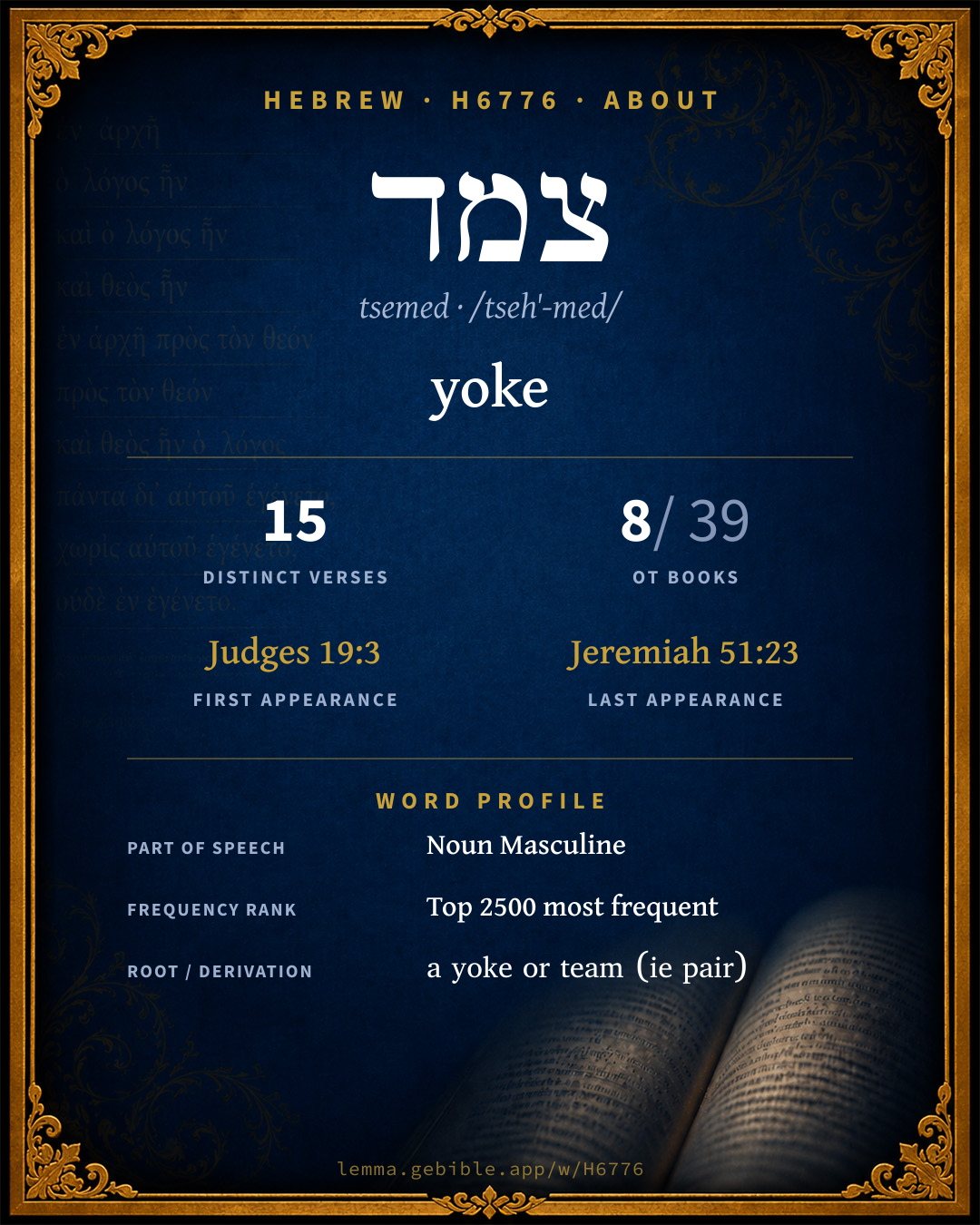
צֶ֫מֶד
yoke
also: couple, pair, team fuller range ↓
Full lexicon entry — Brown-Driver-Briggs (BDB)
From Brown-Driver-Briggs (BDB)
Where this word appears
See every Absolute-state word in the Hebrew Bible →
Grammar key — what these labels mean
Part of speech
- Noun
- A naming word — a person, place, thing, or idea.
Noun type
- Common
- A common noun — a general class of person, place, or thing (“king,” “city,” “water”), not a specific name.
State
- Construct
- A noun bound to a following noun in a possessive / “of” relationship (the construct chain).
- Absolute
- The independent form of a noun, not bound to a following word.
Gender
- Masculine
- Grammatically masculine.
Number
- Singular
- One.
- Plural
- More than one (in Hebrew, generally three or more).
1 verse where H6776 appears in the Construct state in the Book of 2 Kings. Filtered view — show all forms. Click any verse to open its interlinear word-by-word view. Verse text shown in the World English Bible for context — . Each verse’s Hebrew form is shown with its reference; the English is not keyword-highlighted, since the data carries no word-level English alignment. Use “Compare translations” on any verse to read it across multiple English versions. This concordance covers the Hebrew Bible; Septuagint (Greek Old Testament) occurrences are not indexed here.
2 Kings
About this entry
At a glance — auto-summarized from this page’s data, not written by a person. Every figure links to its source below. This summary describes the numbers; it doesn’t interpret them.
At its core, צמד (tsemed) means “yoke.” Its English rendering has broadened — “yoke” classically, “pair of” (unfoldingWord Literal Text) in modern versions; see the renderings breakdown. Spanning 15 verses in 8 books, it ranks among the uncommon words of the Hebrew Bible. It first appears in Judges 19:3. Beyond its headline sense, its full sense range takes in “couple”, “pair”, and “team”. Each statement above links to its evidence; the full detail follows below.
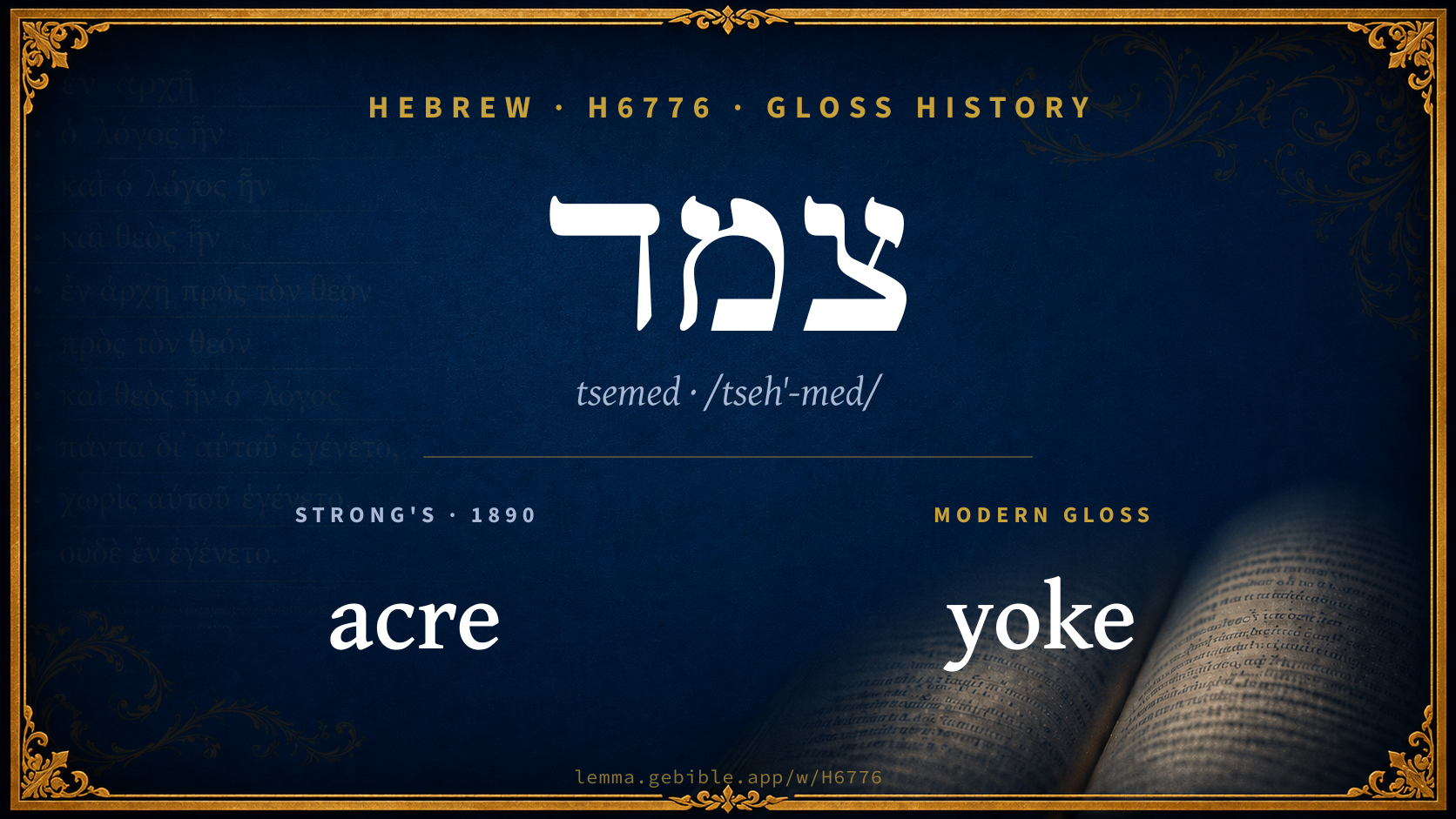
Gloss history
Strong's 1890 vs modern scholarship
About this word
Strong's H6776 catalogs a Hebrew word from the Hebrew Old Testament.
These counts are not copied from any lexicon or concordance. They are computed here, from the morphology-tagged Hebrew Old Testament. What Lemma adds →
- 15
- distinct verses
- The word appears in 15 distinct verses.
- 8 / 39
- OT books
- The word appears in 8 of 39 Old Testament books.
- #1,836
- by frequency
- Top 2500 most frequent Hebrew words (rank 1,836 of 8,640 Hebrew words by occurrence).
View all 15 occurrences in the concordance →
By section of the Old Testament
By traditional corpus
Conventional, traditional groupings — biblical authorship is debated, so this is a traditional corpus grouping, not an authorship claim. Each share is this word’s portion of its verses in that division of the Hebrew canon. Each figure is a share of the word’s 15 distinct verses.
- Prophets (Nevi'im) 13 verses · 87%
- Writings (Ketuvim) 2 verses · 13%
How translations render this word
Counts come from each version’s own published word-to-Strong’s tagging or interlinear alignment — an approximate guide to how each version renders this word, not a word-level alignment the data otherwise carries. Because each total is that version’s own tagged count, the per-version totals vary from one another and need not match the appearance or distinct-verse counts above. These counts may also differ from a printed concordance because Lemma counts each distinctly tagged rendering and does not collapse phrase taggings into a single head-word total. This is a fixed set of word-tagged versions (KJV, ASV, BSB, ULT) and does not change with the reading translation you choose elsewhere. Each version’s license is shown beside its name below (and on Sources).
- King James Version: Yoke 6×, Couple 4×
- American Standard Version: Yoke 5×, Him 2×, Pairs 2×
- Berean Standard Bible: Pair 4×, Teams 2×, Yoke 2×
- unfoldingWord Literal Text: Pair of 7×, Pairs 2×, Yoke of 2×
King James Version Public Domain
Renders H6776 across 15 tagged occurrences — most commonly:
Plus 5 renderings that appear only once — usually multi-word phrases or single function words the recovered tagging swept in, not distinct renderings.
American Standard Version Public Domain
Renders H6776 across 15 tagged occurrences — most commonly:
Plus 6 renderings that appear only once — usually multi-word phrases or single function words the recovered tagging swept in, not distinct renderings.
Berean Standard Bible Public Domain
Renders H6776 across 14 tagged occurrences — most commonly:
Plus 6 renderings that appear only once — usually multi-word phrases or single function words the recovered tagging swept in, not distinct renderings. Not rendered by a distinct English word in 1 further occurrence.
unfoldingWord Literal Text CC BY-SA 4.0
Renders H6776 across 14 tagged occurrences — most commonly:
Plus 3 renderings that appear only once — usually multi-word phrases or single function words the recovered tagging swept in, not distinct renderings.
Senses in the full BDB
What do BDB’s symbols mean?
BDB uses these scholarly abbreviations:
| Symbol | Meaning |
|---|---|
| 𝔊 | the Septuagint (the ancient Greek translation, LXX) |
| 𝔙 | the Vulgate (the Latin translation) |
| 𝔖 | the Syriac version (the Peshitta) |
| 𝔗 | the Targum (the Aramaic translation) |
| ψ | the Psalms |
| √ | root (the underlying root or stem) |
| ‖ | parallel passage (a synonymous or contrasted parallel) |
| † | the dagger: every passage where the word occurs is cited |
The 2 senses and sub-senses the full Brown-Driver-Briggs lexicon distinguishes for this word, in lexicon order (not ranked by frequency), with BDB’s own verbatim wording and sub-sense lettering. Shown in Hebrew script with BDB’s own scholarly abbreviations. The condensed entry is in the Lexicon Entry tab. See also the Forms in the corpus table below.
- 1. couple, pair, usually of animals, צ׳ חֲמֹרִים Ju 19:3, 10; 2 S 16:1; צ׳ (הַ)בָּקָר span of oxen 1 S 11:7; 1 K 19:21, pl. of more than one span v 19 (ploughing), Jb 1:3; 42:12; צֶמֶד פְּרָדִים 2 K 5:17; צ׳ פָּרָשִׁים Is 21:7, 9 a pair of horsemen; pl. also of one pair of riders 2 K 9:25 (but read prob. צֶמֶד, so Kit); צ׳ alone = span (of oxen) Je 51:23. e.g. Judges 19:3
- 2. a measure of land (only square measure in OT) like acre; orig. appar. what a span can plough (in a day; v. NowArch. i. 202 BenzArch. 208; cf. mod. faddân, = what can be ploughed in a season SchumacherZPV xii (1889), 163 f., Across Jordan 22, or in a day BergheimPEQ, 1894, 192, Ency. Bib.ACRE), צ׳ שָׂדֶה 1 S 14:14 (on text v. Dr HPS); צִמְדֵּי־כֶרֶם Is 5:10. e.g. 1 Samuel 14:14
Senses from the full Brown-Driver-Briggs lexicon (Brown, Driver, Briggs; Oxford 1906 — public domain), digitized via Sefaria, supplemented by the OpenScriptures HebrewLexicon (CC BY 4.0). Full attribution on Sources.
Word origin
n.m. 1 K 19:19 couple, pair;—צ׳ cstr. Ju 19:3 +; sf. צִמְדּוֹ Je 51:23; pl. צְמָדִים 1 K 19:19; 2 K 9:25 (but v. infr.); cstr. צִמְדֵּי Is 5:10 (Ges§ 93 m);—
— Brown-Driver-Briggs (Oxford 1906, public domain), digitized via Sefaria, supplemented by the OpenScriptures HebrewLexicon (CC BY 4.0). See Sources.
Origin: a yoke or team (ie pair)
Jastrow Dictionary
A second Hebrew/Aramaic lexicon for comparison, covering Aramaic and post-biblical (Talmudic, Targumic, Midrashic) usage that the biblical-Hebrew BDB does not. Matched by lemma rather than by Strong’s number, so a lemma may carry more than one Jastrow headword (shown separately below), and the entries cover usage well beyond the Bible.
צָמַד
- (b. h.) to press together; to join, couple. Gen. R. s. 5 צְמָדָן בין שני בדי הארון ‘Rashi’ (v. comment. Y’fath Toar a. l.) he matched them (arranged them according to ranks) between the two bars of the Ark (ed., a. Yalk. Josh. 14 סמכן; Lev. R. s. 10 שמן).—Part. pass. צָמוּד; f. צְמוּדָה &c. Num. R. s. 12 אין צב אלא צְמוּדוֹת tsab (Num. VII, 3) means well-joined (wagons, by ref. to Is. XLIX, 22 בחצן, v. חוּץ I; v. Targ. a. l.). e.g. Numbers 7:3
- to be attached, yoked. Tanḥ. Bal. 18 [read:] ונִצְמְדוּ זה לזו וכ׳ and they were joined to one another; thus it is written (Num. XXV, 3), and Israel was joined &c.; ed. Bub. 28 ונִצְמָדִים זה וכ׳. e.g. Numbers 25:3
- to crowd, pack.—Part. pass. מְצוּמָּד; pl. מְצוּמָּדִים. Cant. R. to IV, 1 (play on צמתך, ib.) [read:] נראין מצ׳ … כהדין סדרא רבה וכ׳ they appear to be crowded, and yet are comfortable, as at the great school-hall of Sepphoris (cmp. Ab. V, 5).
צְמַד
- 1. to join, attach, harness. Part. pass. צָמִיד; f. צְמִידָא; pl. צְמִידִין, a) attached, harnessed. Targ. I Kings XIX, 19.—b) attached to, addicted to, in the habit of. Lam. R. to III, 9 הוה צמיד עיית קינדלוי וכ׳ Ar. (ed. הוה מסדרא וכ׳; Y. Maas. Sh. V, 56ᵃ top הוה עביד) made it a habit to prepare his lights on Friday &c. (v. עוּת ch.). Lev. R. s. 26 הות צמידא אמרה נכ׳ (some ed. צְמִידָה) was addicted to evil talk.
- 2. to bind up (a broken limb). (a broken limb). Targ. Ez. XXXIV, 4; 16.
- 3. to narrow in, retain. B. Bath. 53ᵃ דצ׳ לה מיא (ed. Pes. a. oth. דצאמת, v. צְמַת) he retained (dammed) the water for the benefit of the field, opp. ארוח let the water spread.
- same,
- 1. to bind up, heal, mend. Part. pass. מְצַמַּד. Ab. Zar. 55ᵃ דאזלי כי מתברי … מְצַמְּדֵי who go (to an idolatrous temple) broken (crippled), and come out healed; Yalk. Ex. 289 מצמידי (corr. acc., or מִיצַמְּדֵי Ithpe.).
- to be bound up, repaired. Ber. 22ᵇ א׳ חצביה דר"נ R. N.’s pitcher has been mended (the rule he laid down is restored again), opp. אתבר, v. חַצְבָּא.
צֶמֶד
- preced.) yoke; a pair of working animals tied to the yoke. B. Bath. V, 1 מבר … את הצ׳ הבקר if one sold ‘a yoke’, he has not sold the oxen (but only the yoke); ib. אמר מכור לי צִמְדְּךָ וכ׳ (Bab. ed. 77ᵇ צִימְ׳) if he said, sell me thy yoke for two hundred Zuz, it is well known that a yoke is not worth two hundred Zuz (therefore he meant the yoke of oxen); v. צִימְדָּא; Tosef. ib. IV, 1. B. Mets. 116ᵃ צ׳ של פרות a pair of cows with the yoke, Rashi (Tosaf. a yoke for cows, consisting of two pieces).—Kidd. 74ᵇ מצִמְדָּהּ Var. in Ar. s. v. צד, v. תַּבְרָא.
A Dictionary of the Targumim, the Talmud Babli and Yerushalmi, and the Midrashic Literature (Marcus Jastrow; London, Luzac, 1903) — Public Domain. Digitized via Sefaria. Digitized via Sefaria. Full attribution on Sources.
Forms in the corpus
The 12 distinct written forms H6776 takes in the Hebrew Bible, most frequent first — each parse links to that state’s occurrences in the concordance. Hebrew forms include their vowel points and cantillation, so a single lemma takes many written forms.
| Form | Parsing | Example | Uses |
|---|---|---|---|
| צְמָדִים֙ | Noun, Common, Masculine, Plural, Absolute | 1 Kings 19:19 | 2 |
| צֶ֥מֶד | Noun, Common, Masculine, Singular, Construct | 1 Samuel 14:14 | 2 |
| צֶֽמֶד | Noun, Common, Masculine, Singular, Construct | 2 Kings 5:17 | 2 |
| וְ/צִמְדּ֑/וֹ | Noun, Common, Masculine, Singular, Construct | Jeremiah 51:23 | 1 |
| וְ/צֶ֣מֶד | Noun, Common, Masculine, Singular, Construct | Judges 19:3 | 1 |
| וְ/צֶ֨מֶד | Noun, Common, Masculine, Singular, Construct | 2 Samuel 16:1 | 1 |
| צִמְדֵּי | Noun, Common, Masculine, Plural, Construct | Isaiah 5:10 | 1 |
| צֶ֖מֶד | Noun, Common, Masculine, Singular, Construct | Isaiah 21:9 | 1 |
| צֶ֚מֶד | Noun, Common, Masculine, Singular, Construct | Isaiah 21:7 | 1 |
| צֶ֤מֶד | Noun, Common, Masculine, Singular, Construct | Judges 19:10 | 1 |
| צֶ֧מֶד | Noun, Common, Masculine, Singular, Construct | 1 Kings 19:21 | 1 |
| צֶ֨מֶד | Noun, Common, Masculine, Singular, Construct | 1 Samuel 11:7 | 1 |
Septuagint verse parallels
This word appears in 15 verses that also exist in the Greek Old Testament (Septuagint), out of the 15 Hebrew verses it occurs in. You can read those verses in Greek by switching the Old Testament edition to the Septuagint.
Read these verses in the Septuagint
- Judges 19:3
- 1 Samuel 11:7
- 2 Samuel 16:1
- 1 Kings 19:19
- 2 Kings 5:17
- Job 1:3
- Isaiah 5:10
- Jeremiah 51:23
This is a verse-level parallel only — the same verses exist in both the Hebrew and Greek Old Testaments. No word-level Hebrew↔Greek correspondence is claimed: the data carries no such alignment, so no Greek word is shown as this Hebrew word’s translation. Coverage is not total — the Septuagint omits the deuterocanon and renumbers the Psalms, so some Hebrew verses have no direct Greek parallel.