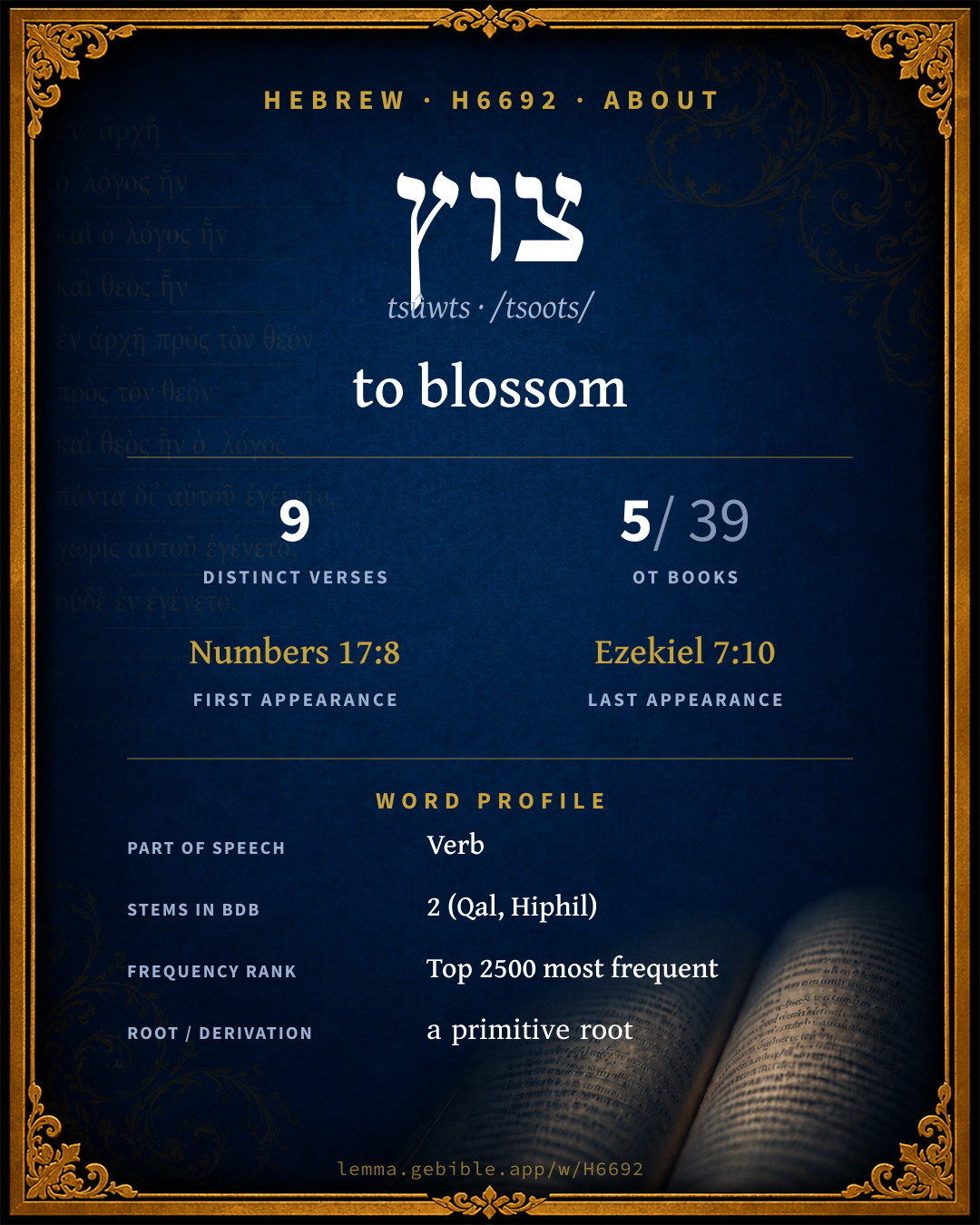
צוּץ
to blossom
also: shine, sparkle fuller range ↓
Full lexicon entry — Brown-Driver-Briggs (BDB)
From Brown-Driver-Briggs (BDB)
Where this word appears
Grammar key — what these labels mean
Part of speech
- Verb
- An action or state-of-being word.
Stem
- Hiphil
- The causative active stem (“he caused / brought about”).
- Qal
- The basic, simple active stem — the plain form of the verb (“he wrote”). Here: ‘shine’
Form
- Imperfect
- An incomplete, ongoing, or future action (“he will / would write”).
- Sequential Imperfect
- An imperfect with prefixed waw — the standard past-narrative form (waw-consecutive imperfect).
- Participle Active
- A verbal adjective expressing ongoing or characteristic action (“writing / one who writes”).
- Perfect
- A completed action or state — Hebrew marks aspect (completeness) more than strict tense (“he wrote”).
State
- Absolute
- The independent form of a noun, not bound to a following word.
Person
- 3rd Person
- The one spoken about (“he / she / it / they”).
Gender
- Masculine
- Grammatically masculine.
Number
- Singular
- One.
- Plural
- More than one (in Hebrew, generally three or more).
Every verse where H6692 appears in the Book of Numbers — 1 distinct verse. Click any verse to open its interlinear word-by-word view. Verse text shown in the World English Bible for context — . Each verse’s Hebrew form is shown with its reference; the English is not keyword-highlighted, since the data carries no word-level English alignment. Use “Compare translations” on any verse to read it across multiple English versions. This concordance covers the Hebrew Bible; Septuagint (Greek Old Testament) occurrences are not indexed here.
Numbers
About this entry
At a glance — auto-summarized from this page’s data, not written by a person. Every figure links to its source below. This summary describes the numbers; it doesn’t interpret them.
צוץ (tsûwts) is a Hebrew verb most often rendered “to blossom.” It clusters heavily in Psalms, which alone accounts for 56% of its uses. It turns up in 9 verses across 5 books, an uncommon footprint. It first appears in Numbers 17:8. Different stems carry different senses — BDB groups them under 2 stems, among them Qal and Hiphil. For the data behind this summary, explore the sense tree and the renderings breakdown below.
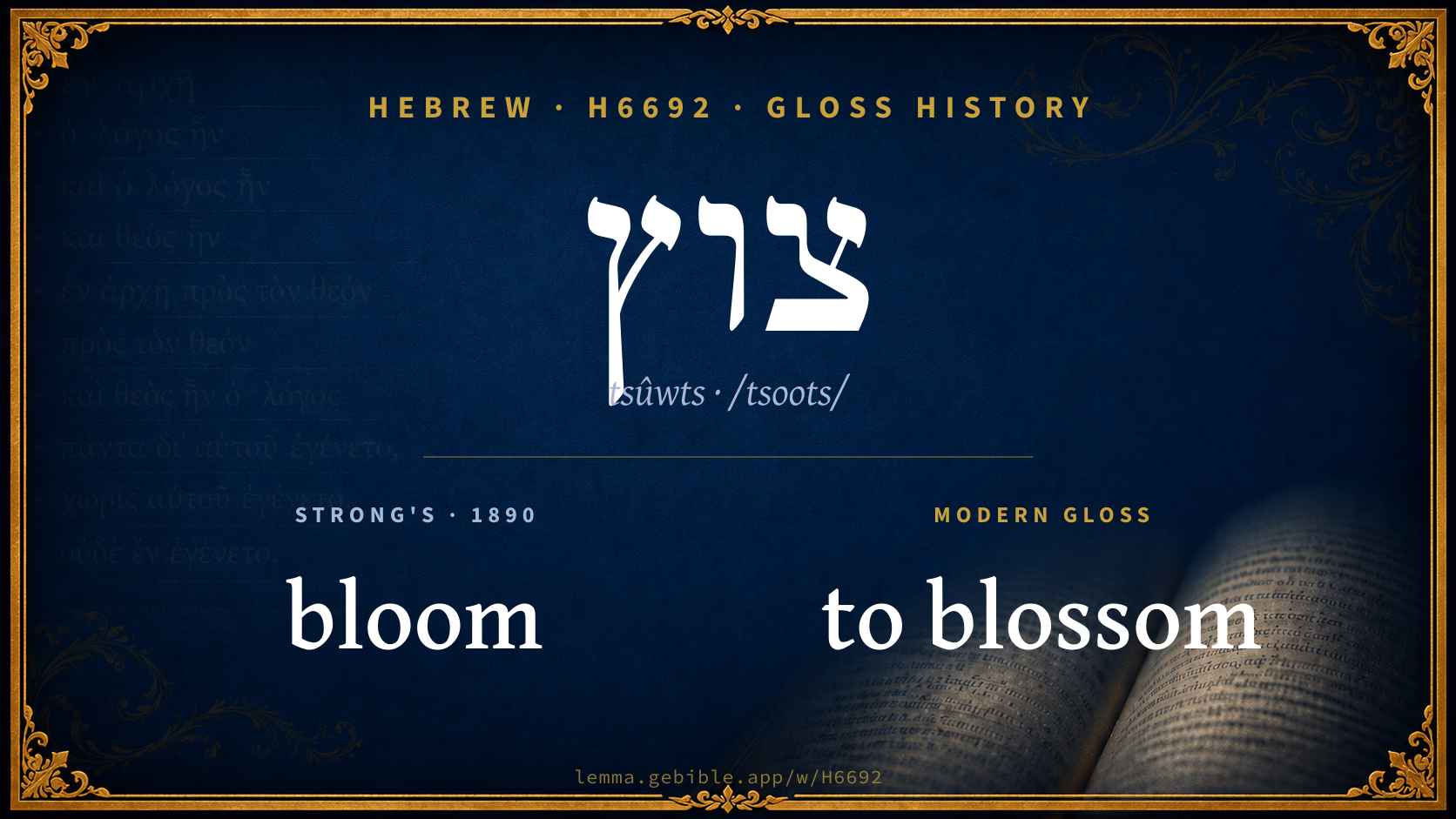
Gloss history
Strong's 1890 vs modern scholarship
About this word
Strong's H6692 catalogs a Hebrew word from the Hebrew Old Testament.
These counts are not copied from any lexicon or concordance. They are computed here, from the morphology-tagged Hebrew Old Testament. What Lemma adds →
- 9
- distinct verses
- The word appears in 9 distinct verses.
- 5 / 39
- OT books
- The word appears in 5 of 39 Old Testament books.
- #2,481
- by frequency
- Top 2500 most frequent Hebrew words (rank 2,481 of 8,640 Hebrew words by occurrence).
View all 9 occurrences in the concordance →
Most concentrated in
- Psalms 5 verses 56%
- Numbers 1 verse 11%
- Song of Solomon 1 verse 11%
By section of the Old Testament
By traditional corpus
Conventional, traditional groupings — biblical authorship is debated, so this is a traditional corpus grouping, not an authorship claim. Each share is this word’s portion of its verses in that division of the Hebrew canon. Each figure is a share of the word’s 9 distinct verses.
- Writings (Ketuvim) 6 verses · 67%
- Prophets (Nevi'im) 2 verses · 22%
- Torah (Pentateuch) 1 verse · 11%
How translations render this word
Counts come from each version’s own published word-to-Strong’s tagging or interlinear alignment — an approximate guide to how each version renders this word, not a word-level alignment the data otherwise carries. Because each total is that version’s own tagged count, the per-version totals vary from one another and need not match the appearance or distinct-verse counts above. These counts may also differ from a printed concordance because Lemma counts each distinctly tagged rendering and does not collapse phrase taggings into a single head-word total. This is a fixed set of word-tagged versions (KJV, ASV, BSB, ULT) and does not change with the reading translation you choose elsewhere. Each version’s license is shown beside its name below (and on Sources).
- King James Version: Bloomed 1×, Do flourish 1×, Flourish 1×
- American Standard Version: Do flourish 1×, Flourish 1×, Flourisheth 1×
- Berean Standard Bible: Flourish 2×
- unfoldingWord Literal Text: And 1×, Blossomed 1×, Flourish 1×
King James Version Public Domain
Renders H6692 across 9 tagged occurrences — most commonly:
American Standard Version Public Domain
Renders H6692 across 9 tagged occurrences — most commonly:
Berean Standard Bible Public Domain
Renders H6692 across 9 tagged occurrences — most commonly:
Plus 7 renderings that appear only once — usually multi-word phrases or single function words the recovered tagging swept in, not distinct renderings.
unfoldingWord Literal Text CC BY-SA 4.0
Renders H6692 across 11 tagged occurrences — most commonly:
Senses in the full BDB
Hebrew verbs can shift meaning by stem (binyan): Qal is the basic action, Niphal is often passive or reflexive, Piel often intensifies or makes it factitive, and Hiphil is typically causative. The senses below are grouped under the stem BDB assigns to each.
What do BDB’s symbols mean?
BDB uses these scholarly abbreviations:
| Symbol | Meaning |
|---|---|
| 𝔊 | the Septuagint (the ancient Greek translation, LXX) |
| 𝔙 | the Vulgate (the Latin translation) |
| 𝔖 | the Syriac version (the Peshitta) |
| 𝔗 | the Targum (the Aramaic translation) |
| ψ | the Psalms |
| √ | root (the underlying root or stem) |
| ‖ | parallel passage (a synonymous or contrasted parallel) |
| † | the dagger: every passage where the word occurs is cited |
The 6 senses and sub-senses the full Brown-Driver-Briggs lexicon distinguishes for this word, in lexicon order (not ranked by frequency), with BDB’s own verbatim wording and sub-sense lettering. Shown in Hebrew script with BDB’s own scholarly abbreviations. The condensed entry is in the Lexicon Entry tab. See also the Forms in the corpus table below.
- 1. blossom.
- 2. shine, sparkle (perhaps orig. meaning of √, but connex. of 1, 2. dub.) (NH id. Hiph., fig. senses, צִיץ n. = BH);—
Qal
- Pf.
- 1. 3 ms. צָץ הַמַּטֶּה Ez 7:10 (fig.; ‖ פָּרַח הַזָּדוֹן); Impf. 3 ms. יָצִיץ ψ 90:6 (of grass, חָצִיר), 103:15 (man under fig. of flower), fig. יָצִיץ וּפָרַח יִשׂ׳ Is 27:6; 3 mpl. יָצִיצוּ ψ 72:16, וַיָּצִיצוּ 92:8 (‖ פָּרַח; both fig. of men =) flourish. e.g. Ezekiel 7:10
- 2. shine, gleam: of crown (נֵזֶר) ψ 132:18. e.g. Psalms 132:18
Hiphil
- Impf. 3 ms. וַיָּצֵץ צִיץ Nu 17:23 it put forth blossoms (of rod;—ֵ perhaps from ‖ וַיֹּצֵא פֶרַח). e.g. Numbers 17:23
Senses from the full Brown-Driver-Briggs lexicon (Brown, Driver, Briggs; Oxford 1906 — public domain), digitized via Sefaria, supplemented by the OpenScriptures HebrewLexicon (CC BY 4.0). Full attribution on Sources.
Word origin
Origin: a primitive root
Jastrow Dictionary
A second Hebrew/Aramaic lexicon for comparison, covering Aramaic and post-biblical (Talmudic, Targumic, Midrashic) usage that the biblical-Hebrew BDB does not. Matched by lemma rather than by Strong’s number, so a lemma may carry more than one Jastrow headword (shown separately below), and the entries cover usage well beyond the Bible.
צָוַץ
- (apocop. of צוצו = צפצף); Pi. צִיוֵּץ, צִיוֵּוץ, Pilp. צִוְצֵי to chirp. Koh. R. to I, 1 צפור מְצַוֵּיץ ויורע על מה מצויץ when a bird chirped, he (Solomon) knew what it chirped for; Cant. R. to I, 1 מְצַוְצֵי (Yalk. Kings 175 מצפצף). Lev. R. s. 6 (expl. המצפצפים, Is. VIII, 19) המְצַוְּוצִין or המְצַיְּיצִין (not המציינין); Yalk. Is. 281 דמצייצ׳ (read המ׳). Gen. R. s. 65 אם מצאתם … מְצַיְּצִין בקולם וכ׳ Ar. (ed. a. Var. Ar. מצפצפין) if you find there school children chirping with their voices, you cannot attack them (the Jews). Ib. בזמן שקולו של יעקב מצוי וכ׳ (read: מְצַוֵּיץ; Ar. s. v. מצוי: מצויין, cler. error for מְצַוֵּיץ; Var. מצפצף) when the voice of Jacob chirps in the synagogues, the hands are not Esau’s hands (they have no power over Jacob). Tosef. Sabb. VI (VII), 15 המְצַיֶּצֶת לאורז (not לאוזן, v. ed. Zuck. note), v. צָוַוח. e.g. Isaiah 8:19
צְוַץ
- Pa. צַיֵּיץ, צַיֵּיץ, (Palp. צַיְצֵי) same. Pesik. Dibré, p. 110ᵇ (expl. צהלי, Is. X, 30) צַיְּיצִי בקלך Ar. (ed. Koh. צַיְּצִי; ed. שישי קולך); Yalk. Is. 284 ציצי קולך chirp with thy voice (let thy voice chirp, in studying the Law); v. לַבְלֵב. Nidd. 42ᵇ שמעית ולד דצַוֵּיץ וכ׳ (Ar. דצייץ) I heard the infant squeak at sunset-time, but it was not born &c. Koh. R. to XII, 4 כד שמע … מְצַוְצְיָין וכ׳ (some ed. מצוייצן, corr. acc.) when he hears the birds chirp, he thinks robbers are coming &c.; Yalk. ib. 979 מְצַיְּיצִין. Lev. R. s. 16 ציפוריא מציצין Ar. (Var., a. ed. קולנין). [Yalk. Is. 281, v. preced.].—Trnsf. (of the singing of boiling water) to boil. B. Mets. 29ᵇ אלא דלא צַיֵּיץ only when the water has not been steaming (Ar. מְצַוְּיָין Ms. F. צַוְיַת; Ms. R. 2 מְצַוְּיַת, v. צְוֵי I); Ḥull. 84ᵇ צַיֵּיץ Ar. (ed. צַיֵּץ). e.g. Isaiah 10:30
צוּץ
- , v. יָצָא) to come forth; to shine; to bloom.
- 1. to bloom, sprout. Koh. R. to XII, 5 מהיכן אדם מֵצִין some ed. (oth. מֵנֵיץ, v. נָצַץ) from what part of the body will man sprout forth (at resurrection)? Yalk. ib. 979 משעה שהוא מֵצִיץ (Koh. R. l. c. 7 משיניץ) from the time of blooming; Lam. R. introd. (R. Josh. 2); a. e.
- 2. to cause sprouting. Gen. R. s. 28 מהיכן הקב"ה מציץ וכ׳ from what part will the Lord cause man to sprout forth?, v. supra; Lev. R. s. 18; Yalk. Koh. l. c. מכין (corr. acc.).
- 3. to look out, peep. Yoma 67ᵃ היו מְצִיצִין ורואין וכ׳ they looked out to see &c.; R. Hash. 31ᵇ. Ḥag. 14ᵇ, a. e., v. פָּגַע. Ḥull. 47ᵇ הֵצַצְתִּי בו I looked at him. Pirké d’R. El. ch. XIX והֵצִיצוּ וכ׳, v. פּוֹעֵל; a. fr.—Yoma 35ᵇ הֵצִיצוּ עיניהן they made their eyes look around (Ms. M. 2 הציצו only).
- to be made to bloom; to break forth. Kidd. 66ᵃ (in a historical fragment) וַתּוּצַץ הרעה ע׳'י וכ׳ and the evil broke forth (took its start) through the agency of Elazar &c.
- (denom. of צִיצִית) to provide with show-fringes. Sabb. 131ᵃ אם צ׳ טליתו (Ms. M. עשה ציץ לט׳) if he put fringes on his cloak (on the Sabbath).—Part. pass. מְצוּיָּיץ; f. מְצוּיֶּיצֶת; pl. מְצוּיָּיצִין; מְצוּיָּיצוֹת. Ib. 25ᵇ סדינין המצ׳ linen cloaks provided with woolen fringes. Men. 43ᵃ. Pesik. R. s. 15; a. e.
צוּץ ²
- ch., v. צִיץ
A Dictionary of the Targumim, the Talmud Babli and Yerushalmi, and the Midrashic Literature (Marcus Jastrow; London, Luzac, 1903) — Public Domain. Digitized via Sefaria. Digitized via Sefaria. Full attribution on Sources.
Forms in the corpus
The 8 distinct written forms H6692 takes in the Hebrew Bible, most frequent first — each parse links to that stem’s occurrences in the concordance. Hebrew forms include their vowel points and cantillation, so a single lemma takes many written forms.
Same root — word family
Other BDB entries built from the same root as H6692, grouped by Strong’s listed origin. These share a root / origin per the lexicon — not necessarily a shared meaning. Each links to that word’s own entry.
Derived from this word
Compare all same-root words → They share a root, not necessarily a meaning.
Septuagint verse parallels
This word appears in 7 verses that also exist in the Greek Old Testament (Septuagint), out of the 9 Hebrew verses it occurs in. You can read those verses in Greek by switching the Old Testament edition to the Septuagint.
Read these verses in the Septuagint
This is a verse-level parallel only — the same verses exist in both the Hebrew and Greek Old Testaments. No word-level Hebrew↔Greek correspondence is claimed: the data carries no such alignment, so no Greek word is shown as this Hebrew word’s translation. Coverage is not total — the Septuagint omits the deuterocanon and renumbers the Psalms, so some Hebrew verses have no direct Greek parallel.