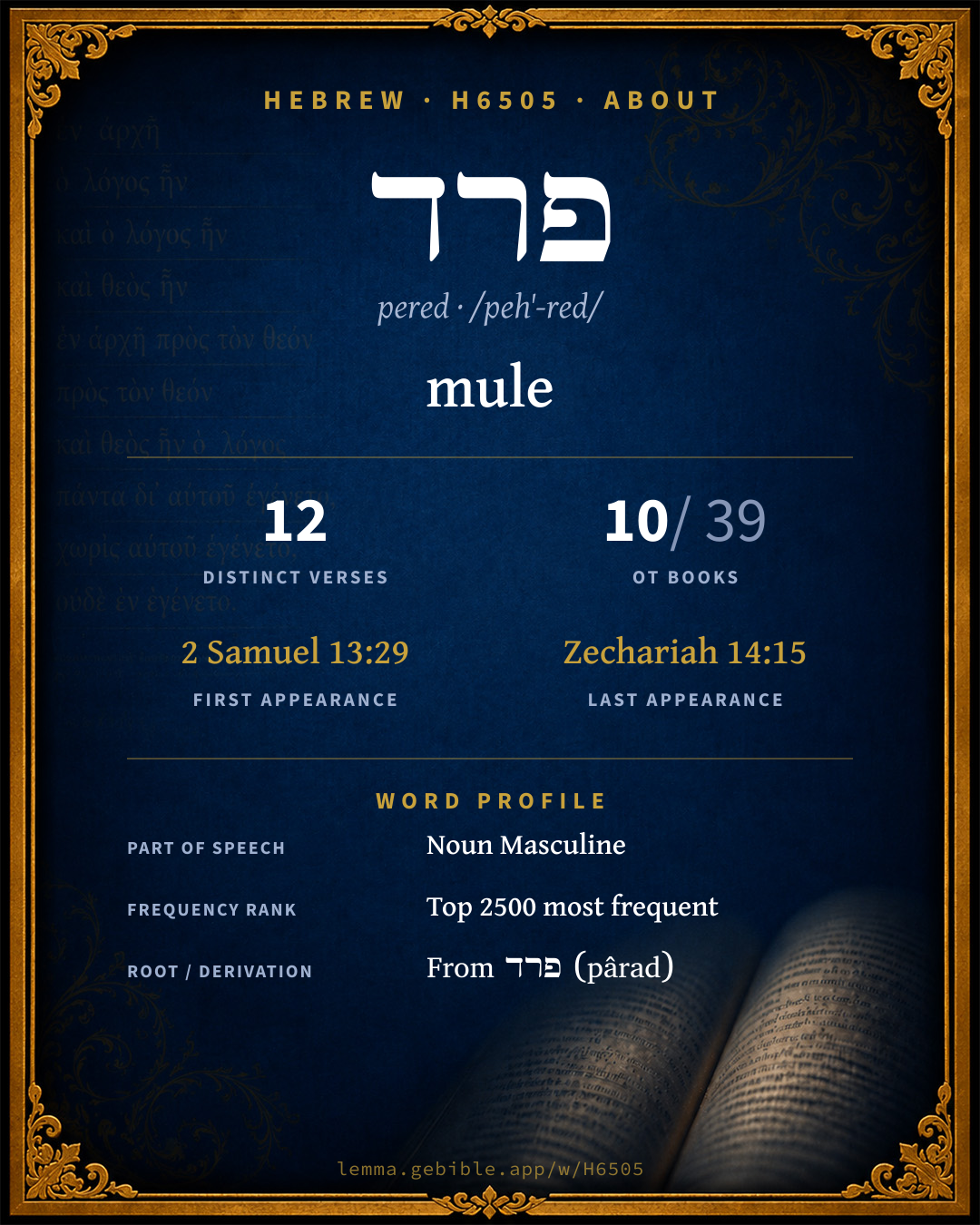
פֶּ֫רֶד
mule
Full lexicon entry — Brown-Driver-Briggs (BDB)
From Brown-Driver-Briggs (BDB)
Where this word appears
See every Absolute-state word in the Hebrew Bible →
Grammar key — what these labels mean
Part of speech
- Noun
- A naming word — a person, place, thing, or idea.
Noun type
- Common
- A common noun — a general class of person, place, or thing (“king,” “city,” “water”), not a specific name.
State
- Absolute
- The independent form of a noun, not bound to a following word.
- Construct
- A noun bound to a following noun in a possessive / “of” relationship (the construct chain).
Gender
- Masculine
- Grammatically masculine.
Number
- Plural
- More than one (in Hebrew, generally three or more).
- Singular
- One.
2 distinct verses where H6505 appears in the Construct state, across 2 books. Filtered view — show all forms. Click any verse to open its interlinear word-by-word view. Verse text shown in the World English Bible for context — . Each verse’s Hebrew form is shown with its reference; the English is not keyword-highlighted, since the data carries no word-level English alignment. Use “Compare translations” on any verse to read it across multiple English versions. This concordance covers the Hebrew Bible; Septuagint (Greek Old Testament) occurrences are not indexed here.
2 Samuel 1 verse
Ezra 1 verse
About this entry
At a glance — auto-summarized from this page’s data, not written by a person. Every figure links to its source below. This summary describes the numbers; it doesn’t interpret them.
At its core, פרד (pered) means “mule.” Scripture first uses it in 2 Samuel 13:29. Spanning 12 verses in 10 books, it ranks among the uncommon words of the Hebrew Bible. From the same root come פרד, בדר and פרדה. Each statement above links to its evidence; the full detail follows below.
Gloss history
Strong's 1890 vs modern scholarship
About this word
Strong's H6505 catalogs a Hebrew word from the Hebrew Old Testament.
These counts are not copied from any lexicon or concordance. They are computed here, from the morphology-tagged Hebrew Old Testament. What Lemma adds →
- 12
- distinct verses
- The word appears in 12 distinct verses.
- 10 / 39
- OT books
- The word appears in 10 of 39 Old Testament books.
- #1,910
- by frequency
- Top 2500 most frequent Hebrew words (rank 1,910 of 8,640 Hebrew words by occurrence).
View all 12 occurrences in the concordance →
By section of the Old Testament
By traditional corpus
Conventional, traditional groupings — biblical authorship is debated, so this is a traditional corpus grouping, not an authorship claim. Each share is this word’s portion of its verses in that division of the Hebrew canon. Each figure is a share of the word’s 12 distinct verses.
- Prophets (Nevi'im) 8 verses · 67%
- Writings (Ketuvim) 4 verses · 33%
How translations render this word
Counts come from each version’s own published word-to-Strong’s tagging or interlinear alignment — an approximate guide to how each version renders this word, not a word-level alignment the data otherwise carries. Because each total is that version’s own tagged count, the per-version totals vary from one another and need not match the appearance or distinct-verse counts above. These counts may also differ from a printed concordance because Lemma counts each distinctly tagged rendering and does not collapse phrase taggings into a single head-word total. This is a fixed set of word-tagged versions (KJV, ASV, BSB, ULT) and does not change with the reading translation you choose elsewhere. Each version’s license is shown beside its name below (and on Sources).
- King James Version: Mules 8×, Mule 5×
- American Standard Version: Mules 9×, Mule 5×
- Berean Standard Bible: Mules 9×, Mule 4×
- unfoldingWord Literal Text: Mules 9×, Mule 4×
King James Version Public Domain
Renders H6505 across 15 tagged occurrences — most commonly:
Plus 2 renderings that appear only once — usually multi-word phrases or single function words the recovered tagging swept in, not distinct renderings.
American Standard Version Public Domain
Renders H6505 across 15 tagged occurrences — most commonly:
Plus 1 rendering that appears only once — usually multi-word phrases or single function words the recovered tagging swept in, not distinct renderings.
Berean Standard Bible Public Domain
Renders H6505 across 14 tagged occurrences — most commonly:
Plus 1 rendering that appears only once — usually multi-word phrases or single function words the recovered tagging swept in, not distinct renderings.
unfoldingWord Literal Text CC BY-SA 4.0
Renders H6505 across 15 tagged occurrences — most commonly:
Plus 2 renderings that appear only once — usually multi-word phrases or single function words the recovered tagging swept in, not distinct renderings.
Senses in BDB
The 1 sense BDB distinguishes for this word, in lexicon order (not ranked by frequency or importance). The full entry — with sub-senses — is in the Lexicon Entry tab.
- mule
Word origin
Derived from פרד (pârad) (H6504) — to divide.
Jastrow Dictionary
A second Hebrew/Aramaic lexicon for comparison, covering Aramaic and post-biblical (Talmudic, Targumic, Midrashic) usage that the biblical-Hebrew BDB does not. Matched by lemma rather than by Strong’s number, so a lemma may carry more than one Jastrow headword (shown separately below), and the entries cover usage well beyond the Bible.
פָּרַד
- (b. h.)
- 1. [to break through, run, v. פֶּרֶד II]
- 2. to break apart; to separate. Ukts. II, 6 הרמון שפְּרָדוֹ a pomegranate which one has cut in two (leaving the seeds in their sheathes; Maim.: שפֵּרְדוֹ, Pi., the grains of which one loosened by drying).—Part. pass. פָּרוּד; f. פְּרוּדָה; pl. פְּרוּדִים, פְּרוּדִין; פְּרוּדוֹת. Succ. 32ᵃ אם היה פ׳ וכ׳, v. כָּפַת; Lev. R. s. 30. Toh. VIII, 8 אוכל פ׳ אינו וכ׳ eatables divided into pieces are not counted together (to make up the required size for levitical cleanness). Ib. IX, 9 נמצא על גבי פ׳ (Maim. פֵּירוּדִים) if the creeping thing is found on broken olives. Ib. פ׳ על גבי פ׳ pieces on top of pieces; a. fr.
- to be separated, spread. Succ. III, 1 נִפְרְדוּ עליו if its leaves are spread, opp. to נפרצו. Hor. 10ᵇ (ref. to Prov. XVIII, 1) זה לוט שנ׳ וכ׳ that means Lot, who separated himself from Abraham; a. fr. e.g. Proverbs 18:1
- to separate, loosen. Ukts. II, 6, v. supra. Tosef. Shebi. VI, 29 מְפָרְדִין (ed. Zuck. a. oth. מְפָרְרִין), v. פֶּרֶד I. Y. B. Mets. II, 11ᵇ bot. המְפָרֵד בגרוגרות who separates dried figs; a. e.
- 1. to separate, estrange. Gen. R. s. 20 (ref. to Prov. XVI, 28) שה׳ אלופו של עולם he (the serpent) caused the friend of the world (the Divine Presence) to withdraw; [Matt. K.; estranged the prince of the world (Adam, from God)]. e.g. Proverbs 16:28
- 2. (neut. verb) to branch off. Gen. R. s. 16 מפְרִיד ‘Rashi’; Yalk. Deut. 801, v. פְּרָת.
- 1. to separate one’s self; to be scattered. Midr. Till. to Ps. XCII, 10 יִתְפָּרְדוּ כמוץ וכ׳ let them be scattered like chaff before the wind; a. e.
- 2. (of pomegranates) to be cut apart. Orl. III, 8 נִתְפָּרְדוּ וכ׳ if the pomegranates are cut; Tosef. Ter. V, 10.
פְּרַד
- , to separate, scatter. Targ. Prov. XI, 24 (ed. Wil. פָּרֵר, corr. acc.; h. text מפזר). Targ. Is. LVIII, 6.—Part. pass. פָּרִיד; f. פָּרִידָא driven off. Targ. Prov. IV, 16.—V. פְּרִידְתָּא.
- same. Part. pass. מְפָרַד driven off, chased. Targ. Is. XIII, 14.
- to make unsteady, bewilder. Targ. Prov. VII, 10.
- 1. to be chased off; to flee. Targ. Y. Gen. XXXI, 40.—Men. 43ᵃ איפרד חזותיה (read אִיפְרְדָא) its color fled (faded).
- 2. to be scattered, spread. Targ. Job XLI, 9 (Ms. מתפרש׳).—Succ. 32ᵃ (expl. נפרדו, v. preced.) דאִיפְּרוּד אִפָּרוּדֵי the leaves are spread.
פֶּרֶד I
- (preced.) a part, esp. (collect. noun) split and dried pomegranates. Maasr. I, 6 הפ׳ והצימוקין וכ׳ dried pomegranates and raisins &c. Tosef. Shebi. VI, 29 מפרדין רימונים לעשותן פ׳ (ed. Zuck. מְפָרְרִין … פֶּרֶר; Var. פרך; some ed. פריך, corr. acc.) you may (in the Sabbatical year) cut pomegranates to make them pered. Tosef. Ter. III, 16 רימונים ועתיד לעשותן פ׳ Var. ed. Zuck. (ed. Zuck. פראנר; oth. ed. כרי, corr. acc.) if one gives T’rumah of pomegranates (intended for sale), with the intention eventually to cut and store them as pered; a. e.
פֶּרֶד II
- preced. wds.) [runner, wild; v. Del. Proleg. p. 94] mule. Pes. 54ᵃ אף האור והפ׳ also fire and the mule (were created on the sixth day at twilight). Ib. הביא שתי … ויצא מהן פ׳ Adam took two (heterogeneous) animals … and from them came forth a mule. Tosef. Kil. V, 5 לא יקשור סוס לפ׳ ופ׳ וכ׳ one must not tie a horse to a mule or a mule to an ass; a. e.—Fem. פִּרְדָּה, פִּי׳ (also for the male). Y. Ber. VIII, 12ᵇ ויצא מהן פ׳, v. supra; Gen. R. s. 82 end ויצאת … פ׳. Ib. פ׳ לבנה a white mule. Tosef. Kil. V, 6 אסור לרכוב ע"ג פי׳ it is forbidden to ride on the back of a mule. Meg. 13ᵇ (play on מפרד, Esth. III, 8) כפְּרִידָה וכ׳ (the Jews are) like the mule that is unproductive. Gen. R. s. 41 (play on הפרד, Gen. XIII, 9) מה הפ׳ הזו אינה קולטת זרע וכ׳ as the mule does not breed the semen she receives, so it is impossible for this man (Lot) to mix with the seed of Abraham. Ib. אברהם פ׳ עקרה, v. עָקָר; a. e.—Pl. פִּרְדּוֹת, פִּירְ׳. Tosef. Kil. V, 5 כל הפ׳ כולן וכ׳ all mules (whether the sire be a horse or an ass) are considered one genus (may be harnessed together); Ḥull. 79ᵃ. Gen. R. s. 64; a. e. e.g. Esther 3:8
A Dictionary of the Targumim, the Talmud Babli and Yerushalmi, and the Midrashic Literature (Marcus Jastrow; London, Luzac, 1903) — Public Domain. Digitized via Sefaria. Digitized via Sefaria. Full attribution on Sources.
Forms in the corpus
The 13 distinct written forms H6505 takes in the Hebrew Bible, most frequent first — each parse links to that state’s occurrences in the concordance. Hebrew forms include their vowel points and cantillation, so a single lemma takes many written forms.
| Form | Parsing | Example | Uses |
|---|---|---|---|
| וּ/פְרָדִ֑ים | Noun, Common, Masculine, Plural, Absolute | 1 Kings 10:25 | 2 |
| הַ/פֶּ֗רֶד | Noun, Common, Masculine, Singular, Absolute | 2 Samuel 18:9 | 1 |
| הַ/פֶּ֡רֶד | Noun, Common, Masculine, Singular, Absolute | 2 Samuel 18:9 | 1 |
| הַ/פֶּ֨רֶד֙ | Noun, Common, Masculine, Singular, Absolute | Zechariah 14:15 | 1 |
| וְ/הַ/פֶּ֥רֶד | Noun, Common, Masculine, Singular, Absolute | 2 Samuel 18:9 | 1 |
| וָ/פֶ֔רֶד | Noun, Common, Masculine, Singular, Absolute | 1 Kings 18:5 | 1 |
| וּ/בַ/פְּרָדִ֜ים | Noun, Common, Masculine, Plural, Absolute | Isaiah 66:20 | 1 |
| וּ/בַ/פְּרָדִ֣ים | Noun, Common, Masculine, Plural, Absolute | 1 Chronicles 12:40 | 1 |
| וּ/פְרָדִ֔ים | Noun, Common, Masculine, Plural, Absolute | Ezekiel 27:14 | 1 |
| כְּ/פֶרֶד֮ | Noun, Common, Masculine, Singular, Absolute | Psalms 32:9 | 1 |
| פְּרָדִ֖ים | Noun, Common, Masculine, Plural, Absolute | 2 Kings 5:17 | 1 |
| פִּרְדֵי/הֶ֕ם | Noun, Common, Masculine, Plural, Construct | Ezra 2:66 | 1 |
| פִּרְדּ֖/וֹ | Noun, Common, Masculine, Singular, Construct | 2 Samuel 13:29 | 1 |
Same root — word family
Other BDB entries built from the same root as H6505, grouped by Strong’s listed origin. These share a root / origin per the lexicon — not necessarily a shared meaning. Each links to that word’s own entry.
Derives from
Shares the same root
Derived from this word
Proper names from this root
People and places named from this root — a name, not an additional meaning of the word.
Compare all same-root words → Showing 4 of 6 — not the complete family. 1 of the same-root words is a proper name (a person or place). They share a root, not necessarily a meaning.
Septuagint verse parallels
This word appears in 12 verses that also exist in the Greek Old Testament (Septuagint), out of the 12 Hebrew verses it occurs in. You can read those verses in Greek by switching the Old Testament edition to the Septuagint.
Read these verses in the Septuagint
- 2 Samuel 13:29
- 1 Kings 10:25
- 2 Kings 5:17
- 1 Chronicles 12:40
- 2 Chronicles 9:24
- Ezra 2:66
- Psalms 32:9
- Isaiah 66:20
- Ezekiel 27:14
- Zechariah 14:15
This is a verse-level parallel only — the same verses exist in both the Hebrew and Greek Old Testaments. No word-level Hebrew↔Greek correspondence is claimed: the data carries no such alignment, so no Greek word is shown as this Hebrew word’s translation. Coverage is not total — the Septuagint omits the deuterocanon and renumbers the Psalms, so some Hebrew verses have no direct Greek parallel.