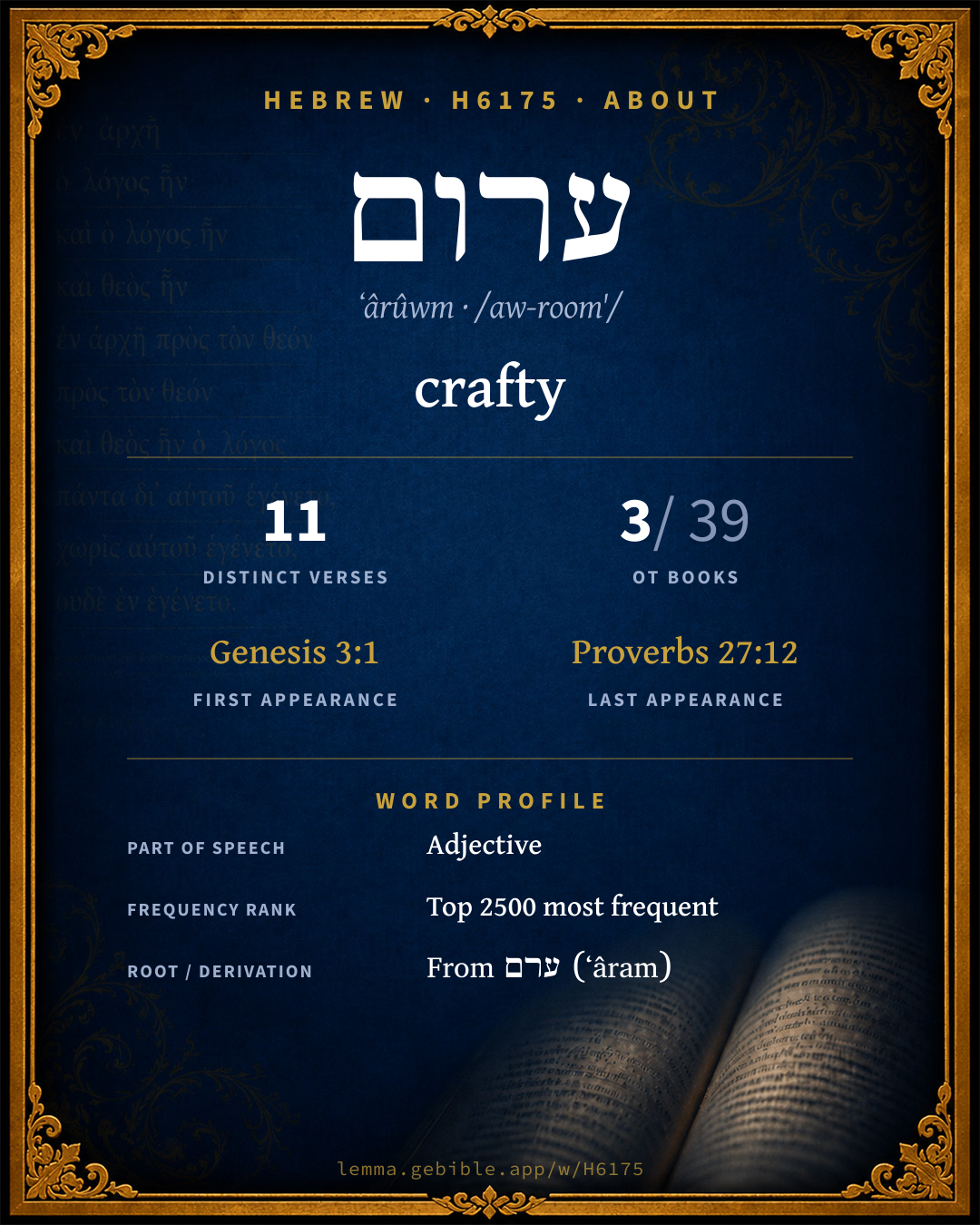
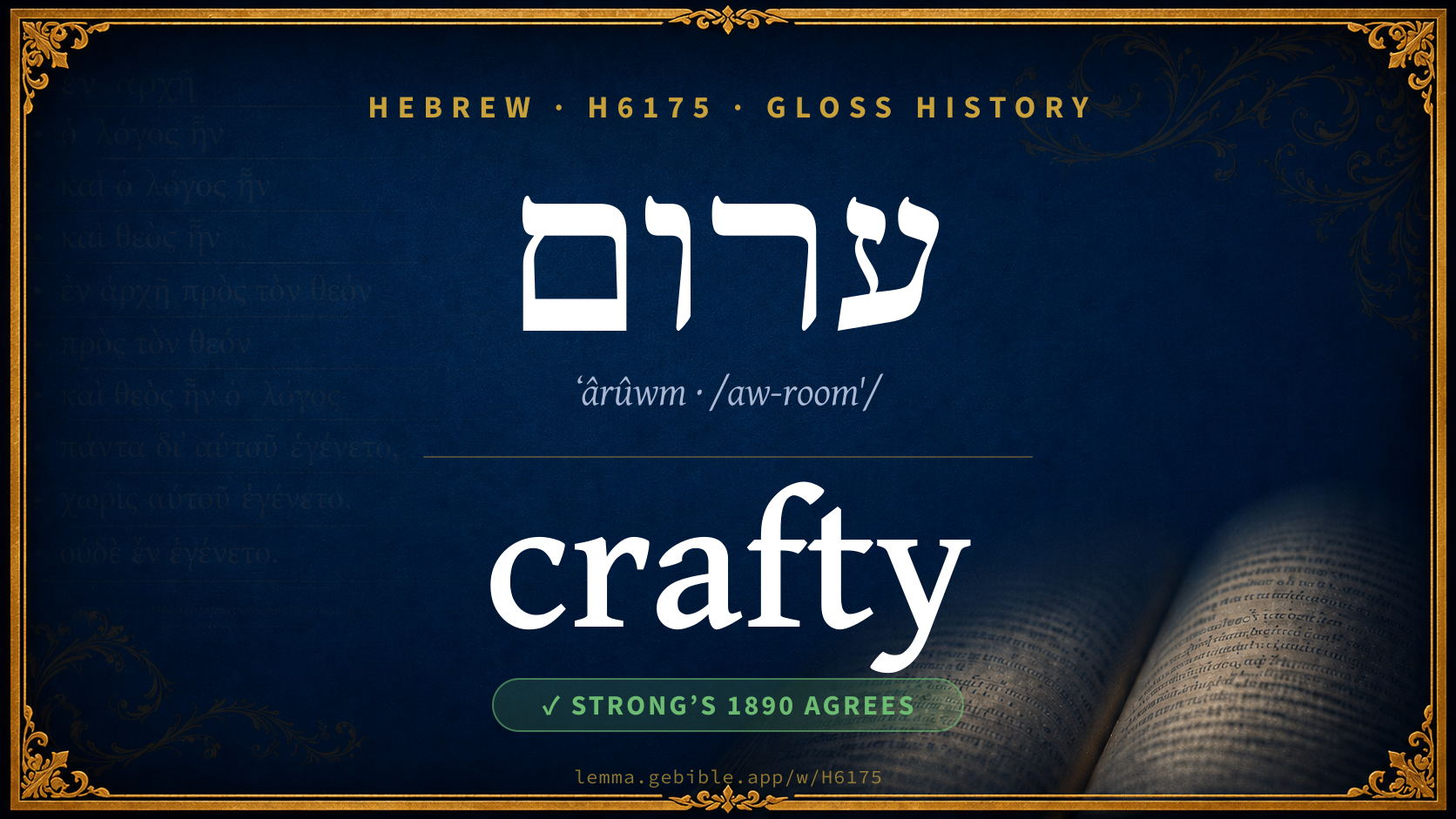
עָרוּם
crafty
also: subtle, shrewd, sly, sensible fuller range ↓
Full lexicon entry — Brown-Driver-Briggs (BDB)
From Brown-Driver-Briggs (BDB)
Where this word appears
Grammar key — what these labels mean
Part of speech
- Adjective
- A word that describes or qualifies a noun.
State
- Absolute
- The independent form of a noun, not bound to a following word.
Gender
- Masculine
- Grammatically masculine.
Number
- Singular
- One.
- Plural
- More than one (in Hebrew, generally three or more).
Every verse where H6175 appears in the Book of Proverbs — 8 distinct verses. Click any verse to open its interlinear word-by-word view. Verse text shown in the World English Bible for context — . Each verse’s Hebrew form is shown with its reference; the English is not keyword-highlighted, since the data carries no word-level English alignment. Use “Compare translations” on any verse to read it across multiple English versions. This concordance covers the Hebrew Bible; Septuagint (Greek Old Testament) occurrences are not indexed here.
Proverbs
- Proverbs 12:16 עָרֽוּם adj Adjective ms A fool shows his annoyance the same day, But one who overlooks an insult is prudent.
- Proverbs 12:23 עָ֭רוּם adj Adjective ms A prudent man keeps his knowledge, But the hearts of fools proclaim foolishness.
- Proverbs 13:16 עָ֭רוּם adj Adjective ms Every prudent man acts from knowledge, But a fool exposes folly.
- Proverbs 14:8 עָ֭רוּם adj Adjective ms The wisdom of the prudent is to think about his way, But the folly of fools is deceit.
- Proverbs 14:15 וְ֝/עָר֗וּם conj + Adjective Adjective ms A simple man believes everything, But the prudent man carefully considers his ways.
- Proverbs 14:18 וַֽ֝/עֲרוּמִ֗ים conj + Adjective Adjective mp The simple inherit folly, But the prudent are crowned with knowledge.
- Proverbs 22:3 עָר֤וּם adj Adjective ms A prudent man sees danger, and hides himself; But the simple pass on, and suffer for it.
- Proverbs 27:12 עָר֤וּם adj Adjective ms A prudent man sees danger and takes refuge; But the simple pass on, and suffer for it:
About this entry
At a glance — auto-summarized from this page’s data, not written by a person. Every figure links to its source below. This summary describes the numbers; it doesn’t interpret them.
“crafty” is the headline sense of the Hebrew adjective ערום (ʻârûwm). It clusters heavily in Proverbs, which alone accounts for 73% of its uses. It turns up in 11 verses across 3 books, an uncommon footprint. Its earliest occurrence is Genesis 3:1. Beyond “crafty” it also covers “subtle”, “shrewd”, and “sly” — see its full sense range. The sections below give every sense, occurrence, and version rendering.
Gloss history
Strong's 1890 vs modern scholarship
About this word
Strong's H6175 catalogs a Hebrew word from the Hebrew Old Testament.
These counts are not copied from any lexicon or concordance. They are computed here, from the morphology-tagged Hebrew Old Testament. What Lemma adds →
- 11
- distinct verses
- The word appears in 11 distinct verses.
- 3 / 39
- OT books
- The word appears in 3 of 39 Old Testament books.
- #2,210
- by frequency
- Top 2500 most frequent Hebrew words (rank 2,210 of 8,640 Hebrew words by occurrence).
View all 11 occurrences in the concordance →
By section of the Old Testament
By traditional corpus
Conventional, traditional groupings — biblical authorship is debated, so this is a traditional corpus grouping, not an authorship claim. Each share is this word’s portion of its verses in that division of the Hebrew canon. Each figure is a share of the word’s 11 distinct verses.
- Writings (Ketuvim) 10 verses · 91%
- Torah (Pentateuch) 1 verse · 9%
How translations render this word
Counts come from each version’s own published word-to-Strong’s tagging or interlinear alignment — an approximate guide to how each version renders this word, not a word-level alignment the data otherwise carries. Because each total is that version’s own tagged count, the per-version totals vary from one another and need not match the appearance or distinct-verse counts above. These counts may also differ from a printed concordance because Lemma counts each distinctly tagged rendering and does not collapse phrase taggings into a single head-word total. This is a fixed set of word-tagged versions (KJV, ASV, BSB, ULT) and does not change with the reading translation you choose elsewhere. Each version’s license is shown beside its name below (and on Sources).
- King James Version: Prudent 7×, Crafty 2×
- American Standard Version: Prudent 7×, Crafty 2×
- Berean Standard Bible: Prudent 6×, Crafty 2×
- unfoldingWord Literal Text: Prudent 6×, One 4×, Crafty 2×
King James Version Public Domain
Renders H6175 across 11 tagged occurrences — most commonly:
Plus 2 renderings that appear only once — usually multi-word phrases or single function words the recovered tagging swept in, not distinct renderings.
American Standard Version Public Domain
Renders H6175 across 11 tagged occurrences — most commonly:
Plus 2 renderings that appear only once — usually multi-word phrases or single function words the recovered tagging swept in, not distinct renderings.
Berean Standard Bible Public Domain
Renders H6175 across 11 tagged occurrences — most commonly:
Plus 3 renderings that appear only once — usually multi-word phrases or single function words the recovered tagging swept in, not distinct renderings.
unfoldingWord Literal Text CC BY-SA 4.0
Renders H6175 across 15 tagged occurrences — most commonly:
Plus 1 rendering that appears only once — usually multi-word phrases or single function words the recovered tagging swept in, not distinct renderings.
Senses in the full BDB
What do BDB’s symbols mean?
BDB uses these scholarly abbreviations:
| Symbol | Meaning |
|---|---|
| 𝔊 | the Septuagint (the ancient Greek translation, LXX) |
| 𝔙 | the Vulgate (the Latin translation) |
| 𝔖 | the Syriac version (the Peshitta) |
| 𝔗 | the Targum (the Aramaic translation) |
| ψ | the Psalms |
| √ | root (the underlying root or stem) |
| ‖ | parallel passage (a synonymous or contrasted parallel) |
| † | the dagger: every passage where the word occurs is cited |
The 2 senses and sub-senses the full Brown-Driver-Briggs lexicon distinguishes for this word, in lexicon order (not ranked by frequency), with BDB’s own verbatim wording and sub-sense lettering. Shown in Hebrew script with BDB’s own scholarly abbreviations. The condensed entry is in the Lexicon Entry tab. See also the Forms in the corpus table below.
- 1. crafty, ע׳ as pred., of serpent Gn 3:1; pl. as subst. מַחְשְׁבוֹת עֲרוּמִים Jb 5:12, לְשׁוֹן ע׳ 15:5. e.g. Genesis 3:1
- 2. in Pr, in good sense (opp. אֱוִיל, כְּסִיל, פֶּתִי); as attrib. אָדָם עָרוּם Pr 12:23 a shrewd or sensible man; ע׳ as subst. = id., v 16; 13:16, so חָכְמַת ע׳ 14:8; = prudent man 14:15; 22:3; 27:12; pl. עֲרוּמִים 14:18. e.g. Proverbs 12:23
Senses from the full Brown-Driver-Briggs lexicon (Brown, Driver, Briggs; Oxford 1906 — public domain), digitized via Sefaria, supplemented by the OpenScriptures HebrewLexicon (CC BY 4.0). Full attribution on Sources.
Word origin
adj. crafty, shrewd, sensible;—
— Brown-Driver-Briggs (Oxford 1906, public domain), digitized via Sefaria, supplemented by the OpenScriptures HebrewLexicon (CC BY 4.0). See Sources.
Derived from ערם (ʻâram) (H6191) — to be crafty.
Jastrow Dictionary
A second Hebrew/Aramaic lexicon for comparison, covering Aramaic and post-biblical (Talmudic, Targumic, Midrashic) usage that the biblical-Hebrew BDB does not. Matched by lemma rather than by Strong’s number, so a lemma may carry more than one Jastrow headword (shown separately below), and the entries cover usage well beyond the Bible.
עָרוּם
- [rubbed, bright, cmp. Lat. tritus,] prudent, deliberate, wise; (in an evil sense) subtle, cunning. Ber. 17ᵃ לעולם יהא אדם ע׳ ביראה man should always be deliberate in the fear of the Lord (consider in what manner he can best serve the Lord). Sot. III, 4 רשע ע׳ a wicked man that is subtle, expl. ib. 21ᵇ זה המטעים וכ׳, v. טָעַם; Tanḥ. Mishp. 6. Sot. l. c. במי שמשים עצמו ע׳ Var. in Rashi, v. next w.; a. fr.—Pesik. Shimʿu, p. 118ᵇ, sq. (in Chald. dict.) לית עיסקא דע׳ מהלך עם שטיא the sane has no business to walk with the fool; (Yalk. Jer. 265 דעָרִים).—Pl. עֲרוּמִים, עֲרוּמִין. Ḥull. 5ᵇ (ref. to Ps. XXXVI, 7) אלו בני אדם שהן ע׳ בדעת וכ׳ that means those men who are clever in knowledge and yet conduct themselves humbly like a domestic animal; a. e. e.g. Psalms 36:7
עָרוֹם
- v. preced.; cmp. עָרָה) stripped, naked, bare. Dem. I, 4 מפרישין אותו ע׳ ובין וכ׳ Y. ed. a. Ms. M. (ed. בין, incorr.) you may separate the priest’s gift there from without being dressed (because it requires no benediction), and at twilight (on the eve of the Sabbath); Sabb. 23ᵃ. Ib. 14ᵃ האוחז ס"ת ע׳ נקבר ע׳ he who handles a naked scroll of the Law (touches it directly with his bare hand), will he buried naked, expl. ע׳ בלא אותה מצוה bare of the merit of that act (of studying or of rolling and dressing it). Tosef. Keth. VI, 7 פסק … שיעמד ע׳ וילבישנה (not וילבשנו) if he agreed with his son-in-law that he will go naked (deprive himself, if necessary) and dress her, אין אומ׳ יעמד ע׳ וילבישנה וכ׳ (not וילבישנו) we do not say, let him become destitute, and he must dress her (make the outfit for her), but he (her father) must cover her as is proper for her; Y. ib. VI, 30ᵈ. Sot. 21ᵇ (play on ערמה, Prov. VIII, 12) אין … אלא במי שמעמיד עצמו ע׳ עליהן the words of the Law remain only with him who makes himself destitute for their sake (who sacrifices comforts for them); (Var. quot. in Rashi: שמשים עצמו עָרוּם עליה who makes himself cunning about it, i.e. goes to work deliberately, studies systematically); a. fr.—Pl. עֲרוּמִּים, עֲרוּמִּין. Snh. 90ᵇ כשהן עומדין עומדין ע׳ וכ׳ when they (the dead) rise, will they rise naked or dressed? Yeb. 63ᵇ אנשי … שמהלכין ע׳ בשוק those of Barbaria … who walk naked in the street; Sifré Deut. 320; a. fr.—Fem. עֲרוּמָּה. Keth. 111ᵇ; Snh. l. c. ומה חיטה שנקברה ע׳ וכ׳ if the wheat-grain, which is buried naked, comes forth wrapped in many dresses, how much more will the righteous dead rise &c. Ib. VI, 3 אין האשה נסקלת ע׳ a woman convict must not be stoned (executed) undressed. Meg. 12ᵇ ובלבד שתהא ע׳ provided she (Vashti) will appear undressed. Snh. 75ᵃ ימות ולא תעמוד לפניו ע׳ let him (the love-sick man) die, but she must not stand undressed before him. Keth. VI, 5 פסק להכניסה ע׳ if the father made an agreement that he (the bridegroom) will take her to his house without the customary outfit; a. fr.—Pl. עֲרוּמּוֹת. Meg. l. c. מפשיטתן ע׳ (not מפשיטן) she forced them to appear undressed; a. e. e.g. Proverbs 8:12
A Dictionary of the Targumim, the Talmud Babli and Yerushalmi, and the Midrashic Literature (Marcus Jastrow; London, Luzac, 1903) — Public Domain. Digitized via Sefaria. Digitized via Sefaria. Full attribution on Sources.
Forms in the corpus
The 8 distinct written forms H6175 takes in the Hebrew Bible, most frequent first — each parse links to that state’s occurrences in the concordance. Hebrew forms include their vowel points and cantillation, so a single lemma takes many written forms.
| Form | Parsing | Example | Uses |
|---|---|---|---|
| עָ֭רוּם | Adjective, Adjective, Masculine, Singular, Absolute | Proverbs 12:23 | 3 |
| עָר֤וּם | Adjective, Adjective, Masculine, Singular, Absolute | Proverbs 22:3 | 2 |
| וְ֝/עָר֗וּם | Adjective, Adjective, Masculine, Singular, Absolute | Proverbs 14:15 | 1 |
| וַֽ֝/עֲרוּמִ֗ים | Adjective, Adjective, Masculine, Plural, Absolute | Proverbs 14:18 | 1 |
| עֲרוּמִ֑ים | Adjective, Adjective, Masculine, Plural, Absolute | Job 5:12 | 1 |
| עֲרוּמִֽים | Adjective, Adjective, Masculine, Plural, Absolute | Job 15:5 | 1 |
| עָר֔וּם | Adjective, Adjective, Masculine, Singular, Absolute | Genesis 3:1 | 1 |
| עָרֽוּם | Adjective, Adjective, Masculine, Singular, Absolute | Proverbs 12:16 | 1 |
Same root — word family
Other BDB entries built from the same root as H6175, grouped by Strong’s listed origin. These share a root / origin per the lexicon — not necessarily a shared meaning. Each links to that word’s own entry.
Derives from
Shares the same root
- מערם maʻărôm H4636 nakedness
- עירם ʻêyrôm H5903 naked
- ערום ʻârôwm H6174 naked
- ערם ʻôrem H6193 craftiness
- ערמון ʻarmôwn H6196 plane tree
Compare all same-root words → Showing 4 of 7 — not the complete family. They share a root, not necessarily a meaning.
Septuagint verse parallels
This word appears in 11 verses that also exist in the Greek Old Testament (Septuagint), out of the 11 Hebrew verses it occurs in. You can read those verses in Greek by switching the Old Testament edition to the Septuagint.
Read these verses in the Septuagint
This is a verse-level parallel only — the same verses exist in both the Hebrew and Greek Old Testaments. No word-level Hebrew↔Greek correspondence is claimed: the data carries no such alignment, so no Greek word is shown as this Hebrew word’s translation. Coverage is not total — the Septuagint omits the deuterocanon and renumbers the Psalms, so some Hebrew verses have no direct Greek parallel.