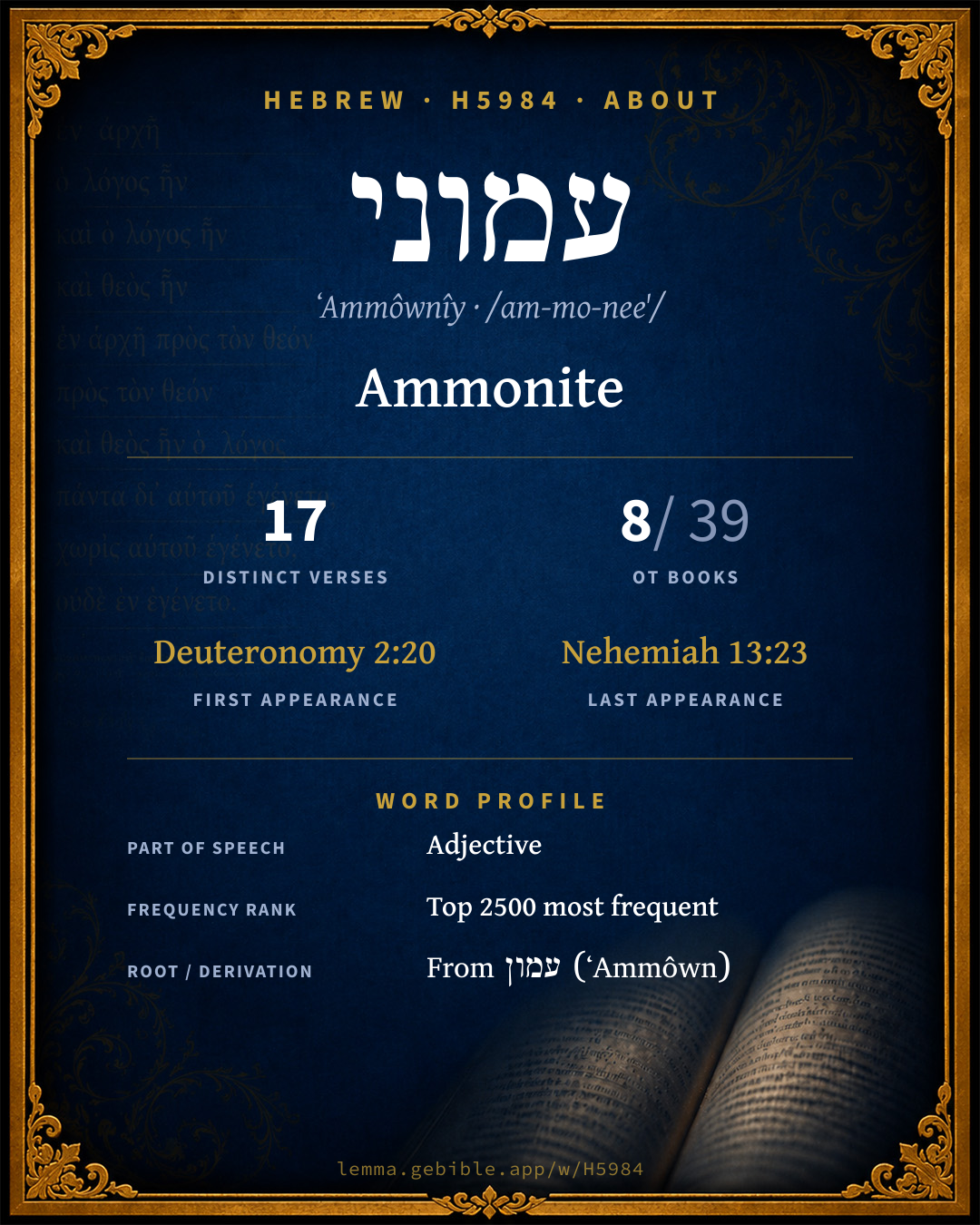
עַמּוֹנִי
Ammonite
BDB lists 2 entries for ‘Ammonite’ fuller range ↓
Full lexicon entry — Brown-Driver-Briggs (BDB)
From Brown-Driver-Briggs (BDB)
Where this word appears
Grammar key — what these labels mean
Part of speech
- Noun
- A naming word — a person, place, thing, or idea.
Noun type
- Gentilic
- A noun naming a member of a people, tribe, or region of origin (e.g. an Israelite, a Moabite).
State
- Absolute
- The independent form of a noun, not bound to a following word.
Gender
- Masculine
- Grammatically masculine.
- Feminine
- Grammatically feminine.
Number
- Singular
- One.
- Plural
- More than one (in Hebrew, generally three or more).
Every verse where H5984 appears in the Book of 2 Samuel — 1 distinct verse. Click any verse to open its interlinear word-by-word view. Verse text shown in the World English Bible for context — . Each verse’s Hebrew form is shown with its reference; the English is not keyword-highlighted, since the data carries no word-level English alignment. Use “Compare translations” on any verse to read it across multiple English versions. This concordance covers the Hebrew Bible; Septuagint (Greek Old Testament) occurrences are not indexed here.
2 Samuel
About this entry
At a glance — auto-summarized from this page’s data, not written by a person. Every figure links to its source below. This summary describes the numbers; it doesn’t interpret them.
At its core, עמוני (ʻAmmôwnîy) means “Ammonite.” Scripture first uses it in Deuteronomy 2:20. Spanning 17 verses in 8 books, it ranks among the uncommon words of the Hebrew Bible. Its uses concentrate in Nehemiah (35% of all occurrences). Dig into 17-verse concordance and the renderings breakdown below.
Gloss history
Strong's 1890 vs modern scholarship
About this word
Strong's H5984 catalogs a Hebrew word from the Hebrew Old Testament.
These counts are not copied from any lexicon or concordance. They are computed here, from the morphology-tagged Hebrew Old Testament. What Lemma adds →
- 17
- distinct verses
- The word appears in 17 distinct verses.
- 8 / 39
- OT books
- The word appears in 8 of 39 Old Testament books.
- #1,612
- by frequency
- Top 2500 most frequent Hebrew words (rank 1,612 of 8,640 Hebrew words by occurrence).
View all 17 occurrences in the concordance →
Most concentrated in
- Nehemiah 6 verses 35%
- Deuteronomy 2 verses 12%
- 1 Samuel 2 verses 12%
By section of the Old Testament
By traditional corpus
Conventional, traditional groupings — biblical authorship is debated, so this is a traditional corpus grouping, not an authorship claim. Each share is this word’s portion of its verses in that division of the Hebrew canon. Each figure is a share of the word’s 17 distinct verses.
- Writings (Ketuvim) 10 verses · 59%
- Prophets (Nevi'im) 5 verses · 29%
- Torah (Pentateuch) 2 verses · 12%
How translations render this word
Counts come from each version’s own published word-to-Strong’s tagging or interlinear alignment — an approximate guide to how each version renders this word, not a word-level alignment the data otherwise carries. Because each total is that version’s own tagged count, the per-version totals vary from one another and need not match the appearance or distinct-verse counts above. These counts may also differ from a printed concordance because Lemma counts each distinctly tagged rendering and does not collapse phrase taggings into a single head-word total. This is a fixed set of word-tagged versions (KJV, ASV, BSB, ULT) and does not change with the reading translation you choose elsewhere. Each version’s license is shown beside its name below (and on Sources).
- King James Version: Ammonite 9×, Ammonites 7×
- American Standard Version: Ammonite 9×, Ammonites 6×
- Berean Standard Bible: Ammonite 12×, Ammonites 5×, Ammon 2×
- unfoldingWord Literal Text: Ammonite 11×, Ammonites 4×
King James Version Public Domain
Renders H5984 across 18 tagged occurrences — most commonly:
Plus 2 renderings that appear only once — usually multi-word phrases or single function words the recovered tagging swept in, not distinct renderings.
American Standard Version Public Domain
Renders H5984 across 18 tagged occurrences — most commonly:
Plus 3 renderings that appear only once — usually multi-word phrases or single function words the recovered tagging swept in, not distinct renderings.
Berean Standard Bible Public Domain
Renders H5984 across 21 tagged occurrences — most commonly:
Plus 2 renderings that appear only once — usually multi-word phrases or single function words the recovered tagging swept in, not distinct renderings.
unfoldingWord Literal Text CC BY-SA 4.0
Renders H5984 across 17 tagged occurrences — most commonly:
Plus 2 renderings that appear only once — usually multi-word phrases or single function words the recovered tagging swept in, not distinct renderings.
Senses in BDB
The 2 senses BDB distinguishes for this word, in lexicon order (not ranked by frequency or importance). The full entry — with sub-senses — is in the Lexicon Entry tab.
- Ammonite = see Ammon " tribal"
- descendants of Ammon and inhabitants of Ammon
Word origin
adj. gent. Ammonite;—abs. ms. עַמּוֹנִי as subst. Dt 23:4 an Ammonite (generic), so עַמֹּנִי Ne 13:1; הָעַמּוֹנִי of individual 1 S 11:1, 2; 2 S 23:37 = 1 Ch 11:39; Ne 2:19, so הָעַמֹּנִי 2:10; 3:35; fs. הָעַמֹּנִית 1 K 14:21 = 2 Ch 12:13; 1 K 14:31, so הָעַמּוֹנִית 2 Ch 24:26; הָעַמֹּנִי as subst. coll. Ezr 9:1; mpl. as subst. עַמֹּנִים 1 K 11:5, הָע׳ Dt 2:20; Ne 4:1, הָעַמּוֹ׳ 2 Ch 26:8 (on 20:1 v. מְעוּנִים); fpl. as adj. עַמֳּנִיֹּת 1 K 11:1, so Ne 13:23 Qr, Kt עמוניות.
— Brown-Driver-Briggs (Oxford 1906, public domain), digitized via Sefaria, supplemented by the OpenScriptures HebrewLexicon (CC BY 4.0). See Sources.
Derived from עמון (ʻAmmôwn) (H5983) — Ammon.
Jastrow Dictionary
A second Hebrew/Aramaic lexicon for comparison, covering Aramaic and post-biblical (Talmudic, Targumic, Midrashic) usage that the biblical-Hebrew BDB does not. Matched by lemma rather than by Strong’s number, so a lemma may carry more than one Jastrow headword (shown separately below), and the entries cover usage well beyond the Bible.
עַמּוֹנִי
- preced.) Ammonite. Y. Snh. X, 28ᵈ top היין הע׳ שהוא קשה Ammonite wine which is strong; Bab. Snh. 106ᵃ. Yeb. VIII, 3. Ib. 69ᵃ, a. e. עמוני ולא עמונית a converted male Ammonite is excluded from intermarriage, but not a female, v. מוֹאָבִי; a. fr.
A Dictionary of the Targumim, the Talmud Babli and Yerushalmi, and the Midrashic Literature (Marcus Jastrow; London, Luzac, 1903) — Public Domain. Digitized via Sefaria. Digitized via Sefaria. Full attribution on Sources.
Forms in the corpus
The 18 distinct written forms H5984 takes in the Hebrew Bible, most frequent first — each parse links to that state’s occurrences in the concordance. Hebrew forms include their vowel points and cantillation, so a single lemma takes many written forms.
| Form | Parsing | Example | Uses |
|---|---|---|---|
| הָ/עַמֹּנִ֑י | Noun, Gentilic, Masculine, Singular, Absolute | 2 Samuel 23:37 | 1 |
| הָ/עַמֹּנִ֖י | Noun, Gentilic, Masculine, Singular, Absolute | Nehemiah 4:3 | 1 |
| הָ/עַמּוֹנִ֑י | Noun, Gentilic, Masculine, Singular, Absolute | 1 Chronicles 11:39 | 1 |
| הָ/עַמּוֹנִ֔י | Noun, Gentilic, Masculine, Singular, Absolute | 1 Samuel 11:2 | 1 |
| הָֽ/עַמֹּנִ֔י | Noun, Gentilic, Masculine, Singular, Absolute | Nehemiah 2:10 | 1 |
| הָֽ/עַמֹּנִי֙ | Noun, Gentilic, Masculine, Singular, Absolute | Ezra 9:1 | 1 |
| הָֽ/עַמּוֹנִ֔י | Noun, Gentilic, Masculine, Singular, Absolute | 1 Samuel 11:1 | 1 |
| הָֽ/עַמּוֹנִ֗י | Noun, Gentilic, Masculine, Singular, Absolute | Nehemiah 2:19 | 1 |
| הָֽ/עַמּוֹנִ֛ים | Noun, Gentilic, Masculine, Plural, Absolute | 2 Chronicles 26:8 | 1 |
| וְ/הָ/עַמֹּנִ֜ים | Noun, Gentilic, Masculine, Plural, Absolute | Nehemiah 4:7 | 1 |
| וְ/הָֽ/עַמֹּנִ֔ים | Noun, Gentilic, Masculine, Plural, Absolute | Deuteronomy 2:20 | 1 |
| מֵֽ/הָ/עַמּוֹנִ֛ים | Noun, Gentilic, Masculine, Plural, Absolute | 2 Chronicles 20:1 | 1 |
| עַמֳּנִיּ֖וֹת | Noun, Gentilic, Feminine, Plural, Absolute | Nehemiah 13:23 | 1 |
| עַמֳּנִיּוֹת֙ | Noun, Gentilic, Feminine, Plural, Absolute | 1 Kings 11:1 | 1 |
| עַמֹּנִ֧י | Noun, Gentilic, Masculine, Singular, Absolute | Nehemiah 13:1 | 1 |
| עַמֹּנִֽים | Noun, Gentilic, Masculine, Plural, Absolute | 1 Kings 11:5 | 1 |
| עַמּוֹנִ֛י | Noun, Gentilic, Masculine, Singular, Absolute | Deuteronomy 23:3 | 1 |
| עמוניות | Noun, Gentilic, Feminine, Plural, Absolute | Nehemiah 13:23 | 1 |
Same root — word family
Other BDB entries built from the same root as H5984, grouped by Strong’s listed origin. These share a root / origin per the lexicon — not necessarily a shared meaning. Each links to that word’s own entry.
Derives from
Proper names from this root
People and places named from this root — a name, not an additional meaning of the word.
Compare all same-root words → 2 of the same-root words are proper names (people or places). They share a root, not necessarily a meaning.
Bible dictionary
Public-domain dictionary articles matched to this entry by name (Ammonite). A biblical name can be shared by more than one person or place, so an article may treat several.
Easton's Bible Dictionary · M. G. Easton, 1897
The usual name of the descendants of Ammon, the son of Lot (Gen. 19:38). From the very beginning (Deut. 2:16-20) of their history till they are lost sight of (Judg. 5:2), this tribe is closely associated with the Moabites (Judg. 10:11; 2 Chr. 20:1; Zeph. 2:8). Both of these tribes hired Balaam to curse Israel (Deut. 23:4). The Ammonites were probably more of a predatory tribe, moving from place to place, while the Moabites were more settled. They inhabited the country east of the Jordan and north of Moab and the Dead Sea, from which they had expelled the Zamzummims or Zuzims (Deut. 2:20; Gen. 14:5). They are known as the Beni-ammi (Gen. 19:38), Ammi or Ammon being worshipped as their chief god. They were of Semitic origin, and closely related to the Hebrews in blood and language. They showed no kindness to the Israelites when passing through their territory, and therefore they were prohibited from "entering the congregation of the Lord to the tenth generation" (Deut. 23:3). They afterwards became hostile to Israel (Judg. 3:13). Jephthah waged war against them, and "took twenty cities with a very great slaughter" (Judg. 11:33). They were again signally defeated by Saul (1 Sam. 11:11). David also defeated them and their allies the Syrians (2 Sam. 10:6-14), and took their chief city, Rabbah, with much spoil (2 Sam. 10:14; 12:26-31). The subsequent events of their history are noted in 2 Chr. 20:25; 26:8; Jer. 49:1; Ezek. 25:3, 6. One of Solomon's wives was Naamah, an Ammonite. She was the mother of Rehoboam (1 Kings 14:31; 2 Chr. 12:13).
The prophets predicted fearful judgments against the Ammonites because of their hostility to Israel (Zeph. 2:8; Jer. 49:1-6; Ezek. 25:1-5, 10; Amos 1:13-15).
The national idol worshipped by this people was Molech or Milcom, at whose altar they offered human sacrifices (1 Kings 11:5, 7). The high places built for this idol by Solomon, at the instigation of his Ammonitish wives, were not destroyed till the time of Josiah (2 Kings 23:13).
Classic public-domain reference works; full attribution on Sources.
Septuagint verse parallels
This word appears in 11 verses that also exist in the Greek Old Testament (Septuagint), out of the 17 Hebrew verses it occurs in. You can read those verses in Greek by switching the Old Testament edition to the Septuagint.
Read these verses in the Septuagint
- Deuteronomy 2:20
- 1 Samuel 11:1
- 2 Samuel 23:37
- 1 Kings 11:1
- 1 Chronicles 11:39
- 2 Chronicles 20:1
- Ezra 9:1
This is a verse-level parallel only — the same verses exist in both the Hebrew and Greek Old Testaments. No word-level Hebrew↔Greek correspondence is claimed: the data carries no such alignment, so no Greek word is shown as this Hebrew word’s translation. Coverage is not total — the Septuagint omits the deuterocanon and renumbers the Psalms, so some Hebrew verses have no direct Greek parallel.