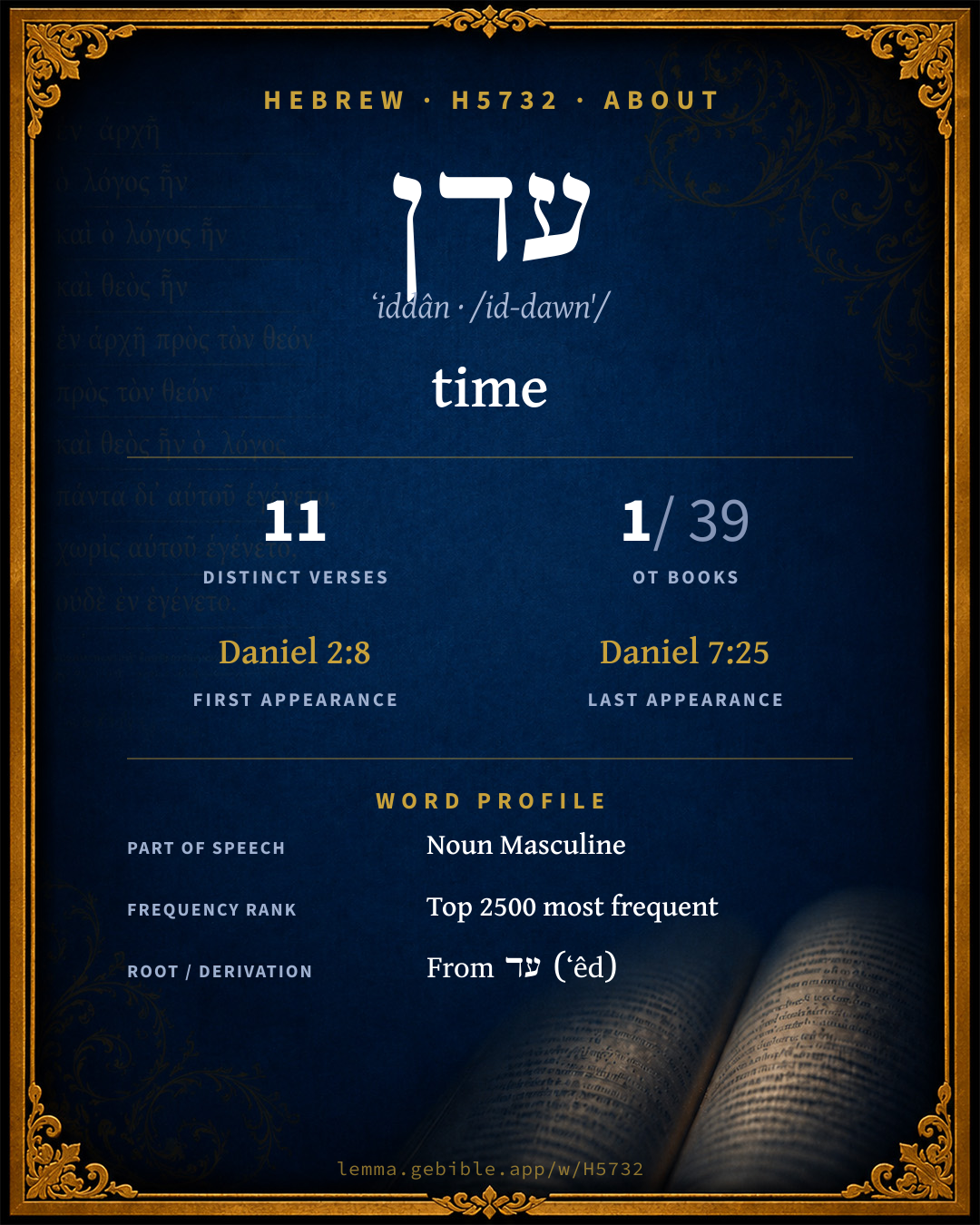
עִדָּן
time
‘time’ is one of 3 main senses fuller range ↓
Full lexicon entry — Brown-Driver-Briggs (BDB)
From Brown-Driver-Briggs (BDB)
Where this word appears
Grammar key — what these labels mean
Part of speech
- Noun
- A naming word — a person, place, thing, or idea.
- Adjective
- A word that describes or qualifies a noun.
Noun type
- Common
- A common noun — a general class of person, place, or thing (“king,” “city,” “water”), not a specific name.
State
- Absolute
- The independent form of a noun, not bound to a following word.
Gender
- Masculine
- Grammatically masculine.
- Both
- Attested as both masculine and feminine.
Number
- Plural
- More than one (in Hebrew, generally three or more).
- Singular
- One.
Grammatical forms
- Particle, Definite Article 5 times (38%)
- Noun, Common, Masculine, Plural, Absolute 4 times (31%)
- Noun, Common, Masculine, Singular, Absolute 3 times (23%)
- Adjective, Cardinal number, Both, Singular, Absolute 1 time (8%)
Parsed forms decoded from the imported morphology (morphhb / Westminster Leningrad Codex — WLC text public domain, morphhb tagging CC BY 4.0), counted across 13 parsed occurrences — not distinct verses.
Every verse where H5732 appears — 11 distinct verses across 1 book. Click any verse to open its interlinear word-by-word view. Verse text shown in the World English Bible for context — . Each verse’s Hebrew form is shown with its reference; the English is not keyword-highlighted, since the data carries no word-level English alignment. Use “Compare translations” on any verse to read it across multiple English versions. This concordance covers the Hebrew Bible; Septuagint (Greek Old Testament) occurrences are not indexed here.
Daniel 11 verses
- Daniel 2:8 עִדָּנָ֖/א n c ms det + ptcl def.art The king answered, I know of a certainty that you would gain time, because you see the thing is gone from me.
- Daniel 2:9 עִדָּנָ֖/א n c ms det + ptcl def.art But if you don't make known to me the dream, there is but one law for you; for you have prepared lying and corrupt words to speak before me, until the time be changed: therefore tell me the dream, and I shall know that you can show me the interpretation of it.
- Daniel 2:21 עִדָּנַיָּ/א֙ n c mp det + ptcl def.art He changes the times and the seasons; he removes kings, and sets up kings; he gives wisdom to the wise, and knowledge to those who have understanding;
- Daniel 3:5 בְּ/עִדָּנָ֡/א prep + n c ms det + ptcl def.art that whenever you hear the sound of the horn, flute, zither, lyre, harp, pipe, and all kinds of music, you fall down and worship the golden image that Nebuchadnezzar the king has set up;
- Daniel 3:15 בְ/עִדָּנָ֡/א prep + n c ms det + ptcl def.art Now if you are ready whenever you hear the sound of the horn, flute, zither, lyre, harp, pipe, and all kinds of music to you fall down and worship the image which I have made, [well]: but if you don't worship, you shall be cast the same hour into the midst of a burning fiery furnace; and who is that god that shall deliver you out of my hands?
- Daniel 4:16 עִדָּנִ֖ין n c mp let his heart be changed from man's, and let a animal's heart be given to him; and let seven times pass over him.
- Daniel 4:23 עִדָּנִ֖ין adj Cardinal number bs Whereas the king saw a watcher and a holy one coming down from the sky, and saying, Hew down the tree, and destroy it; nevertheless leave the stump of the roots of it in the earth, even with a band of iron and brass, in the tender grass of the field, and let it be wet with the dew of the sky: and let his portion be with the animals of the field, until seven times pass over him;
- Daniel 4:25 עִדָּנִ֖ין n c mp that you shall be driven from men, and your dwelling shall be with the animals of the field, and you shall be made to eat grass as oxen, and shall be wet with the dew of the sky, and seven times shall pass over you; until you know that the Most High rules in the kingdom of men, and gives it to whoever he will.
- Daniel 4:32 עִדָּנִ֖ין n c mp and you shall be driven from men; and they dwelling shall be with the animals of the field; you shall be made to eat grass as oxen; and seven times shall pass over you; until you know that the Most High rules in the kingdom of men, and gives it to whoever he will.
- Daniel 7:12 וְ/עִדָּֽן conj + n c ms As for the rest of the animals, their dominion was taken away: yet their lives were prolonged for a season and a time.
- Daniel 7:25 עִדָּ֥ן וְ/עִדָּנִ֖ין עִדָּֽן n c ms conj + n c mp n c ms He shall speak words against the Most High, and shall wear out the saints of the Most High; and he shall think to change the times and the law; and they shall be given into his hand until a time and times and half a time.
About this entry
At a glance — auto-summarized from this page’s data, not written by a person. Every figure links to its source below. This summary describes the numbers; it doesn’t interpret them.
עדן (ʻiddân) is a Hebrew noun most often rendered “time.” Daniel dominates its distribution — 11 of 11 verses. Spanning 11 verses in 1 book, it ranks among the uncommon words of the Hebrew Bible. It first appears in Daniel 2:8. Its lexical range runs to 3 senses. The sections below give every sense, occurrence, and version rendering.
Gloss history
Strong's 1890 vs modern scholarship
About this word
Strong's H5732 catalogs a Hebrew word from the Hebrew Old Testament.
These counts are not copied from any lexicon or concordance. They are computed here, from the morphology-tagged Hebrew Old Testament. What Lemma adds →
- 11
- distinct verses
- The word appears in 11 distinct verses.
- 1 / 39
- OT books
- The word appears in 1 of 39 Old Testament books.
- #2,001
- by frequency
- Top 2500 most frequent Hebrew words (rank 2,001 of 8,640 Hebrew words by occurrence).
View all 11 occurrences in the concordance →
Most concentrated in
- Daniel 11 verses 100%
By section of the Old Testament
By traditional corpus
Conventional, traditional groupings — biblical authorship is debated, so this is a traditional corpus grouping, not an authorship claim. Each share is this word’s portion of its verses in that division of the Hebrew canon. Each figure is a share of the word’s 11 distinct verses.
- Writings (Ketuvim) 11 verses · 100%
How translations render this word
Counts come from each version’s own published word-to-Strong’s tagging or interlinear alignment — an approximate guide to how each version renders this word, not a word-level alignment the data otherwise carries. Because each total is that version’s own tagged count, the per-version totals vary from one another and need not match the appearance or distinct-verse counts above. These counts may also differ from a printed concordance because Lemma counts each distinctly tagged rendering and does not collapse phrase taggings into a single head-word total. This is a fixed set of word-tagged versions (KJV, ASV, BSB, ULT) and does not change with the reading translation you choose elsewhere. Each version’s license is shown beside its name below (and on Sources).
- King James Version: Time 7×, Times 6×
- American Standard Version: Time 6×, Times 5×
- Berean Standard Bible: Times 6×, Time 4×
- unfoldingWord Literal Text: Time 5×, Periods of time 4×, Times 3×
King James Version Public Domain
Renders H5732 across 13 tagged occurrences — most commonly:
American Standard Version Public Domain
Renders H5732 across 13 tagged occurrences — most commonly:
Plus 2 renderings that appear only once — usually multi-word phrases or single function words the recovered tagging swept in, not distinct renderings.
Berean Standard Bible Public Domain
Renders H5732 across 13 tagged occurrences — most commonly:
Plus 3 renderings that appear only once — usually multi-word phrases or single function words the recovered tagging swept in, not distinct renderings.
unfoldingWord Literal Text CC BY-SA 4.0
Renders H5732 across 13 tagged occurrences — most commonly:
Plus 1 rendering that appears only once — usually multi-word phrases or single function words the recovered tagging swept in, not distinct renderings.
Senses in BDB
The 3 senses BDB distinguishes for this word, in lexicon order (not ranked by frequency or importance). The full entry — with sub-senses — is in the Lexicon Entry tab.
- time
- time (of duration)
- year
Word origin
Derived from עד (ʻêd) (H5708) — menstruation.
Jastrow Dictionary
A second Hebrew/Aramaic lexicon for comparison, covering Aramaic and post-biblical (Talmudic, Targumic, Midrashic) usage that the biblical-Hebrew BDB does not. Matched by lemma rather than by Strong’s number, so a lemma may carry more than one Jastrow headword (shown separately below), and the entries cover usage well beyond the Bible.
עִדָּן
- , v. עִידָּן
עָדַן
- (b. h.) [to turn, v. עוּד,] to be round, smooth, pliant. Pi. עִידֵּן
- 1. to make pliant; to bend. M. Kat. 16ᵇ (play on עדינו, II Sam. XXIII, 8) כשהיה … היה מְעַדֵּן עצמו וכ׳ when sitting and studying the Law, he made himself pliant like a worm, opp. מקשה עצמו stiffening one’s self. e.g. 2 Samuel 23:8
- 2. to smooth, lubricate, to improve (the complexion); to refresh, invigorate. Cant. R. to I, 2 מה שמן מְעַדֵּן … מְעַדְּנִים וכ׳ as oil brightens the appearance of the head and the body, so the words of the Law &c. Pes. 43ᵃ משיר … ומעדן את הבשר makes the hair fall out and improves the complexion. Y. Ber. VI, 10ᵇ top אשר … מעדנים לעַדֵּן בהן וכ׳ who created all sorts of delicacies to refresh therewith the soul &c. Gen. R. s. 16 עִדְּנוֹ מכל אילני וכ׳ he nursed him (with fruits) of all the trees of the garden of Eden; ib. לעַדְּנוֹ וכ׳ he had intended to nurse him &c. Sabb. 33ᵇ מרחצאות לעַדֵּן בהן עצמן (Ms. M. לֵעָרֵן בהן; Yalk. Ms. להִתְעַדֵּן, v. Rabb. D. S. a. l. note) (the Romans have erected baths) for their own enjoyment (not for the benefit of the people); Ab. Zar. 2ᵇ; Yalk. Is. 316. Sifré Deut. 306 כל זמן … היו מערבים ומעדנים ומפנקים וכ׳ as long as my son does my will, humor him, nurse him and indulge him and give him to eat and to drink; Yalk. Deut. 942 היו מְעַדְּנִין וכ׳. Sifré l. c. מה רביבים … ומעדנים וכ׳ as the rains come down on the plants and brighten them and embellish them &c.; Yalk. l. c; a. fr.—Part. pass. מְעוּדָּן a) well-nursed, graceful. Y. Ned. IX, end, 41ᶜ (ref. to II Sam. I, 24) אין תכשיט … גוף מע׳ ornamentation becomes only a well-nursed (graceful) body.—b) indulged, used to luxuries. Mekh. Mishp. s. 8 אם היה מרוכך מע׳ מפונק if the wounded man was delicately reared, used to comfort and luxuries; Yalk. Ex. 339. e.g. 2 Samuel 1:24
- to surround, bind, connect. Gen. R. s. 10 (ref. to Job XXXVIII, 31 מעדנות וכ׳) כימה מַעֲדֶנֶת וכ׳ the Kimah binds (gives substance and shape to) the fruits; cmp. מָזַר. e.g. Job 38:31
- to be made smooth, pliable; to be rejuvenated; to be nursed, recover strength. B. Bath. 120ᵃ נ׳ הבשר ונתפשטו וכ׳ the body was again made smooth, the wrinkles of age were straightened out, and beauty returned &c.; Yalk. Ex. 165. Sabb. 33ᵇ, v. supra. Ned. 8ᵇ מִתְעַדְּנִין בה the righteous will be rejuvenated by it (by basking in the sun). Pesik. Haḥod., p. 102ᵃ יִתְעַדֵּן בני וכ׳ let my son be nursed with food and drink for two or three months; יִתְעַדְּנוּ בני וכ׳ let my children be nursed &c.; Cant. R. to II, 5; Koh. R. to III, 11; a. fr.
עֵדֶן
- preced.) refreshment, pleasure; esp. ע׳ or גַּן עֵ׳ (abbrev. ג"ע) the garden of Eden; paradise (of the hereafter). Gen. R. s. 15 (ref. to Gen. II, 8) גן גדול מע׳ the garden was larger than Eden, v. גַּן. Gen. R. s. 16 מכל אילני ג"ע, v. preced. Ber. 34ᵇ גן לחוד וע׳ לחוד the garden and Eden are two distinct things. Pes. 54ᵃ שבעה דברים … וג"ע וכ׳ seven things were created before the world was made: the Law, repentance, paradise, Gehenna, &c. Ber. l. c. (ref. to Is. LXIV, 3) זה ע׳ שלא וכ׳ that is Eden which no living creature’s eye has ever seen; Snh. 99ᵃ. Pes. 94ᵃ; a. fr. e.g. Genesis 2:8
עֵדֶן ²
- Targ. Gen. II, 8. Targ. Job XXXVIII, 18; a. fr.
עדן
- Y. Kidd. IV, 65ᵈ bot., v. מושהן
A Dictionary of the Targumim, the Talmud Babli and Yerushalmi, and the Midrashic Literature (Marcus Jastrow; London, Luzac, 1903) — Public Domain. Digitized via Sefaria. Digitized via Sefaria. Full attribution on Sources.
Forms in the corpus
The 9 distinct written forms H5732 takes in the Hebrew Bible, most frequent first — each parse links to that state’s occurrences in the concordance. Hebrew forms include their vowel points and cantillation, so a single lemma takes many written forms.
| Form | Parsing | Example | Uses |
|---|---|---|---|
| עִדָּנִ֖ין | Noun, Common, Masculine, Plural, Absolute | Daniel 4:16 | 4 |
| עִדָּנָ֖/א | Particle, Definite Article | Daniel 2:8 | 2 |
| בְ/עִדָּנָ֡/א | Particle, Definite Article | Daniel 3:15 | 1 |
| בְּ/עִדָּנָ֡/א | Particle, Definite Article | Daniel 3:5 | 1 |
| וְ/עִדָּֽן | Noun, Common, Masculine, Singular, Absolute | Daniel 7:12 | 1 |
| וְ/עִדָּנִ֖ין | Noun, Common, Masculine, Plural, Absolute | Daniel 7:25 | 1 |
| עִדָּ֥ן | Noun, Common, Masculine, Singular, Absolute | Daniel 7:25 | 1 |
| עִדָּֽן | Noun, Common, Masculine, Singular, Absolute | Daniel 7:25 | 1 |
| עִדָּנַיָּ/א֙ | Particle, Definite Article | Daniel 2:21 | 1 |
Septuagint verse parallels
This word appears in 10 verses that also exist in the Greek Old Testament (Septuagint), out of the 11 Hebrew verses it occurs in. You can read those verses in Greek by switching the Old Testament edition to the Septuagint.
Read these verses in the Septuagint
This is a verse-level parallel only — the same verses exist in both the Hebrew and Greek Old Testaments. No word-level Hebrew↔Greek correspondence is claimed: the data carries no such alignment, so no Greek word is shown as this Hebrew word’s translation. Coverage is not total — the Septuagint omits the deuterocanon and renumbers the Psalms, so some Hebrew verses have no direct Greek parallel.