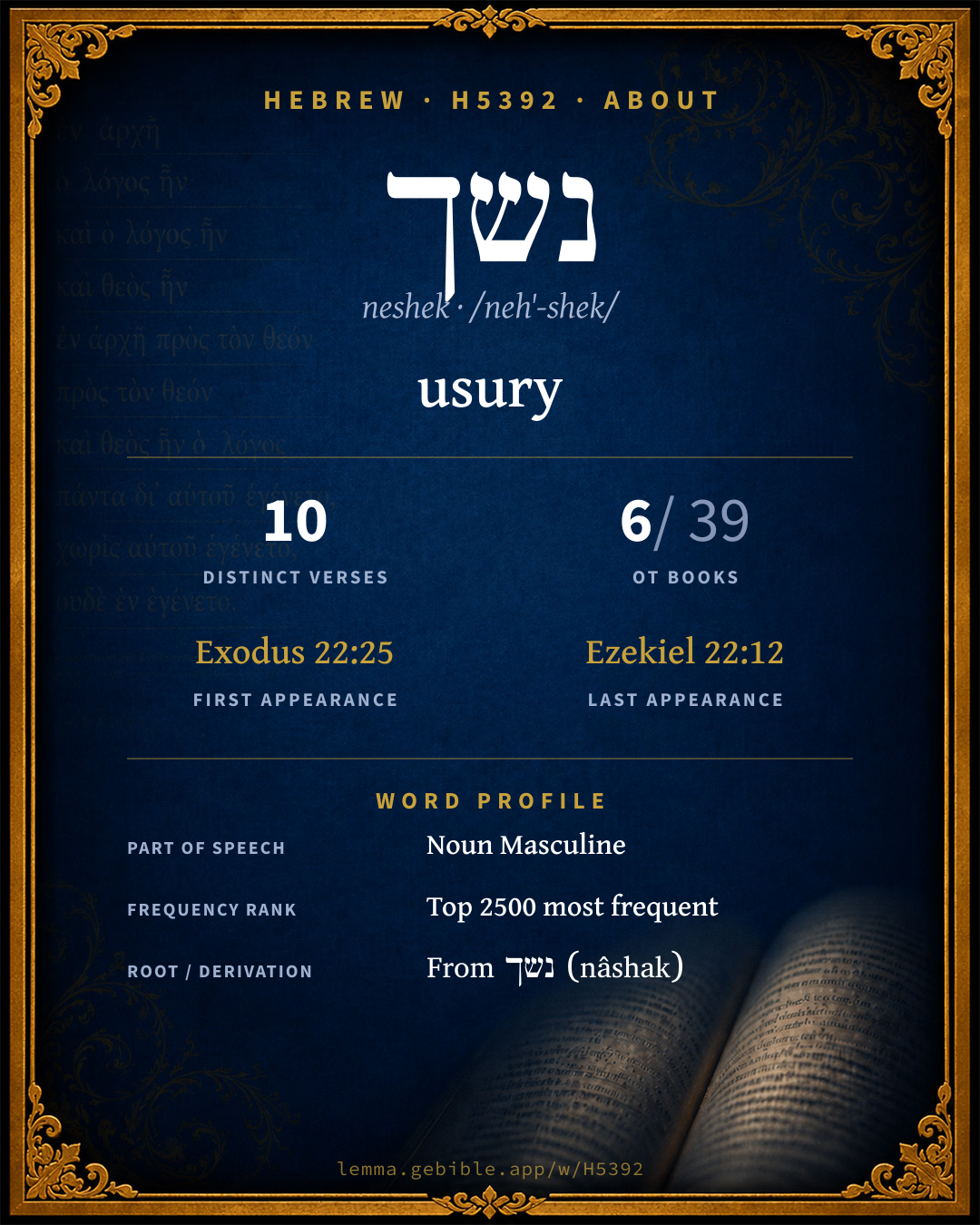
נֶ֫שֶׁךְ
usury
Full lexicon entry — Brown-Driver-Briggs (BDB)
From Brown-Driver-Briggs (BDB)
Where this word appears
Grammar key — what these labels mean
Part of speech
- Noun
- A naming word — a person, place, thing, or idea.
Noun type
- Common
- A common noun — a general class of person, place, or thing (“king,” “city,” “water”), not a specific name.
State
- Absolute
- The independent form of a noun, not bound to a following word.
- Construct
- A noun bound to a following noun in a possessive / “of” relationship (the construct chain).
Gender
- Masculine
- Grammatically masculine.
Number
- Singular
- One.
Every verse where H5392 appears in the Book of Psalms — 1 distinct verse. Click any verse to open its interlinear word-by-word view. Verse text shown in the World English Bible for context — . Each verse’s Hebrew form is shown with its reference; the English is not keyword-highlighted, since the data carries no word-level English alignment. Use “Compare translations” on any verse to read it across multiple English versions. This concordance covers the Hebrew Bible; Septuagint (Greek Old Testament) occurrences are not indexed here.
Psalms
About this entry
At a glance — auto-summarized from this page’s data, not written by a person. Every figure links to its source below. This summary describes the numbers; it doesn’t interpret them.
נשך — transliterated neshek — is a Hebrew noun carrying the sense “usury.” Where the King James Version says “usury,” newer translations reach for “interest” (Berean Standard Bible); the renderings breakdown has the detail. With 10 verses in 6 books, it is an uncommon word in the Hebrew Bible. Its uses concentrate in Ezekiel (40% of all occurrences). Debuting at Exodus 22:25, it then recurs through the corpus. The sections below give every sense, occurrence, and version rendering.
Gloss history
Strong's 1890 vs modern scholarship
About this word
Strong's H5392 catalogs a Hebrew word from the Hebrew Old Testament.
These counts are not copied from any lexicon or concordance. They are computed here, from the morphology-tagged Hebrew Old Testament. What Lemma adds →
- 10
- distinct verses
- The word appears in 10 distinct verses.
- 6 / 39
- OT books
- The word appears in 6 of 39 Old Testament books.
- #2,101
- by frequency
- Top 2500 most frequent Hebrew words (rank 2,101 of 8,640 Hebrew words by occurrence).
View all 10 occurrences in the concordance →
By section of the Old Testament
By traditional corpus
Conventional, traditional groupings — biblical authorship is debated, so this is a traditional corpus grouping, not an authorship claim. Each share is this word’s portion of its verses in that division of the Hebrew canon. Each figure is a share of the word’s 10 distinct verses.
- Torah (Pentateuch) 4 verses · 40%
- Prophets (Nevi'im) 4 verses · 40%
- Writings (Ketuvim) 2 verses · 20%
How translations render this word
Counts come from each version’s own published word-to-Strong’s tagging or interlinear alignment — an approximate guide to how each version renders this word, not a word-level alignment the data otherwise carries. Because each total is that version’s own tagged count, the per-version totals vary from one another and need not match the appearance or distinct-verse counts above. These counts may also differ from a printed concordance because Lemma counts each distinctly tagged rendering and does not collapse phrase taggings into a single head-word total. This is a fixed set of word-tagged versions (KJV, ASV, BSB, ULT) and does not change with the reading translation you choose elsewhere. Each version’s license is shown beside its name below (and on Sources).
- King James Version: Usury 10×
- American Standard Version: Interest 10×
- Berean Standard Bible: Interest 6×, Usury 3×
- unfoldingWord Literal Text: Interest 8×, Interest of 3×
King James Version Public Domain
Renders H5392 across 12 tagged occurrences — most commonly:
Plus 2 renderings that appear only once — usually multi-word phrases or single function words the recovered tagging swept in, not distinct renderings.
American Standard Version Public Domain
Renders H5392 across 11 tagged occurrences — most commonly:
Plus 1 rendering that appears only once — usually multi-word phrases or single function words the recovered tagging swept in, not distinct renderings.
Berean Standard Bible Public Domain
Renders H5392 across 10 tagged occurrences — most commonly:
Plus 1 rendering that appears only once — usually multi-word phrases or single function words the recovered tagging swept in, not distinct renderings. Not rendered by a distinct English word in 2 further occurrences.
unfoldingWord Literal Text CC BY-SA 4.0
Renders H5392 across 12 tagged occurrences — most commonly:
Plus 1 rendering that appears only once — usually multi-word phrases or single function words the recovered tagging swept in, not distinct renderings.
Senses in BDB
The 1 sense BDB distinguishes for this word, in lexicon order (not ranked by frequency or importance). The full entry — with sub-senses — is in the Lexicon Entry tab.
- interest, usury
Word origin
n.[m.] interest, usury (lit. something bitten off);—נ׳ abs. Ex 22:24 +; cstr. Dt 23:20;—c. שִׂים עַל־ Ex 22:24 (E); c. לָקַח מִן Lv 25:36, הֵשִׁיב מִן Ez 18:17, לָקַח 22:12 (no prep.), בְּנֶשֶׁךְ Lv 25:37 at interest, so ψ 15:5 Ez 18:8, 13; בְּנ׳ Pr 28:8 by usury; as acc. cogn. Dt 23:20(×3).
— Brown-Driver-Briggs (Oxford 1906, public domain), digitized via Sefaria, supplemented by the OpenScriptures HebrewLexicon (CC BY 4.0). See Sources.
Derived from נשך (nâshak) (H5391) — to bite.
Jastrow Dictionary
A second Hebrew/Aramaic lexicon for comparison, covering Aramaic and post-biblical (Talmudic, Targumic, Midrashic) usage that the biblical-Hebrew BDB does not. Matched by lemma rather than by Strong’s number, so a lemma may carry more than one Jastrow headword (shown separately below), and the entries cover usage well beyond the Bible.
נָשַךְ
- 1. to bite. Gen. R. s. 74, beg. שאינן נוֹשְׁכִין ואוכלין וכ׳ they do not bite off and eat, but out &c.; Pesik. Par., p. 34ᵃ; Koh. R. to VII, 23. Pirké d’R. El. ch. XXXVII אל תהי קורא וישקהו אלא וַיִּשָּׁכֵהוּ read not, ‘and he kissed him’ (Gen. XXXIII, 4) but, ‘and he bit him.’ Tosef. B. Kam. I, 5 אינה מועדת … לִישּׁוֹךְ is not considered as forewarned (v. מוּעָד) as regards … biting; a. fr.—Part. pass. נָשׁוּךְ, f. נְשׁוּכָה &c. Num. R. s. 20 רופא … בלשונו נְשׁוּךְ נחש a physician that comes to heal with his tongue (charm) one bitten by a serpent. Ter. VIII, 6 נְשׁוּכַת הנחש וכ׳ any food showing traces of being bitten at by a serpent is forbidden &c.; a. fr.—Trnsf. to adhere to, be affixed. Pes. 48ᵇ ככרות … שנוֹשְׁכוֹת זו מזו Babylonian loaves which stick to one another; T’bul Yom I, 1 נושכות זו בזו; Ḥall. II, 4 עד שיִשּׁוֹכוּ (Nif.) until the pieces of dough have grown together in rising, contrad. to נגע. Sabb. 17ᵃ הנושכות clusters of grapes which stick together (and cannot be separated without squeezing some grapes open); a. fr.—Part. pass. as ab. Y. Ḥall. I, 57ᵇ בנ׳ if refers to pieces of dough sticking together, contrad. to בלול kneaded. Ib. III, 59ᶜ top עיסת הנ׳ dough made one lump by sticking; נ׳ מאליו sticking together of itself (by rising), opp. הִשִּׁיכוֹ בידו he pasted it together with his hand. Ib. 58ᵇ bot., sq. הנָ׳ תורה the liability to T’rumah, Ḥallah &c. of joined lumps of dough is Biblical law. Y. Kil. IX, end, 32ᵈ אין אסור אלא נ׳ בלבד the combination of heterogeneous materials (כִּלְאַיִם) is forbidden only when they are interlaced. Ib. וההן נו נ׳, v. נוּ. e.g. Genesis 33:4
- 2. (denom. of נֶשֶׁךְ) to take interest. B. Mets. V, 1; a. e.
- same, to bite. Gen. R. s. 78 לנַשְּׁכוֹ to bite him. Tanḥ. Vayishl. 4 וינַשְּׁכֶנּוּ and may bite him; a. e.—Part. pass. מְנוּשָּׁךְ. Tosef. B. Kam. III, 6 או מ׳ or he is found to have been bitten.
- 1. to cause to bite. Snh. IX, 1 ה׳ בו וכ׳ he brought the serpent near him to bite him, contrad. to שיסה to set on. Ib. 78ᵃ; B. Kam. 23ᵇ, v. נָכַשׁ. Y. Yeb. VIII, 9ᵇ top [read:] מביא נמלין ומַשִּׁיכָן וקוצץ he gets ants and makes them bite (the open wound) and cuts their bodies off (and so the gap is filled), v. Bab. ib. 76ᵃ.—Trnsf. to paste or press together. Y. Ḥall. III, 59ᶜ top, v. מביא ארבע רובעין ומַשִּׁיךְ he takes four lumps of dough which joined contain four fourths of a Kab and presses them together into one lump; a. e.
- 2. to pay interest. B. Mets. 70ᵇ (ref. to Deut. XXIII, 21) מאי תשיך לאו תִּשּׁוֹךְ לא תַּשִּׁיךְ what is meant by tashshikh? Does it not mean thou mayest (or must) take interest? No, it means, thou mayest (or must) pay him interest. e.g. Deuteronomy 23:21
נֶשֶׁךְ
- preced.) [bite, trnsf., cmp. חִבּוּלְיָא) usury, interest. B. Mets. V, 1 איזהו נ׳ המלוה וכ׳ what is neshekh? If one loans a Sela stipulating the debt at five Denars, contrad. to תַּרְבִּית. Ib. 60ᵇ נ׳ איכא דקא נכית וכ׳ in this case it is neshekh, for he bites (injures the debtor) by receiving what he had not given him; a. fr.
A Dictionary of the Targumim, the Talmud Babli and Yerushalmi, and the Midrashic Literature (Marcus Jastrow; London, Luzac, 1903) — Public Domain. Digitized via Sefaria. Digitized via Sefaria. Full attribution on Sources.
Forms in the corpus
The 11 distinct written forms H5392 takes in the Hebrew Bible, most frequent first — each parse links to that state’s occurrences in the concordance. Hebrew forms include their vowel points and cantillation, so a single lemma takes many written forms.
| Form | Parsing | Example | Uses |
|---|---|---|---|
| נֶ֣שֶׁךְ | Noun, Common, Masculine, Singular, Absolute | Leviticus 25:36 | 2 |
| בְּ/נֶ֑שֶׁךְ | Noun, Common, Masculine, Singular, Absolute | Leviticus 25:37 | 1 |
| בְּ/נֶ֣שֶׁךְ | Noun, Common, Masculine, Singular, Absolute | Proverbs 28:8 | 1 |
| בְּ/נֶשֶׁךְ֮ | Noun, Common, Masculine, Singular, Absolute | Psalms 15:5 | 1 |
| בַּ/נֶּ֣שֶׁךְ | Noun, Common, Masculine, Singular, Absolute | Ezekiel 18:8 | 1 |
| בַּ/נֶּ֧שֶׁךְ | Noun, Common, Masculine, Singular, Absolute | Ezekiel 18:13 | 1 |
| נֶ֕שֶׁךְ | Noun, Common, Masculine, Singular, Construct | Deuteronomy 23:19 | 1 |
| נֶ֤שֶׁךְ | Noun, Common, Masculine, Singular, Absolute | Ezekiel 18:17 | 1 |
| נֶ֥שֶׁךְ | Noun, Common, Masculine, Singular, Construct | Deuteronomy 23:19 | 1 |
| נֶ֧שֶׁךְ | Noun, Common, Masculine, Singular, Absolute | Ezekiel 22:12 | 1 |
| נֶֽשֶׁךְ | Noun, Common, Masculine, Singular, Absolute | Exodus 22:25 | 1 |
Septuagint verse parallels
This word appears in 10 verses that also exist in the Greek Old Testament (Septuagint), out of the 10 Hebrew verses it occurs in. You can read those verses in Greek by switching the Old Testament edition to the Septuagint.
Read these verses in the Septuagint
This is a verse-level parallel only — the same verses exist in both the Hebrew and Greek Old Testaments. No word-level Hebrew↔Greek correspondence is claimed: the data carries no such alignment, so no Greek word is shown as this Hebrew word’s translation. Coverage is not total — the Septuagint omits the deuterocanon and renumbers the Psalms, so some Hebrew verses have no direct Greek parallel.