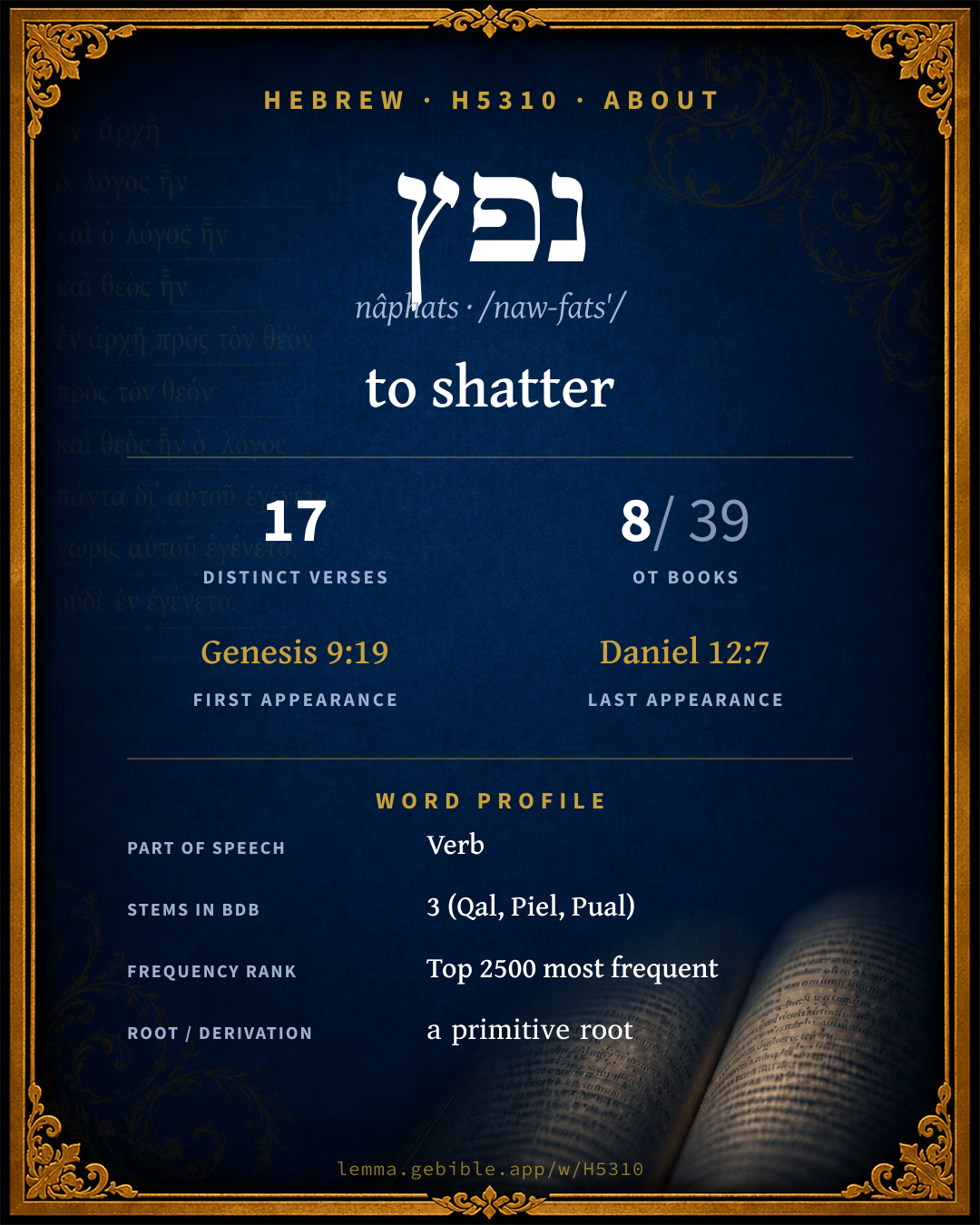
נָפַץ
to shatter
also: break, dash, beat in pieces fuller range ↓
Full lexicon entry — Brown-Driver-Briggs (BDB)
From Brown-Driver-Briggs (BDB)
Where this word appears
Grammar key — what these labels mean
Part of speech
- Verb
- An action or state-of-being word.
Stem
- Piel
- An intensive or resultative active stem. Here: ‘dash to pieces’
- Niphal
- Usually the simple passive or reflexive of the Qal (“he was written”).
- Qal
- The basic, simple active stem — the plain form of the verb (“he wrote”).
- Pual
- The passive counterpart of the Piel.
Form
- Sequential Perfect
- A perfect with prefixed waw continuing a preceding imperfect or command (waw-consecutive perfect).
- Participle Active
- A verbal adjective expressing ongoing or characteristic action (“writing / one who writes”).
- Infinitive Absolute
- An unbound verbal noun, often intensifying or standing in for a finite verb.
- Participle Passive
- A verbal adjective expressing action received (“written”).
- Infinitive Construct
- A bound verbal noun, frequently with prepositions (“to write / in writing”).
- Imperfect
- An incomplete, ongoing, or future action (“he will / would write”).
- Perfect
- A completed action or state — Hebrew marks aspect (completeness) more than strict tense (“he wrote”).
State
- Construct
- A noun bound to a following noun in a possessive / “of” relationship (the construct chain).
- Absolute
- The independent form of a noun, not bound to a following word.
Person
- 1st Person
- The speaker (“I / we”).
- 3rd Person
- The one spoken about (“he / she / it / they”).
- 2nd Person
- The one addressed (“you”).
Gender
- Common
- Either gender — not distinguished for this form.
- Feminine
- Grammatically feminine.
- Masculine
- Grammatically masculine.
Number
- Singular
- One.
- Plural
- More than one (in Hebrew, generally three or more).
Every verse where H5310 appears in the Book of Genesis — 1 distinct verse. Click any verse to open its interlinear word-by-word view. Verse text shown in the World English Bible for context — . Each verse’s Hebrew form is shown with its reference; the English is not keyword-highlighted, since the data carries no word-level English alignment. Use “Compare translations” on any verse to read it across multiple English versions. This concordance covers the Hebrew Bible; Septuagint (Greek Old Testament) occurrences are not indexed here.
Genesis
About this entry
At a glance — auto-summarized from this page’s data, not written by a person. Every figure links to its source below. This summary describes the numbers; it doesn’t interpret them.
נפץ — transliterated nâphats — is a Hebrew verb carrying the sense “to shatter.” Where the King James Version says “thee will i break in pieces,” newer translations reach for “i shatter” (Berean Standard Bible); the renderings breakdown has the detail. The Hebrew Bible uses it across 17 verses — uncommon. More than a third of its appearances fall in Jeremiah. Across 3 stems, its meaning turns on the binyan (Qal, Piel). See the sense tree, 17-verse concordance, and the renderings breakdown below.
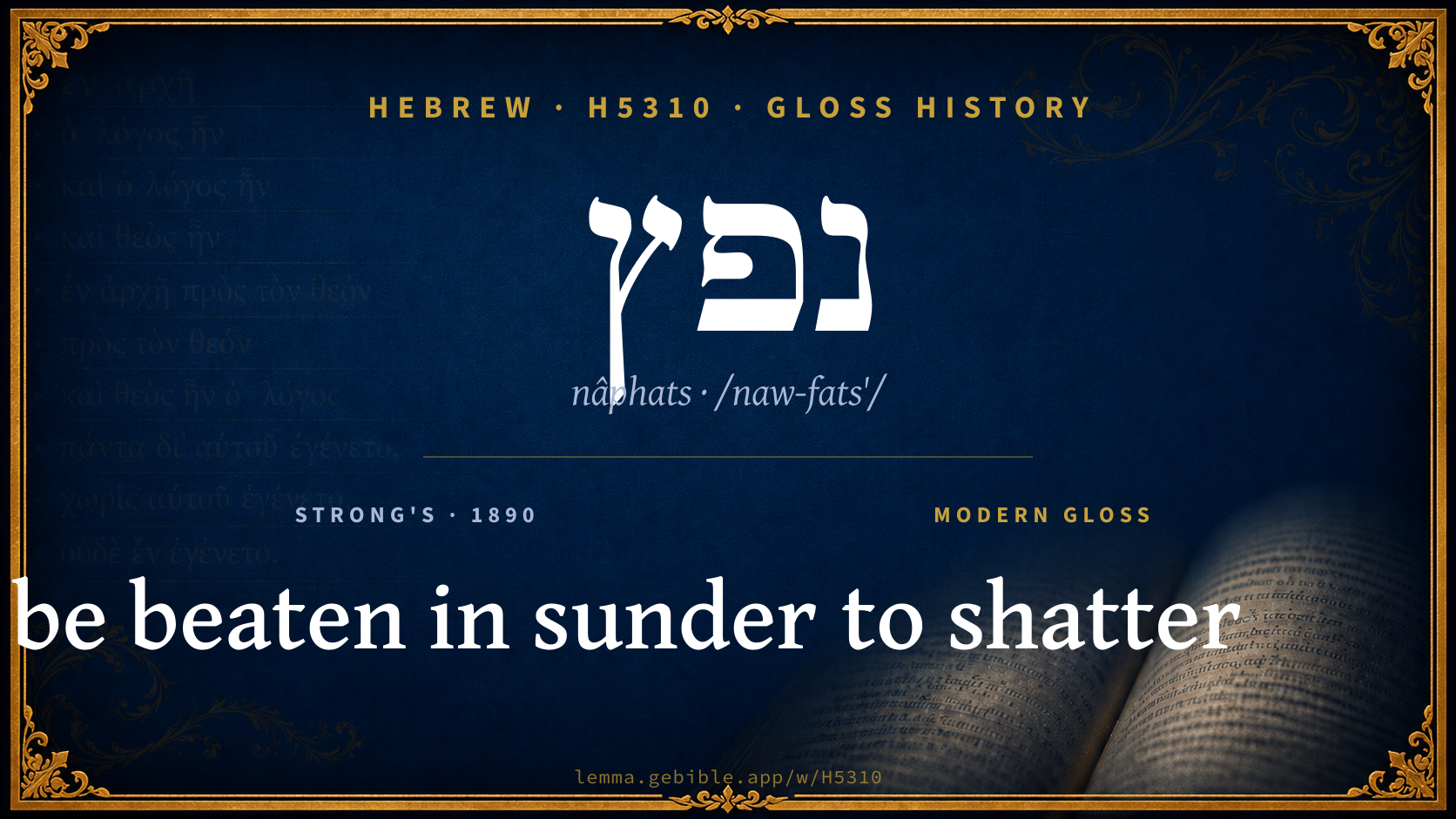
Gloss history
Strong's 1890 vs modern scholarship
About this word
Strong's H5310 catalogs a Hebrew word from the Hebrew Old Testament.
These counts are not copied from any lexicon or concordance. They are computed here, from the morphology-tagged Hebrew Old Testament. What Lemma adds →
- 17
- distinct verses
- The word appears in 17 distinct verses.
- 8 / 39
- OT books
- The word appears in 8 of 39 Old Testament books.
- #1,412
- by frequency
- Top 2500 most frequent Hebrew words (rank 1,412 of 8,640 Hebrew words by occurrence).
View all 17 occurrences in the concordance →
By section of the Old Testament
By traditional corpus
Conventional, traditional groupings — biblical authorship is debated, so this is a traditional corpus grouping, not an authorship claim. Each share is this word’s portion of its verses in that division of the Hebrew canon. Each figure is a share of the word’s 17 distinct verses.
- Prophets (Nevi'im) 13 verses · 76%
- Writings (Ketuvim) 3 verses · 18%
- Torah (Pentateuch) 1 verse · 6%
How translations render this word
Counts come from each version’s own published word-to-Strong’s tagging or interlinear alignment — an approximate guide to how each version renders this word, not a word-level alignment the data otherwise carries. Because each total is that version’s own tagged count, the per-version totals vary from one another and need not match the appearance or distinct-verse counts above. These counts may also differ from a printed concordance because Lemma counts each distinctly tagged rendering and does not collapse phrase taggings into a single head-word total. This is a fixed set of word-tagged versions (KJV, ASV, BSB, ULT) and does not change with the reading translation you choose elsewhere. Each version’s license is shown beside its name below (and on Sources).
BDB lists this Strong’s number as 2 distinct words (homographs). Each count above pools all of them and is not split by sense — see the Senses section below. A low-frequency rendering may belong to a different one of those words, not the primary meaning.
- King James Version†: Thee will i break in pieces 7×, Were scattered 2×
- American Standard Version†: Thee will i break in pieces 8×
- Berean Standard Bible†: I shatter 9×, Shattered 2×
- unfoldingWord Literal Text†: Shattered 2×
King James Version Public Domain
Renders H5310 across 22† tagged occurrences — most commonly:
Plus 13 renderings that appear only once — usually multi-word phrases or single function words the recovered tagging swept in, not distinct renderings.
American Standard Version Public Domain
Renders H5310 across 22† tagged occurrences — most commonly:
Plus 14 renderings that appear only once — usually multi-word phrases or single function words the recovered tagging swept in, not distinct renderings.
Berean Standard Bible Public Domain
Renders H5310 across 22† tagged occurrences — most commonly:
Plus 11 renderings that appear only once — usually multi-word phrases or single function words the recovered tagging swept in, not distinct renderings.
unfoldingWord Literal Text CC BY-SA 4.0
Renders H5310 across 13† tagged occurrences — most commonly:
Plus 11 renderings that appear only once — usually multi-word phrases or single function words the recovered tagging swept in, not distinct renderings.
Senses in the full BDB
Hebrew verbs can shift meaning by stem (binyan): Qal is the basic action, Niphal is often passive or reflexive, Piel often intensifies or makes it factitive, and Hiphil is typically causative. The senses below are grouped under the stem BDB assigns to each. This entry also uses Pual (the passive of Piel).
What do BDB’s symbols mean?
BDB uses these scholarly abbreviations:
| Symbol | Meaning |
|---|---|
| 𝔊 | the Septuagint (the ancient Greek translation, LXX) |
| 𝔙 | the Vulgate (the Latin translation) |
| 𝔖 | the Syriac version (the Peshitta) |
| 𝔗 | the Targum (the Aramaic translation) |
| ψ | the Psalms |
| √ | root (the underlying root or stem) |
| ‖ | parallel passage (a synonymous or contrasted parallel) |
| † | the dagger: every passage where the word occurs is cited |
The 4 senses and sub-senses the full Brown-Driver-Briggs lexicon distinguishes for this word, in lexicon order (not ranked by frequency), with BDB’s own verbatim wording and sub-sense lettering. Shown in Hebrew script with BDB’s own scholarly abbreviations. The condensed entry is in the Lexicon Entry tab. See also the Forms in the corpus table below.
נפץ I shatter (NH id., dash, beat
Qal
- Inf. abs. וְנָפוֹץ c. acc. Ju 7:19 and a shattering (= and shattered) the jars; Pt. pass. עֶצֶב נִבְזֶה נָפוּץ Je 22:28 (fig.) a vessel to be despised (and) shattered (cf. Ew Gie Rothstein Kau); also Pt. act. נֹפֵץ shatterer of the holy people Dn 12:7 (Bev MartiKau, reading כִּכְלוֹת יַד נֹפֵץ). e.g. Judges 7:19
Piel
- dash to pieces: Pf. 3 ms. וְנִפֵּץ consec. ψ 137:9 c. acc. infants ag. (אֶל) rock; 1 s. וְנִפַּצְתִּ֫י of י׳ dashing all in pieces with (ב) Babyl. as war-club Je 51:20, 21(×2), 22(×3) 23(×3); sf. וְנִפַּצְתִּים אִיּשׁ אֶל־אָחִיו 13:14; Impf. 2 ms. sf. כִּכְלִי יוֹצֵר תְּנַפְּצֵם ψ 2:9 (i.e. nations); 3 mpl. נִבְלֵיהֶם יְנַפֵּ֑צוּ Je 48:12 (symbol. of destroying Moab); Inf. נַפֵּץ יַד־עַם־קֹדֶשׁ Dn 12:7 when (they) finish shattering the hand (fig. for power) of the holy people, but read poss. נֹפֵץ, v. Qal.; = break up rafts 1 K 5:23. e.g. Psalms 137:9
Pual
- Pt. fpl. מְנֻפָּצוֹת Is 27:9 like chalk-stones pulverized. e.g. Isaiah 27:9
נפץ II disperse, be scattered (often taken as secondary √ from Niph. of פוץ, yet cf. NH נפץ, Qal (Pt.), Pi., scatter
Qal
- Pf. 3 ms. נ׳ הָעָם מֵעָלַי 1 S 13:11 the people were scattered from me; 3 fs. נָֽפְצָה כָל־הָאָרֶץ Gn 9:19 (J) thence dispersed all (the population of) the earth; 3 pl. נָֽפְצוּ גּוֹיִם Is 33:3 nations were scattered; Pt. pass. fpl. cstr. נְפֻצוֹת יְהוּדָה Is 11:12 the dispersed of Judah (‖ נִדְחֵי יִשְׂרָאֵל)—v. I. [פּוּץ] for 2 S 18:8. e.g. 1 Samuel 13:11
Senses from the full Brown-Driver-Briggs lexicon (Brown, Driver, Briggs; Oxford 1906 — public domain), digitized via Sefaria, supplemented by the OpenScriptures HebrewLexicon (CC BY 4.0). Full attribution on Sources.
Word origin
I. vb. shatter (NH id., dash, beat; Assyrian napâṣu, shatter, destroy DlHWB 475; 𝔗 נְפַע Pa. shatter, but also נְפַץ Pa., id., Syriac ܢܦܰܨ shake, break, so Mand., NöM 240, and ZMG xxxii (1878), 406);—
II. vb. disperse, be scattered (often taken as secondary √ from Niph. of פוץ, yet cf. NH נפץ, Qal (Pt.), Pi., scatter; Syriac ܢܦܰܨ pour out, throw down, 𝔗 נְפַץ; Arabic نَفَضَ shake (irreg. correspondence of sibilants cf. Nö l.c.), Ethiopic ነፍጸ: dissipari, aufugere Di 713);—
— Brown-Driver-Briggs (Oxford 1906, public domain), digitized via Sefaria, supplemented by the OpenScriptures HebrewLexicon (CC BY 4.0). See Sources.
Origin: a primitive root
Jastrow Dictionary
A second Hebrew/Aramaic lexicon for comparison, covering Aramaic and post-biblical (Talmudic, Targumic, Midrashic) usage that the biblical-Hebrew BDB does not. Matched by lemma rather than by Strong’s number, so a lemma may carry more than one Jastrow headword (shown separately below), and the entries cover usage well beyond the Bible.
נָפַץ
- to scatter, shake out, empty. Bicc. I, 8 נוֹפֵץ וכ׳ he scatters them on the ground, and does not read. Tosef. B. Bath. IV, 2 נוֹפְצוֹ he shakes the bag out. Keth. 72ᵃ (the Mishnah means) שתִּמָּלֵא ונוֹפֶצֶת that she should receive (the semen) and then discharge it (by violent movements); a. e.
- 1. same. Kil. V, 7 יְנַפֵּץ he must shake the grain out of the ears; Y. ib. 30ᵃ bot. Deut. R. s. 3 וִינַפַּץ אבני וכ׳ and scatter the stones prepared for rebuilding the Temple. Lev. R. s. 10; s. 19 בשעה שאתה מְנַפְּצוֹ אין וכ׳ as soon as you shake it out (of its marrow), it is good for nothing. Midr. Till. to Ps. XVII אני מְנַפֵּץ … כשם שאתה נִפַּצְתָּ וכ׳ I will dash thy babes against the rock, as thou didst my babes; a. e.
- 2. (interch. with נפס) to beat flax, to hatchel wool. Sabb. XIII, 4 והמְנַפֵּץ (Y. ed. a. Ar. המְנַפֵּס). Ib. VII, 2. Ib. 73ᵇ, v. נָפַט. Ber. 58ᵃ ונִפֵּץ; Tosef. ib. VII (VI), 2 וניפס, ed. Zuck. (Var. נפץ); Y. ib. IX, 13ᶜ top וניפס; a. fr.
- 3. to spread. Midr. Till. to Ps. XXII מְנַפֶּצֶת, v. נָצַץ.
נְפַץ
- 1. to scatter, shake out. Targ. O. Gen. XXIV, 20 (ed. Berl. נְפַצַּת). Targ. Jud. VI, 38 ed. Lag. (ed. נפק, incorr.).—Nidd. 31ᵃ (prov.) פּוּץ מלחא ושדי וכ׳ shake the salt off, and throw the meat to the dog (when life escapes, the body decays). Gen. R. s. 36 (ref. to נפצה, Gen. IX, 19) לדגה … דנַפְצָה עוברה וכ׳ like a large fish that scatters its roe &c.; a. e.—Snh. 67ᵇ דנָפֵיץ (Rashi מְנַפֵּץ) he scattered, i.e. blew his nose e.g. Genesis 9:19
- 2. to shatter, break. Targ. Jud. VII, 19.
- 3. to beat, hatchel. Yoma 20ᵇ, v. אֲגַר II.—Part. pass. נְפִיץ. Ḥull. 51ᵇ, a. e. כיתנא דדייק ולא נ׳ flax which has been pounded, but not carded (freed of hard substances).
- 4. to snap a chalked cord for marking. Targ. Is. XLIV, 13.
- same. Targ. Jer. LI, 34.—Ib. XXIII, 29, v. נְפַע.—Targ. Esth. I, 11 ומְנַפְּסָן.—Part. pass. מְנַפַּץ. Targ. Is. XXVII, 9.—B. Kam. 93ᵇ נַפְּצֵיה נַפּוּצֵי, v. סְרַק II. Sabb. 147ᵃ מְנַפְּצֵי גלימייהו shaking their cloaks. Ib. נַפּוּצוּ וכ׳ shake them in his face. Ḥull. 113ᵃ ומְנַפֵּיץ ליה and shakes the salt off. Ib. 76ᵇ נַפְּצֵיה וכ׳ he split it, and found two nerves; a. e.—[B. Bath. 45ᵃ מפצי; Keth. 91ᵇ, sq. מפצינא, v. פְּצָא.]
A Dictionary of the Targumim, the Talmud Babli and Yerushalmi, and the Midrashic Literature (Marcus Jastrow; London, Luzac, 1903) — Public Domain. Digitized via Sefaria. Digitized via Sefaria. Full attribution on Sources.
Forms in the corpus
The 16 distinct written forms H5310 takes in the Hebrew Bible, most frequent first — each parse links to that stem’s occurrences in the concordance. Hebrew forms include their vowel points and cantillation, so a single lemma takes many written forms.
Same root — word family
Other BDB entries built from the same root as H5310, grouped by Strong’s listed origin. These share a root / origin per the lexicon — not necessarily a shared meaning. Each links to that word’s own entry.
Derived from this word
Compare all same-root words → They share a root, not necessarily a meaning.
Septuagint verse parallels
This word appears in 16 verses that also exist in the Greek Old Testament (Septuagint), out of the 17 Hebrew verses it occurs in. You can read those verses in Greek by switching the Old Testament edition to the Septuagint.
Read these verses in the Septuagint
- Genesis 9:19
- Judges 7:19
- 1 Samuel 13:11
- 1 Kings 5:9
- Psalms 2:9
- Isaiah 11:12
- Jeremiah 13:14
- Daniel 12:7
This is a verse-level parallel only — the same verses exist in both the Hebrew and Greek Old Testaments. No word-level Hebrew↔Greek correspondence is claimed: the data carries no such alignment, so no Greek word is shown as this Hebrew word’s translation. Coverage is not total — the Septuagint omits the deuterocanon and renumbers the Psalms, so some Hebrew verses have no direct Greek parallel.