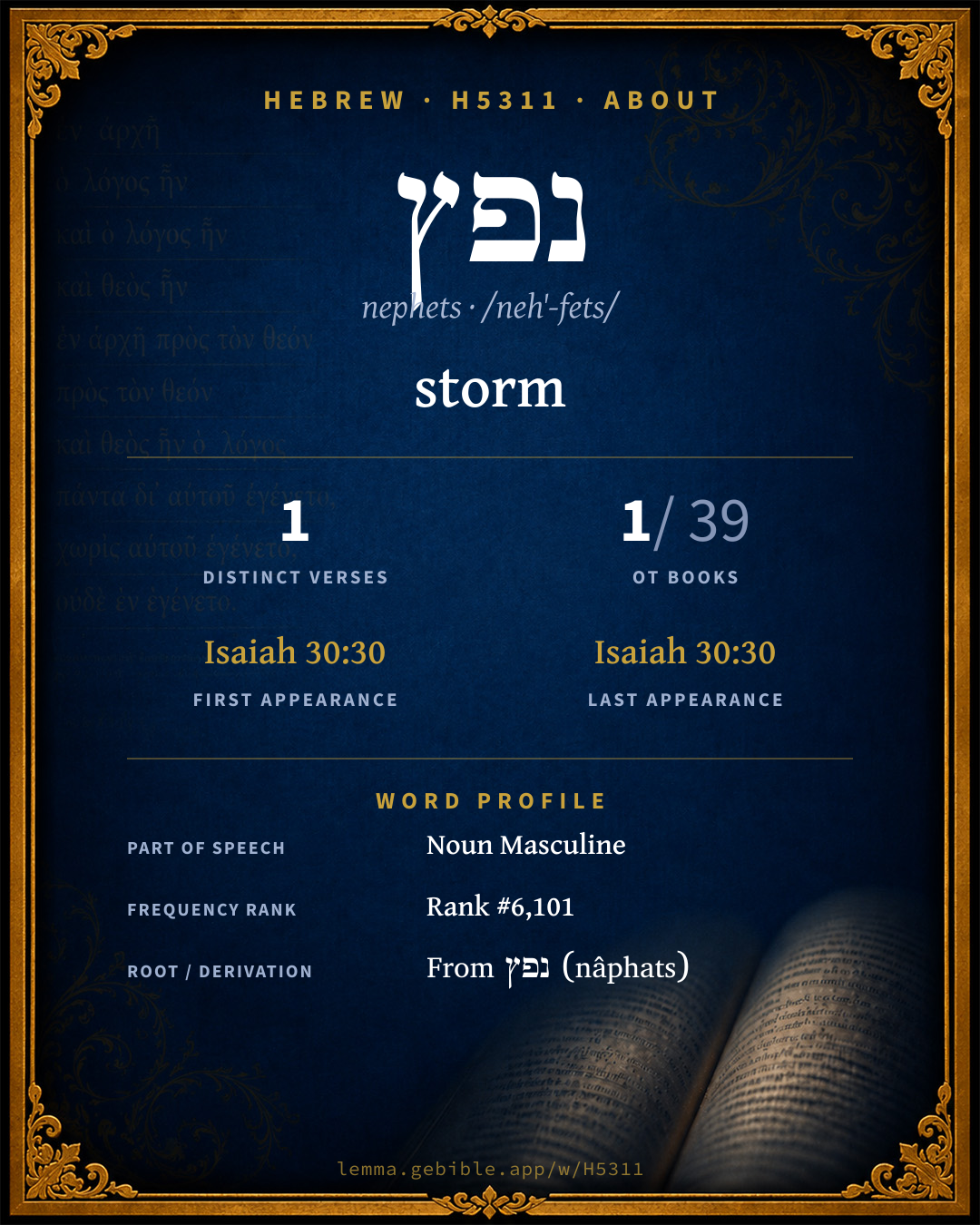
נֶ֫פֶץ
storm
Full lexicon entry — Brown-Driver-Briggs (BDB)
From Brown-Driver-Briggs (BDB)
Where this word appears
Grammar key — what these labels mean
Part of speech
- Noun
- A naming word — a person, place, thing, or idea.
Noun type
- Common
- A common noun — a general class of person, place, or thing (“king,” “city,” “water”), not a specific name.
State
- Absolute
- The independent form of a noun, not bound to a following word.
Gender
- Masculine
- Grammatically masculine.
Number
- Singular
- One.
Every verse where H5311 appears — 1 distinct verse across 1 book. Click any verse to open its interlinear word-by-word view. Verse text shown in the World English Bible for context — . Each verse’s Hebrew form is shown with its reference; the English is not keyword-highlighted, since the data carries no word-level English alignment. Use “Compare translations” on any verse to read it across multiple English versions. This concordance covers the Hebrew Bible; Septuagint (Greek Old Testament) occurrences are not indexed here.
Isaiah 1 verse
About this entry
At a glance — auto-summarized from this page’s data, not written by a person. Every figure links to its source below. This summary describes the numbers; it doesn’t interpret them.
The Hebrew noun נפץ centers on the idea of “storm.” It occurs a mere 1 verse across Scripture. The word gravitates to Isaiah (100%). A true hapax — its single appearance is Isaiah 30:30. It shares a root with נפץ, מפץ and מפץ. For the data behind this summary, explore the sense tree and the renderings breakdown below.
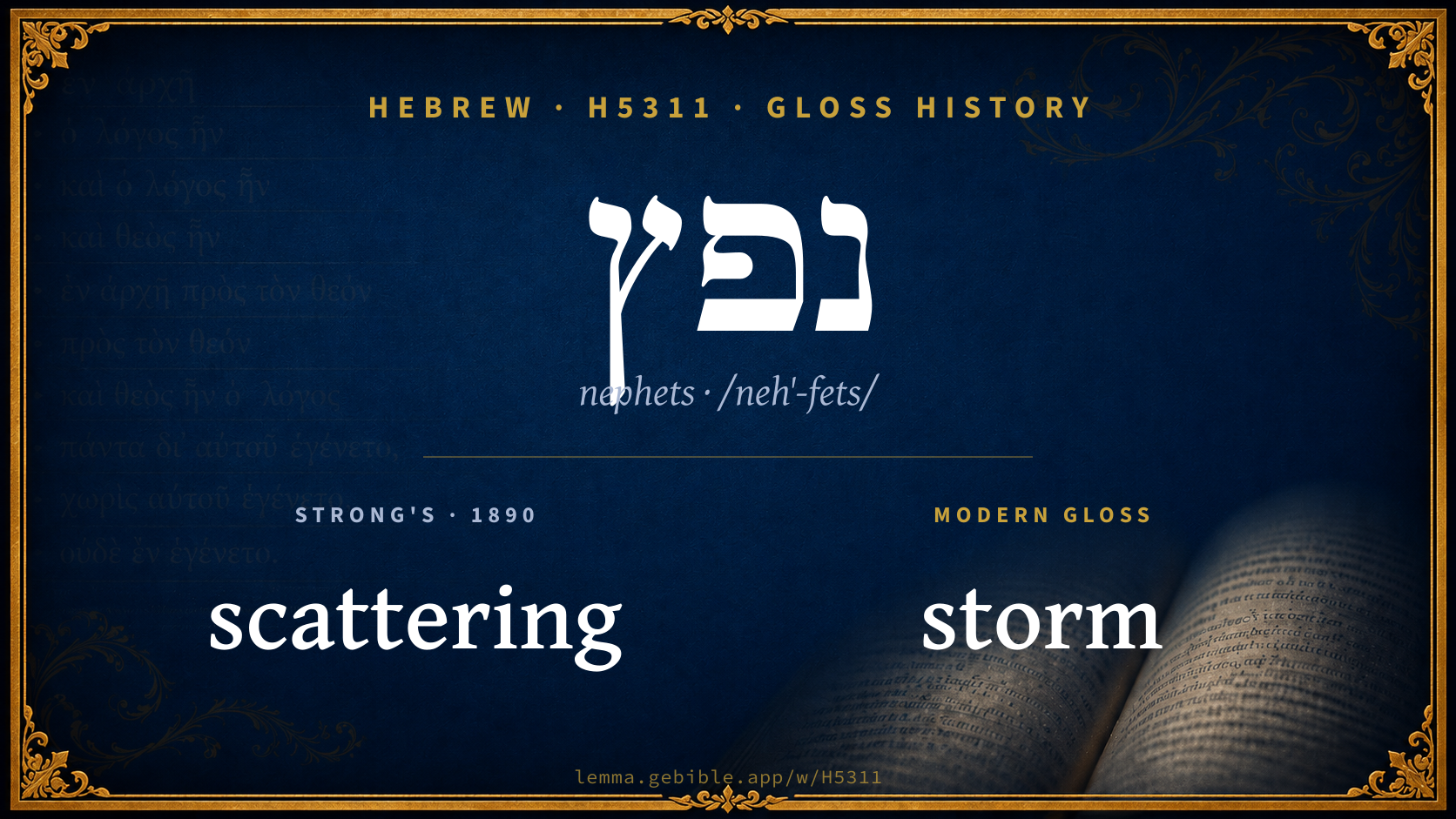
Gloss history
Strong's 1890 vs modern scholarship
About this word
Strong's H5311 catalogs a Hebrew word from the Hebrew Old Testament.
These counts are not copied from any lexicon or concordance. They are computed here, from the morphology-tagged Hebrew Old Testament. What Lemma adds →
- 1
- distinct verses
- The word appears in 1 distinct verse.
- 1 / 39
- OT books
- The word appears in 1 of 39 Old Testament books.
- #6,101
- by frequency
- Rank #6,101 (rank 6,101 of 8,640 Hebrew words by occurrence).
View all 1 occurrence in the concordance →
Most concentrated in
- Isaiah 1 verse 100%
By section of the Old Testament
By traditional corpus
Conventional, traditional groupings — biblical authorship is debated, so this is a traditional corpus grouping, not an authorship claim. Each share is this word’s portion of its verses in that division of the Hebrew canon. Each figure is a share of the word’s 1 distinct verse.
- Prophets (Nevi'im) 1 verse · 100%
How translations render this word
Counts come from each version’s own published word-to-Strong’s tagging or interlinear alignment — an approximate guide to how each version renders this word, not a word-level alignment the data otherwise carries. Because each total is that version’s own tagged count, the per-version totals vary from one another and need not match the appearance or distinct-verse counts above. These counts may also differ from a printed concordance because Lemma counts each distinctly tagged rendering and does not collapse phrase taggings into a single head-word total. This is a fixed set of word-tagged versions (KJV, ASV, BSB, ULT) and does not change with the reading translation you choose elsewhere. Each version’s license is shown beside its name below (and on Sources).
- King James Version: Scattering 1×
- American Standard Version: Blast 1×
- Berean Standard Bible: Cloudburst 1×
- unfoldingWord Literal Text: Cloudburst 1×
King James Version Public Domain
Renders H5311 across 1 tagged occurrence — most commonly:
American Standard Version Public Domain
Renders H5311 across 1 tagged occurrence — most commonly:
Berean Standard Bible Public Domain
Renders H5311 across 1 tagged occurrence — most commonly:
unfoldingWord Literal Text CC BY-SA 4.0
Renders H5311 across 1 tagged occurrence — most commonly:
Senses in BDB
The 1 sense BDB distinguishes for this word, in lexicon order (not ranked by frequency or importance). The full entry — with sub-senses — is in the Lexicon Entry tab.
- driving storm
Word origin
n.[m.] driving storm (lit. bursting of clouds, Che Comm.), נ׳ וָזֶרֶם וְאֶבֶן בָּרָד Is 30:30 (theoph).
— Brown-Driver-Briggs (Oxford 1906, public domain), digitized via Sefaria, supplemented by the OpenScriptures HebrewLexicon (CC BY 4.0). See Sources.
Derived from נפץ (nâphats) (H5310) — to shatter.
Jastrow Dictionary
A second Hebrew/Aramaic lexicon for comparison, covering Aramaic and post-biblical (Talmudic, Targumic, Midrashic) usage that the biblical-Hebrew BDB does not. Matched by lemma rather than by Strong’s number, so a lemma may carry more than one Jastrow headword (shown separately below), and the entries cover usage well beyond the Bible.
נָפַץ
- to scatter, shake out, empty. Bicc. I, 8 נוֹפֵץ וכ׳ he scatters them on the ground, and does not read. Tosef. B. Bath. IV, 2 נוֹפְצוֹ he shakes the bag out. Keth. 72ᵃ (the Mishnah means) שתִּמָּלֵא ונוֹפֶצֶת that she should receive (the semen) and then discharge it (by violent movements); a. e.
- 1. same. Kil. V, 7 יְנַפֵּץ he must shake the grain out of the ears; Y. ib. 30ᵃ bot. Deut. R. s. 3 וִינַפַּץ אבני וכ׳ and scatter the stones prepared for rebuilding the Temple. Lev. R. s. 10; s. 19 בשעה שאתה מְנַפְּצוֹ אין וכ׳ as soon as you shake it out (of its marrow), it is good for nothing. Midr. Till. to Ps. XVII אני מְנַפֵּץ … כשם שאתה נִפַּצְתָּ וכ׳ I will dash thy babes against the rock, as thou didst my babes; a. e.
- 2. (interch. with נפס) to beat flax, to hatchel wool. Sabb. XIII, 4 והמְנַפֵּץ (Y. ed. a. Ar. המְנַפֵּס). Ib. VII, 2. Ib. 73ᵇ, v. נָפַט. Ber. 58ᵃ ונִפֵּץ; Tosef. ib. VII (VI), 2 וניפס, ed. Zuck. (Var. נפץ); Y. ib. IX, 13ᶜ top וניפס; a. fr.
- 3. to spread. Midr. Till. to Ps. XXII מְנַפֶּצֶת, v. נָצַץ.
נְפַץ
- 1. to scatter, shake out. Targ. O. Gen. XXIV, 20 (ed. Berl. נְפַצַּת). Targ. Jud. VI, 38 ed. Lag. (ed. נפק, incorr.).—Nidd. 31ᵃ (prov.) פּוּץ מלחא ושדי וכ׳ shake the salt off, and throw the meat to the dog (when life escapes, the body decays). Gen. R. s. 36 (ref. to נפצה, Gen. IX, 19) לדגה … דנַפְצָה עוברה וכ׳ like a large fish that scatters its roe &c.; a. e.—Snh. 67ᵇ דנָפֵיץ (Rashi מְנַפֵּץ) he scattered, i.e. blew his nose e.g. Genesis 9:19
- 2. to shatter, break. Targ. Jud. VII, 19.
- 3. to beat, hatchel. Yoma 20ᵇ, v. אֲגַר II.—Part. pass. נְפִיץ. Ḥull. 51ᵇ, a. e. כיתנא דדייק ולא נ׳ flax which has been pounded, but not carded (freed of hard substances).
- 4. to snap a chalked cord for marking. Targ. Is. XLIV, 13.
- same. Targ. Jer. LI, 34.—Ib. XXIII, 29, v. נְפַע.—Targ. Esth. I, 11 ומְנַפְּסָן.—Part. pass. מְנַפַּץ. Targ. Is. XXVII, 9.—B. Kam. 93ᵇ נַפְּצֵיה נַפּוּצֵי, v. סְרַק II. Sabb. 147ᵃ מְנַפְּצֵי גלימייהו shaking their cloaks. Ib. נַפּוּצוּ וכ׳ shake them in his face. Ḥull. 113ᵃ ומְנַפֵּיץ ליה and shakes the salt off. Ib. 76ᵇ נַפְּצֵיה וכ׳ he split it, and found two nerves; a. e.—[B. Bath. 45ᵃ מפצי; Keth. 91ᵇ, sq. מפצינא, v. פְּצָא.]
A Dictionary of the Targumim, the Talmud Babli and Yerushalmi, and the Midrashic Literature (Marcus Jastrow; London, Luzac, 1903) — Public Domain. Digitized via Sefaria. Digitized via Sefaria. Full attribution on Sources.
Same root — word family
Other BDB entries built from the same root as H5311, grouped by Strong’s listed origin. These share a root / origin per the lexicon — not necessarily a shared meaning. Each links to that word’s own entry.
Derives from
Shares the same root
Compare all same-root words → They share a root, not necessarily a meaning.
Septuagint verse parallels
This word appears in 1 verse that also exists in the Greek Old Testament (Septuagint), out of the 1 Hebrew verse it occurs in. You can read those verses in Greek by switching the Old Testament edition to the Septuagint.
Read these verses in the Septuagint
This is a verse-level parallel only — the same verses exist in both the Hebrew and Greek Old Testaments. No word-level Hebrew↔Greek correspondence is claimed: the data carries no such alignment, so no Greek word is shown as this Hebrew word’s translation. Coverage is not total — the Septuagint omits the deuterocanon and renumbers the Psalms, so some Hebrew verses have no direct Greek parallel.