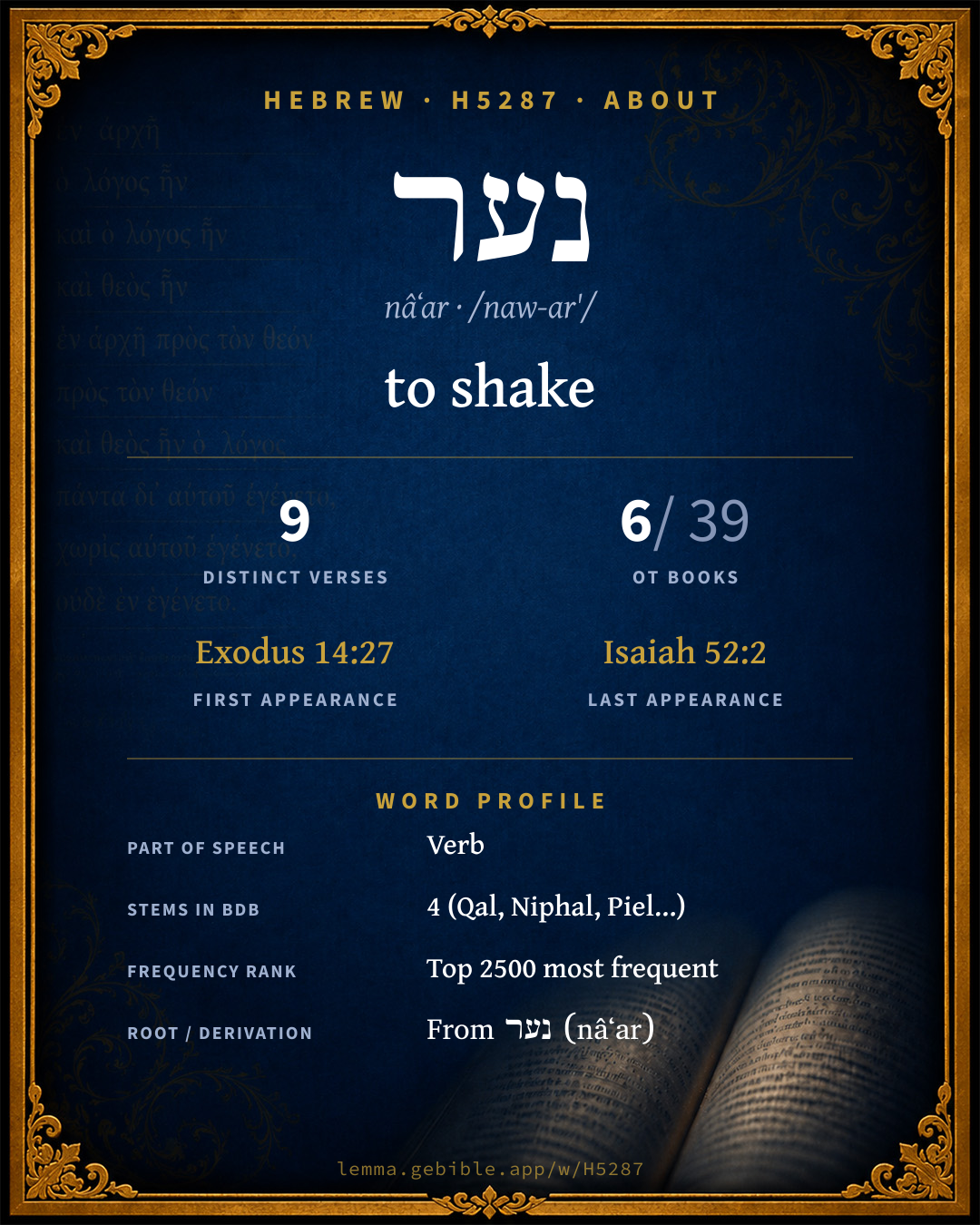
נָעַר
to shake
‘to shake’ is one of 4 main senses fuller range ↓
Full lexicon entry — Brown-Driver-Briggs (BDB)
From Brown-Driver-Briggs (BDB)
Where this word appears
See every Qal verb in the Hebrew Bible →
Grammar key — what these labels mean
Part of speech
- Verb
- An action or state-of-being word.
Stem
- Niphal
- Usually the simple passive or reflexive of the Qal (“he was written”).
- Piel
- An intensive or resultative active stem.
- Qal
- The basic, simple active stem — the plain form of the verb (“he wrote”).
- Hithpael
- The reflexive or reciprocal stem (the subject acts on itself).
Form
- Imperfect
- An incomplete, ongoing, or future action (“he will / would write”).
- Perfect
- A completed action or state — Hebrew marks aspect (completeness) more than strict tense (“he wrote”).
- Sequential Imperfect
- An imperfect with prefixed waw — the standard past-narrative form (waw-consecutive imperfect).
- Participle Active
- A verbal adjective expressing ongoing or characteristic action (“writing / one who writes”).
- Participle Passive
- A verbal adjective expressing action received (“written”).
- Imperative
- A direct command (“write!”).
State
- Absolute
- The independent form of a noun, not bound to a following word.
Person
- 1st Person
- The speaker (“I / we”).
- 3rd Person
- The one spoken about (“he / she / it / they”).
- 2nd Person
- The one addressed (“you”).
Gender
- Common
- Either gender — not distinguished for this form.
- Masculine
- Grammatically masculine.
- Feminine
- Grammatically feminine.
Number
- Singular
- One.
- Plural
- More than one (in Hebrew, generally three or more).
2 verses where H5287 appears in the Qal stem in the Book of Isaiah. Filtered view — show all forms. Click any verse to open its interlinear word-by-word view. Verse text shown in the World English Bible for context — . Each verse’s Hebrew form is shown with its reference; the English is not keyword-highlighted, since the data carries no word-level English alignment. Use “Compare translations” on any verse to read it across multiple English versions. This concordance covers the Hebrew Bible; Septuagint (Greek Old Testament) occurrences are not indexed here.
Isaiah
- Isaiah 33:9 וְ/נֹעֵ֥ר conj + Qal ptcp.act ms The land mourns and languishes; Lebanon is confounded and withers away; Sharon is like a desert; and Bashan and Carmel shake off [their leaves].
- Isaiah 33:15 נֹעֵ֤ר Qal ptcp.act ms He who walks righteously, and speaks blamelessly; he who despises the gain of oppressions, who shakes his hands from taking a bribe, who stops his ears from hearing of blood, and shuts his eyes from looking on evil:
About this entry
At a glance — auto-summarized from this page’s data, not written by a person. Every figure links to its source below. This summary describes the numbers; it doesn’t interpret them.
The Hebrew verb נער centers on the idea of “to shake.” Across 4 stems, its meaning turns on the binyan (Qal, Niphal). It turns up in 9 verses across 6 books, an uncommon footprint. The word gravitates to Isaiah (33%), then Psalms and Exodus. It first appears in Exodus 14:27. The sections below give every sense, occurrence, and version rendering.
Gloss history
Strong's 1890 vs modern scholarship
About this word
Strong's H5287 catalogs a Hebrew word from the Hebrew Old Testament.
These counts are not copied from any lexicon or concordance. They are computed here, from the morphology-tagged Hebrew Old Testament. What Lemma adds →
- 9
- distinct verses
- The word appears in 9 distinct verses.
- 6 / 39
- OT books
- The word appears in 6 of 39 Old Testament books.
- #2,210
- by frequency
- Top 2500 most frequent Hebrew words (rank 2,210 of 8,640 Hebrew words by occurrence).
View all 9 occurrences in the concordance →
By section of the Old Testament
By traditional corpus
Conventional, traditional groupings — biblical authorship is debated, so this is a traditional corpus grouping, not an authorship claim. Each share is this word’s portion of its verses in that division of the Hebrew canon. Each figure is a share of the word’s 9 distinct verses.
- Prophets (Nevi'im) 4 verses · 44%
- Writings (Ketuvim) 4 verses · 44%
- Torah (Pentateuch) 1 verse · 11%
How translations render this word
Counts come from each version’s own published word-to-Strong’s tagging or interlinear alignment — an approximate guide to how each version renders this word, not a word-level alignment the data otherwise carries. Because each total is that version’s own tagged count, the per-version totals vary from one another and need not match the appearance or distinct-verse counts above. These counts may also differ from a printed concordance because Lemma counts each distinctly tagged rendering and does not collapse phrase taggings into a single head-word total. This is a fixed set of word-tagged versions (KJV, ASV, BSB, ULT) and does not change with the reading translation you choose elsewhere. Each version’s license is shown beside its name below (and on Sources).
BDB lists this Strong’s number as 2 distinct words (homographs). Each count above pools all of them and is not split by sense — see the Senses section below. A low-frequency rendering may belong to a different one of those words, not the primary meaning.
- King James Version†: Overthrew 2×, Shake 2×
- American Standard Version†: Shake 2×
- Berean Standard Bible†: Shake 2×
- unfoldingWord Literal Text†: And 3×
King James Version Public Domain
Renders H5287 across 11† tagged occurrences — most commonly:
Plus 7 renderings that appear only once — usually multi-word phrases or single function words the recovered tagging swept in, not distinct renderings.
American Standard Version Public Domain
Renders H5287 across 11† tagged occurrences — most commonly:
Plus 9 renderings that appear only once — usually multi-word phrases or single function words the recovered tagging swept in, not distinct renderings.
Berean Standard Bible Public Domain
Renders H5287 across 11† tagged occurrences — most commonly:
Plus 9 renderings that appear only once — usually multi-word phrases or single function words the recovered tagging swept in, not distinct renderings.
unfoldingWord Literal Text CC BY-SA 4.0
Renders H5287 across 15† tagged occurrences — most commonly:
Plus 12 renderings that appear only once — usually multi-word phrases or single function words the recovered tagging swept in, not distinct renderings.
Senses in the full BDB
Hebrew verbs can shift meaning by stem (binyan): Qal is the basic action, Niphal is often passive or reflexive, Piel often intensifies or makes it factitive, and Hiphil is typically causative. The senses below are grouped under the stem BDB assigns to each. This entry also uses Hithpael (reflexive or reciprocal).
What do BDB’s symbols mean?
BDB uses these scholarly abbreviations:
| Symbol | Meaning |
|---|---|
| 𝔊 | the Septuagint (the ancient Greek translation, LXX) |
| 𝔙 | the Vulgate (the Latin translation) |
| 𝔖 | the Syriac version (the Peshitta) |
| 𝔗 | the Targum (the Aramaic translation) |
| ψ | the Psalms |
| √ | root (the underlying root or stem) |
| ‖ | parallel passage (a synonymous or contrasted parallel) |
| † | the dagger: every passage where the word occurs is cited |
The 5 senses and sub-senses the full Brown-Driver-Briggs lexicon distinguishes for this word, in lexicon order (not ranked by frequency), with BDB’s own verbatim wording and sub-sense lettering. Shown in Hebrew script with BDB’s own scholarly abbreviations. The condensed entry is in the Lexicon Entry tab. See also the Forms in the corpus table below.
נער I growl (NH id. cry, bray
Qal
- Pf. 3 pl. נָֽעֲרוּ כְּגוֹרֵי אֲרָיוֹת Je 51:38 (‖ כַּכְּפִרִים יִשְׁאָ֑גוּ). e.g. Jeremiah 51:38
נער II shake, shake out or off (NH נָעַר shake, stir up, especially Pi. Niph.
Qal
- Pf. 1 s. נָעַ֫רְתִּי Ne 5:13; Pt. act. נֹעֵר Is 33:9, 15; pass. Ne 5:13;—shake out, to shew emptiness, חָצְנִי נ׳ Ne 5:13 (symbol.), נ׳ כַּפָּיו מִתְּמֹךְ בַּשֹּׁחַד Is 33:15; pt. shaken out, emptied נ׳ וָרֵק Ne 5:13 (i.e. stripped of possessions); shake off (leaves) Is 33:9 (cf. ‖ cl.). e.g. Nehemiah 5:13
Niphal
- Pf. 1 s. נִנְעַ֫רְתִּי כָאַרְבֶּה ψ 109:23 I am shaken out like a locust (from fold of a garment; sim. of perishing helplessly); cf. Impf. 3 mpl. וְיִנָּֽעֲרוּ רְשָׁעִים מִמֶּ֑נָּה Jb 38:13 to seize the corners of the earth that wicked men may be shaken out of it; 1 s. אִנָּעֵר Ju 16:20 I will shake myself (free? cf. Hithp. and GFM). e.g. Psalms 109:23
Piel
- Impf. 3 ms. juss. יִנַעֵר Ne 5:13 so may God shake utterly out every man from (מִן) his house, etc.; וַיְנַעֵר Ex 14:27 and י׳ shook off the Egyptian into (ב) the sea, = Pf. נִעֵר ψ 136:15 (also c. acc. + ב). e.g. Nehemiah 5:13
Hithpael
- Imv. fs. הִתְנַעֲרִי מֵעָפָר Is 52:2 shake thyself (free), etc. (of personif. Zion). e.g. Isaiah 52:2
Senses from the full Brown-Driver-Briggs lexicon (Brown, Driver, Briggs; Oxford 1906 — public domain), digitized via Sefaria, supplemented by the OpenScriptures HebrewLexicon (CC BY 4.0). Full attribution on Sources.
Word origin
I. vb. growl (NH id. cry, bray; cf. Syriac ܢܥܰܪ; Arabic نَعَرَ make a noise Lane2815; poss. Assyrian naʾru, cry, roar (?) DlHWB 439);—only
II. vb. shake, shake out or off (NH נָעַר shake, stir up, especially Pi. Niph.; 𝔗 נְעֹרֶת tow (v. infr.); Arabic نَغِرَ, نَغَرَ boil, be in violent commotion, be very angry);—
— Brown-Driver-Briggs (Oxford 1906, public domain), digitized via Sefaria, supplemented by the OpenScriptures HebrewLexicon (CC BY 4.0). See Sources.
Derived from נער (nâʻar) (H5286) — to growl.
Jastrow Dictionary
A second Hebrew/Aramaic lexicon for comparison, covering Aramaic and post-biblical (Talmudic, Targumic, Midrashic) usage that the biblical-Hebrew BDB does not. Matched by lemma rather than by Strong’s number, so a lemma may carry more than one Jastrow headword (shown separately below), and the entries cover usage well beyond the Bible.
נָעַר I
- cmp. next w.) [to be excited, noisy,] esp. (of the ass) to bray. Ber. 3ᵃ. Ib. 56ᵃ (in Chald. dict.) דקאי אאיסדן ונוֹעֵר standing at the head of the bed and braying. B. Kam. 18ᵇ; Kidd. 24ᵇ; a. e.—[Cant. R. to IV, 8 בתחלה הוא נוער, read: נֵעוֹר, v. עוּר.]
נָעַר II
- to shake, stir. Makhsh. I, 4 הנוֹעֵר אגודה וכ׳ he who shakes (the rain off) a bundle of vegetables. Ib. V, 7. Pesik. R. s. 26 לאיוב נָעַרְתִּי מן האשפה וכ׳ I shook Job (making him rise) from the dunghill, and concerning thee (Israel) it is written (Is. LII, 2), shake thyself &c.; a. e. e.g. Isaiah 52:2
- 1. to shake. Pesik. Shek., p. 17ᵃ נַעֲרָהּ קפלה shake it (the garment), fold it; Lev. R. s. 2. B. Mets. II, 8 מצא כסות מְנַעֲרָהּ וכ׳ if one found a garment (and holds it in charge waiting for the owner to claim it), he must shake it once in thirty days. Sabb. 147ᵃ top; a. fr.
- 2. to stir. Ḥull. VIII, 3 נ׳ את הקדרה if he stirred (the meat in) the pot. Y. Ab. Zar. I, 39ᵈ top שמא נ׳ הגוי בקדרה the gentile might have stirred the pot; a. fr.
- 3. to empty; to cause evacuation. Toh. II, 1 מְנָעֶרֶת את הקדרה she may empty (or stir) the dish. Kel. XXVIII, 2 לנָעֵר בו וכ׳ used for (lifting and) emptying the pot. Tosef. Kel. B. Mets. II, 10 שהחנוני מְנָעֵר וכ׳ which the shop-keeper uses when pouring out &c. (or through which he pours for straining), v. יַתִּיךְ; a. e.—נ׳ את הצאן to use means by which to expedite the discharge of excrements of the flock on the spot to be manured (v. דּוּר I, Pi.). Tosef. Shebi. II, 20; M. Kat. 12ᵃ; Y. Shebi. III, 34ᶜ bot. Ib. השוכר … לנַעֲרָהּ he who hires a flock (for manuring) is forbidden to use means &c.; expl. ib. מוליכה ממקום וכ׳ by driving it from place to place.—Part. pass. מְנוֹעָר; f. מְנוֹעֶרֶת; pl. מְנוֹעָרִים, מְנוֹעָרִין: מְנוֹעָרוֹת empty, vacant. Y. Ber. IV, 7ᵇ bot. (play on שִׁנְ֗עָ֗ר̇) שחם מנ׳ מן המצות וכ׳ they (the Babylonians) are vacant of (cannot perform) certain religious observances &c.; Koh. R. to XII, 7; Gen. R. s. 37 שהיא מנ׳ וכ׳ she (Babylonia) is deprived &c. Ḥag. 14ᵃ (play on נערים, Is. III, 4) אלו בני אדם שמנ׳ וכ׳ that means persons empty of good deeds, opp. ממולא; Yalk. Is. 261.—[B. Bath. 74ᵇ ור"י נוער some ed., v. עוּר I.—Ḥull. 51ᵇ ניערה, v. infra.] e.g. Isaiah 3:4
- 1. to be stirred up; to bestir one’s self. B. Bath. 74ᵇ וני׳ ר׳'א and R. El. was stirred up (awoke). Sot. 5ᵃ אין עפרו נ׳ his dust will not be stirred up (for resurrection). Ex. R. s. 1 (play on חלאה ונערה, I Chr. IV, 5) חלתה ונִנְעֲרָה מחליה וכ׳ she (Miriam) was sick, but she bestirred herself (arose) from her sickness, and the Lord restored her to youth. Y. Ber. III, 6ᵈ top (play on מנעריו, Gen. VIII, 21) משעה שהוא נ׳ ויוצא וכ׳ from the moment the embryo bestirs itself to come out into the world; Gen. R. s. 34; Yalk. ib. 61. Ḥull. 51ᵇ ננערה לעמוד וכ׳ Rashi (ed. נִיעֲרָה) if the animal made an effort to get up, although it did not succeed; a. e. e.g. 1 Chronicles 4:5
- 2. (of flax) to be hatcheled. Y. Sabb. II, beg. 4ᶜ (expl. חוסן, ib. II, 1) פשתן שלא ננערה flax which has not yet been hatcheled.
- 3. to be emptied, poured out. Y. Ber. l. c. (play on שנער) ששם נִנְעֲרוּ וכ׳ for into that valley the dead of the generation of the flood were dumped; Gen. R. s. 37; Koh. R. l. c.—Snh. 92ᵃ קשתו נִינְעֶרֶת his bow will be empty (his sexual vitality broken).
- to stir up, to keep awake. Erub. 53ᵇ (play on נערה &c., v. אַהֲרוֹנִית) והִנְעִירָתוֹ and she kept him awake.
- to be emptied; trnsf. to be displaced. Zeb. 116ᵃ (ref. to Cant. IV, 16) תִּתְנַעֵר אומה … ותבא וכ׳ (v. Rabb. D. S. a. l. note) removed be the (Roman) nation whose sacrifices are slaughtered northward (Lev. I, 11, which is entitled only to burnt-offerings), and let the nation enter &c. e.g. Song of Solomon 4:16
נְעַר
- , to shake, stir.—Part. pass. נְעִיר waking. Targ. Job XXI, 32 (Ms. נָעִיר; ed. Wil. יְעִיר, v. עוּר).
- to shake; to empty. Yalk. Zech. 570; Cant. R. to IV, 8 (ref. to Zech. II, 17) דמְנַעֲרָה וכ׳ (דמְנַעֲרָא), v. גֵּו ch.; Gen. R. s. 75. Sabb. 142ᵃ ולִינַעֲרִינְהוּ נַעוּרֵי let him shake the fruit out of the basket. e.g. Zechariah 2:17
נַעַר
- preced., tender, young; lad. Tanḥ. Ḥayé 1 שיתכבד הזקן בַּנַּ׳ that the old may be honored by the young. Ex. R. s. 1 ילד היה ומנהגו כנ׳ he was a child, but his behavior was like that of a lad; a. fr.—Pl. נְעָרִים. Yoma 75ᵇ לנ׳ לחם וכ׳ the manna was bread to the young, oil to the old &c. Tanḥ. Sh’mini 11 אם נ׳ הם וכ׳ if they (the elders) are young &c., v. קָפַץ. Ib. הבחורים והנ׳ the young men and the lads. Sot. 46ᵇ נ׳ היו ובזבזו וכ׳ they were young men, but behaved contemptibly like children; a. fr.—Fem. נַעֲרָה lass, maid, esp. (law) a girl between twelve and twelve and a half years of age, v. בַּגְרוּת. Esth. R. to V, 1; a. fr.—Keth. III, 8, contrad. to בוגרת a. קטנה. Ib. IV, 1; a. fr.—Pl. נְעָרוֹת, constr. נַעֲרוֹת. Ib. III, 1 (29ᵃ). Esth. R. l. c. שתי נַעֲרוֹתֶיהָ her two maids; a. fr.
A Dictionary of the Targumim, the Talmud Babli and Yerushalmi, and the Midrashic Literature (Marcus Jastrow; London, Luzac, 1903) — Public Domain. Digitized via Sefaria. Digitized via Sefaria. Full attribution on Sources.
Forms in the corpus
The 11 distinct written forms H5287 takes in the Hebrew Bible, most frequent first — each parse links to that stem’s occurrences in the concordance. Hebrew forms include their vowel points and cantillation, so a single lemma takes many written forms.
| Form | Parsing | Example | Uses |
|---|---|---|---|
| הִתְנַעֲרִ֧י | Verb, Hithpael, Imperative, 2nd Person, Feminine, Singular | Isaiah 52:2 | 1 |
| וְ/אִנָּעֵ֔ר | Verb, Niphal, Imperfect, 1st Person, Common, Singular | Judges 16:20 | 1 |
| וְ/יִנָּעֲר֖וּ | Verb, Niphal, Imperfect, 3rd Person, Masculine, Plural | Job 38:13 | 1 |
| וְ/נִ֘עֵ֤ר | Verb, Piel, Perfect, 3rd Person, Masculine, Singular | Psalms 136:15 | 1 |
| וְ/נֹעֵ֥ר | Verb, Qal, Participle Active, Masculine, Singular, Absolute | Isaiah 33:9 | 1 |
| וַ/יְנַעֵ֧ר | Verb, Piel, Sequential Imperfect, 3rd Person, Masculine, Singular | Exodus 14:27 | 1 |
| יְנַעֵ֪ר | Verb, Piel, Imperfect, 3rd Person, Masculine, Singular | Nehemiah 5:13 | 1 |
| נִ֝נְעַ֗רְתִּי | Verb, Niphal, Perfect, 1st Person, Common, Singular | Psalms 109:23 | 1 |
| נָע֖וּר | Verb, Qal, Participle Passive, Masculine, Singular, Absolute | Nehemiah 5:13 | 1 |
| נָעַ֗רְתִּי | Verb, Qal, Perfect, 1st Person, Common, Singular | Nehemiah 5:13 | 1 |
| נֹעֵ֤ר | Verb, Qal, Participle Active, Masculine, Singular, Absolute | Isaiah 33:15 | 1 |
Same root — word family
Other BDB entries built from the same root as H5287, grouped by Strong’s listed origin. These share a root / origin per the lexicon — not necessarily a shared meaning. Each links to that word’s own entry.
Derives from
Derived from this word
Compare all same-root words → Showing 4 of 6 — not the complete family. They share a root, not necessarily a meaning.
Septuagint verse parallels
This word appears in 6 verses that also exist in the Greek Old Testament (Septuagint), out of the 9 Hebrew verses it occurs in. You can read those verses in Greek by switching the Old Testament edition to the Septuagint.
Read these verses in the Septuagint
This is a verse-level parallel only — the same verses exist in both the Hebrew and Greek Old Testaments. No word-level Hebrew↔Greek correspondence is claimed: the data carries no such alignment, so no Greek word is shown as this Hebrew word’s translation. Coverage is not total — the Septuagint omits the deuterocanon and renumbers the Psalms, so some Hebrew verses have no direct Greek parallel.