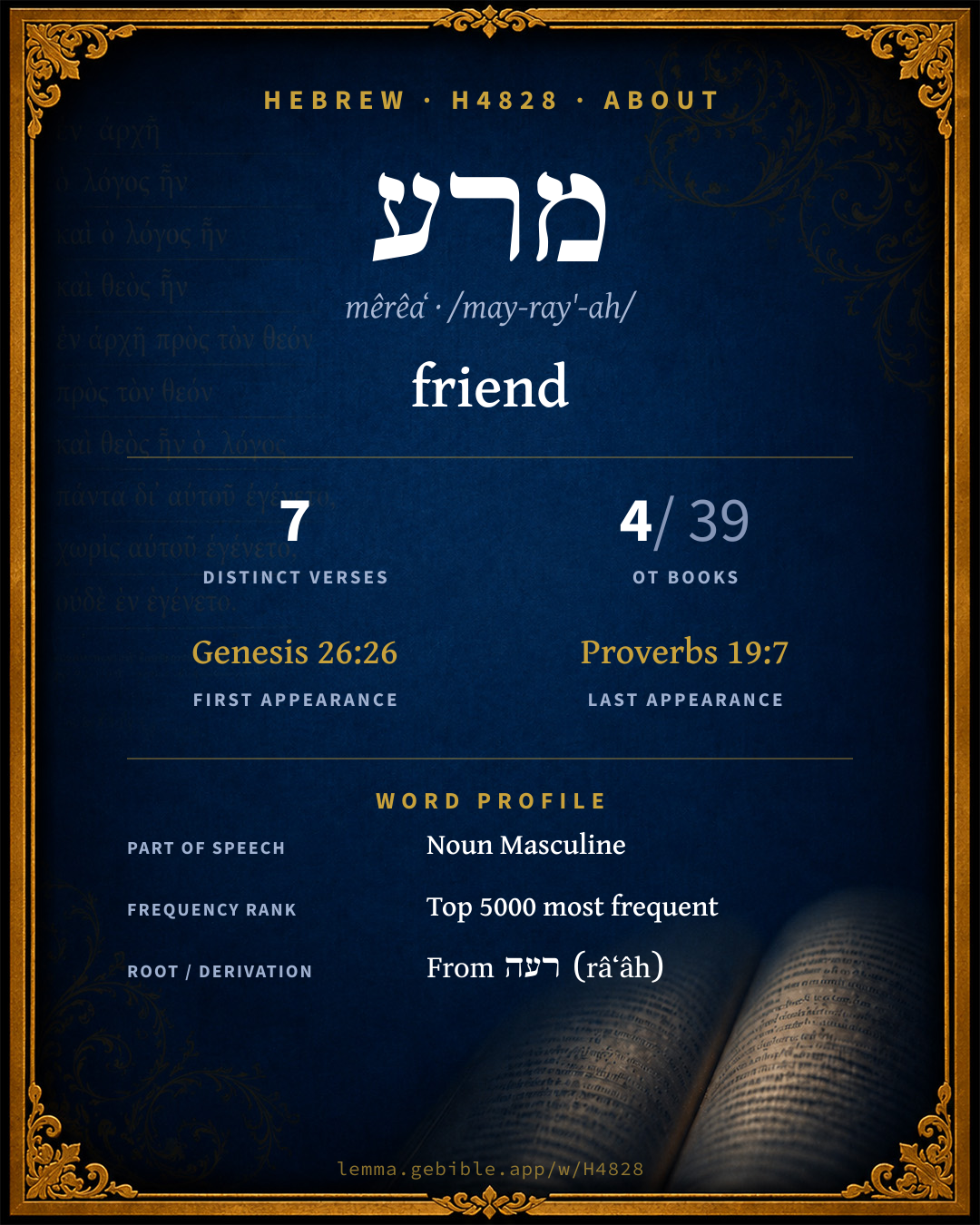
מֵרֵעַ
friend
Full lexicon entry — Brown-Driver-Briggs (BDB)
From Brown-Driver-Briggs (BDB)
Where this word appears
See every Construct-state word in the Hebrew Bible →
Grammar key — what these labels mean
Part of speech
- Noun
- A naming word — a person, place, thing, or idea.
Noun type
- Common
- A common noun — a general class of person, place, or thing (“king,” “city,” “water”), not a specific name.
State
- Construct
- A noun bound to a following noun in a possessive / “of” relationship (the construct chain).
- Absolute
- The independent form of a noun, not bound to a following word.
Gender
- Masculine
- Grammatically masculine.
Number
- Singular
- One.
- Plural
- More than one (in Hebrew, generally three or more).
3 verses where H4828 appears in the Construct state in the Book of Judges. Filtered view — show all forms. Click any verse to open its interlinear word-by-word view. Verse text shown in the World English Bible for context — . Each verse’s Hebrew form is shown with its reference; the English is not keyword-highlighted, since the data carries no word-level English alignment. Use “Compare translations” on any verse to read it across multiple English versions. This concordance covers the Hebrew Bible; Septuagint (Greek Old Testament) occurrences are not indexed here.
Judges
- Judges 14:20 לְ/מֵ֣רֵעֵ֔/הוּ prep + n c ms cs + sfx pers 3ms But Samson's wife was [given] to his companion, whom he had used as his friend.
- Judges 15:2 לְ/מֵרֵעֶ֑/ךָ prep + n c ms cs + sfx pers 2ms Her father said, I most assuredly thought that you had utterly hated her; therefore I gave her to your companion: isn't her younger sister more beautiful than she? Please take her, instead.
- Judges 15:6 לְ/מֵרֵעֵ֑/הוּ prep + n c ms cs + sfx pers 3ms Then the Philistines said, Who has done this? They said, Samson, the son-in-law of the Timnite, because he has taken his wife, and given her to his companion. The Philistines came up, and burnt her and her father with fire.
About this entry
At a glance — auto-summarized from this page’s data, not written by a person. Every figure links to its source below. This summary describes the numbers; it doesn’t interpret them.
“friend” is the headline sense of the Hebrew noun מרע (mêrêaʻ). It clusters heavily in Judges, which alone accounts for 57% of its uses. With 7 verses in 4 books, it is an uncommon word in the Hebrew Bible. First canonically at Genesis 26:26, it enters the text early. It clusters with רעה, מרעה and מרעית under a shared root. See the sense tree, 7-verse concordance, and the renderings breakdown below.
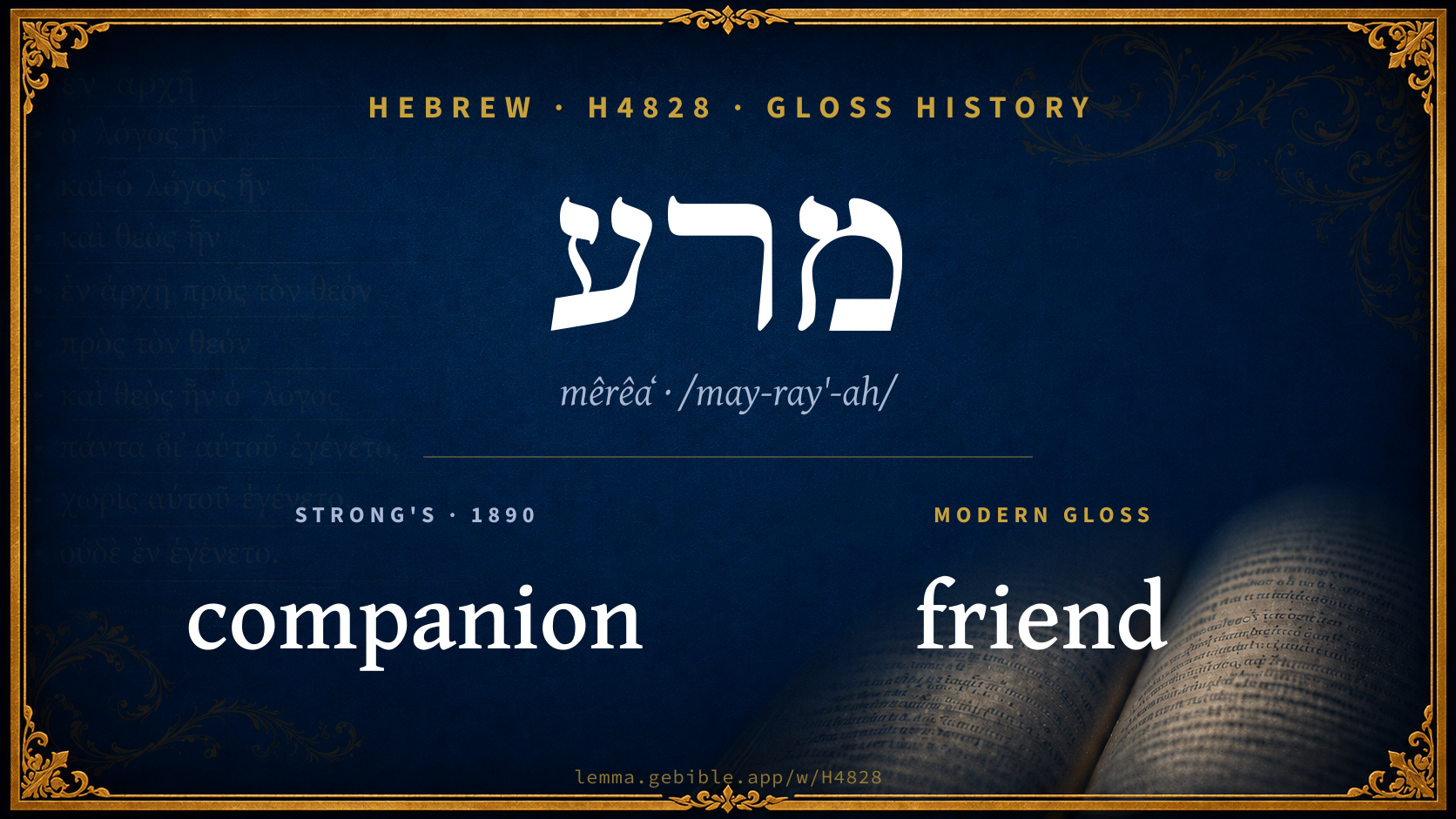
Gloss history
Strong's 1890 vs modern scholarship
About this word
Strong's H4828 catalogs a Hebrew word from the Hebrew Old Testament.
These counts are not copied from any lexicon or concordance. They are computed here, from the morphology-tagged Hebrew Old Testament. What Lemma adds →
- 7
- distinct verses
- The word appears in 7 distinct verses.
- 4 / 39
- OT books
- The word appears in 4 of 39 Old Testament books.
- #2,835
- by frequency
- Top 5000 most frequent Hebrew words (rank 2,835 of 8,640 Hebrew words by occurrence).
View all 7 occurrences in the concordance →
By section of the Old Testament
By traditional corpus
Conventional, traditional groupings — biblical authorship is debated, so this is a traditional corpus grouping, not an authorship claim. Each share is this word’s portion of its verses in that division of the Hebrew canon. Each figure is a share of the word’s 7 distinct verses.
- Prophets (Nevi'im) 5 verses · 71%
- Torah (Pentateuch) 1 verse · 14%
- Writings (Ketuvim) 1 verse · 14%
How translations render this word
Counts come from each version’s own published word-to-Strong’s tagging or interlinear alignment — an approximate guide to how each version renders this word, not a word-level alignment the data otherwise carries. Because each total is that version’s own tagged count, the per-version totals vary from one another and need not match the appearance or distinct-verse counts above. These counts may also differ from a printed concordance because Lemma counts each distinctly tagged rendering and does not collapse phrase taggings into a single head-word total. This is a fixed set of word-tagged versions (KJV, ASV, BSB, ULT) and does not change with the reading translation you choose elsewhere. Each version’s license is shown beside its name below (and on Sources).
BDB lists this Strong’s number as 2 distinct words (homographs). Each count above pools all of them and is not split by sense — see the Senses section below. A low-frequency rendering may belong to a different one of those words, not the primary meaning.
- King James Version†: Companion 2×
- American Standard Version†: Companion 1×, Companions to be with him 1×, Friend 1×
- Berean Standard Bible†: Adviser 1×, Companion 1×, Do his friends 1×
- unfoldingWord Literal Text†: Companion 3×, Friends 2×
King James Version Public Domain
Renders H4828 across 7† tagged occurrences — most commonly:
Plus 5 renderings that appear only once — usually multi-word phrases or single function words the recovered tagging swept in, not distinct renderings.
American Standard Version Public Domain
Renders H4828 across 7† tagged occurrences — most commonly:
Berean Standard Bible Public Domain
Renders H4828 across 6† tagged occurrences — most commonly:
Not rendered by a distinct English word in 1 further occurrence.
unfoldingWord Literal Text CC BY-SA 4.0
Renders H4828 across 7† tagged occurrences — most commonly:
Plus 2 renderings that appear only once — usually multi-word phrases or single function words the recovered tagging swept in, not distinct renderings.
Senses in BDB
The 1 sense BDB distinguishes for this word, in lexicon order (not ranked by frequency or importance). The full entry — with sub-senses — is in the Lexicon Entry tab.
- companion, friend, confidential friend
Word origin
n.m. friend, companion (strange formation; orig. dub.; Wetzst Syriac Dreschtafel, ZEthnol. 1873, 289 cp. مرياع miryâʿ, name of bell-wether among Syriac nomads (proposes [inseparable] companion), and der. from ריע, proposes closely joined; cf. Gerber 97, 162);—sf. מֵרֵעֵ֫הוּ Gn 26:26 +, מְרֵעֵ֫הוּ Pr 19:7, מֵרֵעֶ֑ךָ Ju 15:2; pl. מֵרֵעִים 14:11;—companion, confidential friend, Gn 26:26 (J; cf. רֵעֶה); of bridegroom’s escort Ju 14:11; ‘bestman’ (GFM) v 20; 15:2, 6; more gen. friends (‖ אחים) 2 S 3:8 Pr 19:7; 12:26 is dub., Död Hi De al. מִרְעֵהוּ; Toy conj. poss. מֵרָעָה (יָסֻר), v. further תור.
— Brown-Driver-Briggs (Oxford 1906, public domain), digitized via Sefaria, supplemented by the OpenScriptures HebrewLexicon (CC BY 4.0). See Sources.
Derived from רעה (râʻâh) (H7462) — to shepherd.
Jastrow Dictionary
A second Hebrew/Aramaic lexicon for comparison, covering Aramaic and post-biblical (Talmudic, Targumic, Midrashic) usage that the biblical-Hebrew BDB does not. Matched by lemma rather than by Strong’s number, so a lemma may carry more than one Jastrow headword (shown separately below), and the entries cover usage well beyond the Bible.
מֵרַע
- (רָעַע) shaking, weakening. Y. B. Mets. I, end, 8ᵃ מפני מ׳ כחן וכ׳ because this would injure the privilege of the purchaser.
מְרַע I
- (denom. of next w.)
- 1. to become or be weak, fall sick. Targ. Is. XIV, 10. Ib. XXIII, 4 (h. text חלתי). Targ. Ps. XLI, 9 (h. text שכב, v. next w.); a. e.
- 2. to be shaken, quake. Targ. Mic. IV, 10.
- to make sick, afflict. Targ. O. Deut. XXIX, 21. Targ. Y. II, Gen. III, 15.
- same. Targ. Jer. XIV, 17; Targ. Nah. III, 19 (not מִמְרָ׳) grievous (h. text נחלה).—Part. pass. מְמַרַע suffering, unwell. Targ. Jer. XIV, 18. Targ. I Sam. XIX, 14 ed. Lag. (oth. ed. שכיב מרע, v. next w.). Targ. I Kings XIV, 5 ed. Lag. (oth. ed. מרע); a. e.
- 1. to fall sick. Targ. I Kings XIV, 1 (ed. Lag. מרע). Ib. XXII, 34 ed. Lag. (oth. ed. מרע). Targ. II Sam. XIII, 2; a. e.—Koh. R. to X, 16 (ref. to שכבה, I Kings III, 19) אִיתְמַרְעַת עלוי (not … רטת) she fell sick (fainted and fell) upon him (cmp. Targ. to Ps. XLI, 9); a. e. e.g. 1 Kings 3:19
- 2. to feign sickness. Targ. II Sam. XIII, 5. sq.
- 3. to be shaken, quake. Targ. Jer. LI, 29.
מְרַע II
- (denom. of רְעַע) sick, suffering. Targ. Y. Gen. XVIII, 1 מ׳ מִכֵּיבָא וכ׳ (not מַכִּי׳) suffering from the wound &c.; Targ. Y. I Deut. XXXIV, 6 מ׳ מִגְּזֵרַת וכ׳. Targ. O. Gen. XLVIII, 1 מְרָע ed. Berl. (oth. ed. a. Y. שכיב מ׳); a. fr.—Esp. (in Talm. also in Hebr. dict.) שכיב מ׳ dangerously ill, expected to die. Targ. I Sam. XIX, 14 (v. preced.).—B. Bath. IX, 6 שכיב מ׳ שכתב וכ׳ if a sick man assigns all of his property to a stranger (as an unqualified donation, v. מַתָּנָה). Ib. לא כתב בה ש׳ מ׳ if it was not stated in the document that he was sick; הוא אומר ש׳ מ׳ היה he (the donor) says that he was sick (at the time), opp. בריא. Ib. 152ᵃ, a. fr. מתנת ש׳ מ׳ the donation of a sick man; a. v. fr.—Pl. מַרְעִין, מַרְעַיָּא. Targ. Y. I Deut. l. c. Targ. Ps. CXXVI, 1 היך מ׳ וכ׳ like the sick when recovering (h. text כחלמים, v. חָלַם I). Targ. Ez. XXXIV, 4; a. e.; v. מְרִיעַ.—Fem. מַרְעָא, מְרַעֲתָא, מְרָעיתָא. Targ. Ps. LXIX, 21 והא היא מרעא ed. Lag. (Var. מוצא, cler. error; ed. Wil. והא היא תקיפא; h. text וָאָנוּשָׁה). Targ. Cant. II, 5. Ib. V, 8. Targ. Koh. V, 12; 15; a. e.—Pl. מְרָעְאָן. Targ. Y. Gen. XXX, 36 (some ed. מַרְעָאָן).
מְרַע III
- c. (preced.) evil, sickness, affliction. Targ. I Kings VIII, 37. Targ. Koh. VI, 2; a. fr.—B. Bath. 153ᵃ (in a formula of a deed of donation) ומגו מַרְעֵיה וכ׳ and in consequence of (this) his sickness he departed &c.—Pl. מַרְעִין. Targ. O. Ex. XXIII, 25. Targ. Ps. CXVI, 3 מַרְעֵי Ms. (ed. מְרָעֵי); a. fr.
רַע I
- [shaken,] weak, sick; bad; (noun) evil. Ber. 7ᵃ מפני מה … ורע לו why is there a righteous man who fares well, and another righteous man who fares badly? Ib. 23ᵃ (ref. to Koh. IV, 17) בין טוב לרע וכ׳ they cannot distinguish between good and evil, and want to offer a sacrifice before me? Kidd. 40ᵃ (ref. to Is. III, 11) וכי יש רשע רע ויש שאינו רע is there a bad wicked man and a wicked man that is not bad?; רע לשמים ורע לבריות וכ׳ one bad in his relation to heaven (irreligious) and bad to men is a bad wicked man &c. Ohol. XVIII, 6 שכחן רע whose strength is feeble, v. כֹּחַ. Ab. II, 9 חבר רע a bad companion; לב רע a bad heart; a. v. fr.—Fem. רָעָה bad; (noun) evil. Ib., a. fr. עין ר׳, v. עַיִן. Sabb. 11ᵃ כל ד׳ ולא אשה ר׳ any evil, only not a bad wife. Ber. 61ᵃ אחת … ואחת יועצתו לר׳ one (kidney) counsels for good, the other for evil. Y. Shek. I, beg. 45ᵈ לטובה … לר׳ וכ׳ for a good purpose—‘every liberal-hearted’ (Ex. XXXV, 22), for a bad purpose—‘the whole people’ (ib. XXXII, 3). Hor. 10ᵇ אפי׳ טובתם … ר׳ היא וכ׳ even the good which wicked men do is an evil with the righteous (they do not enjoy it); Yeb. 103ᵃ sq. Koh. R. to V, 12, v. חוֹלָה I. Ber. l. c. (ref. to Koh. IV, 17) אל תהי … אם על ר׳ הם מביאים be not like the fools who sin and offer a sacrifice, not knowing whether they offer it for the good they have done or for the evil; a. v. fr.—Pl. רָעִים; רָעוֹת. Keth. 110ᵇ (quot. fr. Ben Sira) כל ימי עני ר׳ all the days of a poor man are bad; Snh. 101ᵃ. Y. Ber. V, 8ᵈ bot., v. חָצַף. Ex. R. s. 42 (ref. to Jer. II, 13) ושתי ר׳ עשו לבד have they committed no more than two evils?; a. v. fr. e.g. Ecclesiastes 4:17
רַע II
- to be evil, v. רָעַע.
רַע III
- ch. = אֲרַע, v. לרַע
רֵעַ
- , v. רֵיעַ
A Dictionary of the Targumim, the Talmud Babli and Yerushalmi, and the Midrashic Literature (Marcus Jastrow; London, Luzac, 1903) — Public Domain. Digitized via Sefaria. Digitized via Sefaria. Full attribution on Sources.
Forms in the corpus
The 7 distinct written forms H4828 takes in the Hebrew Bible, most frequent first — each parse links to that state’s occurrences in the concordance. Hebrew forms include their vowel points and cantillation, so a single lemma takes many written forms.
| Form | Parsing | Example | Uses |
|---|---|---|---|
| לְ/מֵ֣רֵעֵ֔/הוּ | Noun, Common, Masculine, Singular, Construct | Judges 14:20 | 1 |
| לְ/מֵרֵעֵ֑/הוּ | Noun, Common, Masculine, Singular, Construct | Judges 15:6 | 1 |
| לְ/מֵרֵעֶ֑/ךָ | Noun, Common, Masculine, Singular, Construct | Judges 15:2 | 1 |
| מְ֭רֵעֵ/הוּ | Noun, Common, Masculine, Singular, Construct | Proverbs 19:7 | 1 |
| מֵ֣רֵעֵ֔/הוּ | Noun, Common, Masculine, Singular, Construct | 2 Samuel 3:8 | 1 |
| מֵֽרֵעִ֔ים | Noun, Common, Masculine, Plural, Absolute | Judges 14:11 | 1 |
| מֵֽרֵעֵ֔/הוּ | Noun, Common, Masculine, Singular, Construct | Genesis 26:26 | 1 |
Same root — word family
Other BDB entries built from the same root as H4828, grouped by Strong’s listed origin. These share a root / origin per the lexicon — not necessarily a shared meaning. Each links to that word’s own entry.
Derives from
Shares the same root
- מרעה mirʻeh H4829 pasture
- מרעית mirʻîyth H4830 pasturage
- רע rêaʻ H7453 friend
- רע rêaʻ H7454 thought
- רעה rêʻeh H7463 friend
- רעות rᵉʻûwth H7468 companion
- רעות rᵉʻûwth H7469 longing
- רעי rᵉʻîy H7471 pasture
- רעי rôʻîy H7473 shepherd
- רעיון raʻyôwn H7475 longing
Compare all same-root words → Showing 4 of 12 — not the complete family. They share a root, not necessarily a meaning.
Septuagint verse parallels
This word appears in 7 verses that also exist in the Greek Old Testament (Septuagint), out of the 7 Hebrew verses it occurs in. You can read those verses in Greek by switching the Old Testament edition to the Septuagint.
Read these verses in the Septuagint
This is a verse-level parallel only — the same verses exist in both the Hebrew and Greek Old Testaments. No word-level Hebrew↔Greek correspondence is claimed: the data carries no such alignment, so no Greek word is shown as this Hebrew word’s translation. Coverage is not total — the Septuagint omits the deuterocanon and renumbers the Psalms, so some Hebrew verses have no direct Greek parallel.