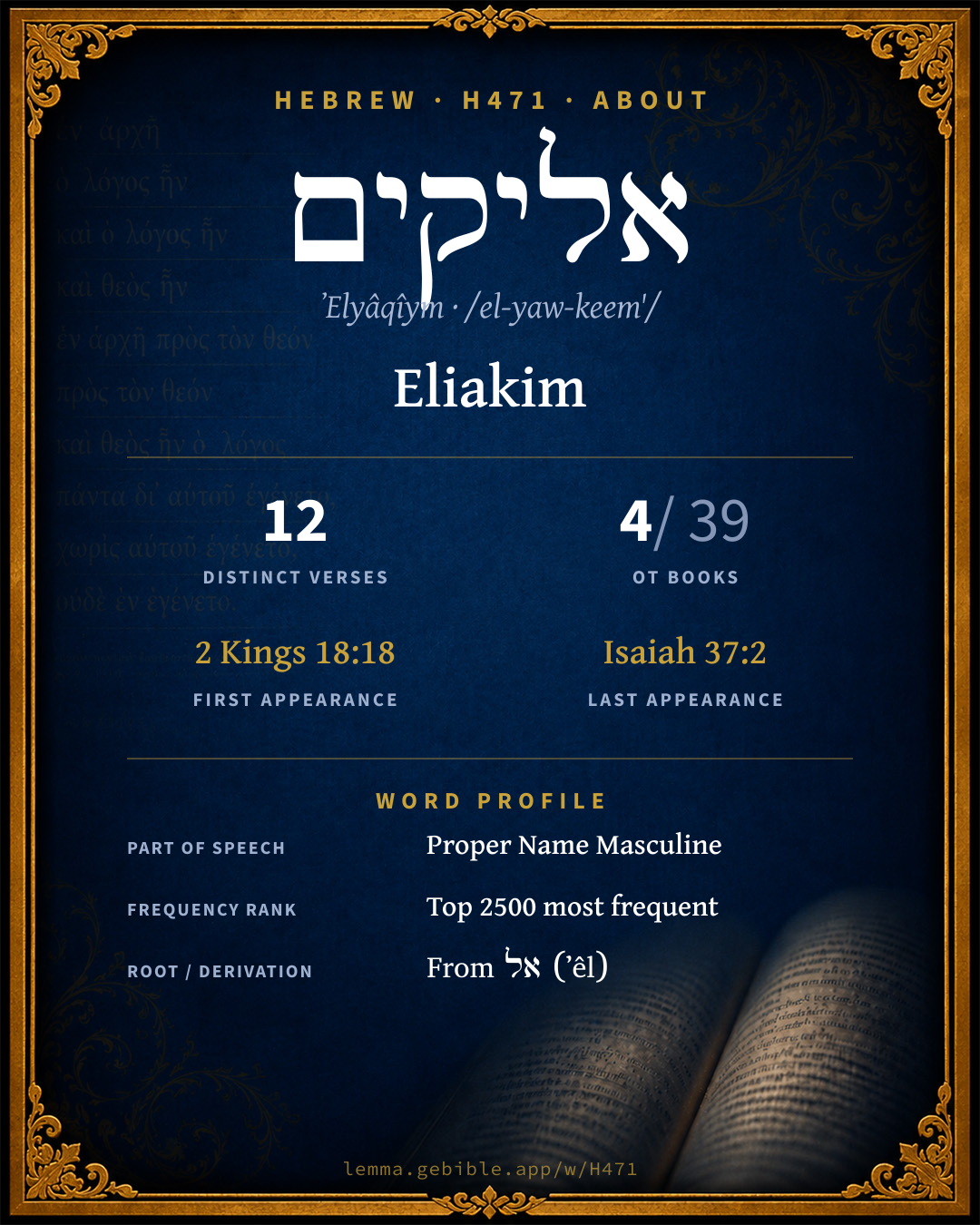
אֶלְיָקִים
Eliakim
BDB lists 4 entries for ‘Eliakim’ fuller range ↓
Full lexicon entry — Brown-Driver-Briggs (BDB)
From Brown-Driver-Briggs (BDB)
Where this word appears
Grammar key — what these labels mean
Part of speech
- Noun
- A naming word — a person, place, thing, or idea.
Noun type
- Proper
- A name of a specific person, place, or people (e.g. Abraham, Zion, Israel).
Every verse where H471 appears — 12 distinct verses across 4 books. Click any verse to open its interlinear word-by-word view. Verse text shown in the World English Bible for context — . Each verse’s Hebrew form is shown with its reference; the English is not keyword-highlighted, since the data carries no word-level English alignment. Use “Compare translations” on any verse to read it across multiple English versions. This concordance covers the Hebrew Bible; Septuagint (Greek Old Testament) occurrences are not indexed here.
2 Kings 5 verses
- 2 Kings 18:18 אֶלְיָקִ֥ים n Proper When they had called to the king, there came out to them Eliakim the son of Hilkiah, who was over the household, and Shebnah the scribe, and Joah the son of Asaph the recorder.
- 2 Kings 18:26 אֶלְיָקִ֣ים n Proper Then said Eliakim the son of Hilkiah, and Shebnah, and Joah, to Rabshakeh, Please speak to your servants in the Syrian language; for we understand it: and don't speak with us in the Jews' language, in the ears of the people who are on the wall.
- 2 Kings 18:37 אֶלְיָקִ֣ים n Proper Then came Eliakim the son of Hilkiah, who was over the household, and Shebna the scribe, and Joah the son of Asaph the recorder, to Hezekiah with their clothes torn, and told him the words of Rabshakeh.
- 2 Kings 19:2 אֶלְיָקִ֨ים n Proper He sent Eliakim, who was over the household, and Shebna the scribe, and the elders of the priests, covered with sackcloth, to Isaiah the prophet the son of Amoz.
- 2 Kings 23:34 אֶלְיָקִ֣ים n Proper Pharaoh Necoh made Eliakim the son of Josiah king in the room of Josiah his father, and changed his name to Jehoiakim: but he took Jehoahaz away; and he came to Egypt, and died there.
2 Chronicles 1 verse
Nehemiah 1 verse
Isaiah 5 verses
- Isaiah 22:20 לְ/אֶלְיָקִ֖ים prep + n Proper It shall happen in that day, that I will call my servant Eliakim the son of Hilkiah:
- Isaiah 36:3 אֶלְיָקִ֥ים n Proper Then came forth to him Eliakim the son of Hilkiah, who was over the household, and Shebna the scribe, and Joah, the son of Asaph, the recorder.
- Isaiah 36:11 אֶלְיָקִים֩ n Proper Then said Eliakim and Shebna and Joah to Rabshakeh, Please speak, to your servants in the Syrian language; for we understand it: and don't speak to us in the Jews' language, in the ears of the people who are on the wall.
- Isaiah 36:22 אֶלְיָקִ֣ים n Proper Then came Eliakim the son of Hilkiah, who was over the household, and Shebna the scribe, and Joah, the son of Asaph, the recorder, to Hezekiah with their clothes torn, and told him the words of Rabshakeh.
- Isaiah 37:2 אֶלְיָקִ֨ים n Proper He sent Eliakim, who was over the household, and Shebna the scribe, and the elders of the priests, covered with sackcloth, to Isaiah the prophet the son of Amoz.
About this entry
At a glance — auto-summarized from this page’s data, not written by a person. Every figure links to its source below. This summary describes the numbers; it doesn’t interpret them.
אליקים — transliterated ʼElyâqîym — is a Hebrew name carrying the sense “Eliakim.” Debuting at 2 Kings 18:18, it then recurs through the corpus. It appears 12 verses across 4 books of the Hebrew Bible, among its uncommon vocabulary. More than a third of its appearances fall in 2 Kings. Each statement above links to its evidence; the full detail follows below.
Gloss history
Strong's 1890 vs modern scholarship
About this word
Strong's H471 catalogs a Hebrew word from the Hebrew Old Testament.
These counts are not copied from any lexicon or concordance. They are computed here, from the morphology-tagged Hebrew Old Testament. What Lemma adds →
- 12
- distinct verses
- The word appears in 12 distinct verses.
- 4 / 39
- OT books
- The word appears in 4 of 39 Old Testament books.
- #2,101
- by frequency
- Top 2500 most frequent Hebrew words (rank 2,101 of 8,640 Hebrew words by occurrence).
View all 12 occurrences in the concordance →
Most concentrated in
- 2 Kings 5 verses 42%
- Isaiah 5 verses 42%
- 2 Chronicles 1 verse 8%
By section of the Old Testament
By traditional corpus
Conventional, traditional groupings — biblical authorship is debated, so this is a traditional corpus grouping, not an authorship claim. Each share is this word’s portion of its verses in that division of the Hebrew canon. Each figure is a share of the word’s 12 distinct verses.
- Prophets (Nevi'im) 10 verses · 83%
- Writings (Ketuvim) 2 verses · 17%
How translations render this word
Counts come from each version’s own published word-to-Strong’s tagging or interlinear alignment — an approximate guide to how each version renders this word, not a word-level alignment the data otherwise carries. Because each total is that version’s own tagged count, the per-version totals vary from one another and need not match the appearance or distinct-verse counts above. These counts may also differ from a printed concordance because Lemma counts each distinctly tagged rendering and does not collapse phrase taggings into a single head-word total. This is a fixed set of word-tagged versions (KJV, ASV, BSB, ULT) and does not change with the reading translation you choose elsewhere. Each version’s license is shown beside its name below (and on Sources).
- King James Version: Eliakim 10×, Made eliakim 2×
- American Standard Version: Eliakim 10×, Made eliakim 2×
- Berean Standard Bible: Eliakim 10×, Made eliakim 2×
- unfoldingWord Literal Text: Eliakim 12×
King James Version Public Domain
Renders H471 across 12 tagged occurrences — most commonly:
American Standard Version Public Domain
Renders H471 across 12 tagged occurrences — most commonly:
Berean Standard Bible Public Domain
Renders H471 across 12 tagged occurrences — most commonly:
unfoldingWord Literal Text CC BY-SA 4.0
Renders H471 across 12 tagged occurrences — most commonly:
Senses in the full BDB
What do BDB’s symbols mean?
BDB uses these scholarly abbreviations:
| Symbol | Meaning |
|---|---|
| 𝔊 | the Septuagint (the ancient Greek translation, LXX) |
| 𝔙 | the Vulgate (the Latin translation) |
| 𝔖 | the Syriac version (the Peshitta) |
| 𝔗 | the Targum (the Aramaic translation) |
| ψ | the Psalms |
| √ | root (the underlying root or stem) |
| ‖ | parallel passage (a synonymous or contrasted parallel) |
| † | the dagger: every passage where the word occurs is cited |
The 3 senses and sub-senses the full Brown-Driver-Briggs lexicon distinguishes for this word, in lexicon order (not ranked by frequency), with BDB’s own verbatim wording and sub-sense lettering. Shown in Hebrew script with BDB’s own scholarly abbreviations. The condensed entry is in the Lexicon Entry tab. See also the Forms in the corpus table below.
- a. Hezekiah’s prefect of the palace 2 K 18:18, 26, 37; 19:2 Is 22:20; 36:3, 11, 22; 37:2. e.g. 2 Kings 18:18
- b. son of Josiah, made king by Pharaoh 2 K 23:34 2 Ch 36:4; = יְהוֹיָקִים 2 K 24:1 Je 1:3 1 Ch 3:15. e.g. 2 Kings 23:34
- c. a priest Ne 12:41. e.g. Nehemiah 12:41
Senses from the full Brown-Driver-Briggs lexicon (Brown, Driver, Briggs; Oxford 1906 — public domain), digitized via Sefaria, supplemented by the OpenScriptures HebrewLexicon (CC BY 4.0). Full attribution on Sources.
Word origin
n.pr.m. (God sets up, cf. Sab. הקמאל, יקמאל Hal615)
— Brown-Driver-Briggs (Oxford 1906, public domain), digitized via Sefaria, supplemented by the OpenScriptures HebrewLexicon (CC BY 4.0). See Sources.
Derived from אל (ʼêl) (H410) — God.
Jastrow Dictionary
A second Hebrew/Aramaic lexicon for comparison, covering Aramaic and post-biblical (Talmudic, Targumic, Midrashic) usage that the biblical-Hebrew BDB does not. Matched by lemma rather than by Strong’s number, so a lemma may carry more than one Jastrow headword (shown separately below), and the entries cover usage well beyond the Bible.
אֶלְיָקִים
- (b. h.) pr. n. m. Eliakim. Ab. Zar. 58ᵃ R. El. attendant of Rabba.
A Dictionary of the Targumim, the Talmud Babli and Yerushalmi, and the Midrashic Literature (Marcus Jastrow; London, Luzac, 1903) — Public Domain. Digitized via Sefaria. Digitized via Sefaria. Full attribution on Sources.
Forms in the corpus
The 6 distinct written forms H471 takes in the Hebrew Bible, most frequent first — each parse links to that state’s occurrences in the concordance. Hebrew forms include their vowel points and cantillation, so a single lemma takes many written forms.
| Form | Parsing | Example | Uses |
|---|---|---|---|
| אֶלְיָקִ֣ים | Noun, Proper | 2 Chronicles 36:4 | 5 |
| אֶלְיָקִ֥ים | Noun, Proper | 2 Kings 18:18 | 2 |
| אֶלְיָקִ֨ים | Noun, Proper | 2 Kings 19:2 | 2 |
| אֶלְיָקִ֡ים | Noun, Proper | Nehemiah 12:41 | 1 |
| אֶלְיָקִים֩ | Noun, Proper | Isaiah 36:11 | 1 |
| לְ/אֶלְיָקִ֖ים | Noun, Proper | Isaiah 22:20 | 1 |
Same root — word family
Other BDB entries built from the same root as H471, grouped by Strong’s listed origin. These share a root / origin per the lexicon — not necessarily a shared meaning. Each links to that word’s own entry.
Derives from
Shares the same root
Proper names from this root
People and places named from this root — a name, not an additional meaning of the word.
- אל אלהי ישראל ʼÊl ʼĕlôhêy Yisrâʼêl H415 Elelohe-israel
- אל ביתאל ʼÊl Bêyth-ʼÊl H416 El-beth-el
- אלדד ʼEldâd H419 Eldad
- אלדעה ʼEldâʻâh H420 Eldaah
- אלוה ʼĕlôwahh H433 God
- אלזבד ʼElzâbâd H443 Elzabad
- אלחנן ʼElchânân H445 Elhanan
- אליאב ʼĔlîyʼâb H446 Eliab
- אליאל ʼĔlîyʼêl H447 Eliel
- אליאתה ʼĔlîyʼâthâh H448 Eliathah
- אלידע ʼElyâdâʻ H450 Eliada
- אליה ʼÊlîyâh H452 Elijah
- אליהו ʼĔlîyhûw H453 Elihu
- אליחבא ʼElyachbâʼ H455 Eliahba
- אליחרף ʼĔlîychôreph H456 Elihoreph
- אלימלך ʼĔlîymelek H458 Elimelech
- אליסף ʼElyâçâph H460 Eliasaph
- אליעזר ʼĔlîyʻezer H461 Eliezer
- אליעם ʼĔlîyʻâm H463 Eliam
- אליפז ʼĔlîyphaz H464 Eliphaz
- אליפל ʼĔlîyphâl H465 Eliphal
- אליפלהו ʼĔlîyphᵉlêhûw H466 Elipheleh
- אליפלט ʼĔlîypheleṭ H467 Eliphelet
- אליצור ʼĔlîytsûwr H468 Elizur
- Ελιακειμ Eliakeím G1662 Eliakim
+24 more proper names from this root (not shown).
Compare all same-root words → Showing 4 of 52 — not the complete family. 50 of the same-root words are proper names (people or places). They share a root, not necessarily a meaning.
Bible dictionary
Public-domain dictionary articles matched to this entry by name (Eliakim). A biblical name can be shared by more than one person or place, so an article may treat several.
Easton's Bible Dictionary · M. G. Easton, 1897
Whom God will raise up. (1.) The son of Melea (Luke 3:30), and probably grandson of Nathan.
(2.) The son of Abiud, of the posterity of Zerubbabel (Matt. 1:13).
(3.) The son of Hilkiah, who was sent to receive the message of the invading Assyrians and report it to Isaiah (2 Kings 18:18; 19:2; Isa. 36:3; 37:2). In his office as governor of the palace of Hezekiah he succeeded Shebna (Isa. 22:15-25). He was a good man (Isa. 22:20; 2 Kings 18:37), and had a splendid and honourable career.
(4.) The original name of Jehoiakim, king of Judah (2 Kings 23:34). He was the son of Josiah.
Smith's Bible Dictionary · William Smith, 1863
(raised up by God.).
+ Son of Hilkiah, master of Hezekiah's household ("over the house," as) (Isaiah 36:3) (2 Kings 18:18,26,37) (B.C. 713.) Eliakim was a good man, as appears by the title emphatically applied to him by God, "my servant Eliakim," (Isaiah 22:20) and also in the discharge of the duties of his high station, in which he acted as a "father to the inhabitants of Jerusalem, and to the house of Judah." (Isaiah 22:21) + The original name of Jehoiakim king of Judah. (2 Kings 23:34; 2 Chronicles 36:4) + A priest in the days of Nehemiah, who assisted at the dedication of the new wall of Jerusalem. (Nehemiah 12:41) (B.C. 446.) + Eldest son of Abiud or Judah; brother of Joseph, and father of Azor. (Matthew 1:13) + son of Melea, and father of Jonan. (Luke 3:30,31)
Hitchcock's Bible Names Dictionary · Roswell D. Hitchcock, 1869
resurrection of God
Classic public-domain reference works; full attribution on Sources.
Septuagint verse parallels
This word appears in 11 verses that also exist in the Greek Old Testament (Septuagint), out of the 12 Hebrew verses it occurs in. You can read those verses in Greek by switching the Old Testament edition to the Septuagint.
Read these verses in the Septuagint
This is a verse-level parallel only — the same verses exist in both the Hebrew and Greek Old Testaments. No word-level Hebrew↔Greek correspondence is claimed: the data carries no such alignment, so no Greek word is shown as this Hebrew word’s translation. Coverage is not total — the Septuagint omits the deuterocanon and renumbers the Psalms, so some Hebrew verses have no direct Greek parallel.