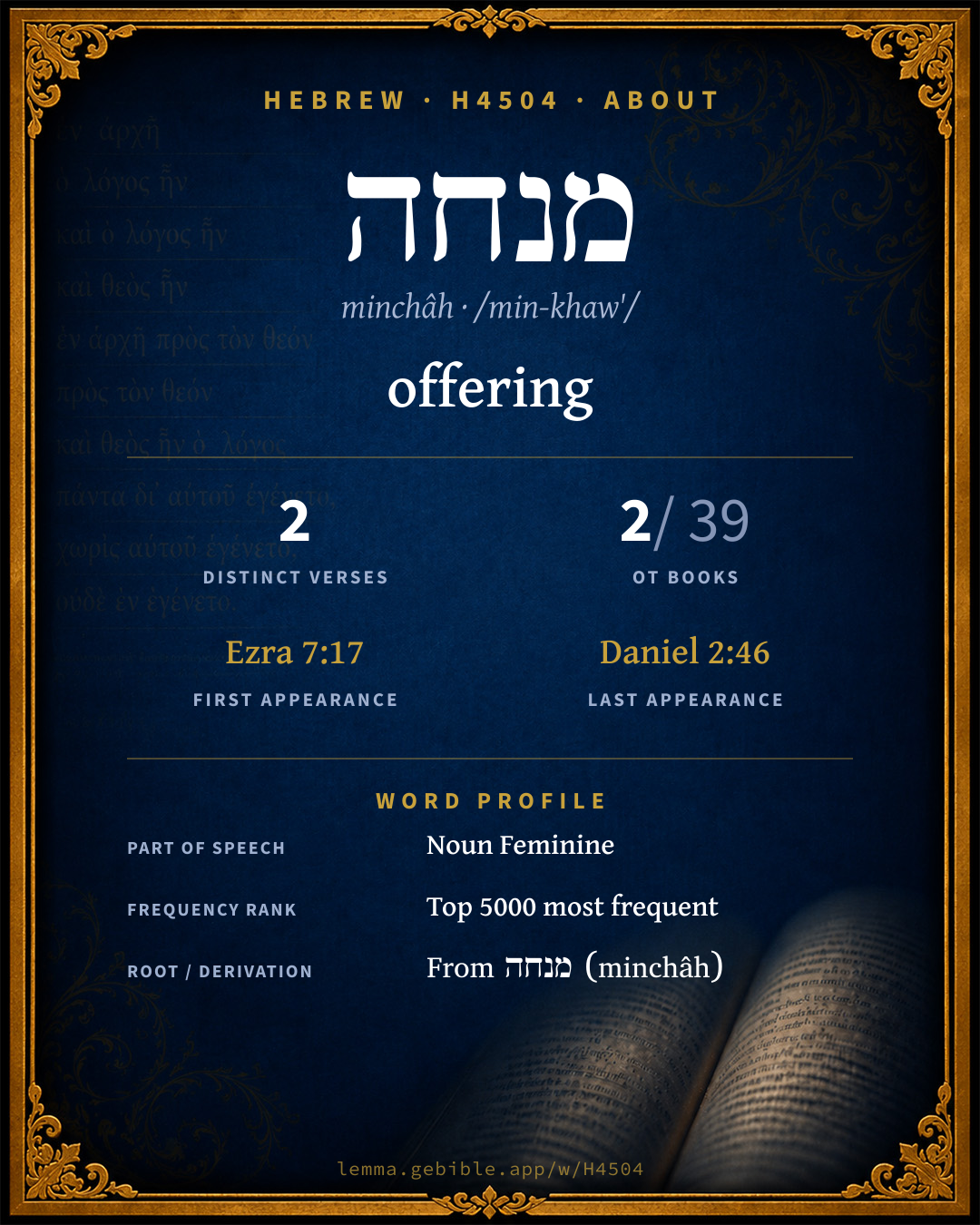
מִנְחָה
offering
‘offering’ is one of 3 main senses fuller range ↓
Full lexicon entry — Brown-Driver-Briggs (BDB)
From Brown-Driver-Briggs (BDB)
Where this word appears
See every Absolute-state word in the Hebrew Bible →
Grammar key — what these labels mean
Noun type
- Common
- A common noun — a general class of person, place, or thing (“king,” “city,” “water”), not a specific name.
State
- Construct
- A noun bound to a following noun in a possessive / “of” relationship (the construct chain).
- Absolute
- The independent form of a noun, not bound to a following word.
Gender
- Feminine
- Grammatically feminine.
Number
- Plural
- More than one (in Hebrew, generally three or more).
- Singular
- One.
Grammatical forms
- Noun, Common, Feminine, Plural, Construct 1 time (50%)
- Noun, Common, Feminine, Singular, Absolute 1 time (50%)
Parsed forms decoded from the imported morphology (morphhb / Westminster Leningrad Codex — WLC text public domain, morphhb tagging CC BY 4.0), counted across 2 parsed occurrences — not distinct verses.
Every verse where H4504 appears — 2 distinct verses across 2 books. Click any verse to open its interlinear word-by-word view. Verse text shown in the World English Bible for context — . Each verse’s Hebrew form is shown with its reference; the English is not keyword-highlighted, since the data carries no word-level English alignment. Use “Compare translations” on any verse to read it across multiple English versions. This concordance covers the Hebrew Bible; Septuagint (Greek Old Testament) occurrences are not indexed here.
Ezra 1 verse
Daniel 1 verse
About this entry
At a glance — auto-summarized from this page’s data, not written by a person. Every figure links to its source below. This summary describes the numbers; it doesn’t interpret them.
מנחה — transliterated minchâh — is a Hebrew noun carrying the sense “offering.” It is rare — just 2 verses in the entire Hebrew Bible. Its uses cluster heavily in Ezra (50% of all occurrences). Debuting at Ezra 7:17, it then recurs through the corpus. The lexicon spreads it across several senses; see its full sense range. Each statement above links to its evidence; the full detail follows below.
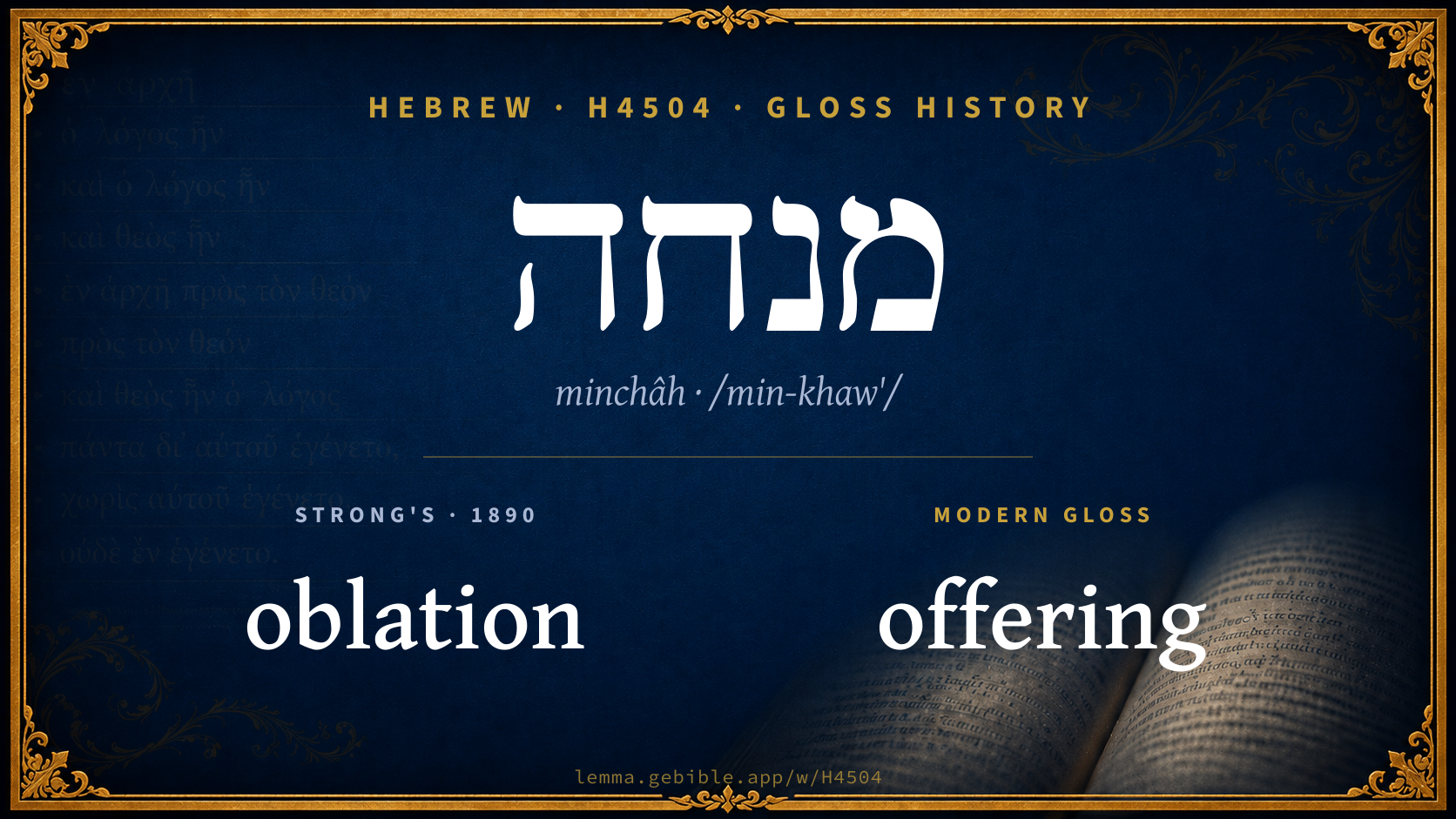
Gloss history
Strong's 1890 vs modern scholarship
About this word
Strong's H4504 catalogs a Hebrew word from the Hebrew Old Testament.
These counts are not copied from any lexicon or concordance. They are computed here, from the morphology-tagged Hebrew Old Testament. What Lemma adds →
- 2
- distinct verses
- The word appears in 2 distinct verses.
- 2 / 39
- OT books
- The word appears in 2 of 39 Old Testament books.
- #4,807
- by frequency
- Top 5000 most frequent Hebrew words (rank 4,807 of 8,640 Hebrew words by occurrence).
View all 2 occurrences in the concordance →
By traditional corpus
Conventional, traditional groupings — biblical authorship is debated, so this is a traditional corpus grouping, not an authorship claim. Each share is this word’s portion of its verses in that division of the Hebrew canon. Each figure is a share of the word’s 2 distinct verses.
- Writings (Ketuvim) 2 verses · 100%
How translations render this word
Counts come from each version’s own published word-to-Strong’s tagging or interlinear alignment — an approximate guide to how each version renders this word, not a word-level alignment the data otherwise carries. Because each total is that version’s own tagged count, the per-version totals vary from one another and need not match the appearance or distinct-verse counts above. These counts may also differ from a printed concordance because Lemma counts each distinctly tagged rendering and does not collapse phrase taggings into a single head-word total. This is a fixed set of word-tagged versions (KJV, ASV, BSB, ULT) and does not change with the reading translation you choose elsewhere. Each version’s license is shown beside its name below (and on Sources).
- King James Version: Meat offerings 1×, Oblation 1×
- American Standard Version: Meal-offerings 1×, Oblation 1×
- Berean Standard Bible: Offering 1×, Together with their grain offerings 1×
- unfoldingWord Literal Text: And 1×, Grain offerings 1×, Offering 1×
King James Version Public Domain
Renders H4504 across 2 tagged occurrences — most commonly:
American Standard Version Public Domain
Renders H4504 across 2 tagged occurrences — most commonly:
Berean Standard Bible Public Domain
Renders H4504 across 2 tagged occurrences — most commonly:
unfoldingWord Literal Text CC BY-SA 4.0
Renders H4504 across 3 tagged occurrences — most commonly:
11 senses and sub-senses in the full BDB
What do BDB’s symbols mean?
BDB uses these scholarly abbreviations:
| Symbol | Meaning |
|---|---|
| 𝔊 | the Septuagint (the ancient Greek translation, LXX) |
| 𝔙 | the Vulgate (the Latin translation) |
| 𝔖 | the Syriac version (the Peshitta) |
| 𝔗 | the Targum (the Aramaic translation) |
| ψ | the Psalms |
| √ | root (the underlying root or stem) |
| ‖ | parallel passage (a synonymous or contrasted parallel) |
| † | the dagger: every passage where the word occurs is cited |
The 11 senses and sub-senses the full Brown-Driver-Briggs lexicon distinguishes for this word, in lexicon order (not ranked by frequency), with BDB’s own verbatim wording and sub-sense lettering. Shown in Hebrew script with BDB’s own scholarly abbreviations. The condensed entry is in the Lexicon Entry tab. See also the Forms in the corpus table below.
- 1. gift, present Gn 32:14, 19, 21, 22 (E), 33:10; 43:11, 15, 25, 26 (J), Ju 6:18 1 S 10:27 1 K 10:25=2 Ch 9:24 2 K 8:8, 9; 20:12=Is 39:1, ψ 45:13 2 Ch 32:23. e.g. Genesis 32:14
- 2. tribute Ju 3:15, 17, 18(×2) 2 S 8:2, 6=Ch 18:2, 6, 1 K 5:1 2 K 17:3, 4 2 Ch 17:5, 11; 26:8 Ho 10:6 ψ 72:10. e.g. Judges 3:15
- 3. offering made to God, of any kind, whether grain or animals Gn 4:3, 4, 5 Nu 16:15 (J), 1 S 2:17, 29; 26:19 Is 1:13 ψ 96:8 Zp 3:10; + (prob.) (לַ)עֲלוֹת הַמִּנְחָה 1 K 18:29, 36 2 K 3:20 (Ephr.; usually regarded as= מִנְחַת עֶרֶב, but that much later usage). This gen. meaning poss. also in foll.: זבח ומנחה 1 S 2:29 (see v 29 b), 3:14 Is 19:21; עלה ומנחה Je 14:12; ‖ עולה ψ 20:4; ‖ שֶׁלֶם Am 5:22 (עֹלוֹת gloss, to explain אָרִיחַ); or these may shew early stage of discrimination. e.g. Genesis 4:3
- 4. grain offering (whether raw, roasted, ground to flour, or prepared as bread or cakes, see below. AV meat offering, misleading meal-offering. GFM Judges 322 renders cereal oblation);—יָבִיאוּ אֶת־הַמִּנְחָה בִּכְלִי טָהוֹר Is 66:20 they bring the grain offering in clean vessels (restored Jews are brought as such an offering), cf. מנחה טהורה Mal 1:11; brought in hands Je 41:5 (late addit. Co); received from hands Mal 1:10; חִטִּים למנחה 1 Ch 21:23 wheat for grain offering; סֹלֶת 1 Ch 23:29, mixed with oil Ez 46:14, baked v 20; disting. from other offerings 1 K 8:64(×2)=2 Ch 7:7, 2 K 16:13, 15(×3) Is 43:23; 57:6; 66:3 Je 17:26; 33:18; 41:5, Ez 42:13; 44:29; 45:15, 17(×2), 25 Am 5:22, 25 Dn 9:27 ψ 40:7; used alone Ne 13:5, 9 Ez 45:24; 46:5(×2), 7, 11, 14(×2), 15 Mal 1:13; 2:12, 13; 3:3, 4 Ju 13:19, 23 (R, GFM Judges 322); מִנְחַת (הָ)עֶרֶב evening grain offering 2 K 16:15 Ezr 9:4, 5 Dn 9:21 ψ 141:2; מִנְחַת הַתָּמִיד continual grain off. Ne 10:34, cf. Lv 6:13 Nu 4:16 (all cases under 4 exilic or post-exilic). e.g. Isaiah 66:20
- 5. grain-offering, always with this meaning in P, in classifications Ex 30:9; 40:29 Lv 7:37; 23:37 Nu 18:9; 29:39 Jos 22:23, 29:— e.g. Exodus 30:9
- a. אָבִיב grain in the ear parched with fire, with oil and frankincense Lv 2:14, 15. e.g. Leviticus 2:14
- b. סֹלֶת fine flour with oil and frankincense Lv 2:1; 6:7, 8; elsewhere בְּלוּלָה בַּשֶּׁמֶן mingled with oil Lv 14:10, 21; 23:13 Nu 7:13 + 10 times 8:8; 15:4, 6, 9 Nu 28:5 + 6 times; 29:3, 9, 14, except sin offering of very poor where offered without oil and frankincense Lv 5:11–13. e.g. Leviticus 2:1
- c. סֹלֶת baked in an oven as חַלּוֹת perforated cakes, or רְקִיקִים flat cakes Lv 2:4; 7:9 Nu 6:15, על הַמַּחֲבַת on a flat pan Lv 2:5; 6:14; 7:9, or מַרְחֶשֶׁת frying pan Lv 2:7; 7:9. All these always unleavned (מַצּוֹת) and mixed with oil and salt Lv 2:11–13. e.g. Leviticus 2:4
- d. at Pentecost to consecrate new bread, מִנְחָה חֲדָשָׁה new grain offering of two loaves of leavened bread Lv 23:16, 17 Nu 28:26. e.g. Leviticus 23:16
- e. barley meal without oil or incense; מִנְחַת קְנָאֹת grain offering of jealousy, מ׳ זִכָּרוֹן Nu 5:15, 18, 25. Cf. phrases מִנְחַת הַבֹּקֶר morning oblation Ex 29:41 Nu 28:8; קָרְבַּן מ׳ Lv 2:1, 4, 13; מ׳ בִּכּוּרִים Lv 2:14; מ׳ פִּתִּים Lv 6:14. e.g. Numbers 5:15
- 6. vbs. of offering are הֵבִיא Gn 4:3 (J), Lv 2:2, 8 (P), Is 1:13; 66:20(×2) Je 17:26 Mal 1:13; הִקְרִיב Lv 2:1, 8, 11; 6:7 Nu 5:25; עשׂה Nu 6:17; 28:31 1 K 8:64=2 Ch 7:7, Ez 45:24; 46:7, 14, 15; הקטיר 2 K 16:13, 15 Je 33:18; העלה Is 57:6; 66:3 Je 14:12; הגישׁ Am 5:25 Mal 2:12; 3:3; הוביל Ho 10:6 Zp 3:10; נשׂא ψ 96:8, also (מ׳=tribute) 2 S 8:2, 6 and ‖; השׁיב 2 K 17:3 ψ 72:10. e.g. Genesis 4:3
Senses from the full Brown-Driver-Briggs lexicon (Brown, Driver, Briggs; Oxford 1906 — public domain), digitized via Sefaria, supplemented by the OpenScriptures HebrewLexicon (CC BY 4.0). Full attribution on Sources.
Word origin
n.f. gift, tribute, offering (NH id.; Ph. מנחת; 𝔗 מִנְחָתָא on Arabic v. supr.);—abs. מ׳ Gn 4:3 + 81 times; cstr. מִנְחַת Lv 2:7 + 22 times; sf. מִנְחָתִי Gn 33:10 + 3 times; + 41 times sfs. sg.; pl. sf. מִנְחֹתֶיךָ ψ 20:4; מִנְחֹתֵיכֶם Nu 29:39 Am 5:22;—
— Brown-Driver-Briggs (Oxford 1906, public domain), digitized via Sefaria, supplemented by the OpenScriptures HebrewLexicon (CC BY 4.0). See Sources.
Derived from מנחה (minchâh) (H4503) — offering.
Jastrow Dictionary
A second Hebrew/Aramaic lexicon for comparison, covering Aramaic and post-biblical (Talmudic, Targumic, Midrashic) usage that the biblical-Hebrew BDB does not. Matched by lemma rather than by Strong’s number, so a lemma may carry more than one Jastrow headword (shown separately below), and the entries cover usage well beyond the Bible.
מִנְחָה
- 1. [laid down,] offering, present.—Pl. מְנָחוֹת. Num. R. s. 13 שלשלמה הביאו האומות מ׳ וכ׳ as the nations brought gifts to Solomon &c.; a. e.—Esp. (in ritual) meal-offering. Men. I, 1 מִנְחַת חוטא the sinner’s meal-offering (Lev. V, 11). Ib. X, 6 (68ᵇ) מנחת בהמה the meal-offering connected with animal offering (e. g. Lev. VII, 13). Ib. XII, 3 הרי עלי מ׳ וכ׳ I vow a minḥah of barley; a. v. fr.—Pl. as ab. Ib. I, 1; a. fr.—M’naḥoth, name of a treatise of the Mishnah, Tosefta, and Talmud Babli of the Order of Kodashim. e.g. Leviticus 5:11
- 2. (cmp. preced. 2) [decline,] afternoon (corresp. to b. h. בֵּין הָעַרְבַּיִם); תְּפִלַּת המ׳ (or מִנְחָה) afternoon-prayer, Minḥah. Ber. IV, 1 (26ᵃ) תפלת המ׳ עד הערב the Minḥah may be read until sunset; ib. 26ᵇ תפלת המ׳ … שהרי תמיד של בין הערבים וכ׳ the Minḥah may be read &c., because the daily sacrifice of the afternoon could be offered until sunset. Ib. עד פלג המ׳ up to the middle of the afternoon. Ib. מ׳ גדולה (מ׳ קמא) the large (first) afternoon, i.e. the time from six and a half hours after sunrise to sunset (the day being divided into twelve hours); (מ׳ אחרונה) מ׳ קטנה the smaller (later) afternoon, i.e. from nine and a half hours to sunset. Ib. פלג מ׳ אחרונה the middle of the late (small) afternoon. Ib. top טעה ולא התפלל מ׳ if by mistake he failed to read the Minḥah; a. fr.
A Dictionary of the Targumim, the Talmud Babli and Yerushalmi, and the Midrashic Literature (Marcus Jastrow; London, Luzac, 1903) — Public Domain. Digitized via Sefaria. Digitized via Sefaria. Full attribution on Sources.
Forms in the corpus
The 2 distinct written forms H4504 takes in the Hebrew Bible, most frequent first — each parse links to that state’s occurrences in the concordance. Hebrew forms include their vowel points and cantillation, so a single lemma takes many written forms.
| Form | Parsing | Example | Uses |
|---|---|---|---|
| וּ/מִנְחָה֙ | Noun, Common, Feminine, Singular, Absolute | Daniel 2:46 | 1 |
| וּ/מִנְחָתְ/ה֖וֹן | Noun, Common, Feminine, Plural, Construct | Ezra 7:17 | 1 |
Septuagint verse parallels
This word appears in 2 verses that also exist in the Greek Old Testament (Septuagint), out of the 2 Hebrew verses it occurs in. You can read those verses in Greek by switching the Old Testament edition to the Septuagint.
Read these verses in the Septuagint
This is a verse-level parallel only — the same verses exist in both the Hebrew and Greek Old Testaments. No word-level Hebrew↔Greek correspondence is claimed: the data carries no such alignment, so no Greek word is shown as this Hebrew word’s translation. Coverage is not total — the Septuagint omits the deuterocanon and renumbers the Psalms, so some Hebrew verses have no direct Greek parallel.