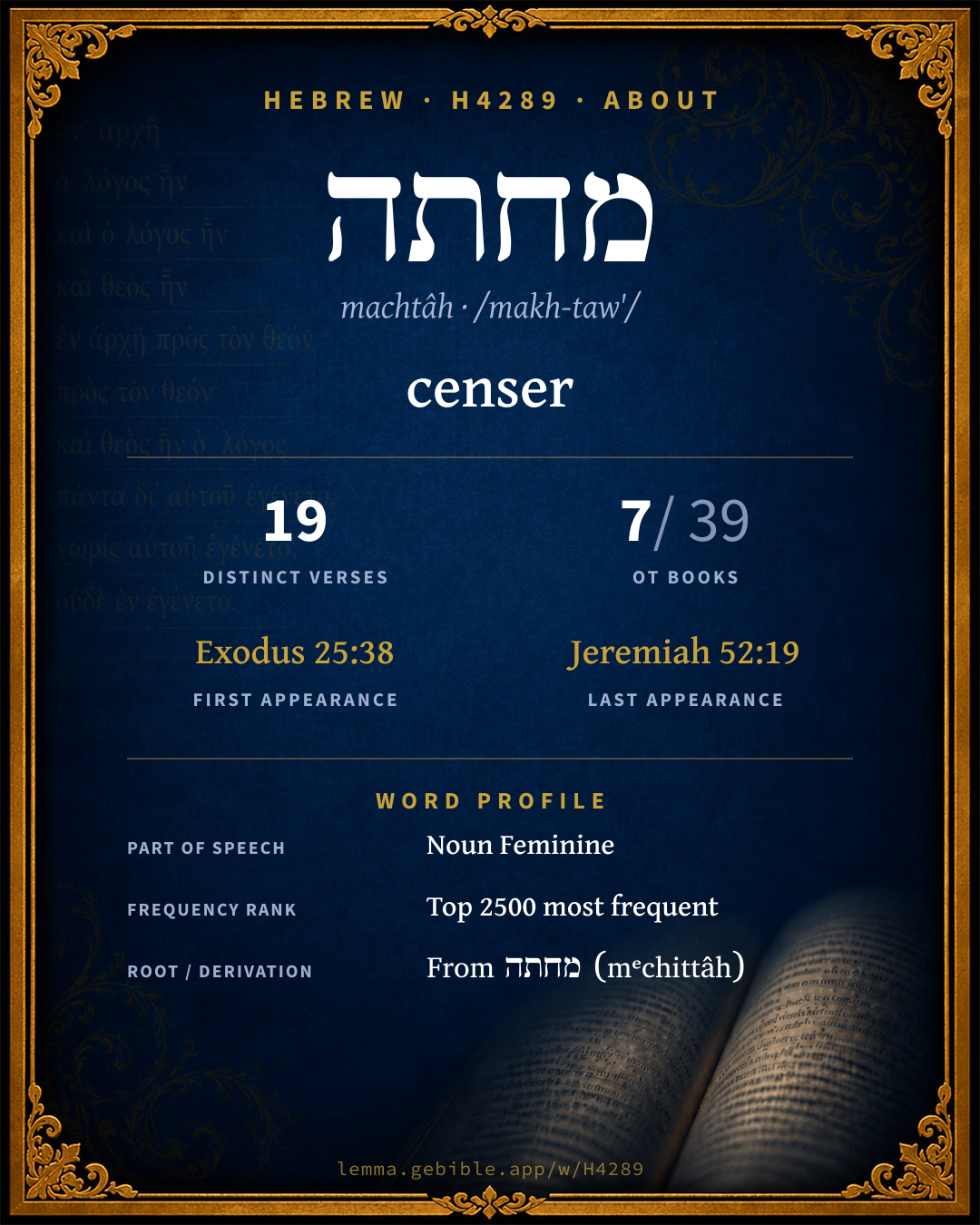
מַחְתָּה
censer
also: fire-holder, firepan, snuff dish, tray fuller range ↓
Full lexicon entry — Brown-Driver-Briggs (BDB)
From Brown-Driver-Briggs (BDB)
Where this word appears
See every Absolute-state word in the Hebrew Bible →
Grammar key — what these labels mean
Part of speech
- Noun
- A naming word — a person, place, thing, or idea.
Noun type
- Common
- A common noun — a general class of person, place, or thing (“king,” “city,” “water”), not a specific name.
State
- Construct
- A noun bound to a following noun in a possessive / “of” relationship (the construct chain).
- Absolute
- The independent form of a noun, not bound to a following word.
Gender
- Feminine
- Grammatically feminine.
Number
- Singular
- One.
- Plural
- More than one (in Hebrew, generally three or more).
Grammatical forms
- Noun, Common, Feminine, Plural, Absolute 9 times (41%)
- Noun, Common, Feminine, Plural, Construct 6 times (27%)
- Noun, Common, Feminine, Singular, Construct 5 times (23%)
- Noun, Common, Feminine, Singular, Absolute 2 times (9%)
Parsed forms decoded from the imported morphology (morphhb / Westminster Leningrad Codex — WLC text public domain, morphhb tagging CC BY 4.0), counted across 22 parsed occurrences — not distinct verses.
Every verse where H4289 appears — 19 distinct verses across 7 books. Click any verse to open its interlinear word-by-word view. Verse text shown in the World English Bible for context — . Each verse’s Hebrew form is shown with its reference; the English is not keyword-highlighted, since the data carries no word-level English alignment. Use “Compare translations” on any verse to read it across multiple English versions. This concordance covers the Hebrew Bible; Septuagint (Greek Old Testament) occurrences are not indexed here.
Exodus 4 verses
- Exodus 25:38 וּ/מַחְתֹּתֶ֖י/הָ conj + n c fp cs + sfx pers 3fs Its snuffers and its snuff dishes shall be of pure gold.
- Exodus 27:3 וּ/מַחְתֹּתָ֑י/ו conj + n c fp cs + sfx pers 3ms You shall make its pots to take away its ashes, its shovels, its basins, its flesh hooks, and its fire pans: all its vessels you shall make of brass.
- Exodus 37:23 וּ/מַחְתֹּתֶ֖י/הָ conj + n c fp cs + sfx pers 3fs He made its seven lamps, and its snuffers, and its snuff dishes, of pure gold.
- Exodus 38:3 הַ/מַּחְתֹּ֑ת ptcl def.art + n c fp He made all the vessels of the altar, the pots, the shovels, the basins, the flesh-hooks, and the fire pans. He made all its vessels of brass.
Leviticus 2 verses
- Leviticus 10:1 מַחְתָּת֗/וֹ n c fs cs + sfx pers 3ms Nadab and Abihu, the sons of Aaron, each took his censer, and put fire in it, and laid incense on it, and offered strange fire before Yahweh, which he had not commanded them.
- Leviticus 16:12 הַ֠/מַּחְתָּה ptcl def.art + n c fs He shall take a censer full of coals of fire from off the altar before Yahweh, and two handfuls of sweet incense beaten small, and bring it within the veil:
Numbers 9 verses
- Numbers 4:9 מַחְתֹּתֶ֑י/הָ n c fp cs + sfx pers 3fs They shall take a blue cloth, and cover the lampstand of the light, and its lamps, and its snuffers, and its snuff dishes, and all its oil vessels, with which they minister to it.
- Numbers 4:14 הַ/מַּחְתֹּ֤ת ptcl def.art + n c fp They shall put on it all its vessels, with which they minister about it, the fire pans, the flesh hooks, the shovels, and the basins; all the vessels of the altar; and they shall spread on it a covering of sealskin, and put in its poles.
- Numbers 16:6 מַחְתּ֔וֹת n c fp This do: take you censers, Korah, and all his company;
- Numbers 16:17 מַחְתָּת֗/וֹ מַחְתָּת֔/וֹ מַחְתֹּ֑ת מַחְתָּתֽ/וֹ n c fs cs + sfx pers 3ms n c fs cs + sfx pers 3ms n c fp n c fs cs + sfx pers 3ms and take every man his censer, and put incense on them, and bring you before Yahweh every man his censer, two hundred fifty censers; you also, and Aaron, each his censer.
- Numbers 16:18 מַחְתָּת֗/וֹ n c fs cs + sfx pers 3ms They took every man his censer, and put fire in them, and laid incense thereon, and stood at the door of the tent of meeting with Moses and Aaron.
- Numbers 16:37 הַ/מַּחְתֹּת֙ ptcl def.art + n c fp Speak to Eleazar the son of Aaron the priest, that he take up the censers out of the burning, and scatter you the fire yonder; for they are holy,
- Numbers 16:38 מַחְתּוֹת֩ n c fp cs even the censers of these sinners against their own lives; and let them be made beaten plates for a covering of the altar: for they offered them before Yahweh; therefore they are holy; and they shall be a sign to the children of Israel.
- Numbers 16:39 מַחְתּ֣וֹת n c fp cs Eleazar the priest took the brazen censers, which those who were burnt had offered; and they beat them out for a covering of the altar,
- Numbers 16:46 הַ֠/מַּחְתָּה ptcl def.art + n c fs Moses said to Aaron, Take your censer, and put fire therein from off the altar, and lay incense thereon, and carry it quickly to the congregation, and make atonement for them: for there is wrath gone out from Yahweh; the plague is begun.
1 Kings 1 verse
2 Kings 1 verse
2 Chronicles 1 verse
Jeremiah 1 verse
About this entry
At a glance — auto-summarized from this page’s data, not written by a person. Every figure links to its source below. This summary describes the numbers; it doesn’t interpret them.
מחתה (machtâh) is a Hebrew noun most often rendered “censer.” The lexical range runs to 4 senses — “censer” plus “fire-holder”, “firepan”, and “snuff dish”. Spanning 19 verses in 7 books, it ranks among the uncommon words of the Hebrew Bible. Numbers dominates its distribution — 9 of 19 verses. It first appears in Exodus 25:38. The sections below give every sense, occurrence, and version rendering.
Gloss history
Strong's 1890 vs modern scholarship
About this word
Strong's H4289 catalogs a Hebrew word from the Hebrew Old Testament.
These counts are not copied from any lexicon or concordance. They are computed here, from the morphology-tagged Hebrew Old Testament. What Lemma adds →
- 19
- distinct verses
- The word appears in 19 distinct verses.
- 7 / 39
- OT books
- The word appears in 7 of 39 Old Testament books.
- #1,412
- by frequency
- Top 2500 most frequent Hebrew words (rank 1,412 of 8,640 Hebrew words by occurrence).
View all 19 occurrences in the concordance →
By section of the Old Testament
By traditional corpus
Conventional, traditional groupings — biblical authorship is debated, so this is a traditional corpus grouping, not an authorship claim. Each share is this word’s portion of its verses in that division of the Hebrew canon. Each figure is a share of the word’s 19 distinct verses.
- Torah (Pentateuch) 15 verses · 79%
- Prophets (Nevi'im) 3 verses · 16%
- Writings (Ketuvim) 1 verse · 5%
How translations render this word
Counts come from each version’s own published word-to-Strong’s tagging or interlinear alignment — an approximate guide to how each version renders this word, not a word-level alignment the data otherwise carries. Because each total is that version’s own tagged count, the per-version totals vary from one another and need not match the appearance or distinct-verse counts above. These counts may also differ from a printed concordance because Lemma counts each distinctly tagged rendering and does not collapse phrase taggings into a single head-word total. This is a fixed set of word-tagged versions (KJV, ASV, BSB, ULT) and does not change with the reading translation you choose elsewhere. Each version’s license is shown beside its name below (and on Sources).
- King James Version: Censer 6×, Censers 6×, Firepans 4×
- American Standard Version: Censer 7×, Firepans 6×, Censers 4×
- Berean Standard Bible: Censers 10×, Censer 4×, Firepans 3×
- unfoldingWord Literal Text: Censer 7×, Censers 4×, Trays 4×
King James Version Public Domain
Renders H4289 across 22 tagged occurrences — most commonly:
Plus 4 renderings that appear only once — usually multi-word phrases or single function words the recovered tagging swept in, not distinct renderings.
American Standard Version Public Domain
Renders H4289 across 22 tagged occurrences — most commonly:
Plus 3 renderings that appear only once — usually multi-word phrases or single function words the recovered tagging swept in, not distinct renderings.
Berean Standard Bible Public Domain
Renders H4289 across 21 tagged occurrences — most commonly:
Plus 1 rendering that appears only once — usually multi-word phrases or single function words the recovered tagging swept in, not distinct renderings. Not rendered by a distinct English word in 1 further occurrence.
unfoldingWord Literal Text CC BY-SA 4.0
Renders H4289 across 22 tagged occurrences — most commonly:
Plus 2 renderings that appear only once — usually multi-word phrases or single function words the recovered tagging swept in, not distinct renderings.
Senses in BDB
The 4 senses BDB distinguishes for this word, in lexicon order (not ranked by frequency or importance). The full entry — with sub-senses — is in the Lexicon Entry tab.
- fire-holder, censer, firepan, snuff dish, tray
- snuff-dish
- fire-pans
- censer
Word origin
Derived from מחתה (mᵉchittâh) (H4288) — destruction.
Jastrow Dictionary
A second Hebrew/Aramaic lexicon for comparison, covering Aramaic and post-biblical (Talmudic, Targumic, Midrashic) usage that the biblical-Hebrew BDB does not. Matched by lemma rather than by Strong’s number, so a lemma may carry more than one Jastrow headword (shown separately below), and the entries cover usage well beyond the Bible.
מַחְתָּה
- 1. coal-pan. Kel. II, 3 מ׳ פרוצה a coal-pan the rims of which are broken off (having a flat plate only), opp. ib. 7 מ׳ שלמה. Yoma V, 1; a. e.
- 2. snuff-dish.—Pl. מַחְתּוֹת. Men. 88ᵇ ואין מלקחיה ומַחְתּוֹתֶיהָ מן הככר the tongs and the snuff-dishes of the candlestick were not made out of the Kikkar of gold; Yalk. Ex. 369; a. e.
A Dictionary of the Targumim, the Talmud Babli and Yerushalmi, and the Midrashic Literature (Marcus Jastrow; London, Luzac, 1903) — Public Domain. Digitized via Sefaria. Digitized via Sefaria. Full attribution on Sources.
Forms in the corpus
The 17 distinct written forms H4289 takes in the Hebrew Bible, most frequent first — each parse links to that state’s occurrences in the concordance. Hebrew forms include their vowel points and cantillation, so a single lemma takes many written forms.
Septuagint verse parallels
This word appears in 14 verses that also exist in the Greek Old Testament (Septuagint), out of the 19 Hebrew verses it occurs in. You can read those verses in Greek by switching the Old Testament edition to the Septuagint.
Read these verses in the Septuagint
This is a verse-level parallel only — the same verses exist in both the Hebrew and Greek Old Testaments. No word-level Hebrew↔Greek correspondence is claimed: the data carries no such alignment, so no Greek word is shown as this Hebrew word’s translation. Coverage is not total — the Septuagint omits the deuterocanon and renumbers the Psalms, so some Hebrew verses have no direct Greek parallel.