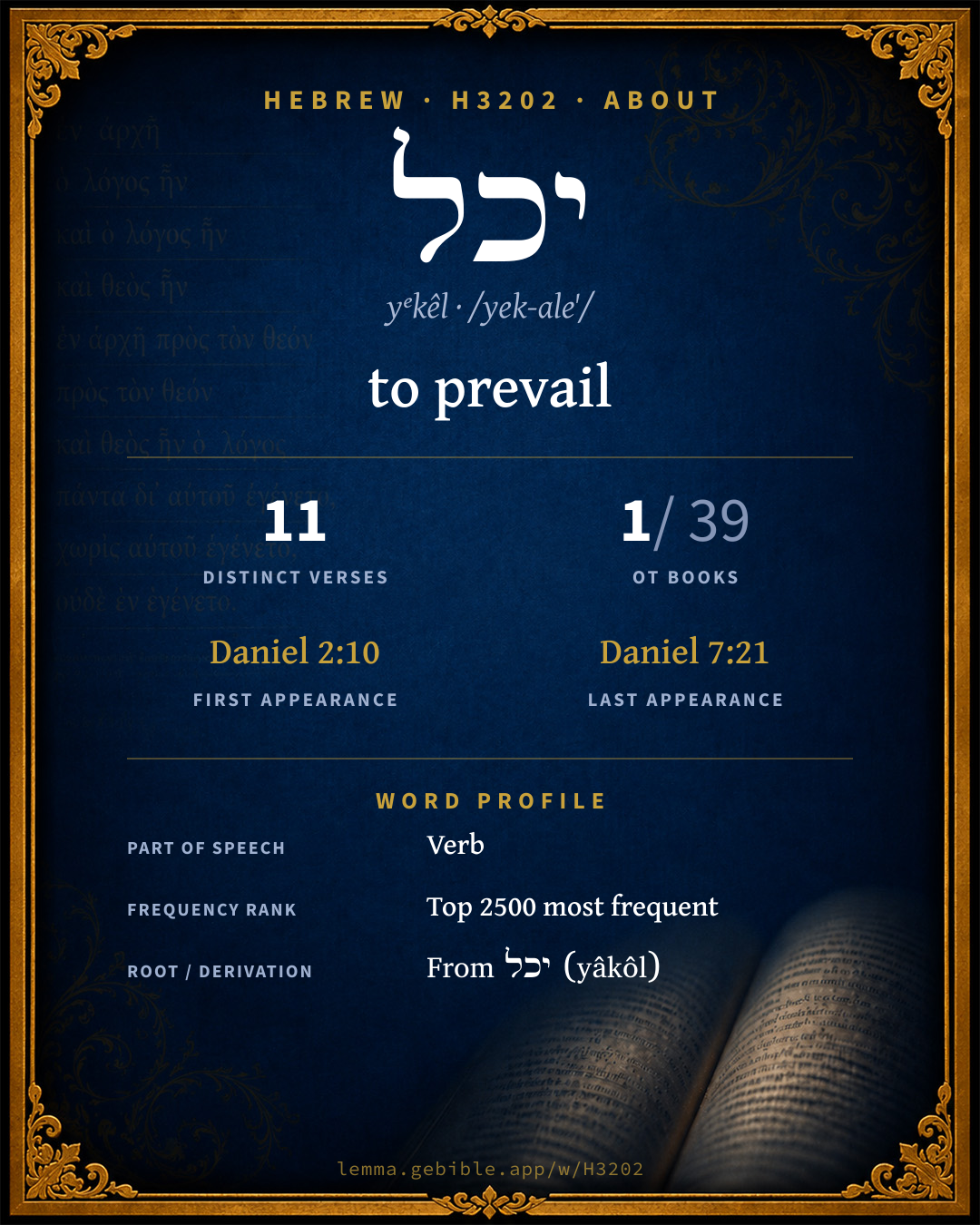
יְכִל
to prevail
‘to prevail’ is one of 2 main senses fuller range ↓
Full lexicon entry — Brown-Driver-Briggs (BDB)
From Brown-Driver-Briggs (BDB)
Where this word appears
Grammar key — what these labels mean
Part of speech
- Verb
- An action or state-of-being word.
Stem
- Qal
- The basic, simple active stem — the plain form of the verb (“he wrote”).
Form
- Imperfect
- An incomplete, ongoing, or future action (“he will / would write”).
- Participle Active
- A verbal adjective expressing ongoing or characteristic action (“writing / one who writes”).
- Perfect
- A completed action or state — Hebrew marks aspect (completeness) more than strict tense (“he wrote”).
State
- Absolute
- The independent form of a noun, not bound to a following word.
Person
- 2nd Person
- The one addressed (“you”).
- 3rd Person
- The one spoken about (“he / she / it / they”).
Gender
- Masculine
- Grammatically masculine.
- Feminine
- Grammatically feminine.
Number
- Singular
- One.
- Plural
- More than one (in Hebrew, generally three or more).
Grammatical forms
- Verb, Qal, Imperfect, 2nd Person, Masculine, Singular 4 times (29%)
- Verb, Qal, Imperfect, 3rd Person, Masculine, Singular 3 times (21%)
- Verb, Qal, Participle Active, Masculine, Plural, Absolute 3 times (21%)
- Verb, Qal, Participle Active, Feminine, Singular, Absolute 1 time (7%)
- Verb, Qal, Perfect, 3rd Person, Masculine, Singular 1 time (7%)
- Verb, Qal, Perfect, 2nd Person, Masculine, Singular 1 time (7%)
- Verb, Qal, Participle Active, Masculine, Singular, Absolute 1 time (7%)
Parsed forms decoded from the imported morphology (morphhb / Westminster Leningrad Codex — WLC text public domain, morphhb tagging CC BY 4.0), counted across 14 parsed occurrences — not distinct verses.
Every verse where H3202 appears — 11 distinct verses across 1 book. Click any verse to open its interlinear word-by-word view. Verse text shown in the World English Bible for context — . Each verse’s Hebrew form is shown with its reference; the English is not keyword-highlighted, since the data carries no word-level English alignment. Use “Compare translations” on any verse to read it across multiple English versions. This concordance covers the Hebrew Bible; Septuagint (Greek Old Testament) occurrences are not indexed here.
Daniel 11 verses
- Daniel 2:10 יוּכַ֖ל Qal impf 3ms The Chaldeans answered before the king, and said, There is not a man on the earth who can show the king's matter, because no king, lord, or ruler, has asked such a thing of any magician, or enchanter, or Chaldean.
- Daniel 2:27 יָכְלִ֖ין Qal ptcp.act mp Daniel answered before the king, and said, The secret which the king has demanded can neither wise men, enchanters, magicians, nor soothsayers, show to the king;
- Daniel 2:47 יְכֵ֔לְתָּ Qal pf 2ms The king answered to Daniel, and said, Of a truth your God is the God of gods, and the Lord of kings, and a revealer of secrets, seeing you have been able to reveal this secret.
- Daniel 3:17 יָכִ֖ל Qal impf 3ms If it be [so], our God whom we serve is able to deliver us from the burning fiery furnace; and he will deliver us out of your hand, O king.
- Daniel 3:29 יִכֻּ֥ל Qal impf 3ms Therefore I make a decree, that every people, nation, and language, which speak anything evil against the God of Shadrach, Meshach, and Abednego, shall be cut in pieces, and their houses shall be made a dunghill; because there is no other god who is able to deliver after this sort.
- Daniel 4:18 יָכְלִ֤ין Qal ptcp.act mp This dream I, king Nebuchadnezzar, have seen; and you, Belteshazzar, declare the interpretation, because all the wise men of my kingdom are not able to make known to me the interpretation; but you are able; for the spirit of the holy gods is in you.
- Daniel 4:37 יָכִ֖ל Qal ptcp.act ms Now I, Nebuchadnezzar, praise and extol and honor the King of heaven; for all his works are truth, and his ways justice; and those who walk in pride he is able to abase.
- Daniel 5:16 תוכל תִיכּ֥וּל תוכל תִּכ֨וּל Qal impf 2ms Qal impf 2ms Qal impf 2ms Qal impf 2ms But I have heard of you, that you can give interpretations, and dissolve doubts; now if you can read the writing, and make known to me the interpretation of it, you shall be clothed with purple, and have a chain of gold about your neck, and shall be the third ruler in the kingdom.
- Daniel 6:4 יָכְלִ֣ין Qal ptcp.act mp Then the presidents and the satraps sought to find occasion against Daniel as touching the kingdom; but they could find no occasion nor fault, because he was faithful, neither was there any error or fault found in him.
- Daniel 6:20 הַ/יְכִ֥ל ptcl inter + Qal pf 3ms When he came near to the den to Daniel, he cried with a lamentable voice; the king spoke and said to Daniel, Daniel, servant of the living God, is your God, whom you serve continually, able to deliver you from the lions?
- Daniel 7:21 וְ/יָכְלָ֖ה conj + Qal ptcp.act fs I saw, and the same horn made war with the saints, and prevailed against them;
About this entry
At a glance — auto-summarized from this page’s data, not written by a person. Every figure links to its source below. This summary describes the numbers; it doesn’t interpret them.
יכל (yᵉkêl) is a Hebrew verb most often rendered “to prevail.” It clusters heavily in Daniel, which alone accounts for 100% of its uses. It turns up in 11 verses across 1 book, an uncommon footprint. Scripture first uses it in Daniel 2:10. Ranging over 2 senses, it is not a single-sense word. For the data behind this summary, explore the sense tree and the renderings breakdown below.
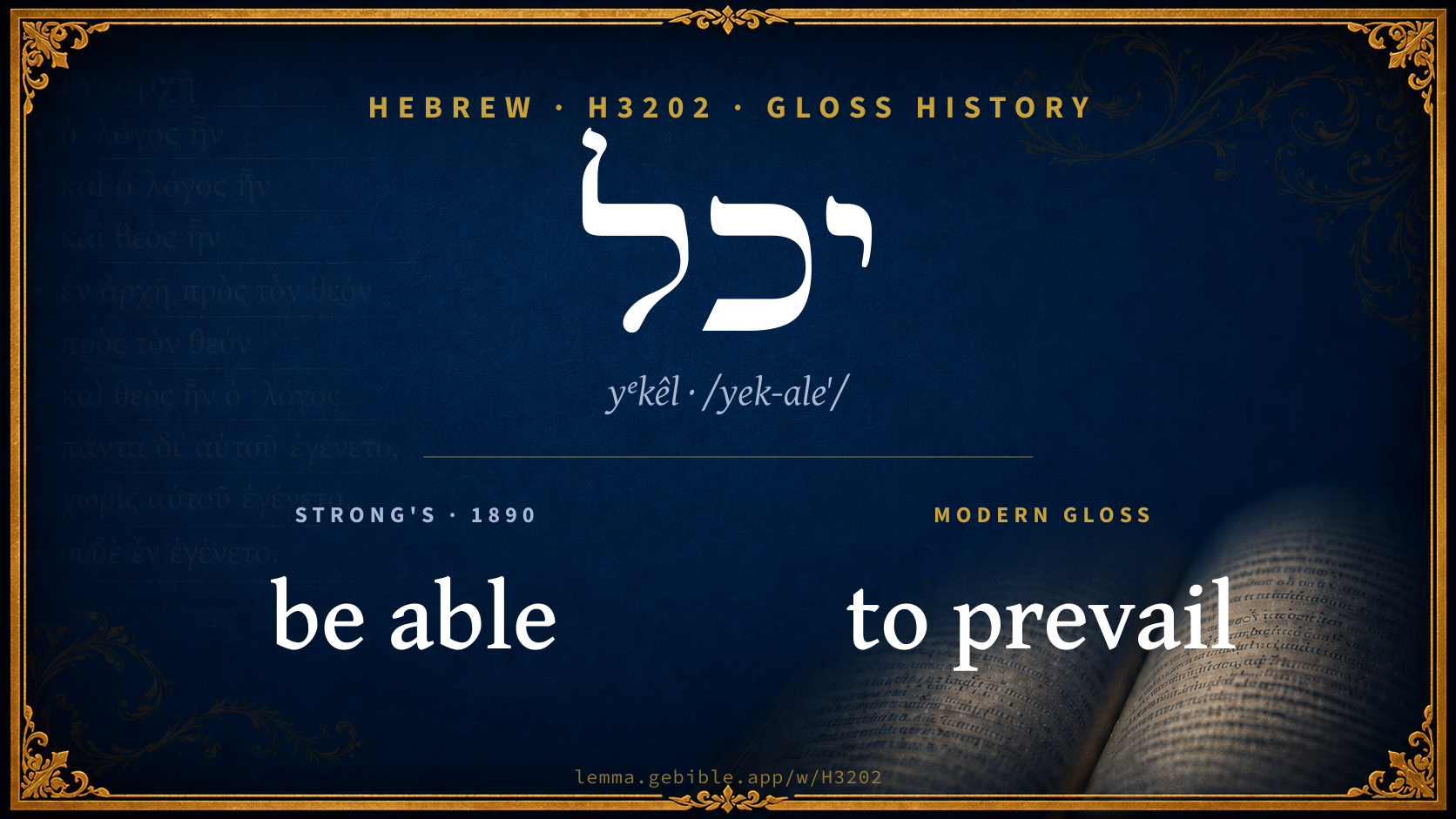
Gloss history
Strong's 1890 vs modern scholarship
About this word
Strong's H3202 catalogs a Hebrew word from the Hebrew Old Testament.
These counts are not copied from any lexicon or concordance. They are computed here, from the morphology-tagged Hebrew Old Testament. What Lemma adds →
- 11
- distinct verses
- The word appears in 11 distinct verses.
- 1 / 39
- OT books
- The word appears in 1 of 39 Old Testament books.
- #1,910
- by frequency
- Top 2500 most frequent Hebrew words (rank 1,910 of 8,640 Hebrew words by occurrence).
View all 11 occurrences in the concordance →
Most concentrated in
- Daniel 11 verses 100%
By section of the Old Testament
By traditional corpus
Conventional, traditional groupings — biblical authorship is debated, so this is a traditional corpus grouping, not an authorship claim. Each share is this word’s portion of its verses in that division of the Hebrew canon. Each figure is a share of the word’s 11 distinct verses.
- Writings (Ketuvim) 11 verses · 100%
How translations render this word
Counts come from each version’s own published word-to-Strong’s tagging or interlinear alignment — an approximate guide to how each version renders this word, not a word-level alignment the data otherwise carries. Because each total is that version’s own tagged count, the per-version totals vary from one another and need not match the appearance or distinct-verse counts above. These counts may also differ from a printed concordance because Lemma counts each distinctly tagged rendering and does not collapse phrase taggings into a single head-word total. This is a fixed set of word-tagged versions (KJV, ASV, BSB, ULT) and does not change with the reading translation you choose elsewhere. Each version’s license is shown beside its name below (and on Sources).
- King James Version: Able 3×, Can 2×, Thou canst 2×
- American Standard Version: Able 3×, Thou canst 2×
- Berean Standard Bible: Can 4×, He is able 2×
- unfoldingWord Literal Text: Is able 3×, Able 2×, You are able 2×
King James Version Public Domain
Renders H3202 across 12 tagged occurrences — most commonly:
Plus 5 renderings that appear only once — usually multi-word phrases or single function words the recovered tagging swept in, not distinct renderings.
American Standard Version Public Domain
Renders H3202 across 11 tagged occurrences — most commonly:
Plus 6 renderings that appear only once — usually multi-word phrases or single function words the recovered tagging swept in, not distinct renderings.
Berean Standard Bible Public Domain
Renders H3202 across 11 tagged occurrences — most commonly:
Plus 5 renderings that appear only once — usually multi-word phrases or single function words the recovered tagging swept in, not distinct renderings.
unfoldingWord Literal Text CC BY-SA 4.0
Renders H3202 across 15 tagged occurrences — most commonly:
Plus 8 renderings that appear only once — usually multi-word phrases or single function words the recovered tagging swept in, not distinct renderings.
Senses in BDB
The 2 senses BDB distinguishes for this word, in lexicon order (not ranked by frequency or importance). The full entry — with sub-senses — is in the Lexicon Entry tab.
- to be able
(Peal)
- to prevail
Word origin
יְכִל vb. be able (Dn)
— Brown-Driver-Briggs (Oxford 1906, public domain), digitized via Sefaria, supplemented by the OpenScriptures HebrewLexicon (CC BY 4.0). See Sources.
Derived from יכל (yâkôl) (H3201) — to prevail.
Jastrow Dictionary
A second Hebrew/Aramaic lexicon for comparison, covering Aramaic and post-biblical (Talmudic, Targumic, Midrashic) usage that the biblical-Hebrew BDB does not. Matched by lemma rather than by Strong’s number, so a lemma may carry more than one Jastrow headword (shown separately below), and the entries cover usage well beyond the Bible.
יָכוֹל
- 1. (adj.) m., יְכוֹלָה f. capable, able to sustain, enduring;
- 2. (verb), impf. יוּכַל, to be capable, able; one can, may; it is possible. Cant. R. to III, 6 לארי יָכֹלְתִּי … איני י׳ I overpowered the lion, and I should not overpower the dog? Ib. שר שלכם לא י׳ … ואתם יְכוֹלִים להם your guardian angel could not stand against their father (Jacob), and (you think) you could master them?—יְכוֹלְנִי = י׳ אני I can. Ḥag. 15ᵃ top Ms. M. (ed. יכול אני); Nidd. 64ᵇ.—Keth. 95ᵃ מפני שי׳ לומר וכ׳ because he may plead &c. Ib. יְכוֹלָה היא שתאמר she may plead. Ib. 43ᵃ, a. e. י׳ הרב לומר וכ׳ the master may (has a right to) say to his slave &c. Ber. 6ᵃ אין כל בריה י׳ לעמוד וכ׳ no creature could stand up (exist) before the demons. Taan. 30ᵇ ביָכוֹל of an able-bodied person.—Yalk. Esth. 1048 שמא תוּכַל להשיאה וכ׳ canst thou give her in marriage to both of them?—Midr. Till. to Ps. XLV לא יָכְלוּ להתודות וכ׳ they could not confess their sins with their mouth; a. v. fr.—Esp. יָכוֹל (= יכול אני לומר or י׳ אתה לומר) I (you) might think, argue, conclude. Sabb. 64ᵃ י׳ שאני מרבה וכ׳ from the Bible text (Lev. XI, 32) I might infer that ropes and cords are included; Sifra Sh’mini Par. 6, ch. VIII; a. v. fr.—כִּבְיָכוֹל as though it were possible, as it were (ref. to an allegorical or anthropomorphous expression with reference to the Lord). Mekh. Bo, Pisḥa, s. 14 כל זמן … כ׳ שכינה עמהם whenever Israel is enslaved, the Divine Majesty, as it were, is with them in slavery. Ib. כ׳ אמרו ישראל וכ׳ the Israelites said, thou, as it were, hast redeemed thyself. Ib. B’shall., Shirah, s. 6 כ׳ כלפי מעלה as if referring to the Lord’s eye. B. Kam. 79ᵇ, v. מַטָּה; a. fr.—Ch. יְכִיל. e.g. Leviticus 11:32
יָכֹל
- , v. יָכוֹל, יְכוֹלֶת.
A Dictionary of the Targumim, the Talmud Babli and Yerushalmi, and the Midrashic Literature (Marcus Jastrow; London, Luzac, 1903) — Public Domain. Digitized via Sefaria. Digitized via Sefaria. Full attribution on Sources.
Forms in the corpus
The 12 distinct written forms H3202 takes in the Hebrew Bible, most frequent first — each parse links to that stem’s occurrences in the concordance. Hebrew forms include their vowel points and cantillation, so a single lemma takes many written forms.
| Form | Parsing | Example | Uses |
|---|---|---|---|
| יָכִ֖ל | Verb, Qal, Imperfect, 3rd Person, Masculine, Singular | Daniel 3:17 | 2 |
| תוכל | Verb, Qal, Imperfect, 2nd Person, Masculine, Singular | Daniel 5:16 | 2 |
| הַ/יְכִ֥ל | Verb, Qal, Perfect, 3rd Person, Masculine, Singular | Daniel 6:20 | 1 |
| וְ/יָכְלָ֖ה | Verb, Qal, Participle Active, Feminine, Singular, Absolute | Daniel 7:21 | 1 |
| יְכֵ֔לְתָּ | Verb, Qal, Perfect, 2nd Person, Masculine, Singular | Daniel 2:47 | 1 |
| יִכֻּ֥ל | Verb, Qal, Imperfect, 3rd Person, Masculine, Singular | Daniel 3:29 | 1 |
| יָכְלִ֖ין | Verb, Qal, Participle Active, Masculine, Plural, Absolute | Daniel 2:27 | 1 |
| יָכְלִ֣ין | Verb, Qal, Participle Active, Masculine, Plural, Absolute | Daniel 6:4 | 1 |
| יָכְלִ֤ין | Verb, Qal, Participle Active, Masculine, Plural, Absolute | Daniel 4:18 | 1 |
| יוּכַ֖ל | Verb, Qal, Imperfect, 3rd Person, Masculine, Singular | Daniel 2:10 | 1 |
| תִיכּ֥וּל | Verb, Qal, Imperfect, 2nd Person, Masculine, Singular | Daniel 5:16 | 1 |
| תִּכ֨וּל | Verb, Qal, Imperfect, 2nd Person, Masculine, Singular | Daniel 5:16 | 1 |
Same root — word family
Other BDB entries built from the same root as H3202, grouped by Strong’s listed origin. These share a root / origin per the lexicon — not necessarily a shared meaning. Each links to that word’s own entry.
Derives from
Shares the same root
Proper names from this root
People and places named from this root — a name, not an additional meaning of the word.
Compare all same-root words → Showing 4 of 7 — not the complete family. 2 of the same-root words are proper names (people or places). They share a root, not necessarily a meaning.
Septuagint verse parallels
This word appears in 10 verses that also exist in the Greek Old Testament (Septuagint), out of the 11 Hebrew verses it occurs in. You can read those verses in Greek by switching the Old Testament edition to the Septuagint.
Read these verses in the Septuagint
This is a verse-level parallel only — the same verses exist in both the Hebrew and Greek Old Testaments. No word-level Hebrew↔Greek correspondence is claimed: the data carries no such alignment, so no Greek word is shown as this Hebrew word’s translation. Coverage is not total — the Septuagint omits the deuterocanon and renumbers the Psalms, so some Hebrew verses have no direct Greek parallel.