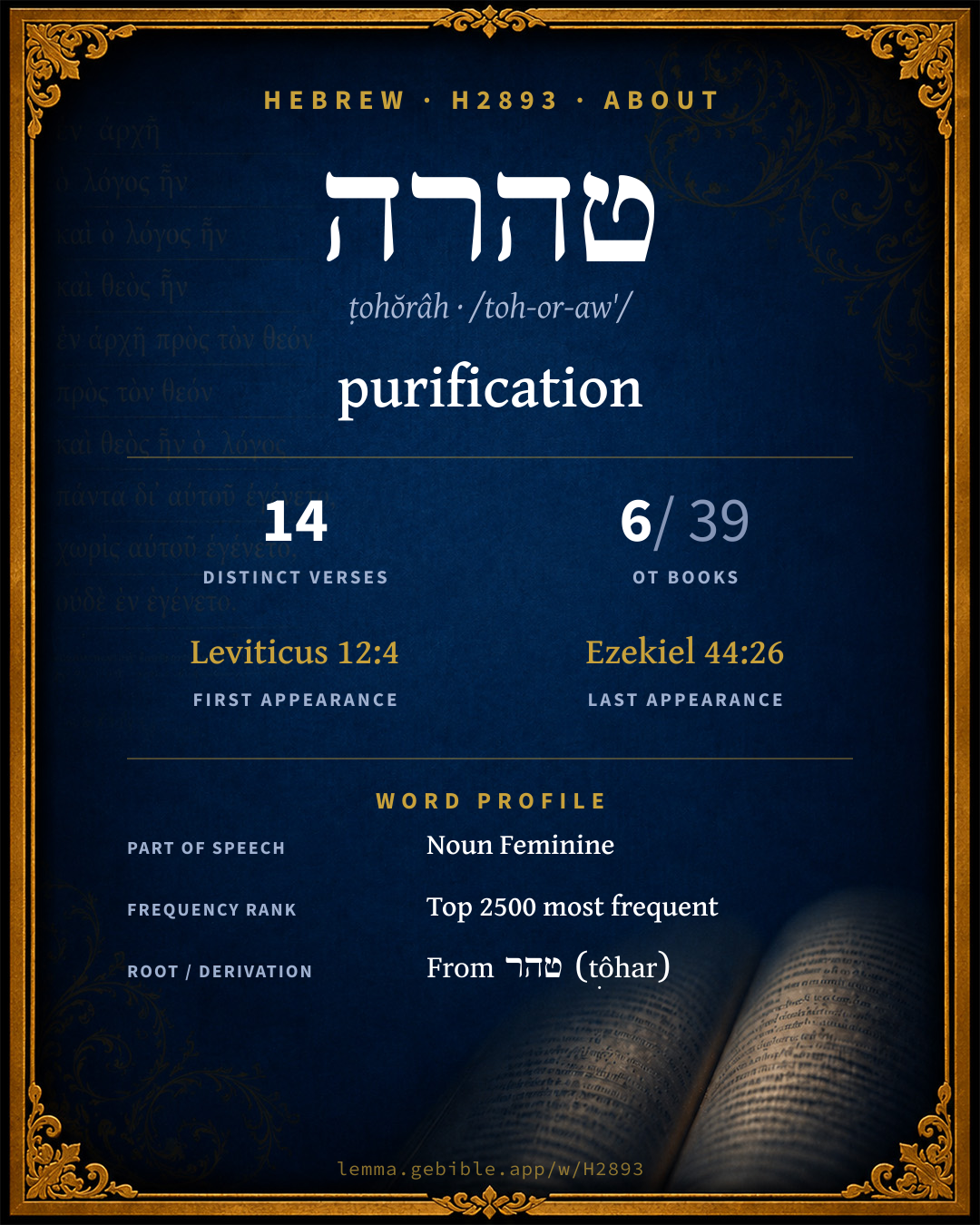
טׇהֳרָה
purification
also: purifying, cleansing, purity, cleanness fuller range ↓
Full lexicon entry — Brown-Driver-Briggs (BDB)
From Brown-Driver-Briggs (BDB)
Where this word appears
Grammar key — what these labels mean
Part of speech
- Noun
- A naming word — a person, place, thing, or idea.
Noun type
- Common
- A common noun — a general class of person, place, or thing (“king,” “city,” “water”), not a specific name.
State
- Construct
- A noun bound to a following noun in a possessive / “of” relationship (the construct chain).
- Absolute
- The independent form of a noun, not bound to a following word.
Gender
- Both
- Attested as both masculine and feminine.
Number
- Singular
- One.
Every verse where H2893 appears in the Book of Ezekiel — 1 distinct verse. Click any verse to open its interlinear word-by-word view. Verse text shown in the World English Bible for context — . Each verse’s Hebrew form is shown with its reference; the English is not keyword-highlighted, since the data carries no word-level English alignment. Use “Compare translations” on any verse to read it across multiple English versions. This concordance covers the Hebrew Bible; Septuagint (Greek Old Testament) occurrences are not indexed here.
Ezekiel
About this entry
At a glance — auto-summarized from this page’s data, not written by a person. Every figure links to its source below. This summary describes the numbers; it doesn’t interpret them.
טהרה — transliterated ṭohŏrâh — is a Hebrew noun carrying the sense “purification.” More than half of its appearances fall in Leviticus. It appears 14 verses across 6 books of the Hebrew Bible, among its uncommon vocabulary. Alongside “purification” the lexicon also lists “purifying”, “cleansing”, and “purity” — part of its full sense range. Older and newer Bibles part ways — “cleansing” in the King James Version, “purification” (unfoldingWord Literal Text) in modern versions. See the renderings breakdown. See the sense tree, 14-verse concordance, and the renderings breakdown below.
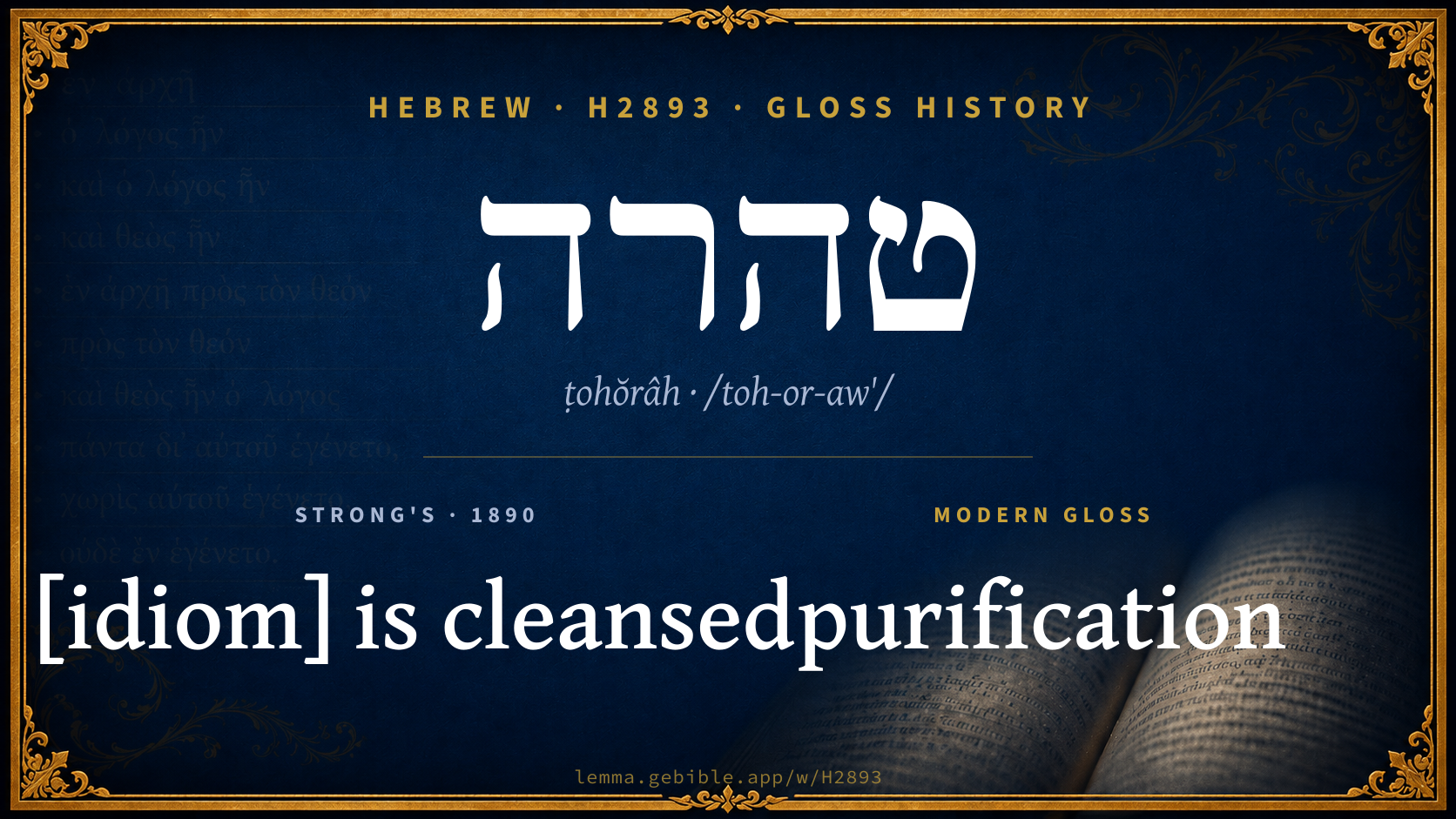
Gloss history
Strong's 1890 vs modern scholarship
About this word
Strong's H2893 catalogs a Hebrew word from the Hebrew Old Testament.
These counts are not copied from any lexicon or concordance. They are computed here, from the morphology-tagged Hebrew Old Testament. What Lemma adds →
- 14
- distinct verses
- The word appears in 14 distinct verses.
- 6 / 39
- OT books
- The word appears in 6 of 39 Old Testament books.
- #1,836
- by frequency
- Top 2500 most frequent Hebrew words (rank 1,836 of 8,640 Hebrew words by occurrence).
View all 14 occurrences in the concordance →
Most concentrated in
- Leviticus 9 verses 64%
- Numbers 1 verse 7%
- 1 Chronicles 1 verse 7%
By section of the Old Testament
By traditional corpus
Conventional, traditional groupings — biblical authorship is debated, so this is a traditional corpus grouping, not an authorship claim. Each share is this word’s portion of its verses in that division of the Hebrew canon. Each figure is a share of the word’s 14 distinct verses.
- Torah (Pentateuch) 10 verses · 71%
- Writings (Ketuvim) 3 verses · 21%
- Prophets (Nevi'im) 1 verse · 7%
How translations render this word
Counts come from each version’s own published word-to-Strong’s tagging or interlinear alignment — an approximate guide to how each version renders this word, not a word-level alignment the data otherwise carries. Because each total is that version’s own tagged count, the per-version totals vary from one another and need not match the appearance or distinct-verse counts above. These counts may also differ from a printed concordance because Lemma counts each distinctly tagged rendering and does not collapse phrase taggings into a single head-word total. This is a fixed set of word-tagged versions (KJV, ASV, BSB, ULT) and does not change with the reading translation you choose elsewhere. Each version’s license is shown beside its name below (and on Sources).
- King James Version: Cleansing 6×, Purifying 3×
- American Standard Version: Cleansing 6×, Purifying 3×
- Berean Standard Bible: Cleansing 6×, Purification 6×
- unfoldingWord Literal Text: Purification 6×, Cleansing 5×
King James Version Public Domain
Renders H2893 across 13 tagged occurrences — most commonly:
Plus 4 renderings that appear only once — usually multi-word phrases or single function words the recovered tagging swept in, not distinct renderings.
American Standard Version Public Domain
Renders H2893 across 13 tagged occurrences — most commonly:
Plus 4 renderings that appear only once — usually multi-word phrases or single function words the recovered tagging swept in, not distinct renderings.
Berean Standard Bible Public Domain
Renders H2893 across 15 tagged occurrences — most commonly:
Plus 3 renderings that appear only once — usually multi-word phrases or single function words the recovered tagging swept in, not distinct renderings.
unfoldingWord Literal Text CC BY-SA 4.0
Renders H2893 across 15 tagged occurrences — most commonly:
Plus 4 renderings that appear only once — usually multi-word phrases or single function words the recovered tagging swept in, not distinct renderings.
Senses in the full BDB
What do BDB’s symbols mean?
BDB uses these scholarly abbreviations:
| Symbol | Meaning |
|---|---|
| 𝔊 | the Septuagint (the ancient Greek translation, LXX) |
| 𝔙 | the Vulgate (the Latin translation) |
| 𝔖 | the Syriac version (the Peshitta) |
| 𝔗 | the Targum (the Aramaic translation) |
| ψ | the Psalms |
| √ | root (the underlying root or stem) |
| ‖ | parallel passage (a synonymous or contrasted parallel) |
| † | the dagger: every passage where the word occurs is cited |
The 2 senses and sub-senses the full Brown-Driver-Briggs lexicon distinguishes for this word, in lexicon order (not ranked by frequency), with BDB’s own verbatim wording and sub-sense lettering. Shown in Hebrew script with BDB’s own scholarly abbreviations. The condensed entry is in the Lexicon Entry tab. See also the Forms in the corpus table below.
- 1. purifying, menstruation Lv 12:4, 5. e.g. Leviticus 12:4
- 2. cleansing, purification, of leper Lv 13:7, 35; 14:2, 23, 32; of Nazirite Nu 6:9: from an issue Lv 15:13 (all P); from contact with the dead Ez 44:26; of sacred things in gen. 1 Ch 23:28; of persons for the passover 2 Ch 30:19; מִשְׁמֶרֶת הַטָּהֳרָה Ne 12:45 the charge, requirement of purification. e.g. Leviticus 13:7
Senses from the full Brown-Driver-Briggs lexicon (Brown, Driver, Briggs; Oxford 1906 — public domain), digitized via Sefaria, supplemented by the OpenScriptures HebrewLexicon (CC BY 4.0). Full attribution on Sources.
Word origin
n.f. purifying, cleansing;—abs. ט׳ Lv 12:4 + 2 times; cstr. טָהֳרַת 1 Ch 23:28 2 Ch 30:19; sf. טָהֳרָתוֹ Lv 13:7 + 7 times;—
— Brown-Driver-Briggs (Oxford 1906, public domain), digitized via Sefaria, supplemented by the OpenScriptures HebrewLexicon (CC BY 4.0). See Sources.
Derived from טהר (ṭôhar) (H2892) — purification.
Jastrow Dictionary
A second Hebrew/Aramaic lexicon for comparison, covering Aramaic and post-biblical (Talmudic, Targumic, Midrashic) usage that the biblical-Hebrew BDB does not. Matched by lemma rather than by Strong’s number, so a lemma may carry more than one Jastrow headword (shown separately below), and the entries cover usage well beyond the Bible.
טָהֳרָה
- ; preced. wds.; preced. wds.)
- 1. clearness of the sky after the rainy season. Ber. 59ᵃ הרואה רקיע בטָהֳרָתָהּ (or בטַהֲ׳) he who sees the sky in its restored brightness (Ms. F. בטיהרו, v. טִיהָר). Ib. נראית רקיע בטהרתה (Ms. M. נראו שמים בטהרה; Yalk. Is. 335 נראה שמים בטִהֲרוֹ, corr. acc.).
- 2. pureness, condition of levitical cleanness; purification. Sabb. 152ᵇ תנה לו כמו שנתנה לך מה הוא בט׳ אף אתה בט׳ Ms. M. (v. Rabb. D. S. a. l. note) give her (the soul) to Him as He has given her to thee, as He (has given her) in pureness, so give thou &c. Snh. 68ᵃ, v. טָהוֹר.—Ber. 16ᵃ (ref. to Num. XXIV, 6) מה נחלים … מטומאה לט׳ וכ׳ as the rivers raise man from a condition of uncleanness to one of cleanness, so do the tents (schools) &c. Ab. Zar. 8ᵃ עובדי ע"ז בט׳ encouraging idolatry, though from no impure motives. Yoma 72ᵇ; Men. 110ᵃ הלומד תורה בט׳ he who studies the Law in (sexual) purity.—Snh. l. c. וטַהֲרָתָן במה שהן and their purification (immersion) is performed in whatever condition they are (whole or torn); a. v. fr.—Esp. ט׳ or טַהֲרַת הקודש observance of levitical rules originally prescribed for the handling of sacred food; also (mostly in pl.) secular food so prepared or pretended to be so prepared; v. חָבֵר.—Gitt. 62ᵃ אין עושין חלת ע"ה בט׳ you must not separate the priest’s share under levitical precautions for a non-observant (because it might mislead the priest); Tosef. Dem. III, 1. Sabb. 13ᵃ עד היכן פרצה ט׳ וכ׳ how far the custom of observing the rules of levitical cleanness for secular food has spread &c. Ḥag. II, 7 היה אוכל על ט׳ הקודש used to eat his ordinary meals with the observance required for sacred food; a. fr.—Pl. טָהֳרוֹת, טַהֲרוֹת. Tosef. Dem. l. c. אין עושין ט׳ לע"ה one must not prepare food with observance of levitical precautions for &c., v. supra. Ber. 19ᵃ; B. Mets. 59ᵇ כל ט׳ שטיהר וכ׳ all objects which R. … had declared clean. Tosef. Dem. II, 20 אין משלחין ט׳ וכ׳ you must not send food levitically prepared through a non-observant; a. v. fr.—Tohŏroth, or Tahăroth, (euphem. for טומאות), name of the sixth order of the Mishnah and Tosefta (סדר ט׳), and of one treatise of that order. e.g. Numbers 24:6
A Dictionary of the Targumim, the Talmud Babli and Yerushalmi, and the Midrashic Literature (Marcus Jastrow; London, Luzac, 1903) — Public Domain. Digitized via Sefaria. Digitized via Sefaria. Full attribution on Sources.
Forms in the corpus
The 14 distinct written forms H2893 takes in the Hebrew Bible, most frequent first — each parse links to that state’s occurrences in the concordance. Hebrew forms include their vowel points and cantillation, so a single lemma takes many written forms.
| Form | Parsing | Example | Uses |
|---|---|---|---|
| לְ/טָהֳרָת֖/וֹ | Noun, Common, Both, Singular, Construct | Leviticus 14:23 | 2 |
| בְּ/טָהֳרָתֽ/וֹ | Noun, Common, Both, Singular, Construct | Leviticus 14:32 | 1 |
| הַֽ/טָּהֳרָ֔ה | Noun, Common, Both, Singular, Absolute | Nehemiah 12:45 | 1 |
| טָֽהֳרָת֑/וֹ | Noun, Common, Both, Singular, Construct | Ezekiel 44:26 | 1 |
| טָהֳרַ֖ת | Noun, Common, Both, Singular, Construct | 1 Chronicles 23:28 | 1 |
| טָהֳרָ֑ה | Noun, Common, Both, Singular, Absolute | Leviticus 12:4 | 1 |
| טָהֳרָ֗/הּ | Noun, Common, Both, Singular, Construct | Leviticus 12:6 | 1 |
| טָהֳרָֽ/הּ | Noun, Common, Both, Singular, Construct | Leviticus 12:4 | 1 |
| טָהֳרָֽה | Noun, Common, Both, Singular, Absolute | Leviticus 12:5 | 1 |
| טָהֳרָת֑/וֹ | Noun, Common, Both, Singular, Construct | Leviticus 14:2 | 1 |
| טָהֳרָת֔/וֹ | Noun, Common, Both, Singular, Construct | Numbers 6:9 | 1 |
| טָהֳרָתֽ/וֹ | Noun, Common, Both, Singular, Construct | Leviticus 13:35 | 1 |
| כְּ/טָהֳרַ֥ת | Noun, Common, Both, Singular, Construct | 2 Chronicles 30:19 | 1 |
| לְ/טָהֳרָת֑/וֹ | Noun, Common, Both, Singular, Construct | Leviticus 13:7 | 1 |
Septuagint verse parallels
This word appears in 13 verses that also exist in the Greek Old Testament (Septuagint), out of the 14 Hebrew verses it occurs in. You can read those verses in Greek by switching the Old Testament edition to the Septuagint.
Read these verses in the Septuagint
This is a verse-level parallel only — the same verses exist in both the Hebrew and Greek Old Testaments. No word-level Hebrew↔Greek correspondence is claimed: the data carries no such alignment, so no Greek word is shown as this Hebrew word’s translation. Coverage is not total — the Septuagint omits the deuterocanon and renumbers the Psalms, so some Hebrew verses have no direct Greek parallel.