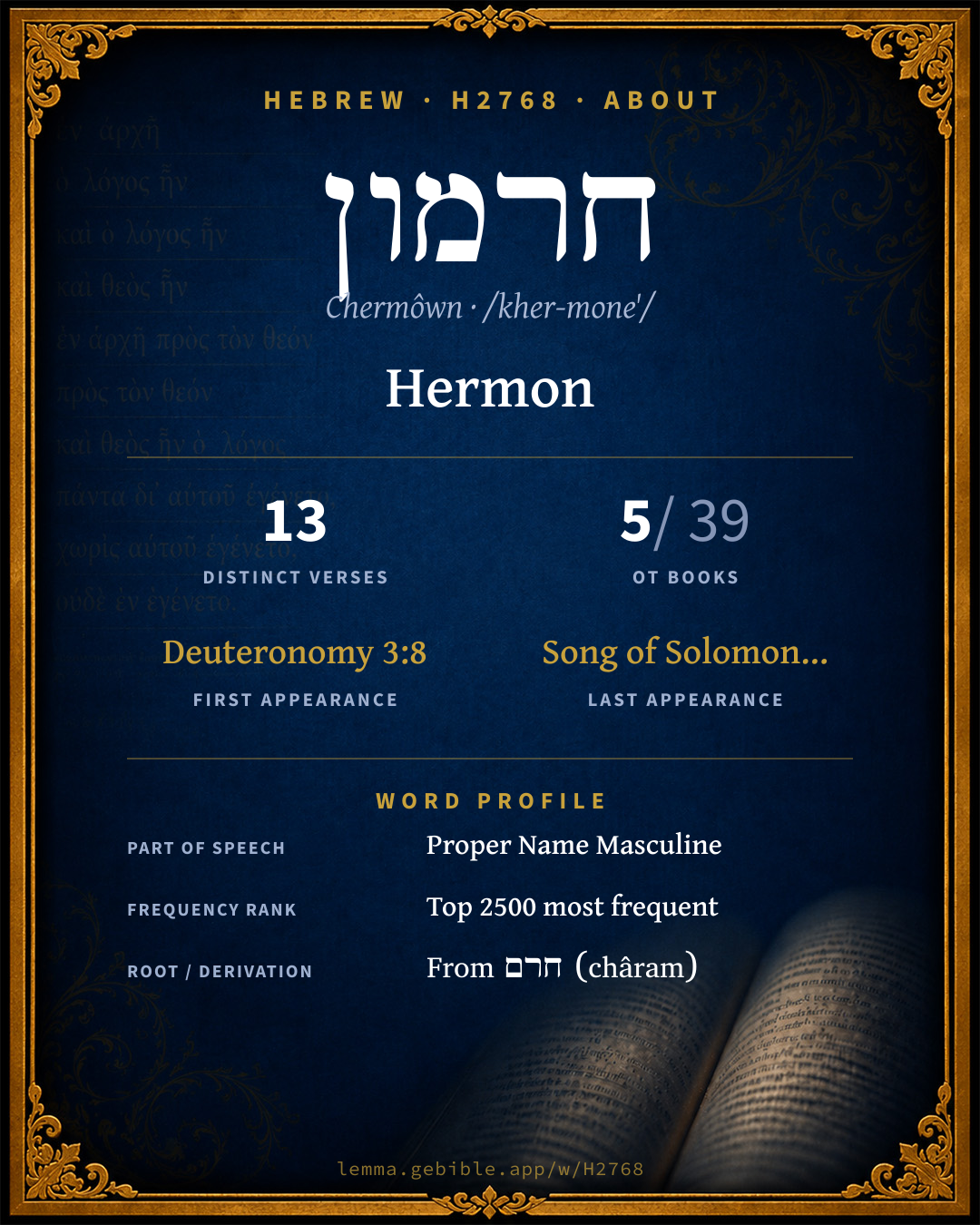
חֶרְמוֹן
Hermon
BDB lists 2 entries for ‘Hermon’ fuller range ↓
Full lexicon entry — Brown-Driver-Briggs (BDB)
From Brown-Driver-Briggs (BDB)
Where this word appears
Grammar key — what these labels mean
Part of speech
- Noun
- A naming word — a person, place, thing, or idea.
Noun type
- Proper
- A name of a specific person, place, or people (e.g. Abraham, Zion, Israel).
Every verse where H2768 appears in the Book of Joshua — 6 distinct verses. Click any verse to open its interlinear word-by-word view. Verse text shown in the World English Bible for context — . Each verse’s Hebrew form is shown with its reference; the English is not keyword-highlighted, since the data carries no word-level English alignment. Use “Compare translations” on any verse to read it across multiple English versions. This concordance covers the Hebrew Bible; Septuagint (Greek Old Testament) occurrences are not indexed here.
Joshua
- Joshua 11:3 חֶרְמ֔וֹן n Proper to the Canaanite on the east and on the west, and the Amorite, and the Hittite, and the Perizzite, and the Jebusite in the hill-country, and the Hivite under Hermon in the land of Mizpah.
- Joshua 11:17 חֶרְמ֑וֹן n Proper from Mount Halak, that goes up to Seir, even to Baal Gad in the valley of Lebanon under Mount Hermon: and all their kings he took, and struck them, and put them to death.
- Joshua 12:1 חֶרְמ֔וֹן n Proper Now these are the kings of the land, whom the children of Israel struck, and possessed their land beyond the Jordan toward the sunrise, from the valley of the Arnon to Mount Hermon, and all the Arabah eastward:
- Joshua 12:5 חֶרְמ֤וֹן n Proper and ruled in Mount Hermon, and in Salecah, and in all Bashan, to the border of the Geshurites and the Maacathites, and half Gilead, the border of Sihon king of Heshbon.
- Joshua 13:5 חֶרְמ֑וֹן n Proper and the land of the Gebalites, and all Lebanon, toward the sunrise, from Baal Gad under Mount Hermon to the entrance of Hamath;
- Joshua 13:11 חֶרְמ֛וֹן n Proper and Gilead, and the border of the Geshurites and Maacathites, and all Mount Hermon, and all Bashan to Salecah;
About this entry
At a glance — auto-summarized from this page’s data, not written by a person. Every figure links to its source below. This summary describes the numbers; it doesn’t interpret them.
חרמון — transliterated Chermôwn — is a Hebrew name carrying the sense “Hermon.” Debuting at Deuteronomy 3:8, it then recurs through the corpus. The Hebrew Bible uses it across 13 verses — uncommon. More than a third of its appearances fall in Joshua. Each statement above links to its evidence; the full detail follows below.
Gloss history
Strong's 1890 vs modern scholarship
About this word
Strong's H2768 catalogs a Hebrew word from the Hebrew Old Testament.
These counts are not copied from any lexicon or concordance. They are computed here, from the morphology-tagged Hebrew Old Testament. What Lemma adds →
- 13
- distinct verses
- The word appears in 13 distinct verses.
- 5 / 39
- OT books
- The word appears in 5 of 39 Old Testament books.
- #2,001
- by frequency
- Top 2500 most frequent Hebrew words (rank 2,001 of 8,640 Hebrew words by occurrence).
View all 13 occurrences in the concordance →
Most concentrated in
- Joshua 6 verses 46%
- Deuteronomy 3 verses 23%
- Psalms 2 verses 15%
By section of the Old Testament
By traditional corpus
Conventional, traditional groupings — biblical authorship is debated, so this is a traditional corpus grouping, not an authorship claim. Each share is this word’s portion of its verses in that division of the Hebrew canon. Each figure is a share of the word’s 13 distinct verses.
- Prophets (Nevi'im) 6 verses · 46%
- Writings (Ketuvim) 4 verses · 31%
- Torah (Pentateuch) 3 verses · 23%
How translations render this word
Counts come from each version’s own published word-to-Strong’s tagging or interlinear alignment — an approximate guide to how each version renders this word, not a word-level alignment the data otherwise carries. Because each total is that version’s own tagged count, the per-version totals vary from one another and need not match the appearance or distinct-verse counts above. These counts may also differ from a printed concordance because Lemma counts each distinctly tagged rendering and does not collapse phrase taggings into a single head-word total. This is a fixed set of word-tagged versions (KJV, ASV, BSB, ULT) and does not change with the reading translation you choose elsewhere. Each version’s license is shown beside its name below (and on Sources).
- King James Version: Hermon 11×
- American Standard Version: Hermon 9×
- Berean Standard Bible: Hermon 12×
- unfoldingWord Literal Text: Hermon 12×
King James Version Public Domain
Renders H2768 across 13 tagged occurrences — most commonly:
Plus 2 renderings that appear only once — usually multi-word phrases or single function words the recovered tagging swept in, not distinct renderings.
American Standard Version Public Domain
Renders H2768 across 12 tagged occurrences — most commonly:
Plus 3 renderings that appear only once — usually multi-word phrases or single function words the recovered tagging swept in, not distinct renderings. Not rendered by a distinct English word in 1 further occurrence.
Berean Standard Bible Public Domain
Renders H2768 across 12 tagged occurrences — most commonly:
Not rendered by a distinct English word in 1 further occurrence.
unfoldingWord Literal Text CC BY-SA 4.0
Renders H2768 across 13 tagged occurrences — most commonly:
Plus 1 rendering that appears only once — usually multi-word phrases or single function words the recovered tagging swept in, not distinct renderings.
Senses in BDB
The 2 senses BDB distinguishes for this word, in lexicon order (not ranked by frequency or importance). The full entry — with sub-senses — is in the Lexicon Entry tab.
- Hermon = "a sanctuary"
- a mountain on the northeastern border of Palestine and Lebanon and overlooking the border city of Dan
Word origin
n.pr.mont. Hermon (sacred mountain, cf. Sab. מחרם, etc., temple, Arabic حَرَامٌ interior of mosque, حُرْمَةٌ asylum, WetzstZKW v. 1884, 115 RSSem i. 93; 2nd ed., 94)—the highest peak of Anti-Lebanon range, usually snow-capped, commanding southern Syria & northern Palestine; it is called שִׂיאֹן by the author of Dt 4:48; by the Amorites שְׂנִיר, by the Sidonians שִׂרְיֹן Dt 3:9. It has three peaks; and the names חרמון and שׂניר, distinguished in 1 Ch 5:23 Ct 4:8, may refer to two of these peaks; חֶרְמוֹנִים ψ 42:7 prob. refers to these different peaks (see RobBR iii, 357 BädPal. 301). It is a northern boundary עד הר ח׳ Dt 3:8 Jos 12:1; הר חרמוֹן mount Hermon is used also Jos 11:17; 12:5; 13:5, 11 1 Ch 5:23; but חרמון Jos 11:3 ψ 89:13; 133:3 Ct 4:8. Vid. בַּעַל חֶרְמוֹן Ju 3:3 1 Ch 5:23 (see Wetzstib. 115).
— Brown-Driver-Briggs (Oxford 1906, public domain), digitized via Sefaria, supplemented by the OpenScriptures HebrewLexicon (CC BY 4.0). See Sources.
Derived from חרם (châram) (H2763) — to ban.
Forms in the corpus
The 10 distinct written forms H2768 takes in the Hebrew Bible, most frequent first — each parse links to that state’s occurrences in the concordance. Hebrew forms include their vowel points and cantillation, so a single lemma takes many written forms.
| Form | Parsing | Example | Uses |
|---|---|---|---|
| חֶרְמ֑וֹן | Noun, Proper | Joshua 11:17 | 2 |
| חֶרְמ֔וֹן | Noun, Proper | Joshua 11:3 | 2 |
| חֶרְמֽוֹן | Noun, Proper | Deuteronomy 3:8 | 2 |
| וְ/חֶרְמ֔וֹן | Noun, Proper | Song of Solomon 4:8 | 1 |
| וְ֝/חֶרְמ֗וֹן | Noun, Proper | Psalms 89:12 | 1 |
| חֶרְמ֖וֹן | Noun, Proper | 1 Chronicles 5:23 | 1 |
| חֶרְמ֗וֹן | Noun, Proper | Psalms 133:3 | 1 |
| חֶרְמ֛וֹן | Noun, Proper | Joshua 13:11 | 1 |
| חֶרְמ֤וֹן | Noun, Proper | Joshua 12:5 | 1 |
| לְ/חֶרְמ֖וֹן | Noun, Proper | Deuteronomy 3:9 | 1 |
Same root — word family
Other BDB entries built from the same root as H2768, grouped by Strong’s listed origin. These share a root / origin per the lexicon — not necessarily a shared meaning. Each links to that word’s own entry.
Derives from
Shares the same root
Proper names from this root
People and places named from this root — a name, not an additional meaning of the word.
- חרומף chărûwmaph H2739 Harumaph
- חרם Chŏrêm H2765 Horem
- חרם Chârim H2766 Harim
- חרמה Chormâh H2767 Hormah
- חרמונים Chermôwnîym H2769 Hermonites
Compare all same-root words → Showing 4 of 9 — not the complete family. 5 of the same-root words are proper names (people or places). They share a root, not necessarily a meaning.
Bible dictionary
Public-domain dictionary articles matched to this entry by name (Hermon). A biblical name can be shared by more than one person or place, so an article may treat several.
Easton's Bible Dictionary · M. G. Easton, 1897
A peak, the eastern prolongation of the Anti-Lebanon range, reaching to the height of about 9,200 feet above the Mediterranean. It marks the north boundary of Palestine (Deut. 3:8, 4:48; Josh. 11:3, 17; 13:11; 12:1), and is seen from a great distance. It is about 40 miles north of the Sea of Galilee. It is called "the Hermonites" (Ps. 42:6) because it has more than one summit. The Sidonians called it Sirion, and the Amorites Shenir (Deut. 3:9; Cant. 4:8). It is also called Baal-hermon (Judg. 3:3; 1 Chr. 5:23) and Sion (Deut. 4:48). There is every probability that one of its three summits was the scene of the transfiguration (q.v.). The "dew of Hermon" is referred to (Ps. 89: 12). Its modern name is Jebel-esh-Sheikh, "the chief mountain." It is one of the most conspicuous mountains in Palestine or Syria. "In whatever part of Palestine the Israelite turned his eye northward, Hermon was there, terminating the view. From the plain along the coast, from the Jordan valley, from the heights of Moab and Gilead, from the plateau of Bashan, the pale, blue, snow-capped cone forms the one feature in the northern horizon."
Our Lord and his disciples climbed this "high mountain apart" one day, and remained on its summit all night, "weary after their long and toilsome ascent." During the night "he was transfigured before them; and his face did shine as the sun." The next day they descended to Caesarea Philippi.
Smith's Bible Dictionary · William Smith, 1863
(a peak, summit), a mountain on the northeastern border of Palestine, (3:8; Joshua 12:1) over against Lebanon, (Joshua 11:17) adjoining the plateau of Bashan. (1 Chronicles 5:23) It stands at the southern end, and is the culminating point of the anti-Libanus range; it towers high above the ancient border city of Dan and the fountains of the Jordan, and is the most conspicuous and beautiful mountain in Palestine or Assyria. At the present day it is called Jebel esh-Sheikh, "the chief mountain," and Jebel eth-Thelj, "snowy mountain." When the whole country is parched with the summer sun, white lines of snow streak the head of Hermon. This mountain was the great landmark of the Israelites. It was associated with their northern border almost as intimately as the sea was with the western. Hermon has three summits, situated like the angles of a triangle, and about a quarter of a mile from each other. In two passages of Scripture this mountain is called Baal-hermon, (Judges 3:3; 1 Chronicles 5:23) possibly because Baal was there worshipped. (It is more than probable that some part of Hermon was the scene of the transfiguration, as it stands near Caesarea Philippi, where we know Christ was just before that event--ED.) The height of Hermon has never been measured, though it has often been estimated. It may safely be reckoned at 10,000 feet.
Hitchcock's Bible Names Dictionary · Roswell D. Hitchcock, 1869
anathema; devoted to destruction
Classic public-domain reference works; full attribution on Sources.
Septuagint verse parallels
This word appears in 13 verses that also exist in the Greek Old Testament (Septuagint), out of the 13 Hebrew verses it occurs in. You can read those verses in Greek by switching the Old Testament edition to the Septuagint.
Read these verses in the Septuagint
This is a verse-level parallel only — the same verses exist in both the Hebrew and Greek Old Testaments. No word-level Hebrew↔Greek correspondence is claimed: the data carries no such alignment, so no Greek word is shown as this Hebrew word’s translation. Coverage is not total — the Septuagint omits the deuterocanon and renumbers the Psalms, so some Hebrew verses have no direct Greek parallel.